AI Data Center Financing 2026: Inside the $700B Buildout
How AI infrastructure gets financed in 2026: Helix (KKR/Nvidia), Apollo/Blackstone (Anthropic), Stargate (OpenAI), and what this means for model pricing.
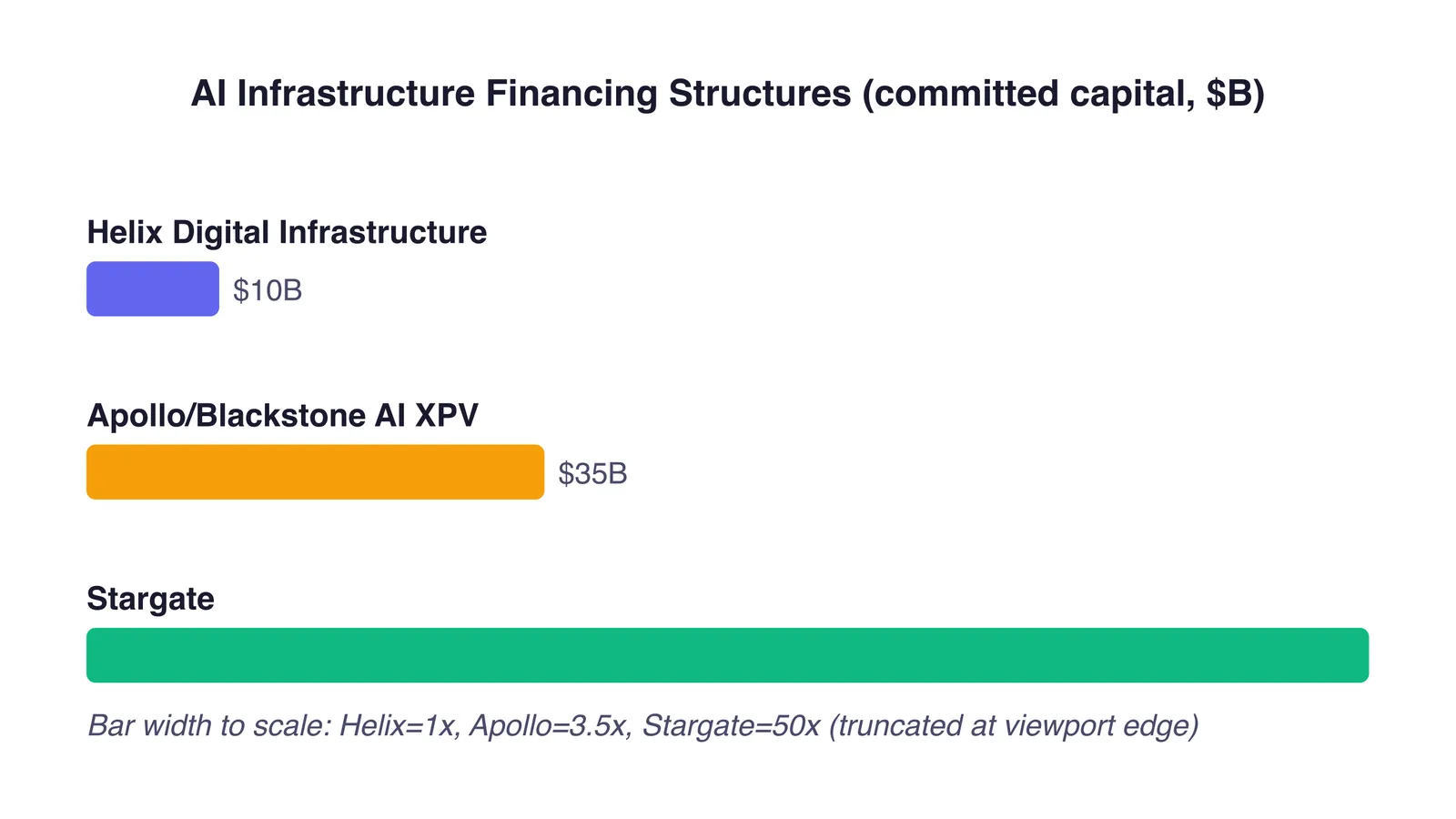
The six largest US tech companies will spend roughly $700 billion on capital expenditure this year, nearly six times what they spent in 2022. That is not an investment cycle. It is a structural reallocation of the economy’s savings toward a single output: compute.
And most of that money is not coming from their income statements anymore. It is coming from insurance companies, pension funds, sovereign wealth funds, and private credit vehicles that have never financed data centers before.
The Old Model Ran Out of Room
Until 2024, AI infrastructure was financed the way everything else at Big Tech was. Microsoft, Google, Amazon, and Meta built data centers on their own balance sheets, funded by operating cash flow and investment-grade bond issuance. The numbers were large but manageable. A $10 billion data center campus was a big project, and you could fund it with a single bond deal.
Then AI training clusters got expensive in a way that broke the model. A single 100,000-GPU cluster costs $3 billion to $4 billion in hardware alone, before you buy a watt of power or pour a cubic foot of concrete. The six largest US hyperscalers will spend more on capex this year than the entire US federal budget for transportation infrastructure.
The result is a new financing architecture. Private equity firms, sovereign wealth funds, and insurance companies have stepped into the gap that Big Tech’s balance sheets can no longer fill. The structures they created look different depending on who is building, who is paying, and who takes the risk. (For the physical and power economics of the buildings this money funds, see what an AI data center is. For where the money lands once spent, see our layer-by-layer map of AI data center capex.)
Three deals tell the story. Together they cover the full spectrum of how AI infrastructure gets financed in mid-2026.
Structure #1: Helix Digital Infrastructure
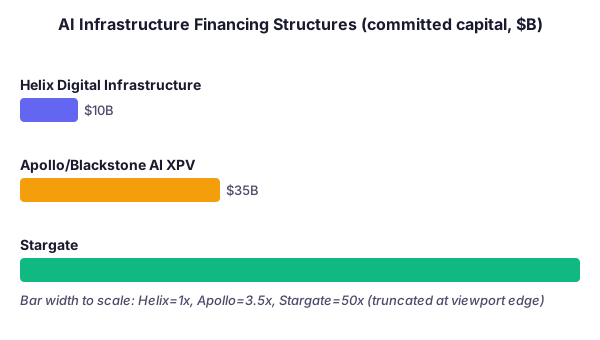
On June 11, 2026, KKR, the Kuwait Investment Authority, Nvidia, and Vistra announced Helix Digital Infrastructure. The company launched with more than $10 billion in committed capital and a single customer in mind: hyperscalers who cannot build fast enough on their own.
Adam Selipsky, the former CEO of Amazon Web Services, runs Helix. His pitch is simple. More than 25% of announced data center projects miss their scheduled delivery dates. Grid-connection queues stretch three to five years. The problem is not a shortage of demand or capital. It is coordination.
Helix acts as a single point of contact for hyperscalers that need data centers, power generation, transmission infrastructure, and fiber connectivity bundled into one product. Nvidia provides the AI-factory design expertise. Vistra supplies the power. KKR and KIA supply the capital.
The structure is a standalone operating company with a dedicated management team and board. It is capitalized with long-duration equity, not short-term debt. That matters because AI infrastructure projects have construction timelines measured in years and useful lives measured in decades. A private equity fund with a 10-year horizon can underwrite that. A corporate CFO under quarterly earnings pressure cannot.
Waldemar Szlezak, KKR’s global head of digital infrastructure, serves as Helix’s CIO. KKR’s infrastructure platform manages over $100 billion in assets, including more than $70 billion across digital and power. Helix has room to add more institutional investors after the founding commitments close.
| Role | Partner |
|---|---|
| Sponsor and capital | KKR |
| Co-anchor | Kuwait Investment Authority |
| Strategic partner | Nvidia (DSX AI factory design) |
| Preferred power | Vistra (18 states, ~50 GW capacity) |
| CEO | Adam Selipsky (former AWS CEO) |
Structure #2: The AI XPV Platform (Apollo + Blackstone + Broadcom)
The day before Helix launched, on June 9, 2026, Apollo Global Management and Blackstone closed a $35 billion debt package to finance AI computing capacity for Anthropic using Broadcom’s custom chips. It was one of the largest private credit transactions in history.
The structure is different from Helix in almost every way. Where Helix is an operating company capitalized with equity, the AI XPV Platform is a debt vehicle secured by hardware. Apollo and Blackstone raised the capital primarily from insurance companies and annuity funds. The debt priced across three tranches, with Broadcom backstopping payments on the senior portions.
The capital buys Google’s custom Tensor Processing Units, which are held in a special purpose vehicle. Anthropic leases the chips back. The SPV structure keeps the $35 billion in hardware off Anthropic’s balance sheet. For a company that confidentially filed for a US IPO in June 2026, after raising $65 billion in Series H at a $965 billion valuation, that accounting treatment is not a detail. It is the point.
The initial deployment provides 1 gigawatt of capacity at Fluidstack-operated data centers starting in mid-2026. The platform targets 20 gigawatts by 2028 and plans to serve other frontier AI labs including OpenAI.
Broadcom CEO Hock Tan described the platform as “bringing together Broadcom’s leading technology and investor partners with the strongest balance sheets to deliver at scale sufficient compute capacity.” S&P called the deal credit-negative for Broadcom, noting the junior tranche of $4.5 billion is unsecured and could pressure the company’s A- rating. Roughly half the $35 billion was syndicated to other institutional investors.
The Apollo deal is the purest expression of a trend Morgan Stanley has quantified: the firm projects $1.15 trillion in private debt, bonds, and securitizations for AI infrastructure over the next four years. By comparison, the entire subprime mortgage securitization market in 2007 was roughly $2 trillion.
Structure #3: Stargate
The largest of the three, announced in January 2025 with a headline figure of $500 billion, is also the furthest from a completed financial structure. Stargate is a joint venture between OpenAI, SoftBank, and Oracle, with MGX (the UAE sovereign fund) and Nvidia as additional partners. SoftBank holds the financial lead; OpenAI handles operations.
By September 2025, the partners had committed to five data center sites across Texas, New Mexico, Ohio, and the Midwest, totaling nearly 7 GW of capacity and more than $400 billion in planned investment. The target is 10 GW.
Stargate’s financing is the least transparent of the three. SoftBank borrowed $40 billion from a syndicate of five global banks (JPMorgan, Goldman Sachs, Mizuho, SMBC, MUFG) in March 2026, with a 12-month maturity. That loan partially funds SoftBank’s $30 billion follow-on investment in OpenAI. The 12-month maturity signals an expectation that OpenAI will IPO before March 2027, providing SoftBank with liquidity to repay the facility.
The project has faced execution challenges. SoftBank reportedly withdrew from operational involvement at one point, with OpenAI and Oracle stepping in to keep construction moving. Nvidia committed up to $100 billion in chip supply to the project.
Stargate is the bet that scale alone creates advantage: that the next generation of models trained on Stargate’s clusters will produce capabilities that justify the upfront infrastructure cost. If the returns on AI model improvements diminish faster than expected, the $500 billion figure goes from ambitious to stranded.
The Three Structures Side by Side
| Dimension | Helix | AI XPV (Apollo/Blackstone) | Stargate |
|---|---|---|---|
| Capital | $10B+ equity | $35B debt | $500B (mixed) |
| Financing type | Long-duration equity | Private credit (insurance/annuity) | Bank loan + equity |
| Lead entity | KKR | Apollo + Blackstone | SoftBank |
| Customer | Hyperscalers (undisclosed) | Anthropic | OpenAI |
| Hardware | Nvidia DSX | Google TPU (via Broadcom) | Nvidia + Oracle |
| Balance sheet | On Helix | Off Anthropic’s | On SoftBank / SPVs |
| CEO | Adam Selipsky (ex-AWS) | N/A (platform) | Masayoshi Son (SoftBank) |
| Risk carrier | KKR / KIA equity | Insurance policyholders | Bank syndicate + equity |
| Speed to revenue | Construction-dependent | Mid-2026 (Fluidstack) | Some capacity live |
The BIS Warning on Shadow Borrowing
The Bank for International Settlements published an analysis in March 2026 that deserves more attention than it got. In “Financing the AI Infrastructure Boom,” BIS economists Egemen Eren, Ingomar Krohn, and Karamfil Todorov described the off-balance-sheet structures underpinning these deals as “shadow borrowing” – obligations that are economically equivalent to debt but sit outside corporate balance sheets.
The concern is transmission risk. Banks support the SPVs with funding lines. Private credit funds hold the debt. Insurers and pension funds own the equity tranches. A disruption at any point – a refinancing freeze, a shift in private credit appetite, a hardware obsolescence shock – could propagate through the system in ways the traditional banking framework does not capture.
The comparison Morgan Stanley drew between the $1.15 trillion in projected AI infrastructure private debt and the $2 trillion subprime securitization market of 2007 is worth sitting with. The structures are different. The underlying assets are different. But the pattern of risk migrating to less regulated parts of the financial system, where it is harder to measure and harder to contain, is the same.
What This Means for Model Pricing
The connection between these financing structures and the API prices you pay per token is not abstract. It runs through the cost of capital.
Private credit for AI infrastructure yields 10% to 15%. Investment-grade corporate bonds yield 4% to 5%. The difference is the spread between a hyperscaler’s balance sheet and a SPV financed by insurance money. Every percentage point of that spread gets embedded in the cost of compute, which gets passed through to model training costs, which sets a floor under inference prices.
This is one reason our analysis in what it costs to train AI models in 2026 identified a persistent gap between the advertised API prices of frontier models and the underlying infrastructure cost. The advertised price reflects the marginal cost of inference on already-built hardware. It does not reflect the cost of building the next data center. The financing structure determines who pays for that gap.
When Anthropic uses the Apollo/Blackstone SPV, it pays lease costs that include the 10%+ return demanded by insurance investors. When OpenAI trains on Stargate’s clusters, the cost structure includes SoftBank’s bank loan interest. These costs constrain how low model prices can go before the financing breaks.
The price reversal we documented – where cheaper per-token models sometimes cost more per task – is connected to this dynamic. Models that require more compute per task consume more of the high-cost off-balance-sheet infrastructure. The financing structure of the data center affects the real economics of which model is actually cheaper to run.
What Happens Next
Three questions determine whether the current financing architecture holds.
First, can the projects deliver on schedule? Sightline Climate estimates 30% to 50% of data centers scheduled to open in 2026 will be delayed or canceled. Grid-connection waits of three to five years are now standard in primary US markets. If delays compound, the cost of capital locked in today will sit idle before earning a return.
Second, will the AI labs grow into the capacity? Stargate and the AI XPV Platform are built on projections of exponential compute demand. If model efficiency improvements (better architectures, smaller datasets, inference-time techniques) reduce the marginal value of another GPU, the utilization rate on these buildouts drops. Stranded data center capacity is the risk nobody in the press release wants to name.
Third, what happens at refinancing? The first wave of private credit deals for AI infrastructure have maturities of three to seven years. When they come due, the prevailing interest rate environment and the condition of the AI industry will determine whether the capital rolls over or calls in. A higher-rate environment in 2030 would transfer billions from AI labs to credit investors.
The answer to all three depends on something no financing structure can control: whether the models that run on this infrastructure generate enough economic value to pay for it. That question is not settled. What is settled is that for the first time, the physical infrastructure of AI is financed not by the companies that build the models, but by the people who save for retirement. Your grandmother’s annuity, in a real sense, is now paying for compute.
Sources
- BIS (March 2026). “Financing the AI Infrastructure Boom.” BIS Quarterly Review. https://www.bis.org/publ/qtrpdf/r_qt2603u.htm
- Futurum Group (February 2026). “AI Capex 2026: The $690B Infrastructure Sprint.” https://futurumgroup.com/insights/ai-capex-2026-the-690b-infrastructure-sprint/
- KKR (June 2026). “KKR Launches Helix Digital Infrastructure.” https://media.kkr.com/news-details/?news_id=6a26acd6-83b8-4377-84be-b1dadb847806
- Apollo Global Management (June 2026). “Apollo Leads $35 Billion Capital Solution for Broadcom AI XPV Platform.” https://www.globenewswire.com/news-release/2026/06/09/3308896/0/en/
- Morgan Stanley (March 2026). “AI Market Trends 2026: Global Investment, Risks, and Buildout.” https://www.morganstanley.com/insights/articles/ai-market-trends-institute-2026
- Colliers (March 2026). “2026 Data Center Marketplace Report.” https://www.colliers.com/en/research/nrep-usdc-data-center-marketplace-2026
- JLL (January 2026). “2026 Global Data Center Market Outlook.” https://www.jll.com/en-us/insights/market-outlook/data-center-outlook
- Ropes & Gray (May 2026). “Data Center Investment in 2026: AI Demand, Power Constraints, and Private Equity Trends.” https://www.ropesgray.com/en/insights/viewpoints/102mvfl/data-center-investment-in-2026
- Sightline Climate (2026). Data center delay estimates cited in MarketWise, June 2026.
- TechCrunch (January 2025). “OpenAI teams up with SoftBank and Oracle on $500B data center project.” https://techcrunch.com/2025/01/21/openai-teams-up-with-softbank-and-oracle-on-50b-data-center-project/