Inkling: Thinking Machines' First Open-Weight Model
Thinking Machines released Inkling, a 975B open-weight model under Apache 2.0. Full pricing, benchmarks against GLM-5.2 and DeepSeek V4, and the verdict.
Mira Murati spent eighteen months building Thinking Machines without shipping a model, on a $2 billion raise at a $12 billion valuation. On July 15, 2026, that changed: the company released Inkling, a 975-billion-parameter open-weight model under a full Apache 2.0 license. Read the launch post and you find something unusual for a debut release. The company does not claim it is the best model available. It says the opposite: Inkling is “not the strongest overall model available today, open or closed.” That is the whole story here, and it is worth taking at face value before deciding whether Inkling matters to you.
What Thinking Machines actually shipped
Inkling is a mixture-of-experts transformer with 975 billion total parameters, of which 41 billion activate for any given token. It has 66 layers, 256 routed experts plus 2 shared experts per MoE layer (6 routed experts fire per token), and an interleaved attention pattern that mixes sliding-window and global layers at a 5:1 ratio. Context runs up to 1 million tokens, though Tinker offers 64K and 256K tiers at launch rather than the full window. It takes text, images (as 40x40-pixel patches), and audio (as spectrograms) as input, was trained on video as well, and produces text, code, and tool calls as output. Training ran on 45 trillion tokens across all four modalities, using a hybrid Muon-and-Adam optimizer on Nvidia GB300 NVL72 systems, the same hardware underpinning a gigawatt-scale Nvidia capacity partnership Thinking Machines struck in March 2026.
There is a smaller sibling, too. Inkling-Small is a preview variant at 276 billion total parameters and 12 billion active, still in testing with no Tinker pricing published yet.
The company also disclosed something most launch posts leave out: part of Inkling’s early post-training used synthetic data generated by other open-weight models, including Moonshot’s Kimi K2.5, before large-scale reinforcement learning took over (30 million-plus rollouts). Thinking Machines says the next model will use fully self-contained post-training instead. It is a small admission, and an honest one, in a field where most labs describe their pipeline as if it sprang from nothing.
None of that is the headline, though. The headline is Apache 2.0: full weights, no attribution string, no “acceptable use” carve-out, plus an NVFP4 quantized checkpoint, all published to Hugging Face. At 975 billion parameters, nothing else with an unrestricted license comes close to this scale. Qwen3-Coder tops out at 480 billion. GLM-5.2 and Kimi K2.6 use their makers’ own “open weights” terms, not Apache 2.0.
Pricing: the Tinker rate card, and a deadline
Thinking Machines does not sell Inkling through a metered API the way OpenAI or Anthropic do. It sells it through Tinker, the fine-tuning and inference platform that is the company’s actual revenue product. At the 64K-context tier, Inkling costs $1.87 per million input tokens (Tinker calls this “prefill”) and $4.68 per million output tokens (“sample”), with cached input discounted 80% to $0.374. Step up to the 256K tier and every one of those numbers exactly doubles. There is also a $5.61 train-meter rate for teams actually fine-tuning the model, separate from inference.
Here is the part worth acting on before you read further: those are launch rates. Tinker’s own pricing documentation states prefill and sample prices rise roughly 50% (train rates about 10%) on July 17, 2026, two days after Inkling shipped. If you want to run real numbers on Inkling at the discounted rate, this week is the window. After that, whatever you modeled needs a 50% haircut on the token-price side.
That rate is in the AI model registry and reconciled with what Artificial Analysis independently lists for Inkling’s first-party API, so it is not a reseller markup. It also means Inkling is fully priced in the cost calculator and the model comparison tool: plug in your own task mix and see where it actually lands against Claude, GPT, or DeepSeek, rather than trusting the sticker rate.
The benchmarks: where Inkling leads, and where it does not
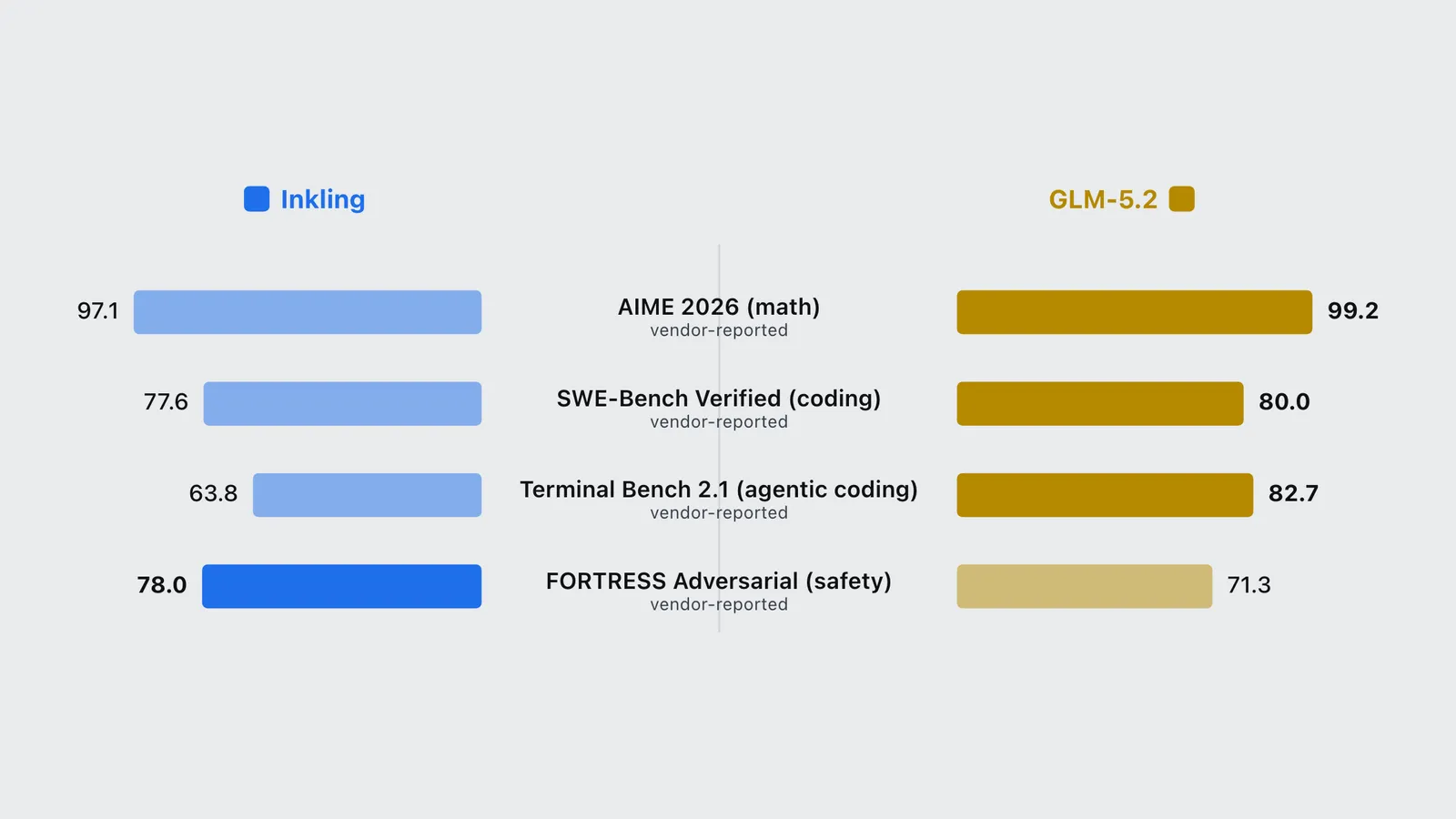
The company published a comprehensive benchmark table at launch, and the honest way to read it is against GLM-5.2, the model this site currently ranks as the strongest overall open-weight option.
| Metric | Inkling | GLM-5.2 |
|---|---|---|
| AIME 2026 (math) | 97.1 | 99.2 |
| SWE-Bench Verified (coding) | 77.6 | 80.0 |
| Terminal Bench 2.1 (agentic coding) | 63.8 | 82.7 |
| FORTRESS Adversarial (safety) | 78.0 | 71.3 |
Three of four go to GLM-5.2, and the Terminal Bench gap is not close. That single benchmark measures agentic coding in a real terminal, the exact skill a coding agent needs, and Inkling loses it by nearly 19 points. Widen the comparison and the pattern holds: Inkling scores 43.9% on SimpleQA Verified against DeepSeek V4 Pro’s 57.0%, and it beats DeepSeek V4 Pro on AIME 2026 by all of four tenths of a point (97.1% vs 96.7%), the kind of margin that is really a tie. On the Artificial Analysis Intelligence Index, Inkling scores 41, good for 10th of 97 tracked models, at 72.4 output tokens per second.
There is one place Inkling actually leads the field: safety and factuality. Its FORTRESS Adversarial score of 78.0 beats every open-weight comparator Thinking Machines published, including Nemotron 3 Ultra (77.6), GLM-5.2 (71.3), Kimi K2.6 (65.6), and DeepSeek V4 Pro, which posts a startling 36.0. Inkling also scores +2.1 on Artificial Analysis Omniscience, a factuality measure that penalizes confident wrong answers. Most open models score negative there: Nemotron 3 Ultra sits at -1.0, Kimi K2.5 at -8.0, DeepSeek V4 Pro at -10.0. A model that is not the best coder but is one of the few open models that knows what it doesn’t know is a real, if narrow, differentiator.
A model built to not comply with censorship
Buried in the launch post is a claim no other model at this scale has made in public. Thinking Machines “commissioned external safety testers” to evaluate Inkling, and on Cognition’s Propaganda and Censorship Eval, the company reports Inkling “exhibited strong patterns of censorship non-compliance.” Read plainly: the model refuses to parrot state-aligned propaganda framing when tested against it, and Thinking Machines is treating that as a feature worth publishing, not a risk to manage quietly.
That is a genuinely different axis from the usual “is it safe” question labs answer at launch. It also reads as a positioning move against the open-weight field’s current center of gravity, which runs through Chinese labs whose models operate under different content constraints. Whether that framing holds up under wider, adversarial testing is a question for the weeks after launch, not the announcement itself. But it is the first time an open-weight lab has made resistance to censorship part of the pitch instead of an afterthought.
The Bridgewater example: what “customizable” actually buys
Thinking Machines’ whole argument is that Inkling matters less as a finished product than as a base you fine-tune. The one concrete example it has to show for that argument comes from finance, which happens to be exactly the audience reading this.
Bridgewater Associates, the hedge fund, worked with Thinking Machines to fine-tune an existing open-source model on Tinker using Bridgewater’s own financial expertise. The result reportedly scored 84.7% on financial reasoning tests, beating top proprietary models, while costing roughly a fourteenth as much to run. That is the number that should make a finance-adjacent reader pay attention: a fine-tuned open model beating frontier proprietary models on a domain task, at a fraction of the running cost.
Take it with the caveat both companies themselves attach: this is Bridgewater and Thinking Machines’ own evaluation, not an independent one, and “beating top proprietary models” on an internal benchmark is not the same claim as beating them on a neutral one. It is also not, strictly, a claim about Inkling itself. Fine-tuning requires real machine-learning talent on staff, which most teams do not have sitting around. Still, it is the most concrete evidence yet that the fine-tuning bet behind Tinker, and behind Inkling as its open-weight base, produces something a general-purpose frontier model does not: a domain specialist that costs a fraction as much to run once you have put in the work to build it.
Licensing: the most permissive frontier-scale open-weight model
Apache 2.0 sounds like a formality until you compare it to what everyone else in this weight class actually ships. MiniMax M3 requires a “Built with MiniMax M3” credit on anything commercial. Several Chinese labs use custom community licenses whose terms move release to release. GLM-5.2 and Kimi K2.6 both use their own “open weights” terms rather than a standard license. Inkling ships under the same Apache 2.0 terms as DeepSeek V4 and Qwen3-Coder, and it is the only model in that permissive tier that clears 500 billion parameters, let alone 975 billion.
That combination, frontier scale plus zero-string license, is genuinely new. It does not make Inkling the best open-weight model. It makes it the best open-weight model to build on if the license itself is the constraint, which for a lot of enterprise legal teams, it is. The full open-weight field breakdown covers where Inkling sits against GLM-5.2, DeepSeek V4, and the rest by use case, not just by license.
Who should actually use Inkling
Not the team looking for the single best open-weight coder today. GLM-5.2 and Kimi K2.6 beat it on the benchmarks that matter for that job, sometimes by a wide margin, and Thinking Machines says as much itself.
Reach for Inkling if you are building a domain-specific model and the plan was always to fine-tune, not use something off the shelf. The Bridgewater result is the proof of concept: a fine-tuned base beating frontier generalists on one narrow, high-value task, at a fraction of the running cost. It is also the pick if your organization has a hard requirement for a clean, unrestricted license at real scale, or if the censorship-resistance framing matters to your use case in a way the benchmarks do not capture.
Run your own numbers before committing either way. The AI coding cost calculator has Inkling priced in alongside every other tracked model, the value leaderboard ranks it by benchmark points per dollar, and the July 2026 model release roundup has it in context against everything else that shipped this month. And do the Tinker math before July 17. The rate that makes this an easy trial gets meaningfully less easy two days after this post goes up.
Frequently asked questions
- What is Inkling?
- Inkling is Thinking Machines' first open-weight model, released July 15, 2026: a 975-billion-parameter mixture-of-experts model (41 billion active per token) under an Apache 2.0 license. It takes text, image, and audio input and produces text, code, and tool calls. The company frames it as a customizable fine-tuning base rather than a frontier-leading model.
- How much does Inkling cost?
- Through Thinking Machines' own Tinker platform, Inkling costs $1.87 per million input tokens and $4.68 per million output tokens at the 64K-context tier, with cached input at 80% off. The 256K tier costs exactly double. Those rates rise roughly 50% on July 17, 2026, two days after launch.
- Is Inkling open source?
- Inkling is open-weight, not fully open source: the trained weights are published under Apache 2.0 on Hugging Face, including an NVFP4 quantized variant, but the training data and full training code are not released. Apache 2.0 has no attribution requirement, which makes it more permissive than the custom licenses several other open-weight labs use.
- How does Inkling compare to GLM-5.2 and DeepSeek V4?
- On Thinking Machines' own launch benchmarks, Inkling trails GLM-5.2 on agentic coding (Terminal Bench 2.1: 63.8% vs 82.7%) and real-repo coding (SWE-Bench Verified: 77.6% vs 80.0%), and trails DeepSeek V4 Pro on factuality (SimpleQA Verified: 43.9% vs 57.0%). It edges ahead on AIME 2026 math (97.1% vs DeepSeek's 96.7%) and leads both on the FORTRESS Adversarial safety benchmark.
- Why did Thinking Machines say Inkling is not the strongest model available?
- The company's own launch framing is that Inkling is "not the strongest overall model available today, open or closed," positioning it instead as a broad, customizable base for fine-tuning through its Tinker platform. Its benchmark table backs that up: Inkling trails several open-weight rivals on coding while leading on safety and factuality.
Sources
Thinking Machines Lab (2026, July 15). Inkling: Our open-weights model. Thinking Machines Lab. https://thinkingmachines.ai/news/introducing-inkling/
Thinking Machines Lab (2026). Inkling (model card). Hugging Face. https://huggingface.co/thinkingmachines/Inkling
Thinking Machines Lab (2026). Models and pricing. Tinker documentation. https://tinker-docs.thinkingmachines.ai/tinker/models/
Artificial Analysis (2026). Inkling: Intelligence, performance and price analysis. https://artificialanalysis.ai/models/inkling
TechCrunch (2026, July 15). Thinking Machines amps up its bet against one-size-fits-all AI with its first open model, Inkling. TechCrunch. https://techcrunch.com/2026/07/15/thinking-machines-amps-up-its-bet-against-one-size-fits-all-ai-with-its-first-open-model-inkling/
Axios (2026, July 15). Mira Murati’s Thinking Machines debuts its first AI model. Axios. https://www.axios.com/2026/07/15/mira-murati-thinking-machines-open-weight-model-inkling
Fortune (2026, July 15). What is Mira Murati’s Thinking Machines first AI model, Inkling. Fortune. https://fortune.com/2026/07/15/what-is-mira-murati-thinking-machines-first-ai-model-inkling/