AI Search Broke the Web's Business Model. What Replaces It.
68% of searches end without a click. AI Overviews cut publisher traffic 40%. What replaces the click economy in the citation era.
In early 2026, 68% of US Google searches ended without a single click to a website. A decade earlier, that number was 45%. The click, which funded the entire open web for twenty years, is disappearing. And the replacement economy is already here, it just doesn’t pay publishers yet.
A randomized field experiment from Indian School of Business and Carnegie Mellon (Agarwal & Sen, April 2026) put the first causal number on it: AI Overviews cut organic clicks by 39.8% on queries where they appear. Not correlated. Caused. Meanwhile, Google’s own Q1 2026 earnings showed search revenue up 19% while publisher network revenue fell 4%. The platform monetizes the AI answer. The publisher whose content grounds that answer gets nothing.
The click economy is collapsing
The open web ran on a simple bargain. Publishers produced content. Search engines sent users to that content. Visits generated revenue. That feedback loop, clicks producing signals producing better discovery producing more clicks, is breaking. The economics mirror the broader AI productivity paradox: adoption surges while the return on investment stays blurry.
| Date | Zero-click % |
|---|---|
| 2016-01-01 | 45% |
| 2017-01-01 | 47% |
| 2018-01-01 | 49% |
| 2019-01-01 | 52% |
| 2020-01-01 | 54% |
| 2021-01-01 | 56% |
| 2022-01-01 | 58% |
| 2023-01-01 | 60% |
| 2024-01-01 | 60.45% |
| 2025-01-01 | 64% |
| 2026-01-01 | 68% |
The Pew Research Center watched what 900 US adults actually did on Google in March 2025. When an AI summary sat at the top of the results, people clicked through to a website on just 8% of those visits. Without a summary, they clicked 15% of the time. Clicks on the sources cited inside the summary happened on a mere 1% of visits. That single gap, 8 versus 15, is the entire reason answer engine optimization exists.
And here’s the part most people miss: the click you lost to an AI Overview is not going to a competitor. It’s ending on the results page itself. The user read the answer, got what they needed, and left. No website was visited. No revenue was generated. No signal was produced.
The numbers behind the shift
The scale of this is bigger than most realize.
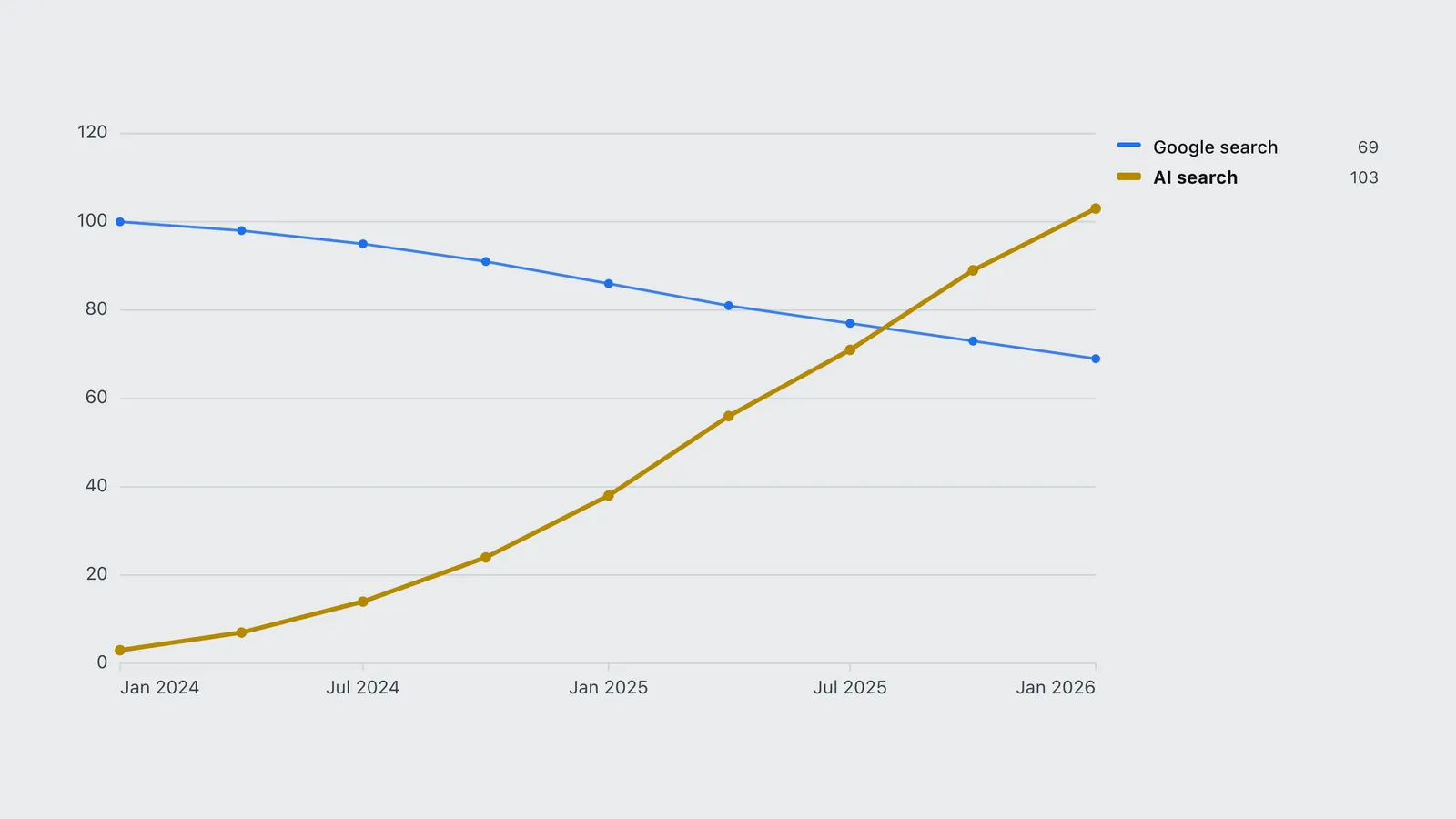
Google search volume declined 31% from Q1 2024 to Q1 2026, exceeding Gartner’s 2024 prediction that traditional search would drop 25% by 2026. AI search volume increased 3,333% in the same period, but from a small base. Total search activity is actually up 67%. People are searching more than ever. They’re just not searching on Google the way they used to.
| Date | Google search | AI search |
|---|---|---|
| 2024-01-01 | 100 | 3 |
| 2024-04-01 | 98 | 7 |
| 2024-07-01 | 95 | 14 |
| 2024-10-01 | 91 | 24 |
| 2025-01-01 | 86 | 38 |
| 2025-04-01 | 81 | 56 |
| 2025-07-01 | 77 | 71 |
| 2025-10-01 | 73 | 89 |
| 2026-01-01 | 69 | 103 |
ChatGPT now processes roughly 2.8 billion queries per day, up from 1.6 billion a year earlier. Google still handles about 8.5 billion, but the ratio closed from 8x to 1.8x in two years. And Google itself is becoming an AI search engine: AI Overviews now appear on 47% of all Google queries, meaning the distinction between “AI search” and “Google search” is blurring structurally.
The vertical variation is striking. Healthcare queries see AI Overviews on 88% of searches. Education: 83%. B2B tech: 82% (BrightEdge, 2026). These are the categories where informational queries dominate and the AI can provide a complete answer without a click. Transactional queries, where someone is ready to buy, still generate clicks. For now.
What “durable attention capital” means and why it’s disappearing
Here’s where the economics get genuinely uncomfortable. In June 2026, Jason Chan at Harvard Business School published a paper titled “AI and the collapse of the www” that identified something nobody else was talking about. Not traffic loss. Signal loss.
The open web ran on what Chan calls “durable attention capital”: the accumulated stock of quality signals that human engagement generates for a piece of content. Subscribers, repeat readers, backlinks, bookmarks, search authority, reputation markers. These signals helped search systems and future readers find quality sources.
This is the argument the traffic-decline conversation has been missing. A randomized field experiment by Agarwal and Sen tested Google’s claim that AI Overviews improve click quality. Three engagement measures, back-button navigation, sub-ten-second bounce rate, and time on page, showed no meaningful difference between sessions with and without AI Overviews. The additional clicks generated when AI Overviews were removed were just as engaged as the clicks that already existed. Google’s quality-click argument has no public data behind it.
When the signals stop forming, the entire discovery layer degrades. The web doesn’t collapse because content disappears. It collapses because the ability to tell good content from bad disappears with the signals that measured it.
Google’s asymmetric monetization problem
The numbers from Alphabet’s Q1 2026 earnings tell the story in a single line: Google’s own search revenue up 19%, publisher network revenue down 4%.
| Metric | Publishers | |
|---|---|---|
| Search revenue | 0% | 19% |
| Cloud revenue | 0% | 28% |
| YouTube ads | 0% | 10% |
| Network (publisher ads) | 4% | 0% |
Google monetizes the answer its AI wrote using publisher content. The publisher whose content grounded that answer gets neither the visit nor the ad impression. The click that would have generated a pageview, an ad impression, a signal, and a potential subscriber is replaced by an AI Overview that generates revenue only for Google.
And it’s not just Google. Sponsored clicks were unaffected by AI Overviews in the Agarwal-Sen experiment. The displacement is specific to organic publisher traffic. Paid ads still get through. Organic doesn’t. The economic transfer is directional.
The $84 billion SEO industry’s identity crisis
The global SEO services market reached $83.98 billion in 2026, up from $74.9 billion in 2025, with a path toward $148.86 billion by 2031. Budgets are rising. Search still drives the most qualified traffic on the open web. But the unit of success just changed.
The shift is from clicks to citations. From ranking position to being inside the answer. From organic sessions to AI citation share. And most teams haven’t updated their scorecard.
A 2026 analysis of the AI coding agent landscape shows the parallel: 84% of developers now use AI tools, up from 76% in 2024, but trust in AI output accuracy declined from 40% to 29% over the same period. Adoption surged while skepticism deepened. The same dynamic is playing out in search: more AI answers, less trust in where they come from.
Teams running the old playbook, keyword targeting, link building, ranking optimization, are experiencing what one analyst called “what feels like death.” It’s not death. It’s repricing. The channel works. The scorecard doesn’t.
What replaces the click economy
The emerging model is the citation economy. Being the answer, not just a source in a summary.
Here’s what the data says about what works:
Answer Engine Optimization (AEO) is the practice of structuring content so AI answer engines cite it directly. The GEO paper from Princeton, Georgia Tech, and IIT Delhi (Aggarwal et al., KDD 2024) found that adding cited sources, quotations, and concrete statistics lifted visibility in AI-generated answers by up to 40%. Keyword stuffing showed no improvement and sometimes underperformed the baseline.
The five factors that correlate with getting cited, based on 2026 multi-source research:
- Extractability. Put a direct, self-contained answer near the top of the page. Answer engines lift extractable passages. A page that buries its answer under 600 words of preamble gets skipped.
- Evidence. Back every claim with something verifiable. Specific numbers, named sources, dated references. “AI traffic is growing” is unciteable. “AI Overviews appear on 47% of US English queries per BrightEdge tracking” is exactly the kind of sentence an engine reaches for.
- Structure. Clean HTML, logical heading hierarchy, Article and FAQPage schema. Heading hierarchy matters more than for classic SEO because engines use it to understand which passage answers which question.
- Authority. Topical depth, author expertise, and third-party mentions on Reddit, Quora, and YouTube. Off-site brand-mention density correlates with roughly a 4x citation multiplier (Airops, 2026). YouTube has overtaken Reddit as the number one social citation source at 39.2% share.
- Machine-readability. Server-rendered HTML, no critical content gated behind client-side JavaScript. If an engine can’t read your content without executing JS, none of the other factors matter.
Cloudflare’s July 2026 shift from Pay Per Crawl to Pay Per Use is the first infrastructure-level attempt to reconnect publisher value to AI output. It gives publishers granular controls: allow search crawlers for discoverability, price training and agent crawlers, and block mixed-use bots. The strategic move is selective engagement, not blanket refusal.
The publisher’s playbook for the citation economy
If you run a content site, here’s what changes immediately:
Rewrite your openers. The first 60 to 100 words of every high-traffic page should define the concept or answer the query directly. Put the answer in the first paragraph, then earn the reader with the rest. This matches how AI retrieval models extract snippets. Pew measured a 67-word median for AI Overview answers. Your opening paragraph should be that answer.
Add quick-answer blocks after every H2. Two to four sentences summarizing what the section covers. This gives AI models a scannable, extractable version of your page. It also helps human readers who skim.
Earn off-site mentions. Get cited where the engines look: relevant Reddit threads, YouTube content, Hacker News, comparison posts, podcasts. YouTube is now the number one social citation source for AI engines. Consistent, authentic mentions on these platforms move citation rates more than almost anything you can do on your own domain.
Build entity authority. Author profiles with sameAs links to LinkedIn, Twitter, and other platforms. Consistent brand naming everywhere. AI engines build internal knowledge graphs of brands, and they verify expertise through entity graphs. Pages with 3+ corroborating sameAs links receive citations 2-3x more frequently.
Update your schema. Article and Organization schema are still high-value. FAQPage schema no longer earns rich results after Google retired FAQ rich results in May 2026, but the content on the page still helps for the words it contains. Speakable schema matters for voice-assistant capture.
What this means for content monetization
The unit of value is shifting from the click to the impression. When a user reads your brand inside a Perplexity answer and never visits your site, the win is the impression, not the click. That’s a fundamental change for ad-supported publishing, and it echoes the price reversal problem in AI model selection: the sticker price and the real cost are diverging everywhere.
But the numbers are more complicated than “clicks are dead.”
AI referral traffic converts at 7.1% via Similarweb data, second only to paid search at 7.8% and 2.5x higher than Google organic. Visitors from ChatGPT, Perplexity, and Gemini convert at roughly three times the rate of average organic traffic. The volume is lower today but growing. The quality is higher.
And 59% of consumers say they’re likely to visit a brand’s website after an AI chatbot mentions or recommends it. The citation is the impression. The impression creates downstream intent. The intent produces a click, just not on the SERP.
The question isn’t whether to choose between SEO and AEO. It’s how to allocate across both while the economics settle. For now, transactional queries still pay via clicks. Informational queries increasingly pay via citations. The smart money is instrumenting both.
Sources
SparkToro (2026). Zero-click search analysis, Similarweb clickstream data, US Google searches, January-April 2026.
Agarwal, S. and Sen, A. (2026). “The Impact of Google AI Overviews on Publisher Traffic and User Experience: Evidence from a Field Experiment.” SSRN working paper, revised June 17, 2026. Abstract ID 6513059.
Chan, J. (2026). “AI and the collapse of the www.” Harvard Business School working paper, June 2026. As reported by The Register, July 1, 2026.
Pew Research Center (2025). “How Americans use search engines and AI.” March 2025 survey of 900 US adults.
Aggarwal, P. et al. (2024). “GEO: Generative Engine Optimization.” KDD 2024, arXiv:2311.09735. Princeton, Georgia Tech, Allen Institute for AI, IIT Delhi.
BrightEdge (2026). AI Overview coverage data, February 2025-February 2026. As reported by Search Engine Journal, March 2026.
Gartner (2024). “Gartner Predicts Search Engine Volume Will Drop 25% by 2026.” Press release, February 19, 2024.
Presence AI (2026). “2026 GEO Benchmarks Report: AI Search Traffic Statistics & Trends.” January 2026.
Presenc AI (2026). “AI Search vs Google Search Statistics 2026.” March 2026.
Seer Interactive (2026). “AIO Impact on Google CTR 2026 Update.” April 2026.
Alphabet Inc. (2026). Q1 2026 earnings report. As reported by multiple outlets.
Mordor Intelligence (2026). Global SEO services market sizing, 2026-2031.
Airops (2026). AI citation multiplier analysis, Reddit/Quora brand mention density.
Cloudflare (2026). Pay Per Use announcement, July 1, 2026.
Smalk AI (2026). “AI Search Cuts Publisher Clicks 40% and Erodes Discovery Signals.” July 4, 2026.