The 2026 AI Coding Agent Landscape: Leaders, Costs, Harness
A grounded survey of the 2026 AI coding agent field: Claude Code, Cursor, Copilot, Codex and Antigravity, by interface, cost, and why the harness matters.
The AI coding field in mid-2026 splits three ways: terminal agents that drive your shell, IDE-native tools that live in the editor, and platform agents woven into a code host. The leaders are Claude Code, OpenAI’s Codex, Cursor, GitHub Copilot, and Google’s newly standalone Antigravity, with a cluster of Chinese contenders undercutting all of them on price. The number that decides which one ships working code is rarely the model. It is the harness around it.
That last point is the one most comparison guides miss. A coding agent is two things bolted together: a model that reasons, and a harness that feeds it files, runs its commands, and checks its work. The same model scores differently inside different harnesses, which is why “which model is best” is the wrong question and “which agent ships the task” is the right one. This survey maps the field by interface, grounds it in current benchmarks and published prices, and explains where each tool earns its keep. For a side-by-side reference of every tool, its maker, and its pricing model, see the AI coding agents comparison. For the wider practice question of whether any of this measurably works, see the state of AI programming in 2026, which covers the adoption numbers, the technique stack, and the contested productivity evidence.
The field at a glance
Three interface shapes now define the category, and the shape tells you more about how a tool behaves than its logo does.
| Tool | Maker | Interface | Entry price | Where it fits |
|---|---|---|---|---|
| Claude Code | Anthropic | Terminal agent | $20/mo (Claude Pro) | Multi-file refactors, large-codebase debugging |
| Codex | OpenAI | Terminal agent + IDE | $20/mo (ChatGPT Plus) | Deterministic multi-step tasks, test loops |
| Antigravity 2.0 | Desktop app + CLI | Bundled in Google AI plans | Orchestrating parallel subagents | |
| Gemini CLI | Terminal agent | Free tier + paid | Lightweight terminal use in the Google stack | |
| Cursor | Anysphere | AI-native IDE | $20/mo | Inline editing, file-aware completions |
| Windsurf | Cognition | AI-native IDE | $20/mo | Editor work with an in-house model |
| Kiro | Amazon | AI-native IDE | Paid (AWS) | Spec-driven development on AWS |
| GitHub Copilot | GitHub | Platform-integrated | $10/mo | Broadest adoption, full GitHub workflow |
| GLM / Kimi / Qwen | Zhipu / Moonshot / Alibaba | Bring-your-own harness | $18-$50/mo | Cost-led use, often inside Claude Code or Cline |
Prices are the published entry tiers as of June 2026, verified on each provider’s pricing page. The full breakdown, including overage structures and the Chinese tiers, sits in the AI coding plan pricing comparison.
Why the harness matters more than the model
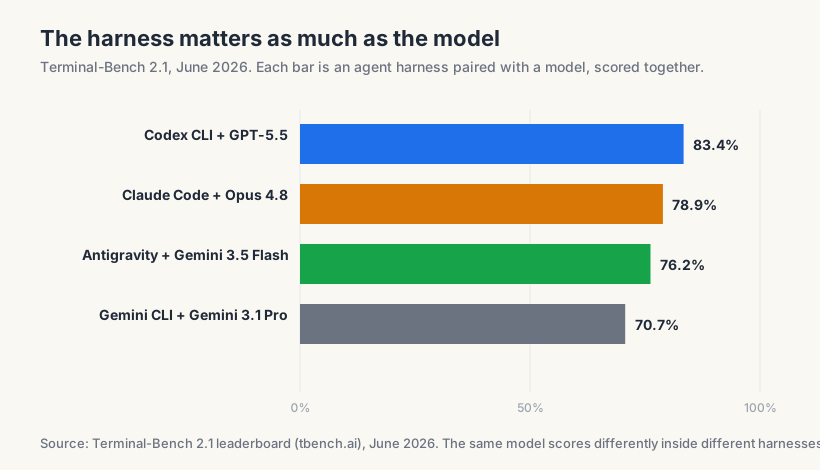
Start with the evidence, because it is counterintuitive. On the Terminal-Bench 2.1 leaderboard (June 2026), which scores the agent and model together on real terminal tasks, Codex CLI on GPT-5.5 leads at 83.4%, Claude Code on Opus 4.8 follows at 78.9%, and Google Antigravity on Gemini 3.5 Flash lands at 76.2%. The same GPT-5.5 model posts different numbers depending on whether it runs inside Codex CLI or a rival harness. The scaffolding, not just the weights, moves the result.
Update (June 27, 2026): OpenAI’s GPT-5.6 Sol launch reports Sol topping Terminal-Bench 2.1 at 88.76% in max mode and 91.91% in ultra mode, ahead of Claude Mythos 5 at 88%. Those are OpenAI’s own figures, not independent leaderboard runs, and Sol shipped in a government-gated preview to about 20 partners, so the public tbench.ai standings above still reflect the field most teams can actually run. Treat the Sol numbers as vendor-reported until independent results land.
The cleaner proof comes from holding the harness constant. Scale’s SWE-bench Pro public leaderboard runs every model through one shared SWE-Agent scaffold, which isolates raw model capability from harness quality. Under that uniform setup, the top score tops out around 59% (GPT-5.4 at the xHigh setting), with a tight pack behind it. Compare that to the vendor-reported SWE-bench Verified figures, which reach the low-to-mid 90s. Those vendor numbers are real, but they are produced on each maker’s own tuned harness, not a level field. The gap between a comparable-scaffold 59% and a vendor-reported 93% is the harness doing work the benchmark headline hides.
The practical takeaway: do not pick a coding agent by its model’s leaderboard rank. A mediocre model in a well-built harness routinely beats a stronger model in a clumsy one. Buy the tool that completes your kind of task, then care about the model inside it.
What this stuff actually costs
Every tool in the table advertises a flat monthly price, and almost every one of them meters usage underneath it. The sticker price is the floor, not the bill.
The reason is structural. An agent harness re-reads the task, the relevant files, and its own prior steps before each action, so the context grows with every turn and so does the token spend. A 2026 preprint, How Do AI Agents Spend Your Money? (Bai et al.), with authors at the University of Michigan, Stanford University, All Hands AI, Google DeepMind, Microsoft AI and MIT, found that agentic coding tasks burn on the order of 1000 times more tokens than ordinary code chat, that input tokens drive the cost, and that runs on the same task can vary by up to 30x in total tokens. It is a preprint, not a peer-reviewed study, so treat it as strong early evidence rather than settled fact. The direction is unambiguous though: a coding agent’s cost is set per task, by token consumption, not by the plan page. The same study measured how far that consumption varies between models, covered in which coding model burns the fewest tokens.
This shows up in the billing models. GitHub Copilot, the cheapest dedicated plan at $10/mo, moved to usage-based billing in mid-2026, where the fee covers a monthly credit allowance and overage bills per credit. OpenAI meters Codex by API tokens beyond the plan’s included credits, and heavy real-world use often runs $100 to $200 a month despite the $20 entry point. Cursor Pro at $20 bundles roughly $20 of agent usage that heavy users exhaust before month-end. The pattern is consistent: light users live comfortably inside the flat fee, and heavy agentic users land on the meter whether they planned to or not. Any cost figure worth trusting is modeled from published per-token rates and dated, in line with the editorial standards that govern numbers on this site.
The shifts that defined the first half of 2026
Three moves reshaped the field this year.
Codex re-emerged as a serious agent. What was once a legacy model name is now an agent-first tool with a CLI and IDE presence, and it currently tops Terminal-Bench. Developers describe it as more deterministic on multi-step work: it understands repo structure, makes coordinated changes, runs tests, and iterates without drifting. That follow-through is why it leads a benchmark built on real terminal tasks.
Google made Antigravity standalone. At Google I/O 2026 on May 19, Antigravity 2.0 shipped as a standalone agent platform: a desktop app, a Go-based CLI, an SDK, and Managed Agents that run in isolated Linux environments. It is built around orchestrating multiple subagents in parallel rather than assisting inside an editor, and it runs on Gemini 3.5 Flash, Google’s fast frontier model launched the same day. The bet is that multi-agent orchestration, not inline assistance, is the primary abstraction for serious work.
The Chinese contenders turned price into a weapon. Zhipu’s GLM Coding Plan starts at $18/mo, Moonshot’s Kimi Code at $19/mo, and Alibaba’s Qwen at $50/mo, and several are designed to plug into Western harnesses like Claude Code and Cline rather than ship their own. For cost-led teams, a capable model behind a familiar harness at half the price is a real option, and one most Western roundups skip entirely.
How to choose by the shape of your work
The interface category maps cleanly onto a workload, which makes the decision less about brand and more about what you do all day.
- Hard, agent-shaped tasks (multi-file refactors, cross-codebase debugging, migrations) favor a terminal agent. Claude Code and Codex are the strongest here, and a terminal harness that reads precisely what it needs tends to deliver more output per dollar on this work.
- Inline editing and completions, where most of the day is spent inside the editor, favor an AI-native IDE. Cursor is the default answer; Windsurf and Kiro are credible alternatives, the latter if the stack is AWS-centric.
- Broad team adoption across the full development workflow favors GitHub Copilot, the most widely adopted AI coding tool, woven into pull requests, issue triage, and code review across GitHub.
- Parallel, orchestrated automation is the case Antigravity 2.0 is built for, if the workflow genuinely needs multiple agents running background tasks at once.
- Cost-led use is where the Chinese plans compete, especially for teams comfortable running a non-Western model inside a harness they already trust.
A useful test: if the work is genuinely hard for a human and well-shaped for an agent, the more capable terminal tool pays for itself quickly. If the work is routine editing, a cheaper IDE tool is the better value, and reaching for a premium agent is paying agent prices for chat-grade tasks.
Frequently asked questions
What is the best AI coding agent in 2026?
There is no single best. For multi-file refactors and large-codebase debugging, Claude Code and Codex lead. For inline editing inside an IDE, Cursor is the default. For broad adoption across a team’s full workflow, GitHub Copilot. The right choice depends on the shape of your work, not on a model’s leaderboard rank, because the harness around the model determines how much work actually ships.
Does the model or the harness matter more for a coding agent?
The harness matters more than most comparisons admit. On benchmarks that hold the scaffold constant, top models cluster near 59%, while vendor-reported numbers on each maker’s own tuned harness reach the low-to-mid 90s. The same model scores differently inside different agents, so the tool’s design, not just its underlying model, decides whether a task gets completed.
How much do AI coding agents cost per month?
Entry plans run $10 to $20 a month: GitHub Copilot at $10, and Cursor, Claude Code, Codex, and Windsurf at $20. The catch is usage-based billing underneath the flat fee. Heavy agentic use can push real spend to $100 to $200 a month, because cost is set per task by token consumption, not by the plan price. The Claude Code cost-per-task breakdown works that math through one agent in detail. Chinese plans like GLM and Kimi start lower, around $18 to $19.
Is Google Antigravity worth switching to?
Antigravity 2.0 is built for orchestrating multiple agents in parallel rather than assisting inside an editor. It is worth evaluating if a workflow genuinely needs background automation and parallel subagents. For single-developer editing or focused terminal work, the established terminal agents and IDEs remain simpler and cheaper.
Bottom line
The 2026 AI coding field is not a contest between models. It is a contest between harnesses, with the model as one component inside each. Pick the interface that matches the shape of the work, then budget by the task rather than the plan, because the meter underneath the flat fee is where the real cost lives. Terminal agents win on hard, multi-file work; IDE tools win on inline editing; platform agents win on team-wide reach; and the cheaper contenders are now genuine options rather than curiosities. The leaderboard rank of the model inside is the least useful number in the comparison.
Sources
- Bai, L., et al. (2026). How Do AI Agents Spend Your Money? Analyzing and Predicting Token Consumption in Agentic Coding Tasks. arXiv preprint arXiv:2604.22750. arxiv.org/abs/2604.22750
- Terminal-Bench (2026). Terminal-Bench 2.1 leaderboard (agent-and-model scores). Verified June 2026. tbench.ai/leaderboard
- Scale (2026). SWE-bench Pro public leaderboard (uniform SWE-Agent scaffold). Verified June 2026. labs.scale.com/leaderboard/swe_bench_pro_public
- Google (2026). I/O 2026 developer highlights (Antigravity 2.0 components, subagents, Gemini 3.5 Flash). May 19, 2026. blog.google
- Provider pricing pages (GitHub, Cursor, Anthropic, OpenAI, Cognition, Zhipu, Moonshot, Alibaba). Verified 2026-06-14. Compiled in the site’s AI pricing dataset.