Claude Code Pricing 2026: What It Really Costs Per Task
Claude Code plans run $20 to $200 a month, but the real number is cost per task. A modeled breakdown of token spend, where it wins, and where it burns money.
The sticker price for Claude Code is $20 a month. The number that actually matters is closer to $1.50, and it shows up a few hundred times a week.
That gap is the whole story. A subscription tier tells you the floor. What you pay in practice is set by how many tokens an agent burns chewing through your codebase, and that figure swings by more than an order of magnitude depending on what you ask and which model answers. Anyone budgeting for Claude Code off the monthly plan price is reading the wrong line on the invoice.
This breaks down what Claude Code is, what it costs once you model the token math instead of the plan page, where it earns its keep, and where it quietly lights money on fire. For where Claude Code sits among the rival agents, see the 2026 AI coding agent landscape and the full AI coding agents comparison; for how the plans stack up on price against Cursor, Copilot, and the rest, start with the AI coding plan pricing comparison.
What Claude Code actually is
Claude Code is a terminal agent harness from Anthropic. You type a request, and it reads files, runs commands, edits code, and checks its own work in a loop until the task is done or you stop it. It is not an autocomplete in your editor. It is a process that drives your shell on your behalf, and it bills by the tokens that loop consumes.
That distinction drives everything about the cost. An in-editor assistant suggests the next few lines and charges almost nothing per keystroke. An agent harness re-reads the task, the files, and its own prior steps before every action. The context grows with each turn. So does the bill.
What Claude Code costs in 2026
There are two ways to pay: a flat subscription, or per-token API billing. Most individual developers want the subscription. Teams that run automation or multiple instances often end up on the API meter whether they planned to or not.
| Plan | Price | Who it fits |
|---|---|---|
| Pro | $20/mo ($17 billed annually) | Solo devs, light-to-moderate daily use |
| Max 5x | $100/mo | Heavy daily use, one developer |
| Max 20x | $200/mo | Power users running long sessions |
| Team Standard | $20/seat/mo ($25 billed monthly) | Smaller teams, standard usage on shared billing |
| Team Premium | $100/seat/mo ($125 billed monthly) | Teams needing 5x the standard seat’s usage |
| Enterprise | $20/seat + API usage | Orgs wanting central cost tracking |
The Team plan distinction worth knowing before you provision seats is usage, not access. Both Team seat types now include Claude Code: the Standard seat at $20/seat ships it with standard usage, and the Premium seat at $100/seat carries 5x that allowance. The two can be mixed within one Team plan, so size seats to who actually runs the agent rather than buying everyone the top tier.
On the API, the rates that feed the per-task math are published per million tokens (Mtok):
| Model | Input | Output | Cache read |
|---|---|---|---|
| Opus | $5 | $25 | ~$0.50 |
| Sonnet | $3 | $15 | ~$0.30 |
| Haiku | $1 | $5 | ~$0.10 |
Cache reads are the line to watch. Claude Code caches the repeated parts of a session (system prompt, files it has already seen) and reads them back at roughly a tenth of the input price. In a long session, most of your input tokens are cache reads, which is the difference between a tolerable bill and a brutal one. More on the published pricing and how it stacks against Cursor and Copilot sits in our AI coding plan pricing comparison.
Those Sonnet rates now describe Claude Sonnet 5, which replaced Sonnet 4.6 on June 30, 2026 at the same $3 / $15 standard rate, so the per-task math below is unchanged (and cheaper still on the $2 / $10 introductory rate running through August 31, 2026).
The real cost is per task, not per month
Here is where most pricing guides stop and where the useful part starts.
A 2026 preprint, How Do AI Agents Spend Your Money? (Bai et al.), with authors at the University of Michigan, Stanford University, All Hands AI, Google DeepMind, Microsoft AI and MIT, measured what these loops actually consume across SWE-bench Verified trajectories from eight frontier models. The headline finding: agentic coding tasks burn around 1000 times more tokens than ordinary code chat, and input tokens, not output, drive the cost. Worse for anyone trying to budget, runs on the same task can differ by up to 30x in total tokens. The agent is stochastic. Ask it to fix the same bug twice and you can pay wildly different amounts. (It is a preprint, not yet peer-reviewed, so treat it as strong early evidence rather than settled fact.) The per-model numbers are broken down separately in which coding model burns the fewest tokens.
That variance is why a single per-task number is a lie and a modeled range is honest. Every figure below is modeled from published rates and dated, in line with the editorial standards that govern numbers on this site.
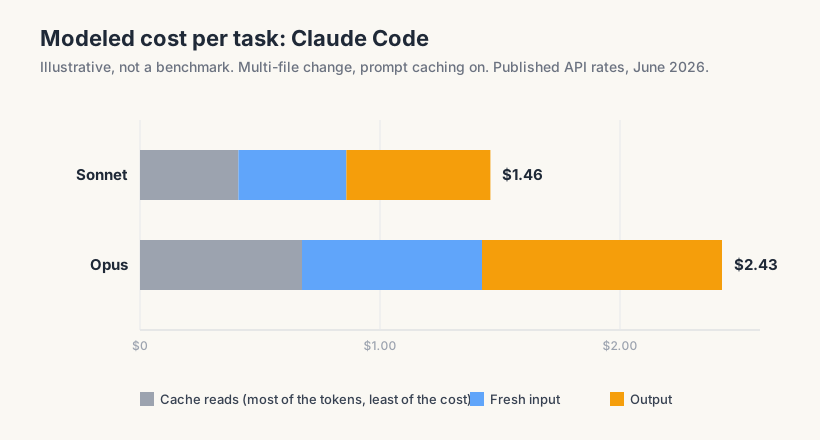
Modeled cost per task (illustrative, not a benchmark)
Assumptions: a multi-file change on Sonnet. The session processes ~1.5M input tokens, of which 90% are cache reads at $0.30/Mtok and 10% are fresh input at $3/Mtok, plus ~40k output tokens at $15/Mtok.
Cache reads: 1.35M x $0.30 = $0.41. Fresh input: 150k x $3 = $0.45. Output: 40k x $15 = $0.60. Total: about $1.46.
Run the same shape on Opus ($5 input, $25 output, $0.50 cache read) and it lands near $2.40. These figures are modeled from published prices and stated assumptions. Your real numbers depend on your codebase and how tightly you scope the request.
The same math, made adjustable. Change the model, the task shape, the cache hit-rate, or the loop count and watch the per-task number move:
Cost-per-task calculator
Modeled estimate- Cache reads: $0.270 (28%)
- Fresh input: $0.300 (31%)
- Output: $0.400 (41%)
A flat $10/mo plan (GitHub Copilot Pro) pays for itself above about 10 tasks/month at this cost-per-task. You are modeling 66. Below the break-even, pure usage billing is cheaper; above it, the subscription is.
| Model | Sticker (in/out) | Cost/task |
|---|---|---|
| GLM-5.3-Flash | $0.15/$0.5 | $0.083 |
| DeepSeek V4.1 Flash | $0.3/$1.2 | $0.101 |
| GPT-5.6 Luna | $0.2/$1.2 | $0.105 |
| Gemini 3 Flash | $0.5/$3 | $0.262 |
| Gemini 3.7 Flash | $0.75/$3.75 | $0.364 |
| Gemini 3.6 Flash | $0.75/$3.75 | $0.364 |
| Gemini 3.8 Flash | $0.75/$3.75 | $0.364 |
| DeepSeek V4 Pro | $1.32/$3.96 | $0.416 |
| Claude Haiku 4.5 | $1/$5 | $0.485 |
| Kimi K2.7 Code | $0.95/$4 | $0.559 |
| Muse Spark 1.2 | $1.25/$4.25 | $0.560 |
| Muse Spark 1.3 | $1.25/$4.25 | $0.560 |
| GLM-5.2 | $1.4/$4.4 | $0.737 |
| Gemini 3.5 Flash | $1.5/$9 | $0.787 |
| Qwen3.8-Max | $2/$6 | $0.877 |
| Qwen3.8-Max-0902 | $2/$6 | $0.877 |
| Grok 4.5 | $2/$6 | $0.945 |
| Claude Sonnet 5 selected | $2/$10 | $0.970 |
| Inkling | $1.87/$4.68 | $0.973 |
| Pareto 26.9 | $2.5/$7.5 | $1.01 |
| Qwen3.7 Max | $2.5/$7.5 | $1.01 |
| Gemini 3.1 Pro | $2/$12 | $1.05 |
| GPT-5.6 Terra | $2/$12 | $1.05 |
| Grok 4.6 | $2/$6 | $1.21 |
| Claude Sonnet 4.6 | $3/$15 | $1.46 |
| Kimi K3 | $3/$15 | $1.46 |
| GPT-5.6 Sol | $4/$20 | $1.94 |
| Claude Opus 5 | $5/$25 | $2.42 |
| Claude Opus 4.8 | $5/$25 | $2.42 |
| GPT-5.5 | $5/$30 | $2.63 |
| Claude Fable 5.1 | $10/$50 | $3.84 |
| Claude Fable 5 | $10/$50 | $4.85 |
| GPT-6 Astra | $10/$50 | $4.85 |
Modeled from published per-token API rates and stated token assumptions, not a benchmark. Real cost varies with your codebase and how tightly you scope each request; the same task can swing by an order of magnitude between runs. Open the full cost-per-task calculator to adjust every assumption.
Scale that mentally. A simple one-file utility might cost ten to thirty cents. A multi-file feature lands in the dollar-to-three-dollar band. And an agent left to grind unsupervised, looping on a problem it cannot crack, can run several dollars on a single task before you notice. That pattern fits the preprint’s finding directly: higher token spend does not translate into higher accuracy, so the most expensive runs are often the ones that fail.
This is also why the published “average” holds up. Anthropic’s own Claude Code cost documentation reports that enterprise deployments average around $13 per developer per active day and $150 to $250 per developer per month, with 90% of users staying under $30 on any given active day. Treat that as a vendor’s self-reported figure, not an independent audit. It squares with the per-task math, though: $13 a day is roughly eight to ten of the dollar-ish tasks modeled above, or a few dozen cheaper one-file edits at a few cents each, or some mix of the two. A solid day of real use, not dozens of multi-file tasks.
Where Claude Code wins
The economics tilt in Claude Code’s favor on work that is genuinely hard for a human and well-shaped for an agent.
Tracing a bug across a large codebase. Multi-file refactors where the change touches a dozen files and a human would spend an afternoon just mapping the blast radius. Writing and fixing tests against existing code. Migrations. The kind of task where you would otherwise context-switch for hours.
On that work, the token efficiency of a terminal agent that reads precisely what it needs beats the alternative. A $2 task that saves 90 minutes is not a cost. A developer billing $100 an hour who recaptures two hours a week is generating $800 of time against a $100 Max plan. The ROI math is not subtle when the work is the right shape.
Where it burns money
The same loop that earns its keep on hard problems wastes money on the wrong ones, and the waste is usually invisible until the bill arrives.
Three patterns show up again and again. Using the heavyweight Opus model for trivial tasks that Sonnet or Haiku would finish for a fraction of the tokens. Letting an agent run unsupervised on a problem it cannot solve, so it loops, re-reads, and re-edits the same files without progress (the preprint’s point about high spend and low success made concrete). And treating Claude Code as a search engine, asking it questions a quick grep would answer, paying agent prices for chat answers.
There is a structural version of this too. Agent teams, where one session spawns multiple Claude Code instances, use roughly 7x the tokens of a standard session, because each teammate carries its own context window. Powerful, occasionally worth it, and a fast way to turn a $2 task into a $14 one if you reach for it by reflex.
The fix is boring and it works: pick the smallest model that can do the job, scope requests tightly, clear context between unrelated tasks, and stop a run the moment it starts spinning.
Is it worth it? It depends who you are
For a solo developer doing substantial work, Pro at $20 is close to a rounding error against the time it saves. The harder questions are at the edges.
If you bill by the hour, the calculation is mechanical: any plan pays for itself the moment it recaptures more billable time than it costs, and on agent-shaped work that threshold is low. If you are evaluating a team rollout, model it per active day, not per seat. A 20-person team at $13 a day per active developer is a real line item, but it is a predictable one once you have a week of pilot data.
The only people who should hesitate are those whose actual usage is the waste pattern above: lots of trivial queries, little hard agentic work. For them the subscription is fine and the API meter is a trap.
Frequently asked questions
Is Claude Code worth $20 a month?
For a developer doing real coding work, yes. At the Pro tier, $20 buys a capable terminal agent as part of an existing Claude subscription, and a single saved hour per month covers it many times over. The value erodes only if your usage is mostly trivial queries an agent is overkill for.
Does the Claude Pro plan include Claude Code?
Yes. Claude Code ships with Pro, Max, both Team seat types (Standard and Premium), and Enterprise. On the Team plan the seats differ by usage allowance, not by whether the agent is included, so size seats to who runs the agent rather than defaulting everyone to the top tier.
How much does Claude Code cost per month in practice?
Anthropic reports enterprise averages of $150 to $250 per developer per month, or about $13 per active day, with 90% of users under $30 on a given day. Subscription users on Pro or Max pay the flat plan price; the per-token figures apply to API and Enterprise usage.
Is Claude Code cheaper than Cursor?
It depends on workload shape. On complex multi-file work, Claude Code’s token efficiency tends to deliver more output per dollar. On heavy inline editing and autocomplete, an in-editor tool can be the better value. The honest answer needs a per-task comparison, which is its own deep-dive.
Bottom line
Budget Claude Code by the task, not the plan. The $20 line is the entrance fee. The number that determines whether it is cheap or expensive is the modeled cost per task (call it a dollar or two for real work) multiplied by how disciplined you are about model choice and scope. Used on hard, agent-shaped problems with the right model, it is one of the best-value tools a developer can buy. Pointed at trivial work or left to loop unsupervised, it is a meter that spins whether or not you get an answer.
Sources
- Bai, L., et al. (2026). How Do AI Agents Spend Your Money? Analyzing and Predicting Token Consumption in Agentic Coding Tasks. arXiv preprint arXiv:2604.22750. arxiv.org/abs/2604.22750
- Anthropic. (2026). Pricing (plans and per-token API rates). Verified 2026-06-14. claude.com/pricing
- Anthropic. (2026). Claude Code: Manage costs effectively (per-developer cost figures, prompt caching, agent teams). Verified 2026-06-14. code.claude.com/docs/en/costs