Claude Fable 5.1: Pricing, Benchmarks, Cost
Claude Fable 5.1 holds Fable 5 rates at $10/$50 per million tokens and cuts the cache read to $0.25. Benchmarks, specs, and modeled cost per task.
- $10
- $10
- $50
- $50
- $12.50
- $12.50
- $0.25
- $1.00
- 1M tokens
- 1M tokens
- 128K tokens
- 128K tokens
Anthropic released Claude Fable 5.1 and Claude Mythos 5.1 on September 1, 2026. Every headline number on the rate card is the number Fable 5 already charged. Input is still $10 per million tokens, output is still $50, the cache writes are unchanged, and the context window is the same 1M.
One line moved. The cache read dropped from $1.00 to $0.25 per million tokens.
That sounds like a rounding detail until you look at what a coding agent actually sends. A long agentic session re-reads the same file tree, the same system prompt and the same conversation history on every single step, and the overwhelming majority of its input tokens are cache hits rather than fresh text. Anthropic priced Fable 5.1 for exactly that shape, and it is the reason the bill falls while the sticker does not.
The rumor mill deserves a scorecard here. When the pre-launch leak claims were audited in August, the single most-repeated claim was that pricing would hold at $10/$50. That turned out to be right. The claimed August window was wrong by a day, and not one of the leaked claims mentioned the cache read, which is the only thing that actually changed. Leaks are reliably good at the number on the poster and blind to the number on the invoice. The model tracker now carries the row as released with a verified price.
How much does Claude Fable 5.1 cost?
Claude Fable 5.1 costs $10 per million input tokens and $50 per million output tokens, the same as Claude Fable 5. Cache reads cost $0.25 per million tokens, down from $1.00. Batch requests are half price at $5 and $25. Those rates are read from the Claude Platform pricing documentation.
| Rate | Claude Fable 5.1 | Claude Fable 5 | Claude Opus 5 |
|---|---|---|---|
| Input | $10.00 | $10.00 | $5.00 |
| Output | $50.00 | $50.00 | $25.00 |
| 5 minute cache write | $12.50 | $12.50 | $6.25 |
| 1 hour cache write | $20.00 | $20.00 | $10.00 |
| Cache read | $0.25 | $1.00 | $0.50 |
| Batch input / output | $5 / $25 | $5 / $25 | $2.50 / $12.50 |
The cache read is the row worth staring at. Every other Claude model prices a cache hit at 10% of its base input rate. Fable 5.1 and Mythos 5.1 price it at 2.5%, and the pricing docs call this out as the only exception in the lineup.
Run that through: Fable 5.1 charges $0.25 to read a million cached tokens. Opus 5 charges $0.50. Anthropic’s most expensive model now has the cheapest cache read in the Claude family, at half the rate of a model that costs half as much on input. Nothing else in the price list behaves that way.
What the cache cut does to a real bill
Anthropic’s own framing is that the change lowers typical Fable spend by about 25%, and highly agentic spend by up to about 45%.
Those are the vendor’s numbers. Here is what the change does to the task profiles the cost-per-task calculator on this site already used before Fable 5.1 existed, so the model was not built to flatter it.
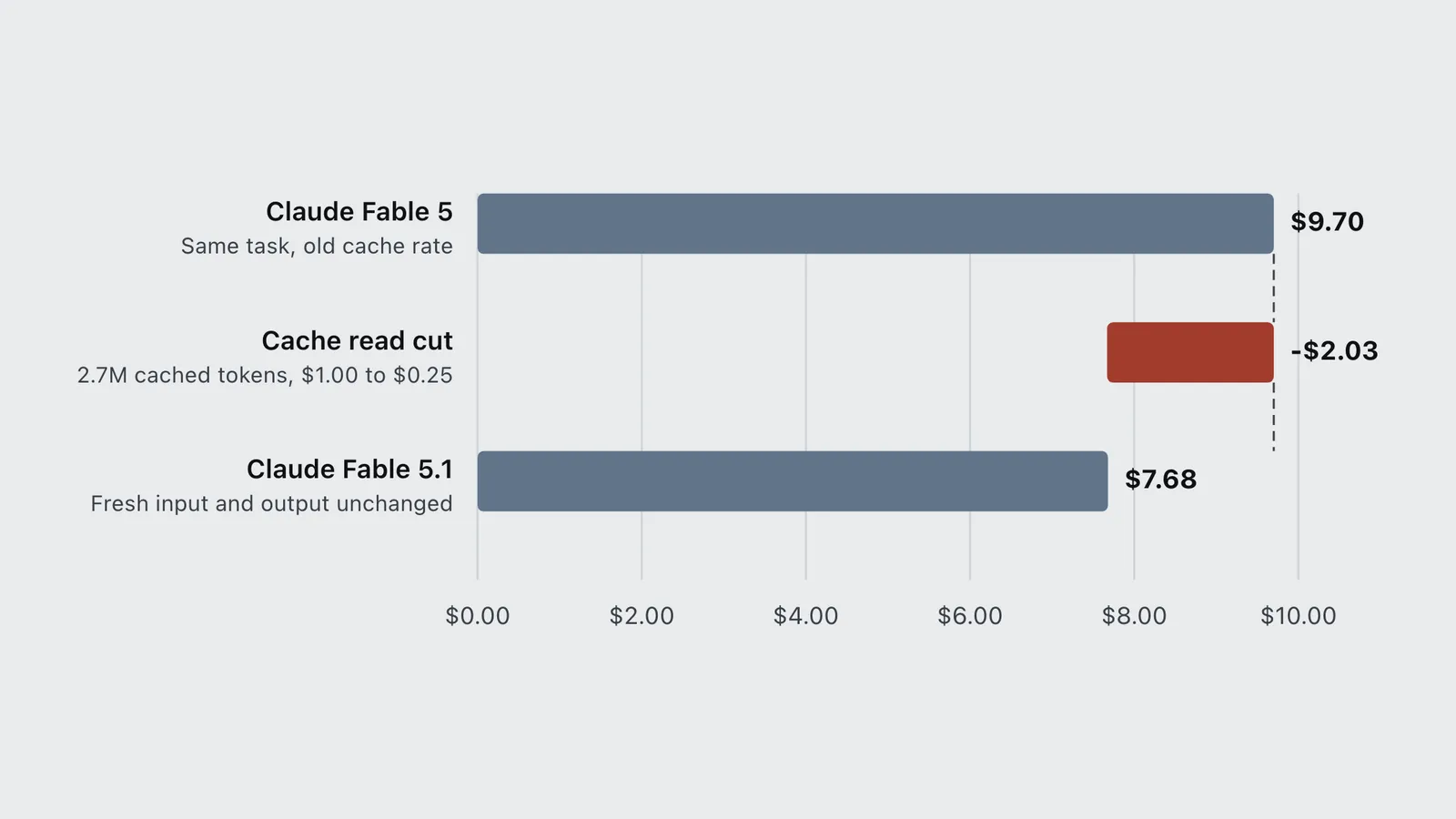
Take the agentic preset: 3 million input tokens, 90% of them cache hits, 80,000 output tokens, one pass.
| Step | Change | Running total |
|---|---|---|
| Claude Fable 5 (Same task, old cache rate) | $9.70 | $9.70 |
| Cache read cut (2.7M cached tokens, $1.00 to $0.25) | -$2.03 | $9.70 |
| Claude Fable 5.1 (Fresh input and output unchanged) | $7.68 | $7.68 |
The saving is $2.03, and all of it comes off one line. Fable 5 paid $2.70 to re-read its 2.7 million cached tokens; Fable 5.1 pays $0.675 for the identical work. Fresh input stays at $3.00 and output stays at $4.00, untouched.
So the total falls from $9.70 to $7.68, a cut of 20.9%.
That is meaningfully less than 45%. It is also close to the 25% Anthropic quotes for typical workloads, which suggests the vendor’s headline and the model here are describing the same effect with different assumptions about how much output a task generates.
The saving scales with cache share, and only with cache share
Because the discount lands entirely on cached tokens, how much you save is decided by one variable: what fraction of your input comes from cache.
| Item | Claude Fable 5 | Claude Fable 5.1 |
|---|---|---|
| One-file edit (80% cache) | $0.82 | $0.73 |
| Multi-file change (90% cache) | $4.85 | $3.84 |
| Multi-step agentic (90% cache) | $9.70 | $7.68 |
A one-file edit at 80% cache share saves 11%. Push to 90% and the saving roughly doubles to 20.9%. The pattern is not a coincidence and it is not about task size: the multi-file change and the agentic task differ by a factor of two in absolute dollars but save the identical 20.9%, because both run at the same 90% cache share.
Which raises the obvious question about Anthropic’s upper figure.
Can you actually reach the 45% saving?
Only at a cache share almost no real agent runs.
The arithmetic is short enough to check. The saving is $0.75 per million cached tokens, measured against a bill of cached tokens plus fresh input plus output. Set output to zero, which is the most generous case possible, and a 45% total saving needs a cache share of 93.75%. At the 90% share used above, the ceiling with zero output tokens is 35.5%, and every output token you add drags it down from there.
So 45% is real, but it describes a workload that is almost pure cache replay and generates barely any text. A coding agent that writes 80,000 tokens of diffs and explanations is not that workload. Budget on 20% and treat anything above it as upside.
The benchmarks Anthropic published
| Capability | Benchmark | Fable 5.1 | Fable 5 | Opus 5 | GPT-5.6 Sol |
|---|---|---|---|---|---|
| Agentic scientific research | Terminal-Bench-Science 0.1 | 52.6% | 24.7% | 29.0% | 22.4% |
| Agentic coding | Terminal-Bench 4.0 | 55.8% | 42.0% | 52.3% | 37.3% |
| Knowledge work | GDPval-AA v2 | 1853 | 1723 | 1824 | 1711 |
| Computer use | OSWorld 2.0, partial | 77.9% | 72.9% | 75.4% | not reported |
| Computer use | OSWorld 2.0, strict | 41.7% | 36.1% | 39.6% | not reported |
| Multidisciplinary reasoning | Humanity’s Last Exam, no tools | 60.9% | 57.8% | 56.6% | not reported |
| Multidisciplinary reasoning | Humanity’s Last Exam, with tools | 65.0% | 63.8% | 63.6% | not reported |
| Business workflows | AutomationBench | 31.4% | 17.1% | 26.9% | 19.6% |
| Agentic coding | CursorBench 3.2.0 | 73.4% | 70.5% | 70.0% | 67.2% |
The Terminal-Bench-Science result is the one Anthropic is selling: more than double Fable 5 on the same test, and more than double GPT-5.6 Sol. Everything else is narrower. On Terminal-Bench 4.0, Fable 5.1 clears Opus 5 by 3.5 points while costing roughly 1.6 times as much to run; on AutomationBench the margin is 4.5 points, on GDPval-AA v2 it is 29 points on that benchmark’s own scale, and on CursorBench 3.2.0 it is 3.4 points. Mythos 5.1, the variant Anthropic says does not carry the same safeguards, scores 60.9% on Terminal-Bench 4.0, above Fable 5.1 itself.
One row is close to noise: on Humanity’s Last Exam with tools, the three Anthropic models sit inside 1.4 points of each other. Anthropic also reports no GPT-5.6 Sol figure for OSWorld or Humanity’s Last Exam, so the cross-vendor comparison exists on only four of the nine rows.
Read the scores and the prices together and the value case is thinner than the headline. A 3.5 point gain on a coding benchmark for a 58% cost increase is a defensible trade for a hard task and a poor one for routine work.
Does Fable 5.1 beat Opus 5 on cost?
No, and the crossover point shows why by a wide margin.
Fable 5.1 narrows the gap. Under Fable 5, the premium over Anthropic’s own Opus 5 was a flat 2.0x on every profile, because both models priced every line at exactly double. The cache cut breaks that symmetry: the agentic task now costs 1.58 times Opus 5 instead of 2.00, and a one-file edit costs 1.78 times.
Narrower is not cheaper. For Fable 5.1 to actually undercut Opus 5, the cache share has to reach 20/21, about 95.2%, and the task has to generate no output tokens at all. Add any realistic output volume and the crossover disappears entirely, because output still bills at $50 against Opus 5 at $25 and no cache discount touches it.
Opus 5 remains the cheaper model on every task anyone actually runs. What changed is the size of the penalty for choosing Fable 5.1 when a task genuinely needs it.
What breaks if you switch
Three changes will fail an existing Fable 5 integration rather than merely behave differently, per the Fable 5.1 model documentation:
- Forced tool use returns an error. If your harness pins
tool_choiceto a specific tool, that call now fails. - Earlier models cannot read Fable 5.1 thinking blocks. A fallback path that hands a failed request down to Opus 5 mid-conversation will break on the thinking history.
- Editing an earlier turn invalidates thinking blocks. Any harness that rewrites conversation history to save context has to account for this.
Five additions are optional: per-message effort changes mid-conversation, turn-scoped system messages, readable progress updates between tool calls, content provenance, and the cache read cut itself. The first three are behind beta headers.
The second item deserves attention if you run a mixed fleet. A cheap, common pattern is to route most work to a smaller model and escalate hard cases upward. Escalating into Fable 5.1 is fine. Falling back out of it, carrying its thinking blocks, is not.
Should you use it?
For most work, no. Anthropic’s own documentation says to start with Opus 5 and reach for Fable 5.1 only for demanding reasoning and long-horizon agentic work, or when Opus 5 at higher effort still fails your evals. The cost analysis above agrees: 1.58x the price for a few benchmark points is a bad default and a reasonable exception.
The teams that should look hardest are the ones already paying for Fable 5. For them this is a 20% price cut with no migration cost beyond the three breaking changes, and no reason to wait.
And if you are choosing between tiers rather than upgrading within one, model your own token mix in the cost-per-task tool before committing. The cache share is doing all the work here, and yours is unlikely to match the presets exactly.
Frequently asked questions
- How much does Claude Fable 5.1 cost?
- Claude Fable 5.1 costs $10 per million input tokens and $50 per million output tokens, identical to Claude Fable 5. The cache read costs $0.25 per million tokens, down from $1.00. Batch requests are half price at $5 and $25 per million tokens.
- Is Claude Fable 5.1 cheaper than Claude Fable 5?
- Yes, on any cache-heavy task, despite identical headline rates. Modeled on a multi-step agentic task at 90% cache share, Fable 5.1 costs $7.68 against $9.70 for Fable 5, a 20.9% saving. On a one-file edit at 80% cache share the saving is 11%. A task with no cached tokens costs exactly the same on both.
- Is Claude Fable 5.1 cheaper than Claude Opus 5?
- No. Fable 5.1 costs about 1.58 times Opus 5 on a modeled agentic task, down from a flat 2.0 times under Fable 5. Fable 5.1 only undercuts Opus 5 above roughly 95.2% cache share with no output tokens, which is not a workload real coding agents run.
- What is the difference between Claude Fable 5.1 and Claude Mythos 5.1?
- They are the same model with the same specifications and the same pricing. Fable 5.1 is generally available with Anthropic production safeguards. Mythos 5.1 is restricted to invited Project Glasswing participants in cybersecurity and life sciences who need capabilities those safeguards constrain.
- What breaks when upgrading from Claude Fable 5 to 5.1?
- Three things. Forced tool use returns an error, earlier models cannot read Fable 5.1 thinking blocks so downward fallback paths fail, and editing an earlier conversation turn invalidates thinking blocks.
- What is the context window of Claude Fable 5.1?
- One million tokens, with a maximum output of 128,000 tokens per response. Adaptive thinking is always on and the default effort level is high. The reliable knowledge cutoff is June 2026.
Sources
Anthropic (2026). Claude Fable 5.1 and Claude Mythos 5.1. Anthropic announcement. https://www.anthropic.com/claude-fable-and-mythos-5-1 Verified 2026-09-02.
Anthropic (2026). Pricing. Claude Platform documentation. https://platform.claude.com/docs/en/about-claude/pricing Verified 2026-09-02.
Anthropic (2026). Claude Fable 5.1. Claude Platform model documentation. https://platform.claude.com/docs/en/models/fable-5-1/overview Verified 2026-09-02.
Anthropic (2026). Models overview. Claude Platform documentation. https://platform.claude.com/docs/en/models/overview Verified 2026-09-02.
Cost-per-task figures are modeled by Capital & Compute from the rates above, using the task profiles published on the cost-per-task calculator: cost equals cached tokens times the cache rate, plus fresh input tokens times the input rate, plus output tokens times the output rate.