What AI Changes About the Professional Profile
Three studies measured AI at work and disagreed: 40 percent faster writing, 14 percent more support tickets, 19 percent slower coding.
AI has not made experience irrelevant. It has made the language of experience cheaper. In a randomized experiment on 444 college-educated professionals, published in Science in 2023 as Experimental evidence on the productivity effects of generative artificial intelligence, economists Shakked Noy and Whitney Zhang found that access to ChatGPT cut the average time taken on midlevel professional writing tasks by 40 percent while raising assessed output quality by 18 percent. A credible project summary, a clean portfolio description or a polished explanation of a technical decision can now be drafted in seconds. That is useful, but it weakens an old assumption behind the professional profile: that a well-presented account of work is, by itself, evidence of the work.
The answer is not to become suspicious of every well-written sentence. It is to ask the profile to do a more demanding job. In an environment where machines can manufacture polish on demand, a professional profile should show what changed, what the person contributed, how decisions were made and where the supporting evidence lives.
The CV was built for a world of scarce attention
A conventional CV is a compression format. It reduces years of work to employers, dates, titles and a few bullets because the reader has limited time and the candidate has limited space. That bargain has always discarded context, but it worked reasonably well when job titles, institutional names and carefully written bullets served as acceptable proxies for competence.
No CV was ever a database of truth. It was closer to a map drawn at postcard size. Still, the effort required to produce a coherent narrative created some friction. The candidate had to choose what mattered, explain it and make the pieces fit. Generative AI removes much of that friction. It can make weak experience sound orderly, and it can make strong experience sound indistinguishable from everyone else’s strong experience.
This does not mean AI makes profiles dishonest. It means prose quality carries less information than it used to. When good phrasing is abundant, the scarce signals move elsewhere: specificity, provenance, judgment and a record that stays current.
Output is not the same as ownership
The distinction matters most in fields where AI can participate directly in production. A coding agent can help generate an implementation, tests and documentation. A design tool can produce variations. A writing model can turn rough notes into a convincing case study. The finished artifact may be real and useful, but the artifact alone says less about who understood the problem, selected the approach, caught the failure or accepted the tradeoff.
Agent benchmarks already make this distinction explicit. Terminal-Bench, a benchmark built by researchers at Stanford University and the Laude Institute, evaluates an agent-model combination inside a harness with defined environments, tasks and tests. The score belongs to the system, not to one component in isolation, which is why the same model can post very different numbers depending on the scaffold around it, a pattern covered in more depth in the 2026 guide to AI agent benchmarks. A professional profile should apply the same discipline to human work: name the system, state the person’s role and show how the result was evaluated.
A stronger profile separates output from ownership. It does not require a ritual confession every time software was involved. It asks for the information a serious collaborator would want: What was the starting condition? Which constraints mattered? What did the person decide? What did tools or teammates contribute? What evidence shows the result? What would the person change next time?
For a hypothetical engineering project, “built an AI support agent” is weak because it names an object without revealing the work. A more useful account might explain the evaluation set, the failure categories discovered during testing, the latency or cost constraint that shaped the design and the parts the author personally owned. The point is not to make every profile read like a forensic report. It is to expose enough of the reasoning that the reader can tell whether the person operated the tools or merely described their output.
The professional profile becomes an evidence layer
Once the summary is no longer enough, the profile has to connect claims to proof. That proof will differ by profession. An engineer may link to a repository, a benchmark, a technical note or a shipped feature. A product manager may show the decision behind a change, the constraints considered and the metric used to judge it. A researcher may connect a claim to a paper, dataset or protocol. A designer may show the problem, the rejected directions and the final system in use.
Not every project can be public. Confidential work, security constraints and client privacy are real. A useful profile can still describe the class of problem, the candidate’s responsibility, the method and the shape of the outcome without exposing sensitive details. “I cannot show the artifact” is not the same as “I cannot explain my reasoning.”
This is a better model than stuffing more keywords into a document. A keyword says that a person wants to be associated with a capability. An evidence trail shows how that capability appeared in practice. The former is cheap to generate. The latter is harder to fake consistently because its parts have to agree.
Maintenance matters more than another redesign
The static CV also has a time problem. It tends to be updated under pressure, usually when someone needs a job, and then frozen again. That produces a strange professional ritual: people do their most important work and postpone recording it until memory has compressed the decisions into three vague bullets.
A maintained career page changes the unit of work. Instead of redesigning a document every year, a person can add a project when it ships, revise a claim when the evidence changes and retire details that no longer represent the direction of the career. The page becomes closer to a lightweight changelog than a monument carved before the application deadline.
The PDF still has a job. It remains useful where application systems require a document and where recruiters want a compact, standardized view. The career page should complement it, not pretend those workflows have vanished. The PDF carries the summary. The page carries the context, links, projects, media and updates that do not fit cleanly into two pages.
Design for people first, with machines in mind
A maintained page also creates a cleaner interface for software. Explicit sections, clear dates, consistent project descriptions, links and authorship labels are easier to interpret than a visually elaborate PDF whose meaning depends on position and typography. Whether the reader is a recruiter, a hiring manager or a tool helping them organize information, structure reduces ambiguity.
That does not justify building a profile for robots and hoping a human tolerates it. The profile still needs a point of view. It should make the important work easy to scan, explain why it mattered and allow the reader to go deeper. Machine readability is useful when it follows human clarity. It becomes absurd when people turn their careers into metadata soup to satisfy a parser they have never seen.
AI should help maintain the profile, not become its author of record
There is a productive irony here. The same technology that makes polished career language less scarce can make an evidence-rich profile easier to maintain. AI can structure material from an existing CV, shorten a project explanation, identify missing context, translate a section or keep presentation consistent. It can reduce the administrative cost that caused profiles to go stale in the first place.
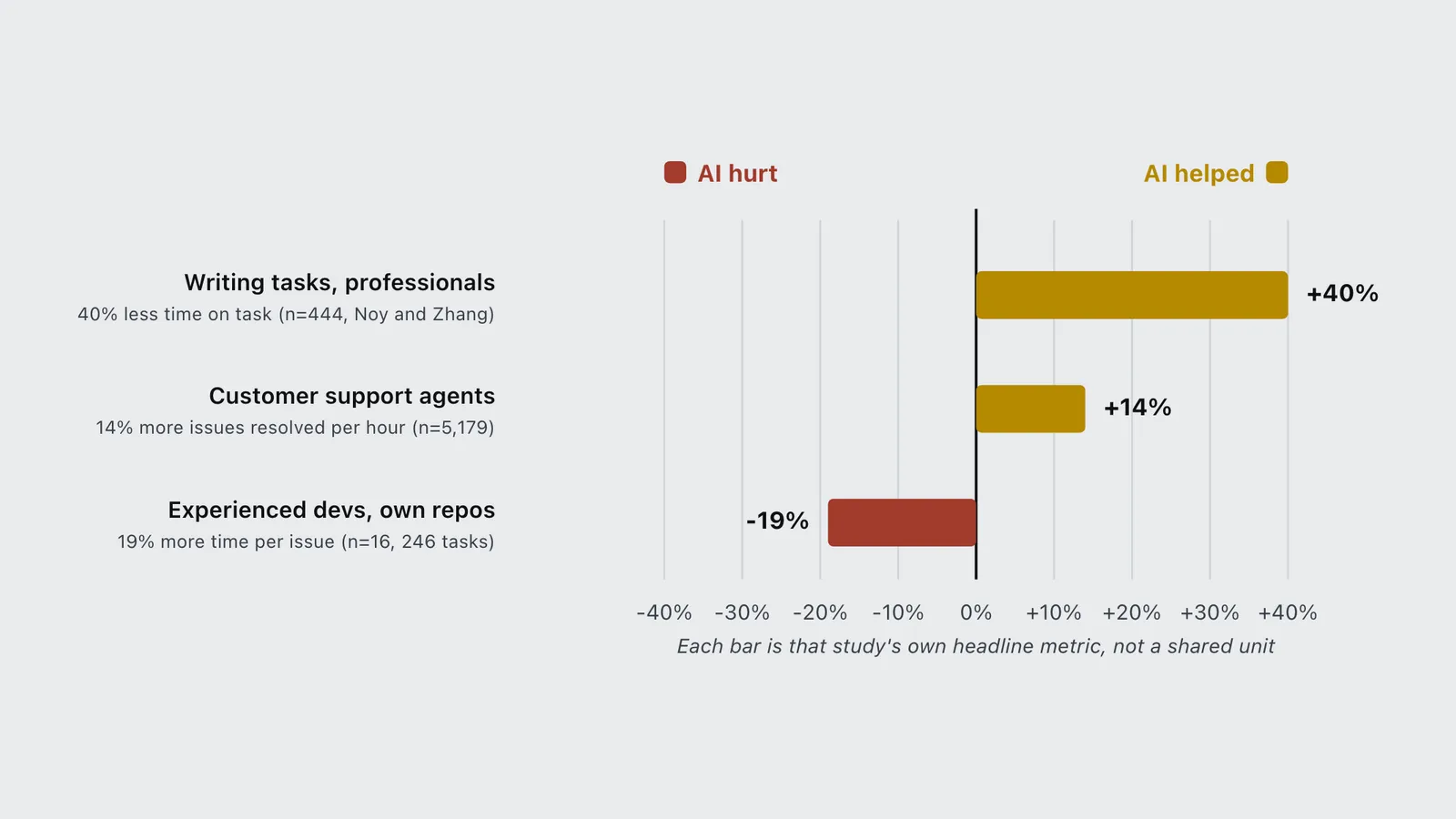
Evidence on productivity also cuts both ways, and the disagreement is larger than it is usually presented.
| Study | Measured effect | Metric and sample |
|---|---|---|
| Writing tasks, professionals | +40% | 40% less time on task (n=444, Noy and Zhang) |
| Customer support agents | +14% | 14% more issues resolved per hour (n=5,179) |
| Experienced devs, own repos | -19% | 19% more time per issue (n=16, 246 tasks) |
A 2023 NBER working paper, Generative AI at Work by Erik Brynjolfsson, Danielle Li and Lindsey R. Raymond, studied the staggered rollout of a generative AI-based conversational assistant across 5,179 customer support agents and found access to the tool raised productivity, measured as issues resolved per hour, by 14 percent on average. In a very different setting, a randomized controlled trial by METR, a non-profit research institute, found that 16 experienced open-source developers took 19 percent longer to complete 246 issues in their own repositories when allowed to use early-2025 AI tools, even though they believed the tools had sped them up.
That second result deserves a caveat its popular retellings usually drop. In February 2026 METR announced it was changing the experiment design, reporting that developers increasingly declined to participate without AI, that between 30 and 50 percent of them avoided submitting tasks they felt required AI assistance, and that time reporting was unreliable when developers multitasked while waiting on agents. METR now describes its own estimate as a likely lower bound on the true productivity effect and believes developers are more sped up in early 2026 than the original study implied.
The contradiction is the useful part, and it survives the caveat: the effect depends on the task, the worker’s context and the cost of verification. The same pattern shows up in the AI productivity paradox, where a central bank found that time saved with AI had close to no correlation with measured output. Any profile claim that leans on “AI made me more productive” is asserting something the research does not yet support as a general fact.
But the final responsibility has to remain with the person. A model can propose language. It cannot decide which claim the person is willing to defend in an interview. It can organize a project, but it should not quietly invent ownership, certainty or results. The useful boundary is simple: AI assists with extraction, structure and editing; the individual reviews the evidence and publishes the account.
That premise shaped Self, the product I am building. Self turns existing CV or portfolio material into a hosted personal page that the user can review, edit, customize, publish and keep current. The product is not an argument that the CV is dead. It is an attempt to make the layer beyond the CV practical enough that people will actually maintain it.
What changes for hiring
If profiles evolve this way, hiring teams should change what they reward. Perfect prose should count for less. Specificity should count for more. A useful review process would look for claims connected to artifacts, clear boundaries around contribution, signs that the candidate understands tradeoffs and evidence that the profile has been maintained rather than assembled in one frantic afternoon.
Interviews can then start from the evidence instead of repeating the summary. Why was this constraint important? Which approach failed? What did the agent produce, and what did you change? Which result surprised you? These questions do not punish the use of AI. They reveal whether the candidate can exercise judgment around it.
The professional profile is becoming less like a brochure and more like an accountable interface to a body of work. That is the useful consequence of AI lowering the cost of expression. When anyone can produce a plausible description, the valuable signal is no longer the description alone. It is the maintained record of choices, evidence and responsibility behind it.
Frequently asked questions
- Does AI make a CV less useful?
- It makes the writing on a CV less informative, not the document useless. Application systems still require a standardized document, and recruiters still want a compact view. What changes is that polished bullets no longer serve as evidence of the work behind them, so the CV needs a companion layer that connects claims to artifacts.
- How much does AI actually improve productivity at work?
- It depends heavily on the task. A 2023 Science study found ChatGPT cut writing-task time by 40 percent and raised quality by 18 percent. A 2023 NBER working paper found customer support agents resolved 14 percent more issues per hour. A 2025 METR randomized trial found experienced open-source developers took 19 percent longer on issues in their own repositories, though METR said in February 2026 that selection effects likely made that a lower bound on the true effect.
- Should a candidate disclose that they used AI on a project?
- A blanket disclosure on every item adds little. What helps is describing the system and the boundary of ownership: what the starting condition was, which constraints mattered, what the person decided, what tools or teammates contributed, and what evidence shows the result. That is more informative than a yes or no about tool use.
- What should hiring teams look for now?
- Claims connected to artifacts, explicit boundaries around individual contribution, signs the candidate understands the tradeoffs they made, and evidence that the profile has been maintained over time rather than assembled at once. Interviews should start from that evidence instead of restating the summary.
Sources
Noy, S. and Zhang, W. (2023). Experimental evidence on the productivity effects of generative artificial intelligence. Science, Vol. 381, Issue 6654, pp. 187-192 (peer-reviewed). https://www.science.org/doi/10.1126/science.adh2586
Brynjolfsson, E., Li, D. and Raymond, L. R. (2023). Generative AI at Work. NBER Working Paper 31161 (working paper, not peer-reviewed). https://www.nber.org/papers/w31161
METR (2025). Measuring the Impact of Early-2025 AI on Experienced Open-Source Developer Productivity. METR (research report; preprint at arXiv:2507.09089). https://metr.org/blog/2025-07-10-early-2025-ai-experienced-os-dev-study/
METR (2026). We are Changing our Developer Productivity Experiment Design. METR (research update, February 2026). https://metr.org/blog/2026-02-24-uplift-update/
Laude Institute and Stanford University (2026). Terminal-Bench. Benchmark documentation. https://www.tbench.ai/