Why Is My YouTube RPM So Low? A Guide for New Creators
A $0.21 RPM is normal for a new channel with mostly Shorts or non-US viewers. What RPM means, what 1,000 views pay, and the steps that actually raise it.
Your YouTube RPM is low because most new channels earn on Shorts, non-US views or short videos without mid-roll ads. A $0.21 RPM is about normal for Shorts and about a tenth of the $2.30 long-form median.
RPM (revenue per mille) is what you keep per 1,000 views after YouTube’s cut, counting every view, including the ones that showed no ad. That makes it the most honest number in YouTube Studio and the most discouraging one for a new channel. This guide explains what drags a new channel’s RPM down to cents, what 1,000 views are actually worth, how the YouTube Partner Program tiers work (including the rule changes that take effect on February 1, 2027), and which fixes move the number, in order of how much they move it.
What is the difference between RPM and CPM on YouTube?
CPM is the advertiser’s price; RPM is your paycheck. YouTube’s own RPM and CPM help article defines CPM as “the cost per 1000 ad impressions before YouTube revenue share,” and RPM as “how much money you’ve earned per 1,000 video views.”
Three things push RPM below CPM:
- YouTube’s revenue share. Under the YouTube Partner Program terms, YouTube pays creators 55% of net revenue from ads on the watch page, so it keeps 45%. For Shorts, creators keep 45% of the revenue allocated to them from the Shorts Creator Pool.
- Views that showed no ad. RPM “includes all views, including ones that weren’t monetized,” in YouTube’s words. A view from someone with an ad blocker, a view where no advertiser bid, or a view of a video with limited ads all add to the denominator and nothing to the numerator.
- CPM counts ad impressions, RPM counts views. One view can carry several ads (a pre-roll plus mid-rolls) or none. CPM only measures the ones that ran.
RPM is not only ads. YouTube’s article lists ads, channel memberships, YouTube Premium revenue, Super Chat and Super Stickers as inputs. For a brand-new channel, ads and Premium are usually the only ones with any money in them.
| Step | Change | Running total |
|---|---|---|
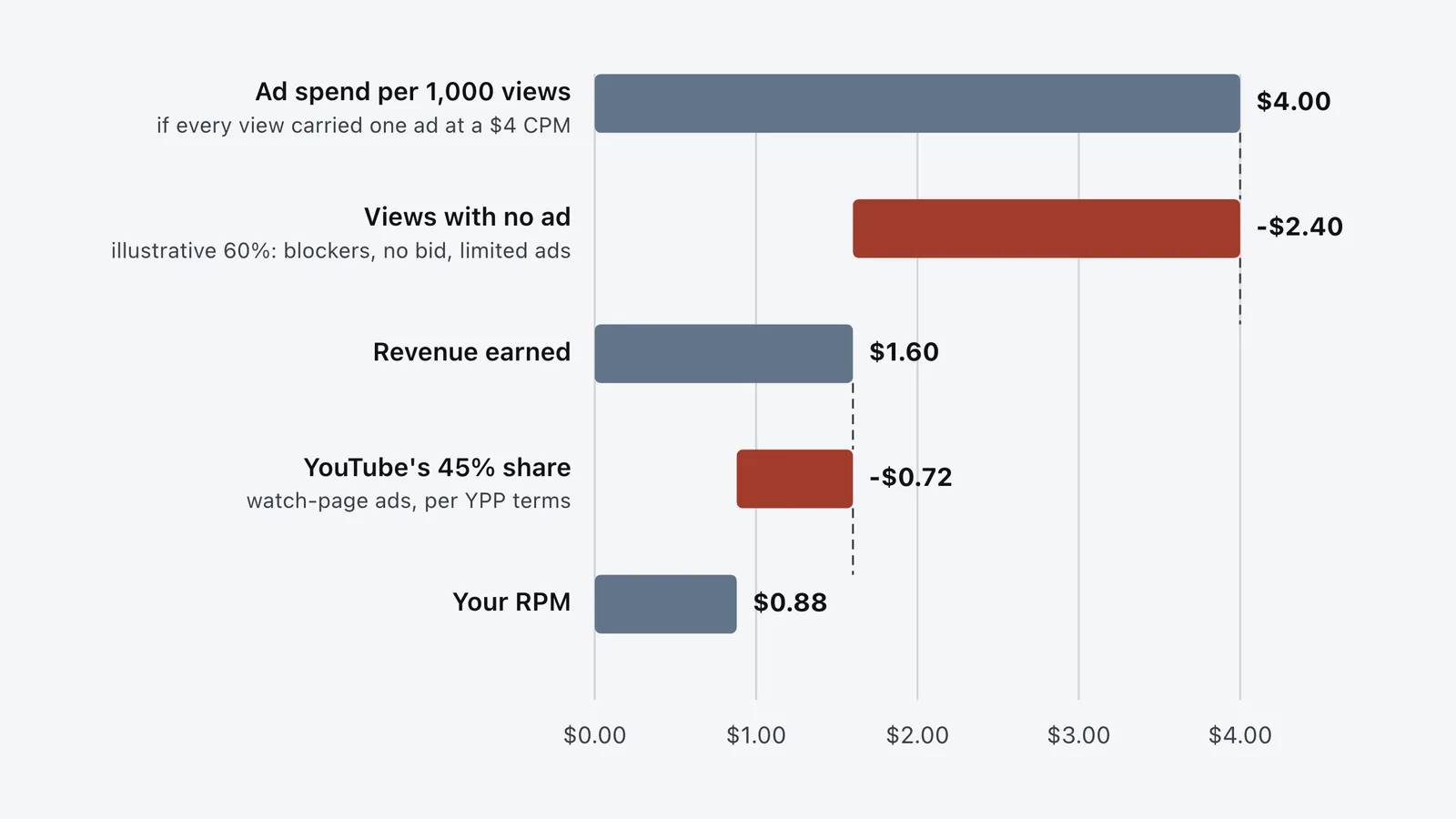
| Ad spend per 1,000 views (if every view carried one ad at a $4 CPM) | $4.00 | $4.00 |
| Views with no ad (illustrative 60%: blockers, no bid, limited ads) | -$2.40 | $4.00 |
| Revenue earned | $1.60 | $1.60 |
| YouTube's 45% share (watch-page ads, per YPP terms) | -$0.72 | $1.60 |
| Your RPM | $0.88 | $0.88 |
The numbers in that chart are invented for illustration; only the 45% share comes from YouTube. The point is the shape: a healthy-looking CPM can sit next to a thin RPM when most of your views never carry an ad.
Where to find RPM and CPM in YouTube Studio
Open Studio → Analytics → Revenue. RPM sits on the overview cards next to estimated revenue. CPM and playback-based CPM appear further down the Revenue tab and in Advanced mode, where you can also split revenue by country, by content type (Videos, Shorts, Live) and by individual video. Splitting by content type is the first thing to do with a low number: a channel-wide RPM blends Shorts and long-form into one figure that describes neither.
Why is my YouTube RPM so low as a new creator?
Usually several of the reasons below at once. They are listed roughly in order of how much they move the number.
1. Most of your views are Shorts
Shorts are not paid per ad. Ads running between Shorts in the feed are pooled each month, and the creators’ portion is shared out by engaged views. YouTube’s Shorts monetization policies describe it: revenue goes into the Creator Pool “based on engaged views and music usage,” a Short that uses one music track sends part of its revenue to the music partners, and “monetizing creators will keep 45% of their allocated revenue, regardless if music was used or not.”
The result is a tiny per-view rate. AIR Media-Tech, a YouTube partner network, studied 274 of its channels (3,044 channel-months of Studio data, last updated September 16, 2026) in YouTube Shorts RPM vs long-form. It found Shorts RPM “clusters between $0.07 and $0.20 per 1,000 views for most niches,” that Shorts pay 3% to 14% of long-form RPM in almost every niche (music is the exception), and that most channels need 11,000 to 34,000 Shorts views to earn what 1,000 long-form views pay. AIR is a network with a commercial interest in the topic, and its figures are medians from its own client base, not YouTube data.
If your $0.21 is mostly Shorts, you are at or above that median. Nothing is broken.
2. Your viewers are not in high-CPM countries
Advertisers pay far more to reach viewers in some countries than others. The AIR Shorts study lists median Shorts RPM by viewer country of $0.328 for the US, $0.193 for Australia, $0.166 for the UK, $0.165 for Canada and $0.163 for Germany. Long-form gaps are wider. A channel whose views come mainly from India, Indonesia, Brazil or the Philippines can have excellent retention and still post a cents-level RPM, because the advertisers bidding for those viewers pay less.
Check Analytics → Audience → Top geographies, then compare revenue by country in Advanced mode. If the US, UK, Canada, Australia and Western Europe make up a small share of views, geography is likely your main cause.
3. Your videos are under 8 minutes
YouTube’s mid-roll ads help page says: “On monetized videos that are 8 minutes or longer, you can turn on ads during the middle of the video.” A 6-minute video can carry ads before and after it, but not in the middle, so it earns from fewer impressions per view. Mid-rolls only earn if people are still watching when they play, which is why retention and length work together.
4. Your niche attracts low-paying advertisers
Advertisers pay for buyers. Topics close to purchases (software, education, cars, money) tend to draw higher bids than broad entertainment or content for children. AIR’s 300-channel study, How much does YouTube really pay in 2026 (May 2025 to May 2026, last updated July 1, 2026), reports these median RPMs by niche:
| Niche | Median RPM | Note |
|---|---|---|
| Education & Science | $10.22 | |
| Transport | $5.69 | fewer than 10 channels |
| Lifestyle | $2.98 | |
| News & Politics | $2.60 | fewer than 10 channels |
| Entertainment | $2.43 | |
| Crafting & Handmade | $2.39 | |
| Gadgets & Tech | $2.33 | |
| Music | $2.28 | |
| Food & Cooking | $2.25 | fewer than 10 channels |
| Gaming | $2.05 | |
| Business & Finance | $2.01 | fewer than 10 channels |
| Health & Sport | $1.23 | |
| Kids & Teens | $0.33 | |
| All niches | $2.30 | median across 300 channels |
Two caveats. These are one network’s channels, which skew toward entertainment, music and gaming, so the medians are not a census. And Business & Finance at $2.01 contradicts the common claim that finance always pays $20 or more; with fewer than ten channels in AIR’s sample, treat it as directional either way.
5. Your content is marked made for kids or carries limited ads
Content for children earns least: Kids & Teens came in at a $0.33 median in AIR’s data, and YouTube’s made-for-kids monetization page warns that low-quality kids content can earn limited or no ads. Separately, every upload is checked against YouTube’s advertiser-friendly content guidelines. A video that gets a “Limited ad earnings” notice (the yellow dollar icon) serves few or no ads, and you can request a human review of that decision through the ad suitability review process. Strong language in the first seconds, violence, sensitive events and controversial topics are the usual triggers.
6. It is the wrong time of year
Ad prices swing through the year. AIR’s 300-channel monthly medians climb from $1.56 in January to a peak of $2.35 in November, as holiday advertisers bid up inventory, then fall again in the new year.
| Item | Value |
|---|---|
| January | $1.56 |
| February | $1.82 |
| March | $1.84 |
| April | $1.93 |
| May | $1.90 |
| June | $2.05 |
| July | $1.91 |
| August | $1.98 |
| September | $2.15 |
| October | $2.19 |
| November | $2.35 |
| December | $2.12 |
A channel that joined YPP in January sees its worst month first. A drop in early January is the calendar, not a penalty.
7. The channel is new and the sample is small
With a few thousand views a month, a handful of US viewers can double your RPM one week and their absence can halve it the next. A new channel also tends to have more Shorts, shorter videos and an audience YouTube is still working out, which overlaps with every cause above. The next section covers what is and is not documented about a “ramp-up.”
Is there a ramp-up period before YouTube RPM stabilizes?
Not one YouTube documents. Blog ad networks describe a learning period after a site joins; YouTube’s help pages describe no such thing for channels. What new channels do see is early volatility, and most of it has an ordinary cause.
What YouTube does document for new uploads. Every video goes through checks for copyright and ad suitability, and the monetization icon can change as checks complete. In May 2025, YouTube began testing an automatic second review for videos that get a “limited or no ads” rating, and said creators “will receive an email notification within 24 hours once a final decision is available,” as reported by Social Media Today. Views a video gets while it is limited, or before you switch ads on, earn little or nothing. Estimated revenue in Studio is also an estimate: final earnings are added to your AdSense balance between the 7th and 12th of the following month, per YouTube’s payment timeline.
What creators report, and why. Creators often describe low, jumpy RPM in their first weeks of monetization. That pattern is anecdote, not policy, and it is explained by things already covered: small samples, a Shorts-heavy mix, short videos, limited-ads icons on early uploads, and whichever season they joined in.
How the blog ad-network ramp-up differs. On a website, the ad network has to learn the site itself. Ezoic’s support documentation says its “AI generally takes 30 days to Ramp Up to gather enough data to optimize your revenue.” Mediavine does not publish a figure for its Journey program; one blogger’s first three months on Journey describe very low earnings in the first weeks and a monthly RPM that roughly doubled from month one to month three, while also noting they started in the year’s weakest quarter. Those networks are tuning ad placements, layouts and bidder setups for one site. YouTube controls the player, the ad slots and the auction across the whole platform, and advertisers target viewers and topics rather than learning a new channel, so there is no per-channel setup to tune.
How long to wait before judging RPM.
- Use 28-day windows at minimum, and 90 days once you have them. Ignore single days.
- Wait until a month’s figures are finalized before comparing months.
- Compare like with like: long-form against long-form, and this November against last November, not against January.
- Judge after a meaningful sample. Below a few tens of thousands of monthly views, one video’s audience can swing the whole channel’s RPM.
Is $0.21 RPM normal for a new channel?
Yes, for the content most new channels make. Here is how $0.21 reads against the published medians:
| If your views are mostly… | Typical RPM (median) | What $0.21 means |
|---|---|---|
| Shorts | $0.07–$0.20 in most niches (AIR, 274 ch.) | At or above typical |
| Long-form, kids content | $0.33 (AIR, Kids & Teens) | Slightly below typical |
| Long-form, entertainment/gaming | $2.05–$2.43 (AIR) | Well below typical |
| Long-form, education & science | $10.22 (AIR) | Far below typical |
A reasonable beginner target for long-form is somewhere in the $1 to $3 range in a general niche, rising toward the higher medians if the topic sits close to purchases and the audience sits in high-CPM countries. If your long-form RPM is $0.21, check geography and the yellow icons first: one of them is very likely the cause.
How much does YouTube pay per 1,000 views?
Your RPM, by definition. The table shows what different view counts pay at three RPMs: $0.21 (typical Shorts, or long-form with a low-CPM audience), $2 (close to the long-form median) and $8 (a strong niche with a Tier 1 audience).
| Views | At $0.21 RPM | At $2 RPM | At $8 RPM |
|---|---|---|---|
| 10,000 | $2.10 | $20 | $80 |
| 100,000 | $21 | $200 | $800 |
| 1,000,000 | $210 | $2,000 | $8,000 |
YouTube pays through AdSense once your balance reaches the payment threshold, $100 in US dollars, and YouTube earnings have their own threshold separate from any website AdSense earnings. At a $0.21 RPM, that first payout takes about 476,000 views. At $2 it takes 50,000.
What are the YouTube Partner Program requirements?
There are two tiers. YouTube’s YPP overview and its changes page set them out:
| Tier | Until January 31, 2027 | From February 1, 2027 |
|---|---|---|
| Fan funding and Shopping (no ad revenue) | 500 subscribers, 3 public uploads in 90 days, plus 3,000 watch hours in 12 months or 3M Shorts views in 90 days | Unchanged |
| Ad revenue sharing | 1,000 subscribers plus 4,000 watch hours in 12 months or 10M Shorts views in 90 days | 1,000 subscribers plus 8,000 watch hours in 365 days or 20M Shorts views in 90 days |
| Shorts Creator Pool payouts | Any YPP channel that accepts the Shorts module | Requires 10M qualified Shorts views over the last 90 days |
Some details that trip new creators up:
- Shorts watch time does not count toward the watch-hour path. YouTube’s overview says qualified watch hours “from Shorts views in the Shorts Feed won’t count towards the 4,000.” Watch hours and Shorts views are separate routes; they do not add together.
- Existing partners keep their place. “If you are already in YPP, your status is not impacted by this update,” per the changes page. A channel accepted before February 1, 2027 joins under today’s bar.
- Activity rules arrive too. From February 2027, a channel counts as active with 1,000 watch hours in 365 days, 1 million Shorts views in 90 days, or 2 long-form videos or 5 Shorts uploaded every 90 days. Creators must accept the updated terms in Studio by January 31, 2027.
- RPM only appears once ads are on. RPM and revenue metrics show up in Studio after you are accepted into the ad tier and switch on monetization. Views before that earned nothing.
The practical upshot for a channel getting close: if you can reach 1,000 subscribers and 4,000 long-form watch hours before February 1, 2027, you join under the lower bar.
How do I increase my YouTube RPM?
In order of impact for a typical new channel:
- Make long-form the core. Shorts pay a few percent of what long-form pays per view, and from February 2027 they pay nothing below 10 million views a quarter. Treat Shorts as discovery, not income.
- Go to 8 minutes or more when the topic supports it, then leave automatic mid-rolls on or place breaks at natural pauses. Do not pad a 5-minute idea to 8 minutes; lost retention costs more than a mid-roll earns.
- Pick topics advertisers pay for. Within your niche, lean toward videos tied to decisions and purchases: comparisons, tutorials for paid software, buying guides, how-tos in education, money or tech.
- Reach high-CPM audiences. Publish in English (or the language of a high-CPM market), use titles and examples that match what viewers in those countries search for, and schedule uploads for their time zones. Do not buy views or promote in low-CPM regions to inflate counts; it lowers RPM.
- Avoid limited-ads triggers. Keep the first 30 seconds clean of profanity, graphic material and shock thumbnails. Use the self-certification questionnaire honestly, and request review on yellow icons you think are wrong.
- Check ad settings per video. In Content → video → Monetization, make sure pre-roll, post-roll and mid-roll ads are enabled, and fix any video accidentally set as made for kids.
- Hold retention. Mid-rolls only earn if people are still watching. Cut slow intros and deliver what the title promised.
- Time big uploads for Q4. The same video earns more per view in October and November than in January. Hold your strongest long-form ideas for autumn where you can.
- Upload on a schedule. Consistency builds the returning audience that watches long videos and, from 2027, keeps you above the activity bar.
How can new YouTubers make money besides ads?
Early on, often more than from ads. At a $0.21 RPM, 100,000 views pay about $21; a dozen $5 channel memberships pay more every month.
- Channel memberships, Super Chat, Super Stickers and Super Thanks. These open in the 500-subscriber tier. YouTube pays creators “70% of net revenues” from all four, per the YPP terms. That is a better share than the 55% from ads, and it does not depend on where your viewers live.
- YouTube Shopping affiliate program. Eligible creators earn commission when viewers buy tagged third-party products through their videos. A product review watched by 2,000 buyers can out-earn 200,000 views of ads.
- Affiliate links of your own. Links in descriptions to tools and products you actually use. Disclose them clearly in the video and description.
- Sponsorships. Brands pay for audience fit, not raw views; a small channel in a buyer-heavy niche can land sponsors before it reaches the ad tier.
- Your own products. Templates, courses, presets, consulting. These carry the highest margin and the slowest start.
This is the same playbook websites use when ad rates fall short, covered in the publisher revenue playbook for the AI search era: ads are the floor, not the business.
YouTube RPM myths and mistakes to avoid
- “RPM is a quality score.” It is not. It reflects format, audience location, niche and season. A brilliant gaming Short watched mostly in India will post a lower RPM than an average software tutorial watched in the US.
- “More subscribers means higher RPM.” Subscribers do not set ad prices. They help indirectly: returning viewers watch longer, which earns mid-rolls, and a bigger channel unlocks fan funding and sponsors.
- “Chase views from anywhere.” Cheap views from low-CPM countries can raise views and revenue slightly while dragging RPM down, and they teach the recommendation system to show your videos to more of the same audience.
- “Delete your Shorts to fix RPM.” Deleting Shorts removes a discovery channel and the subscribers it brings. Split RPM by content type in Studio instead, and judge long-form on its own figure.
- “Sub4sub and bought views will get me monetized faster.” Artificial views are excluded from Shorts revenue under YouTube’s Shorts monetization rules, and fake engagement can get a channel rejected from or removed from YPP. Subscribers who never watch also hurt how new uploads perform.
- “January means I did something wrong.” The 300-channel median fell about a third from November to January. Wait for February and March before reacting.
For a sense of where YouTube itself is heading, including the messaging features it has been testing, see whether YouTube is building a separate social app.
Frequently asked questions
- Why is my YouTube RPM so low?
- Usually because most of your views are Shorts, your viewers are mainly outside high-CPM countries like the US, UK, Canada and Australia, your videos are under 8 minutes so they carry no mid-roll ads, or some videos have limited ads. January also runs about a third below November.
- Is $0.21 RPM good?
- For Shorts, yes: AIR Media-Tech data on 274 channels puts median Shorts RPM at $0.07 to $0.20 in most niches. For long-form videos it is low, against a median of about $2.30 across 300 channels, and points to audience geography, short videos or limited ads.
- How much does YouTube pay per 1,000 views?
- Your RPM. At $0.21, 1,000 views pay 21 cents; at the long-form median of about $2.30 they pay $2.30. YouTube keeps 45% of watch-page ad revenue and pays out once your AdSense balance reaches $100.
- Do Shorts have lower RPM than long videos?
- Yes, much lower. Shorts revenue is pooled and shared by engaged views, with creators keeping 45% of their allocation. AIR Media-Tech found Shorts RPM is 3% to 14% of long-form RPM in almost every niche. From February 1, 2027, Shorts pool earnings require 10 million qualified Shorts views in 90 days.
- When does YouTube RPM go up?
- Seasonally in autumn: the 300-channel median rose from $1.56 in January to $2.35 in November. For your channel, it goes up when more views come from long-form videos over 8 minutes, from high-CPM countries and from topics advertisers pay for.
- Does YouTube RPM go up after the first month of monetization?
- Often, but not because of a documented learning period. YouTube describes no ramp-up for channels. Early RPM is low and volatile because samples are small, early uploads may carry limited ads, and many channels are Shorts-heavy. Judge RPM on 28-day or 90-day windows.
- Does RPM increase with more subscribers?
- Not directly. Subscriber count does not set ad prices. Subscribers help indirectly by watching longer, which earns mid-roll ads, and by unlocking memberships, Super Thanks and sponsorships.
- What is the difference between RPM and CPM on YouTube?
- CPM is what advertisers pay per 1,000 ad impressions before YouTube takes its share. RPM is what you earn per 1,000 views after YouTube takes its share, counting views that showed no ad. RPM is always lower than CPM.
Sources
- YouTube (2026). Changes to the YouTube Partner Program. YouTube Help. https://support.google.com/youtube/answer/12843009?hl=en
- YouTube (2026). YouTube Partner Program overview & eligibility. YouTube Help. https://support.google.com/youtube/answer/72851?hl=en
- YouTube (2026). YouTube Partner Program terms and payments (revenue shares, payment timeline). YouTube Help. https://support.google.com/youtube/answer/72902?hl=en
- YouTube (2026). Revenue Per Mille (RPM) and CPM. YouTube Help. https://support.google.com/youtube/answer/9314357?hl=en
- YouTube (2026). YouTube Shorts monetization policies. YouTube Help. https://support.google.com/youtube/answer/12504220?hl=en
- YouTube (2026). Manage mid-roll ad breaks in long videos. YouTube Help. https://support.google.com/youtube/answer/6175006?hl=en
- YouTube (2026). Advertiser-friendly content guidelines. YouTube Help. https://support.google.com/youtube/answer/6162278?hl=en
- YouTube (2026). Request human review of videos marked Limited or no ads. YouTube Help. https://support.google.com/youtube/answer/9269751?hl=en
- YouTube (2026). Monetization for made for kids content. YouTube Help. https://support.google.com/youtube/answer/1311392?hl=en
- Google (2026). Payment thresholds. Google AdSense Help. https://support.google.com/adsense/answer/1709871?hl=en
- AIR Media-Tech (2026). YouTube Shorts RPM vs long-form: 274-channel data. AIR Media-Tech (partner network; client data). https://air.io/en/air-data-findings/youtube-shorts-rpm-vs-long-form-how-much-do-shorts-earn-in-2026
- AIR Media-Tech (2026). How much does YouTube really pay in 2026: real RPM data from 300 channels. AIR Media-Tech (partner network; client data). https://air.io/en/air-data-findings/how-much-does-youtube-really-pay-in-2026-real-rpm-data-from-300-channels
- Social Media Today (2025). YouTube Updates Content Reviews to Maximize Ad Opportunities. May 27, 2025 (secondary coverage). https://www.socialmediatoday.com/news/youtube-adds-secondary-monetization-checks-ad-suitability/749073/
- Ezoic (2026). Why Join Ezoic?. Ezoic Support documentation. https://support.ezoic.com/kb/article/why-join-ezoic
- Danny in the North (2026). My Travel Blog’s First 3 Months With Mediavine Journey. Personal blog (single publisher’s report). https://danny-cph.com/mediavine-journey-first-3-months/