AI Data Center Stocks: Where the Capex Lands
Alphabet, Microsoft and Meta spent about $198B in the first half of 2026 and Nvidia booked $75.2B in a quarter. Who is funding the rest with debt.
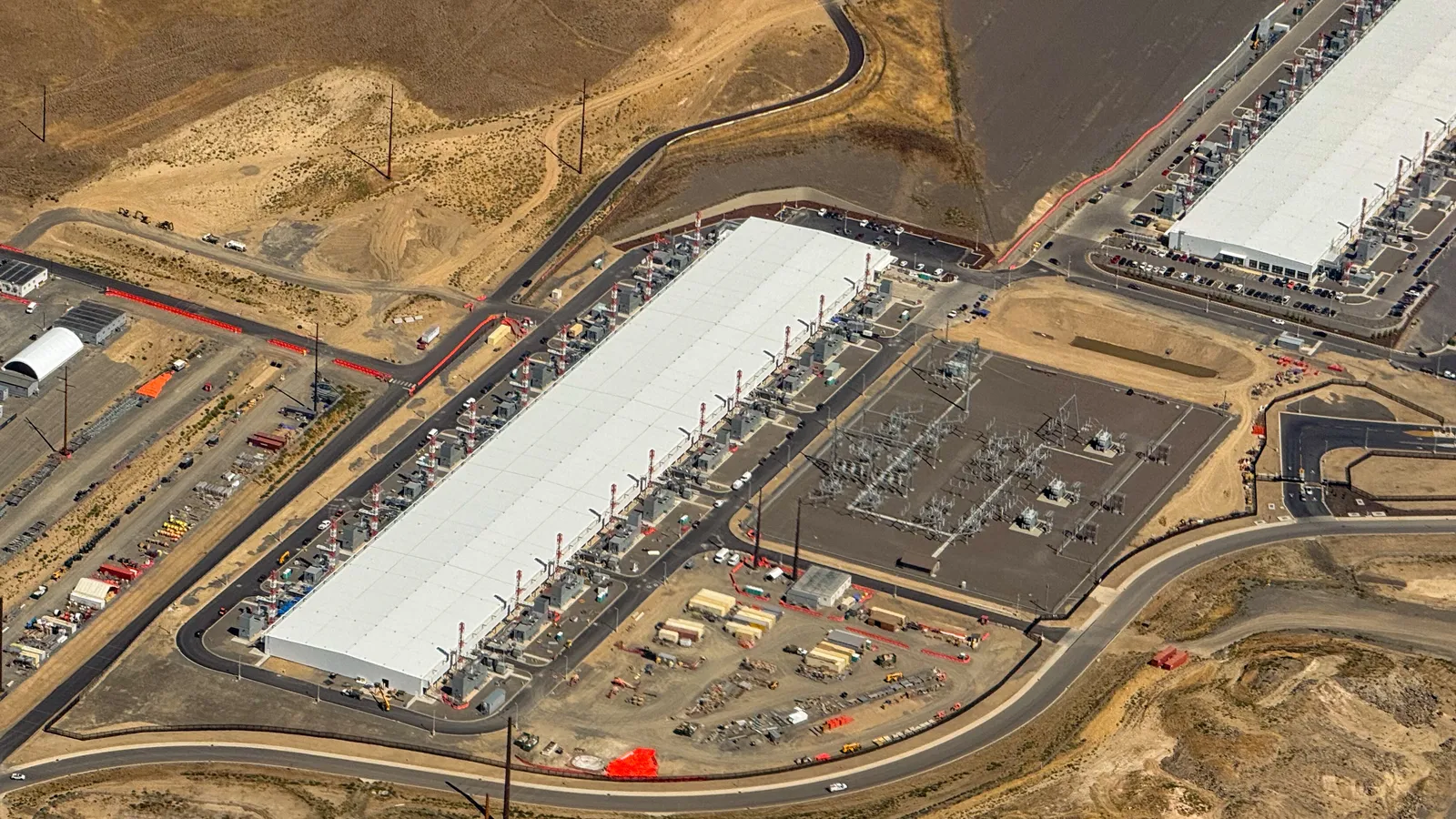
Three hyperscalers spent about $198 billion on property and equipment in the first six months of 2026: $80.6 billion at Alphabet, $66.7 billion at Microsoft, and $50.9 billion at Meta, all figures taken from their own quarterly releases. The interesting question is not how big that number is. It is where it goes, and who books it as revenue on the other side.
This piece traces the money through five layers of the stack, using only figures the companies have published in earnings releases and regulatory filings. It names no best buy, sets no price target, and takes no view on any share price.
Every figure below was checked against its primary source on August 13, 2026. Where a number exists only in earnings-call commentary rather than a published release, it has been left out and the omission noted.
Layer one: who is doing the spending
The four large US hyperscalers report capital expenditure differently, which matters if you are comparing them.
Alphabet reported purchases of property and equipment of $44,924 million in the second quarter of 2026 and $80,598 million for the six months to June 30. Meta reported $49,113 million of property and equipment purchases plus $1,805 million of principal payments on finance leases for the same half, giving $50,918 million on the basis Meta itself guides to. Microsoft runs a June fiscal year end, so its calendar first half is the sum of two fiscal quarters: $30.9 billion in the quarter to March 31 and $35.8 billion in the quarter to June 30, per its FY26 Q3 and FY26 Q4 releases.
Amazon is the awkward one. Its Q2 2026 release does not print a quarterly capital expenditure line in the highlights, but it does disclose that trailing-twelve-month purchases of property and equipment rose $66.1 billion year over year, and that AWS grew 37% to $42.2 billion, an annualised run rate of about $169 billion.
Only one of the four publishes a full-year capital expenditure range in the written release itself. Meta guides to “$130-145 billion, narrowed from our prior outlook of $125-145 billion.” The widely quoted full-year numbers for Microsoft, Alphabet and Amazon come from earnings calls rather than published releases, so this piece does not use them.
Layer two: the silicon that captures it
Nvidia’s data center segment is the single clearest place the capital lands. In the quarter ended April 26, 2026, Nvidia reported data center revenue of $75,246 million, up 92% year over year, against total revenue of $81,615 million. The CFO commentary filed with the SEC breaks that down by customer platform, which is the part most coverage skips.
| Period | Hyperscale | AI clouds, industrial and enterprise | Total |
|---|---|---|---|
| Q1 FY26 (a year earlier) | $17.6B | $21.5B | $39.1B |
| Q4 FY26 (prior quarter) | $33.8B | $28.5B | $62.3B |
| Q1 FY27 (ended Apr 26, 2026) | $37.9B | $37.4B | $75.2B |
Nvidia reports two customer platforms inside the data center segment, and they now sit almost exactly level. Hyperscale revenue grew 115% year over year to $37,869 million. The AI clouds, industrial and enterprise line grew 74% to $37,377 million. Together they make up the $75,246 million segment total. A third platform, edge computing, sits outside data center at $6,369 million and brings company-wide revenue to $81,615 million. Nvidia guided to $91.0 billion of total revenue for the following quarter, plus or minus 2%, excluding data center compute revenue from China.
A year earlier the split was the other way around: hyperscale was $17,599 million against $21,513 million for AI clouds and enterprise. The cloud majors buying for their own fleets have gone from the smaller half of Nvidia’s data center business to the larger one in four quarters.
That second line is the one worth watching, because it is where the neoclouds sit.
Layer three: the neoclouds, and their balance sheets
Neoclouds rent GPU capacity to model labs and enterprises. They are the most leveraged expression of the buildout, and their filings show why.
CoreWeave reported second-quarter revenue of $2,575 million, up 112% year over year, with adjusted EBITDA of $1,510 million at a 59% margin. It also reported a net loss of $626 million, capital expenditure of $14,117 million for the half, total recourse debt of $31,405 million and non-recourse debt of $3,663 million. Revenue backlog stood at about $104 billion at June 30, with more than $25 billion of net new commitments added in early Q3. Active power was 1.5 gigawatts against about 3.7 gigawatts contracted. We have covered how CoreWeave’s business actually works separately.
Hold those two numbers next to each other: roughly $35.1 billion of total debt against $1.5 billion of quarterly adjusted EBITDA, while the net loss widens.
Nebius reported second-quarter revenue of $582.3 million, up 454% year over year, adjusted EBITDA of $236.2 million, a net loss from continuing operations of $190.4 million, and six-month capital expenditure of $8.13 billion, up 671%.
TeraWulf shows the contract structure in its purest form. Its July 6, 2026 announcement describes a 20-year lease with Anthropic at its Hawesville, Kentucky campus covering about 401 megawatts of critical IT load and approximately $19 billion of contracted revenue over the initial term. Initial capacity is scheduled to come into service in the second half of 2027, reaching full load in early 2028. That is a large contracted number attached to revenue that does not begin for more than a year.
| Company | Ticker | Latest reported revenue | The number that defines it |
|---|---|---|---|
| CoreWeave | CRWV | $2,575M (Q2 2026, +112%) | ~$104B backlog against ~$35.1B total debt |
| Nebius | NBIS | $582.3M (Q2 2026, +454%) | $8.13B capex in six months, up 671% |
| TeraWulf | WULF | Not comparable | ~$19B, 401 MW Anthropic lease, in service from H2 2027 |
Layer four: the landlords
Data center REITs monetise the same demand with far less balance-sheet drama, and their disclosures are a useful independent read on whether leasing is real.
Equinix reported second-quarter revenue of $2.625 billion, up 16%, AFFO per share of $11.78, up 19%, gross bookings of $424 million annualised, up 23% and the second-highest on record, and a record 9,700 net interconnections added. The more telling disclosure is the raised long-term outlook: for 2027 to 2029 Equinix now guides to annual revenue growth of 10-13%, up from 7-10%, and total capital expenditure of $5.0-7.0 billion annually, up from $3.0-4.0 billion. A near-doubling of a multi-year capital plan is a stronger signal about expected demand than any single quarter of bookings.
Digital Realty reported second-quarter revenue of $1.9 billion, up 29% year over year, and core FFO per share of $2.65, or $2.13 excluding $188 million of net promote income. Bookings signed in the quarter are expected to generate $307 million of annualised GAAP base rent at 100% share. Its signed-but-not-commenced backlog reached a record $1.9 billion at 100% share, and renewal leases repriced upward by 25.4% on a cash basis and 32.0% on a GAAP basis. In July it signed two further hyperscale leases representing $410 million of annualised GAAP base rent at 100% share.
Renewal pricing up 25% is the clearest evidence in this whole chain that capacity is genuinely scarce rather than merely being announced.
Layer five: power and grid equipment
Electricity is the binding constraint on the whole stack, a point covered in more depth in our explainer on what an AI data center actually is.
GE Vernova reported second-quarter orders of $24.2 billion, up 88% organically, a backlog of $176 billion, and Electrification orders of $6.3 billion, up 66% organically, for a book-to-bill of about 1.7. Its Electrification equipment backlog reached $40.6 billion, up 69% year over year. Gas power equipment backlog plus slot reservation agreements grew from 100 to 116 gigawatts.
We are also seeing continued demand growth in Electrification, with data center orders reaching over $5 billion year-to-date, more than double our 2025 total.
That is one of the few places a manufacturer quantifies data center demand as a distinct order book rather than folding it into a general growth narrative.
On the demand side, the most authoritative recent estimate comes from Lawrence Berkeley National Laboratory. Its United States Data Center Energy Usage Report: 2025 Update (Smith et al., June 2026, LBNL-2001758) puts 2024 US data center electricity use at 192 TWh, or 4.7% of national consumption, and projects a 2030 reference case of 649 TWh, about 11.8% of forecast US electricity, within an uncertainty range of 521-843 TWh. It estimates data centers account for 33% of total US load growth between 2024 and 2030, implying roughly 148 gigawatts of interconnection capacity by 2030.
Note that this revised the 2024 figure downward from the previous edition, mainly because reported GPU shipments for 2023 and 2024 came in lower than assumed and inference power estimates were revised. Most articles still quote the superseded December 2024 report. Globally, the IEA’s Key Questions on Energy and AI puts data center consumption at 485 TWh in 2025, growing about 17% that year, and roughly 950 TWh by 2030.
The financing question underneath all of it
The layer map above describes where money goes. The more consequential 2026 development is where it now comes from.
Alphabet’s second quarter is the cleanest illustration. Operating cash flow was $39,069 million against capital expenditure of $44,924 million, producing negative free cash flow of $5,855 million, though trailing-twelve-month free cash flow remained positive at $53,273 million. In the same period Alphabet raised $49.6 billion net in Class A and C stock and mandatory convertible preferred, stating the proceeds were for general corporate purposes “including capital expenditures to scale AI infrastructure and global compute,” established a $40.0 billion at-the-market programme, and issued $20.3 billion net of senior unsecured notes. Amazon’s trailing-twelve-month free cash flow was negative $7.6 billion, against positive $18.2 billion a year earlier.
For most of the past decade this buildout was funded out of operating cash flow. In 2026 it is increasingly funded with external capital, which is a different risk profile. Our piece on how the buildout is financed covers the private-credit and SPV structures in detail.
The Bank for International Settlements looked at this directly in Financing the AI boom: from cash flows to debt (Aldasoro, Doerr and Rees, BIS Bulletin No 120, January 2026). It reports that private credit outstanding to AI-related sectors has risen from near zero to over $200 billion, that AI’s share of direct loan volumes went from under 1% to almost 8%, and that this could reach $300-600 billion by 2030. It also notes US IT-related investment has reached about 5% of GDP, exceeding the dot-com peak, though driven this time by IT-producing rather than IT-using firms.
Its central observation is the one worth sitting with: loan spreads on private credit to AI firms are close to those charged to non-AI borrowers, meaning lenders price these loans as ordinary risk, which sits oddly beside equity valuations implying outsized future returns. The BIS puts it as a schism in which either lenders are underestimating risk or equity markets are overestimating future cash flows.
Bottom line
The AI data center buildout is not one trade, it is five different businesses with different economics: a chip vendor with 92% year-over-year growth in its data center segment, leveraged capacity operators carrying debt many multiples of current EBITDA, REITs repricing renewals up 25%, grid equipment makers with multi-year backlogs, and the hyperscalers funding all of it while their own free cash flow turns negative.
Those are the reported figures as of August 13, 2026. What they are worth is a separate question, and not one this piece answers.
Frequently asked questions
- How much are hyperscalers spending on AI data centers in 2026?
- Alphabet reported $80.6 billion of property and equipment purchases in the six months to June 30, 2026, Microsoft reported $66.7 billion across the two fiscal quarters covering calendar H1 2026, and Meta reported $50.9 billion including finance lease principal. Meta is the only one of the large four to publish a full-year 2026 range in its written release, at $130-145 billion.
- How much of Nvidia data center revenue comes from hyperscalers?
- In the quarter ended April 26, 2026, Nvidia reported $37,869 million of hyperscale revenue out of $75,246 million of total data center revenue, so slightly over half. The AI clouds, industrial and enterprise platform made up the near-identical balance of $37,377 million. A separate edge computing platform of $6,369 million sits outside the data center segment.
- What is a neocloud?
- A neocloud is a company that builds and rents GPU compute capacity to AI labs and enterprises, rather than operating a full general-purpose cloud. CoreWeave, Nebius, IREN and Applied Digital are commonly grouped this way. In Nvidia reporting terms they fall largely within the AI clouds, industrial and enterprise category rather than hyperscale.
- Are AI data center companies profitable?
- It varies sharply by layer. Nvidia reported net income of $45,548 million in the quarter ended April 26, 2026. CoreWeave reported adjusted EBITDA of $1,510 million but a net loss of $626 million in Q2 2026, and Nebius reported a net loss from continuing operations of $190.4 million. The capacity operators are generally EBITDA positive and net-loss making because of depreciation and interest.
- How much electricity will AI data centers use by 2030?
- Lawrence Berkeley National Laboratory projects a 2030 reference case of 649 TWh for US data centers, about 11.8% of forecast US electricity, within a range of 521 to 843 TWh (June 2026). The IEA projects global data center consumption of roughly 950 TWh by 2030, about 3% of global electricity, up from 485 TWh in 2025.
- Is AI data center capex funded by debt?
- Increasingly, yes. The BIS reported in January 2026 that private credit outstanding to AI-related sectors rose from near zero to over $200 billion and could reach $300-600 billion by 2030. Alphabet raised $49.6 billion net in equity in June 2026 partly for AI infrastructure, and posted negative free cash flow of $5.86 billion in Q2 2026.
Sources
Alphabet (2026). Alphabet Announces Second Quarter 2026 Results [capex of $44,924M in Q2 and $80,598M for the half, operating cash flow $39,069M, negative free cash flow $5,855M, $49.6B net equity raise, $40.0B ATM programme, $20.3B senior unsecured notes, Google Cloud revenue $24,768M]. Verified August 13, 2026.
Microsoft (2026). Microsoft FY26 Q3 Earnings Release [additions to property and equipment of $30.9B in the quarter and $80.1B for the nine months to March 31, 2026]. Verified August 13, 2026.
Microsoft (2026). Microsoft FY26 Q4 Earnings Release [additions to property and equipment of $35.8B in the quarter to June 30, 2026]. Verified August 13, 2026.
Meta Platforms (2026). Meta Reports Second Quarter 2026 Results [Q2 capex including finance lease principal $31.08B, H1 property and equipment $49,113M plus $1,805M finance lease principal, full-year 2026 guidance of $130-145B]. Verified August 13, 2026.
Amazon (2026). Amazon.com Announces Second Quarter Results [AWS revenue $42.2B up 37%, trailing-twelve-month free cash flow negative $7.6B, trailing-twelve-month purchases of property and equipment up $66.1B]. Verified August 13, 2026.
NVIDIA (2026). Q1 FY2027 CFO Commentary [data center revenue $75,246M, hyperscale $37,869M, AI clouds/industrial/enterprise $37,377M, edge computing $6,369M, prior-period comparatives, net income $45,548M]. Filed with the SEC. Verified August 13, 2026.
CoreWeave (2026). CoreWeave Reports Strong Second Quarter 2026 Results [revenue $2,575M, adjusted EBITDA $1,510M, net loss $626M, backlog ~$104B, recourse debt $31,405M, non-recourse debt $3,663M, H1 capex $14,117M, 1.5 GW active power]. Verified August 13, 2026.
Nebius Group (2026). Nebius Reports Second Quarter 2026 Financial Results [revenue $582.3M up 454%, adjusted EBITDA $236.2M, net loss from continuing operations $190.4M, six-month capex $8.13B]. Verified August 13, 2026.
TeraWulf (2026). TeraWulf Announces Anthropic Lease at Justified Data Campus [20-year Anthropic lease, ~401 MW critical IT load, ~$19B contracted revenue, in service H2 2027 to early 2028]. Verified August 13, 2026.
Equinix (2026). Equinix Reports Second Quarter Results [revenue $2.625B up 16%, AFFO per share $11.78, gross bookings $424M annualised, 9,700 net interconnections, 2027-2029 capex outlook raised to $5.0-7.0B annually]. Verified August 13, 2026.
Digital Realty (2026). Digital Realty Reports Second Quarter 2026 Results [revenue $1.9B up 29%, core FFO per share $2.65 and $2.13 excluding promote, bookings $307M annualised GAAP base rent, record backlog $1.9B, renewals up 25.4% cash and 32.0% GAAP, July hyperscale leases $410M]. Verified August 13, 2026.
GE Vernova (2026). GE Vernova Reports Second Quarter 2026 Financial Results [orders $24.2B up 88% organically, backlog $176B, Electrification orders $6.3B, equipment backlog $40.6B, gas backlog plus slot reservations 100 to 116 GW, CEO quote on data center orders exceeding $5B year-to-date]. Verified August 13, 2026.
Smith, S.J., Hubbard, A., Newkirk, A., Ganeshalingam, M., Holecek, B., Sartor, D., Mills, M., Shehabi, A. (2026). United States Data Center Energy Usage Report: 2025 Update [2024 US data center electricity 192 TWh at 4.7% of national consumption, 2030 reference case 649 TWh at 11.8%, range 521-843 TWh, 33% of US load growth, ~148 GW interconnection by 2030]. Lawrence Berkeley National Laboratory, LBNL-2001758, DOI 10.71468/P1RP4F. Verified August 13, 2026.
International Energy Agency (2026). Key Questions on Energy and AI [global data centre electricity 485 TWh in 2025 growing 17%, roughly 950 TWh by 2030 at about 3% of global electricity]. Verified August 13, 2026.
Aldasoro, I., Doerr, S. and Rees, D. (2026). Financing the AI boom: from cash flows to debt [private credit to AI-related sectors above $200B rising from near zero, AI share of direct loan volumes under 1% to almost 8%, $300-600B projection by 2030, US IT investment about 5% of GDP exceeding the dot-com peak, the spread versus equity valuation schism]. BIS Bulletin No 120, Bank for International Settlements. Verified August 13, 2026.
Capital & Compute. What Is an AI Data Center? Cost, Power, and Scale [power density and cost per megawatt for the physical build].
Capital & Compute. AI Data Center Financing 2026: Inside the $700B Buildout [the SPV and private-credit structures behind the buildout].
Capital & Compute. What Does CoreWeave Do? AI Cloud Business Explained [how the neocloud business model works].