Artificial Analysis Index v5: Which Models Dropped
Artificial Analysis Index v5 lowered 21 of 25 models. Kimi K3.1 Pro fell 9 points and GLM-5.3 fell 13, while GPT-6 Astra and GPT-6.1 Sol gained.
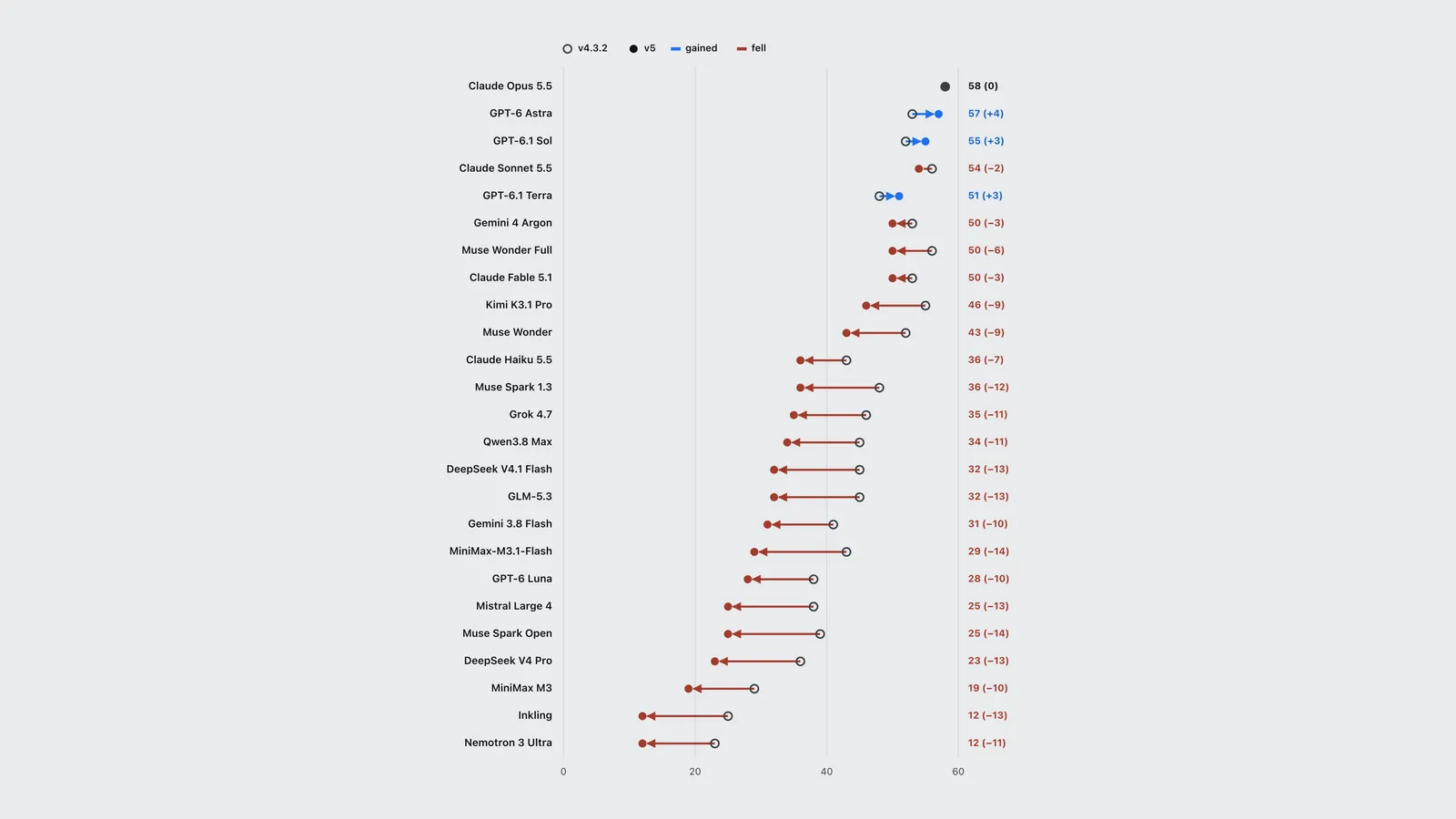
Artificial Analysis Intelligence Index v5, released October 27, 2026, lowered 21 of the 25 models scored on both versions. Kimi K3.1 Pro fell from 55 to 46 and GLM-5.3 from 45 to 32. Only OpenAI’s GPT-6 Astra, GPT-6.1 Sol and GPT-6.1 Terra gained, and Claude Opus 5.5 held 58.
That is the whole story in one line: v5 is a frontier-separating rebuild. The median model lost 10 points. The frontier models from Anthropic, OpenAI and Google moved 4 points or less, and almost everything below them, open-weight and Chinese models in particular, fell by 9 to 14.
| Model | Lab | v4.3.2 | v5 | Change |
|---|---|---|---|---|
| Claude Opus 5.5 | Anthropic | 58 | 58 | 0 |
| GPT-6 Astra | OpenAI | 53 | 57 | +4 |
| GPT-6.1 Sol | OpenAI | 52 | 55 | +3 |
| Claude Sonnet 5.5 | Anthropic | 56 | 54 | −2 |
| GPT-6.1 Terra | OpenAI | 48 | 51 | +3 |
| Gemini 4 Argon | 53 | 50 | −3 | |
| Muse Wonder Full | Meta | 56 | 50 | −6 |
| Claude Fable 5.1 | Anthropic | 53 | 50 | −3 |
| Kimi K3.1 Pro | Moonshot | 55 | 46 | −9 |
| Muse Wonder | Meta | 52 | 43 | −9 |
| Claude Haiku 5.5 | Anthropic | 43 | 36 | −7 |
| Muse Spark 1.3 | Meta | 48 | 36 | −12 |
| Grok 4.7 | xAI | 46 | 35 | −11 |
| Qwen3.8 Max | Alibaba | 45 | 34 | −11 |
| DeepSeek V4.1 Flash | DeepSeek | 45 | 32 | −13 |
| GLM-5.3 | Zhipu | 45 | 32 | −13 |
| Gemini 3.8 Flash | 41 | 31 | −10 | |
| MiniMax-M3.1-Flash | MiniMax | 43 | 29 | −14 |
| GPT-6 Luna | OpenAI | 38 | 28 | −10 |
| Mistral Large 4 | Mistral | 38 | 25 | −13 |
| Muse Spark Open | Meta | 39 | 25 | −14 |
| DeepSeek V4 Pro | DeepSeek | 36 | 23 | −13 |
| MiniMax M3 | MiniMax | 29 | 19 | −10 |
| Inkling | Thinking Machines | 25 | 12 | −13 |
| Nemotron 3 Ultra | Nvidia | 23 | 12 | −11 |
Each model is at its highest-scoring reasoning-effort setting on each version (max for most). Two changed setting: Claude Fable 5.1 now scores best at xhigh (50, against 49 at max), and Grok 4.7 at high (35, against 34 at xhigh). The v4.3.2 column is this site’s own record, read from Artificial Analysis between September 25 and October 27, 2026. The v5 column was read twice from the Artificial Analysis models leaderboard on October 28 with matching values; Muse Spark 1.3 comes from its model page, since Artificial Analysis now marks it deprecated.
Which models dropped the most in v5?
The biggest falls were 14 points: MiniMax-M3.1-Flash (43 to 29) and Meta’s open-weight Muse Spark Open (39 to 25). Right behind them, at 13, sit both DeepSeek models, GLM-5.3, Mistral Large 4 and Thinking Machines’ Inkling.
Look at who those are. Every one is an open-weight model, a small model, or both. The drop is not random noise around a mean. It is a sorting.
| Model | v4.3.2 | v5 | Change |
|---|---|---|---|
| Claude Opus 5.5 | 58 | 58 | 0 |
| GPT-6 Astra | 53 | 57 | +4 |
| GPT-6.1 Sol | 52 | 55 | +3 |
| Claude Sonnet 5.5 | 56 | 54 | −2 |
| GPT-6.1 Terra | 48 | 51 | +3 |
| Gemini 4 Argon | 53 | 50 | −3 |
| Muse Wonder Full | 56 | 50 | −6 |
| Claude Fable 5.1 | 53 | 50 | −3 |
| Kimi K3.1 Pro | 55 | 46 | −9 |
| Muse Wonder | 52 | 43 | −9 |
| Claude Haiku 5.5 | 43 | 36 | −7 |
| Muse Spark 1.3 | 48 | 36 | −12 |
| Grok 4.7 | 46 | 35 | −11 |
| Qwen3.8 Max | 45 | 34 | −11 |
| DeepSeek V4.1 Flash | 45 | 32 | −13 |
| GLM-5.3 | 45 | 32 | −13 |
| Gemini 3.8 Flash | 41 | 31 | −10 |
| MiniMax-M3.1-Flash | 43 | 29 | −14 |
| GPT-6 Luna | 38 | 28 | −10 |
| Mistral Large 4 | 38 | 25 | −13 |
| Muse Spark Open | 39 | 25 | −14 |
| DeepSeek V4 Pro | 36 | 23 | −13 |
| MiniMax M3 | 29 | 19 | −10 |
| Inkling | 25 | 12 | −13 |
| Nemotron 3 Ultra | 23 | 12 | −11 |
The most consequential single move is Kimi K3.1 Pro. On v4.3.2 it was 55, three points off the top and the best open-weight model by a distance. On v5 it is 46, and it is still the best open-weight model, which tells you how far the rest fell. The Kimi K3.1 Pro launch analysis set it against Claude Sonnet 5.5, which shares its $2 and $10 rate card, at 55 against 56. On v5 the same pair is 46 against 54, and the comparison reads very differently.
Meta’s Muse family took a broad hit too. Muse Wonder Full fell 6 and the API-priced Muse Wonder fell 9, from 52 to 43, which drops it from level with GPT-6.1 Sol to eight points behind GPT-6.1 Terra at four times Terra’s price per token.
Which models gained?
Three, all from OpenAI’s GPT-6 generation: GPT-6 Astra (+4), GPT-6.1 Sol (+3) and GPT-6.1 Terra (+3). OpenAI’s cheap tier did not come along. GPT-6 Luna fell 10, the same as the median.
Anthropic held rather than gained. Claude Opus 5.5 kept 58 and the lead, Sonnet 5.5 lost 2 and Fable 5.1 lost 3. On v4.3.2 Anthropic and Meta held three of the top four places. On v5 the top five are Anthropic and OpenAI only, which Artificial Analysis states in its v5 announcement.
What changed in Artificial Analysis Intelligence Index v5?
Artificial Analysis rebuilt the composite around nine evaluations in four categories weighted 25% each, and about 60% of the weight now runs on private test sets or held-out answers, up from 45% in v4.3. The firm calls it the largest update since v4 in January.
| Category (25% each) | v5 evaluations | What left |
|---|---|---|
| Knowledge Work | AA-Briefcase 15%, AutomationBench-AA 5%, GDP.pdf 5% | GDPval-AA v2.1 |
| Coding | FrontierCode 2.0 15% (new), Terminal-Bench 4.0 10% | SciCode |
| Science | Terminal-Bench-Science 15% (new), CritPt v2 hard subset 10% | Humanity’s Last Exam (now HLE-Diamond) |
| General | AA-Omniscience v1.1 15%, HLE-Diamond 10% | AA-LCR v1.1 |
Under v4.3 the split was Agents 30%, General 30%, Coding 20% and Scientific Reasoning 20%. So coding and science each gained five points of weight, and both of the new heavyweights are agentic, long-horizon and private:
- FrontierCode 2.0 is Cognition’s private coding set of 132 tasks, graded on whether a maintainer would merge the change rather than on whether tests pass. Claude Opus 5.5 leads it at 46%. The original is in the benchmarks directory.
- Terminal-Bench-Science is 70 agentic research tasks run in a terminal. GPT-6 Astra leads at 63%. It sits beside Terminal-Bench 4.0, which stays at 10%.
- HLE-Diamond replaces the full Humanity’s Last Exam with 1,000 questions split evenly between reasoning and knowledge.
- AA-Omniscience v1.1 drops saturated and public questions. Artificial Analysis says scores average 2 points lower than on v1.
Why did open-weight models fall so far?
Because v5 moved weight onto exactly the work where they trail most. Artificial Analysis puts the gap between the best open-weight model and the leader at 12 points on v5, against 3 on v4.3. Its two largest per-evaluation gaps are HLE-Diamond (Kimi K3.1 Pro 37% against Opus 5.5’s 68%) and Terminal-Bench-Science (34% against GPT-6 Astra’s 63%), and Terminal-Bench-Science is a new 15% component.
There is a second mechanism, and it matters more than it looks. Private test sets remove whatever advantage a model gained from public questions leaking into training data. Artificial Analysis raised the private share from 45% to 60% in one release, so a larger part of the score now comes from questions no model could have seen. That does not show any lab trained on test data, and the scores alone cannot separate that effect from plain difficulty. It does mean v5 is harder to prepare for.
Some of it is just difficulty. Long agentic tasks punish small models twice: they fail more individual steps, and an early failure on a long task can sink every step after it. That is why OpenAI’s GPT-6 Luna and Anthropic’s Claude Haiku 5.5, closed models from the gaining labs, still fell 10 and 7.
What does a point of intelligence cost on v5?
More than it did, because v5 tasks are longer. Artificial Analysis reports the median model’s output per index task rose from 35,000 tokens on v4.3 to 59,000 on v5. Agentic evaluations are 55% of the weight but about 90% of the output tokens, and Terminal-Bench-Science alone is about a third.
| Model (max effort) | v5 score | Cost per index task, v5 | Cost per index task, v4.3.2 |
|---|---|---|---|
| Claude Fable 5.1 | 49 | $13.04 | |
| Claude Opus 5.5 | 58 | $10.04 | |
| GPT-6 Astra | 57 | $6.24 | |
| GPT-6.1 Sol | 55 | $1.27 | $0.72 |
| GPT-6.1 Terra | 51 | $0.96 | $0.40 |
The v5 costs are from the Artificial Analysis v5 announcement. The v4.3.2 costs for Sol and Terra were read from their model pages on October 27, 2026, the day before the switch, for the GPT-6.1 Terra cost-per-task analysis. Blank cells are figures this site did not record on v4.3.2.
Same models, same prices per token, and a task on Terra now costs 2.4 times what it did a day earlier. The point for anyone budgeting from benchmark costs: a cost-per-task figure is a property of the index version too, not just the model.
Within v5, the spread is the useful number. GPT-6.1 Sol lands 3 points under Opus 5.5 at about one-eighth of the cost per task ($1.27 against $10.04). Fable 5.1 at max costs more than Opus 5.5 and scores 9 points less. The homepage price-against-intelligence chart now plots v5 scores, and the free AI models ranking has moved to v5 as well.
Does reasoning effort matter more on v5?
Yes, much more. Opus 5.5 scores 35 at low effort (about $0.98 a task) and 58 at max. Artificial Analysis measures Claude Sonnet 5.5’s spread from low to max at 29 points, up from 20 on v4.3, and GPT-6.1 Sol’s at 20, double the 10 it was.
So “Sonnet 5.5 scores 54” is now an incomplete sentence. At medium effort it scores 30 on the same leaderboard. Anyone quoting a v5 number without the effort setting is quoting a range of 25 to 54 as if it were one point.
Can you compare v4.3 and v5 scores?
No. A v5 score and a v4.3 score measure different task sets with different weights, so a model that “fell 9 points” did not get worse. It was measured on a harder test. Compare models only within one version, and treat every v4.x figure in older coverage, including this site’s launch posts, as a v4.x figure.
This is the fourth version in under five months: v4.1 in June, v4.2 on September 4, v4.3 on September 7 and v5 on October 27. The Artificial Analysis Intelligence Index explainer tracks each change. If you need a score that stays still for a year, a composite rebuilt this often is the wrong tool. Pick the component that matches your workload, or compare it with the Vals Index, which weights by economic sector and ranks the same models differently.
What should you do with the new numbers?
- Re-read, don’t adjust. There is no conversion factor from v4.3 to v5; the falls range from 0 to 14 points. Pull fresh v5 numbers for every model you compare.
- Record the effort setting next to every score. On v5 it moves a model by up to 29 points.
- Re-check open-weight shortlists. If you picked an open model because it was within 3 points of the frontier, it is now about 12 behind on this index. Test it on your own tasks before trusting either number.
- Re-price agent budgets. For the two models with both figures on record, v5 cost per task is 1.8 and 2.4 times the v4.3 figure, because the tasks are longer. That reflects the benchmark, not your bill, but it is a better proxy for long agent runs than v4.3 was.
Frequently asked questions
- Which models dropped in Artificial Analysis Intelligence Index v5?
- Of 25 models scored on both v4.3.2 and v5, 21 fell. The biggest drops were MiniMax-M3.1-Flash and Muse Spark Open at 14 points each, then DeepSeek V4.1 Flash, DeepSeek V4 Pro, GLM-5.3, Mistral Large 4 and Inkling at 13. Kimi K3.1 Pro fell from 55 to 46. The median change was minus 10.
- Which models gained in Artificial Analysis Intelligence Index v5?
- Only three: GPT-6 Astra rose from 53 to 57, GPT-6.1 Sol from 52 to 55 and GPT-6.1 Terra from 48 to 51. Claude Opus 5.5 held 58 and still leads.
- Who leads Artificial Analysis Intelligence Index v5?
- Claude Opus 5.5 at max effort leads with 58, followed by GPT-6 Astra at 57, GPT-6.1 Sol at 55 and Claude Sonnet 5.5 at 54. The top open-weight model is Kimi K3.1 Pro at 46, though its weights are not yet released.
- Why did Kimi K3.1 Pro drop on Artificial Analysis?
- v5 added Terminal-Bench-Science and HLE-Diamond, the two evaluations where Artificial Analysis found the biggest open-weight gaps, and raised the private-test share to about 60%. Kimi K3.1 Pro scores 37% on HLE-Diamond against 68% for Claude Opus 5.5, so its index fell from 55 to 46.
Sources
Artificial Analysis (2026). Announcing Artificial Analysis Intelligence Index v5. Launch article, October 27, 2026: nine evaluations, four categories at 25%, about 60% private; per-evaluation leaders; open-weights gap 3 to 12 points; cost per index task; effort spreads; median output tokens 35k to 59k. https://artificialanalysis.ai/articles/artificial-analysis-intelligence-index-v5 Verified 2026-10-28.
Artificial Analysis (2026). Announcing the Artificial Analysis Intelligence Index v4.3. September 7, 2026: category weights Agents 30%, General 30%, Coding 20%, Scientific Reasoning 20%; 45% private. https://artificialanalysis.ai/articles/artificial-analysis-intelligence-index-v4-3 Verified 2026-10-28.
Artificial Analysis (2026). Models leaderboard. Intelligence Index v5 per model and per reasoning-effort setting, read twice on October 28, 2026 with matching values. https://artificialanalysis.ai/leaderboards/models Verified 2026-10-28.
Artificial Analysis (2026). Muse Spark 1.3 model page. Intelligence Index v5 of 36 at max effort; marked deprecated. https://artificialanalysis.ai/models/muse-spark-1-3 Verified 2026-10-28.
Capital & Compute (2026). Artificial Analysis Intelligence Index snapshot, v4.3.2. This site’s record of Artificial Analysis scores, read September 25 to October 27, 2026, the before-side of the table above.