LLM Evaluation Metrics: Accuracy, Cost, and CI in 2026
A practitioner guide to LLM evaluation metrics: reference-based scores, LLM-as-judge, and human review, ranked by accuracy and cost per 10,000 responses.
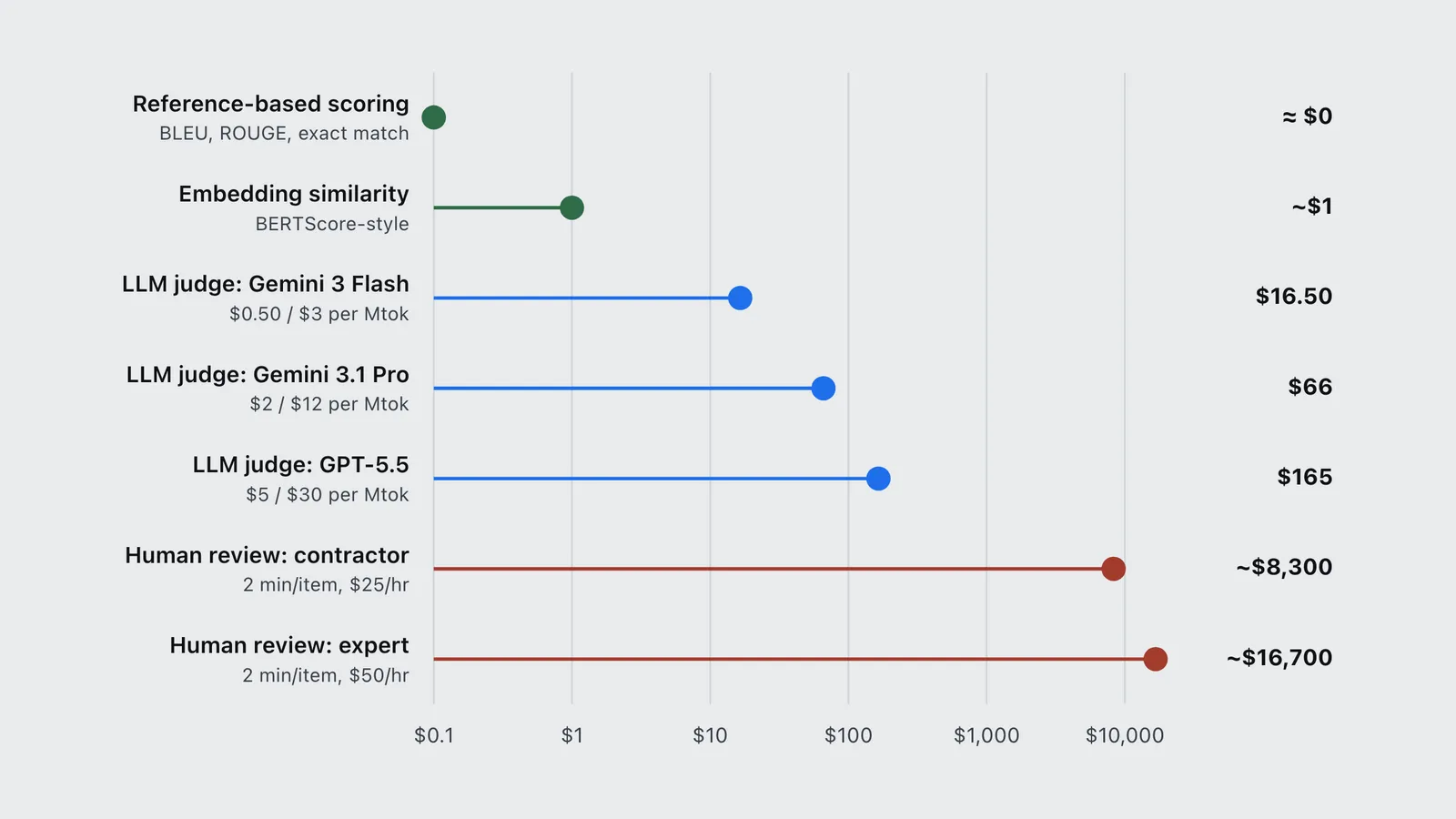
Grading 10,000 AI responses can cost you 17 dollars or 17,000. Same batch, same question asked of every output (is this actually good?), and a thousand-fold spread in the bill. The gap is not a rounding error. It is the evaluation metric you picked.
Most guides to LLM evaluation metrics will hand you a taxonomy: reference-based here, reference-free there, a paragraph each on BLEU and faithfulness, a nod to LLM-as-judge. Useful, and none of them tell you the part that decides whether your eval survives contact with a real budget. Every metric buys a different mix of accuracy and cost, and the expensive ones are expensive for a reason you can measure.
What LLM evaluation metrics actually are
An LLM evaluation metric is a rule that turns a model output into a score you can track, so you can tell whether a change to your prompt, model, or retrieval made things better or worse. The rule can be a string comparison, a small classifier, another language model acting as a judge, or a human with a rubric. What it measures depends entirely on what you ask it to check: factual correctness, relevance, tone, safety, format, or whether the code even runs.
There are two very different jobs hiding under the same words, and conflating them is the most common mistake I see.
The first is benchmark evaluation: scoring a model against a fixed public test like MMLU or SWE-bench to rank it on a leaderboard. That is what most people picture when they hear “LLM evaluation,” and it is a genuinely hard thing to trust, because public scores get gamed, saturated, and contaminated. We cover that in depth in are AI benchmarks reliable and the AI benchmarks reference; this piece assumes you already suspect the leaderboard.
The second is application evaluation: scoring your own system on your own traffic. Does this support bot answer the actual question? Does this RAG pipeline cite the retrieved document or make something up? This is the eval that keeps your product from embarrassing you, and it is the one with a running cost, because you rerun it on every change.
The rest of this guide is about the second job.
The metrics, grouped by how they score
Forget the long alphabetical lists. Every metric belongs to one of three families, and the family tells you the cost and the failure mode before you read a single formula.
Reference-based scoring: cheap, and only as good as your answer key
These compare an output to a known-correct answer. Exact match and F1 are the blunt instruments: did the output equal the reference, token for token? They work for closed tasks (classification, extraction, a math answer) and punish anything with more than one valid phrasing.
Then the overlap metrics. BLEU, introduced by Papineni and colleagues at IBM in a 2002 ACL paper for machine translation, scores n-gram overlap between output and reference. ROUGE, from Chin-Yew Lin in 2004, does the same for summarization with a recall bias. Both are fast, deterministic, and free to compute. Both also reward surface overlap, not meaning: a fluent, correct paraphrase that shares few words with the reference scores badly, and a garbled sentence that happens to reuse the right nouns scores well.
Embedding-based metrics soften that. BERTScore (Zhang et al., ICLR 2020) compares outputs and references in embedding space, so a paraphrase counts as close. You pay a little for the embedding calls, but it is still cents on a 10,000-response batch.
The catch with the whole family is the answer key. Reference-based scoring needs ground-truth outputs, and building those is human labor you pay once up front. No golden answers, no reference-based score.
Task-based scoring: let the world grade it
For code and other verifiable tasks, skip the judgment call and run the thing. Unit-test pass rate is exactly what it sounds like. pass@k, the metric from OpenAI’s 2021 Codex paper (Chen et al.), measures the share of problems solved when you let the model draw k samples and count a problem solved if any sample passes the tests. It is the honest way to score a coding agent, and it generalizes to anything with a checkable outcome: valid JSON, a SQL query that returns the right rows, a tool call with the right arguments. When you can verify mechanically, do. It is cheap and it does not lie. Our AI agent benchmarks breakdown digs into how pass rates translate (and mistranslate) into real agent capability.
LLM-as-judge: flexible, biased, metered by the token
When there is no reference and no test suite, the 2026 default is to have another model grade the output against a rubric. This is the workhorse for open-ended quality: helpfulness, tone, faithfulness, relevance. It handles nuance that code cannot, and the research backs it up. In Judging LLM-as-a-Judge (Zheng et al., NeurIPS 2023), a strong judge like GPT-4 matched human preferences more than 80% of the time, which is about how often two humans agree with each other.
The same paper is why you should not trust it blindly. LLM judges show position bias (they favor whichever answer is shown first), verbosity bias (they reward longer answers), and self-enhancement bias (they prefer outputs from their own model family). Structured variants try to tame this. G-Eval (Liu et al., EMNLP 2023) uses chain-of-thought and form-filling to lift correlation with human ratings. For retrieval systems, RAGAS (Es et al., 2023) scores faithfulness (does the answer stick to the retrieved context?), answer relevancy, and context precision and recall without needing a reference answer at all.
The cost lands here. Every judgment is an API call: the judge reads your rubric, the user input, and the candidate answer, then writes a score with reasoning. That is real tokens, every run, forever.
That bill is what makes the judge-model category worth revisiting in 2026. A decision model returns a typed score with a calibrated probability and writes no reasoning at all, which removes the output meter entirely: outside testers measured a decision model that judges at $0.043 per 1,000 calls. The catch is that it cannot explain itself, and whatever it declines to answer still has to go to a full model.
Human review: the gold standard you cannot afford to run on everything
Humans with a rubric are the ground truth every automated metric is trying to approximate. They are also slow and expensive, which is the entire reason the other two families exist. Human review is what you use to validate your automated judge on a small sample, not what you run on all of production.
Here is the decision on one screen:
| Metric family | What it measures | Needs ground truth? | Matches human judgment | Cost to run | Fails when |
|---|---|---|---|---|---|
| Exact match / F1 | Literal correctness | Yes | High on closed tasks | Free | Any valid paraphrase |
| Decision model | Closed-set judgments | No | 96 to 98% in outside tests | ~$0.04 per 1,000 | Anything needing an explanation, plus the abstain tail |
| BLEU / ROUGE | N-gram overlap | Yes | Weak on meaning | Free | Correct answers, worded differently |
| BERTScore | Semantic similarity | Yes | Moderate | ~cents | Subtle factual errors that read fluently |
| pass@k / unit tests | Verifiable success | No (tests instead) | Exact, where checkable | Cheap | Task has no mechanical check |
| LLM-as-judge | Open-ended quality | No | >80% (with bias) | $$ per run | Position, verbosity, self-preference bias |
| Human review | Anything | No | Definitional | $$$$ | Scale, speed, budget |
What running LLM evaluations actually costs
This is the number the vendor guides leave out. Not one of the top-ranking LLM evaluation guides I read puts a dollar figure on their own methods, which is strange, because it is the figure that decides your eval strategy.
So here is the model. Take one job: score 10,000 candidate responses on a single quality criterion. Assume an LLM judge reads about 1,500 input tokens (your rubric, the user input, the candidate answer) and writes about 300 tokens of reasoned score per judgment. Price it against verified 2026 per-token API rates from our model registry. For human review, assume two minutes per item, which is fast for a careful rubric judgment, at contractor and domain-expert rates.
| Evaluation method | Modeled cost per 10,000 responses |
|---|---|
| Reference-based scoring (BLEU, ROUGE, exact match) | ≈ $0 |
| Embedding similarity (BERTScore-style) | ~$1 |
| LLM judge: Gemini 3 Flash ($0.50 / $3 per Mtok) | $16.50 |
| LLM judge: Gemini 3.1 Pro ($2 / $12 per Mtok) | $66 |
| LLM judge: GPT-5.5 ($5 / $30 per Mtok) | $165 |
| Human review: contractor (2 min/item, $25/hr) | ~$8,300 |
| Human review: expert (2 min/item, $50/hr) | ~$16,700 |
The shape is the point. Reference-based scoring is a rounding error. An LLM judge on a cheap frontier-lab model runs about $16.50 for the batch; on a top-tier judge it is $165. Human review of the same 10,000 items runs into the thousands: roughly $8,300 at a $25 hourly rate, and it climbs from there. The cheapest LLM judge is about 500 times cheaper than the human panel.
Two consequences fall out of that curve. First, you do not run human review on production traffic; you run it on a small sample to check that your LLM judge agrees with people. Second, you do not run an LLM judge on all of live traffic either. Sample it. At a 5% sample of those 10,000 responses with a cheap judge, the online eval costs under a dollar. This is the same economic logic that drives model choice itself, where the cheaper model often wins on cost-per-task once you price the whole job.
Evaluation in CI: the golden set and regression testing
An eval you run once is a research project. An eval you run on every change is a test suite, and that is where the value is.
Start with a golden set: 10 to 50 inputs paired with expected behavior. Not 10,000. A small, well-chosen set that covers your common requests, your known edge cases, your policy boundaries, and the specific failures that have burned you in the past. Wire it into CI so every prompt tweak and model swap runs against it automatically. That alone catches most regressions before a user ever sees them, and it costs cents per run because the set is small.
Then split offline from online. Offline evaluation runs your golden set against a curated dataset, deterministic and cheap, the gate on your pull requests. Online evaluation samples live production traffic, because the real world always finds inputs your golden set did not, and a narrow test set produces scores that look great and do not generalize. The 2026 practice is to run both, and to keep the trace: link every score back to the exact prompt, model version, and input that produced it, so a regression tells you what changed.
The tools: what each one is for
You do not need to build the plumbing. The current crop of evaluation tools all support LLM-as-judge workflows and CI integration; they differ mostly in whether you want an open-source library or a hosted platform with dashboards.
- OpenAI Evals is the open-source registry-based framework for writing and running evals, model-agnostic despite the name.
- promptfoo is a developer-first CLI and config-file approach, good for red-teaming and side-by-side prompt comparison in CI.
- DeepEval is an open-source, pytest-style framework with a large built-in metric set (G-Eval, RAG metrics, hallucination).
- RAGAS is the focused choice for retrieval systems, with faithfulness and context metrics out of the box.
- LangSmith and Braintrust are hosted platforms built around tracing, datasets, and eval dashboards for teams.
- Evidently is open-source with a large metric library spanning both classic ML and LLM outputs.
Pick by your bottleneck. If you live in CI and version control, a library like promptfoo or DeepEval keeps evals next to your code. If you need non-engineers reviewing traces and curating datasets, a hosted platform earns its subscription. The metrics underneath are the same ones above; the tool is packaging.
Frequently asked questions
- What are LLM evaluation metrics?
- They are rules that score a language model output against criteria you define, such as correctness, relevance, faithfulness, or safety. The three main families are reference-based scoring (compare to a known answer), LLM-as-judge (another model grades against a rubric), and human review. The choice sets both how well your score matches human judgment and what each evaluation run costs.
- Is LLM-as-a-judge reliable?
- Reliable enough to be the 2026 default for open-ended quality, with caveats. A strong judge model matches human preferences more than 80% of the time, about the rate two humans agree. But LLM judges show position bias, verbosity bias, and a preference for their own model family, so validate the judge against a small human-reviewed sample before trusting it at scale.
- How much does it cost to evaluate an LLM?
- Modeled on verified 2026 API prices, scoring 10,000 responses costs about $16 to $165 with an LLM judge, near zero for reference-based metrics like BLEU or exact match, and roughly $8,300 with a human contractor panel. Automated scoring is orders of magnitude cheaper, which is why production teams sample rather than review everything.
- Which metrics should I use for a RAG system?
- Use retrieval-aware metrics: faithfulness (does the answer stay grounded in retrieved context?), answer relevancy, and context precision and recall. Frameworks like RAGAS compute these without a reference answer. Pair them with a small human-reviewed sample to confirm the automated scores track real quality.
- How big should my evaluation dataset be?
- Start small: a golden set of 10 to 50 inputs with expected behavior, chosen to cover common requests, edge cases, policy boundaries, and past failures. Wire it into CI to catch regressions on every change, then grow it with real production failures over time. Dataset quality matters more than size.
Bottom line
LLM evaluation metrics are usually taught as a vocabulary quiz. Treat them instead as a budget. Reference-based scoring is nearly free and only works when you have an answer key. LLM-as-judge is flexible and cheap enough to run often, as long as you know its biases and validate it against people. Human review is the truth and the thing you can least afford to run at scale, so you run it on samples. Build a small golden set, put it in CI, sample production, and keep the trace from every score back to what produced it. Do that and your evaluation tells you something true without quietly costing more than the model it is grading.
Sources
- Papineni, K., Roukos, S., Ward, T., & Zhu, W. (2002). BLEU: a Method for Automatic Evaluation of Machine Translation. ACL 2002. https://aclanthology.org/P02-1040/
- Lin, C. (2004). ROUGE: A Package for Automatic Evaluation of Summaries. Text Summarization Branches Out, ACL 2004. https://aclanthology.org/W04-1013/
- Zhang, T., Kishore, V., Wu, F., Weinberger, K. Q., & Artzi, Y. (2020). BERTScore: Evaluating Text Generation with BERT. ICLR 2020 (preprint). https://arxiv.org/abs/1904.09675
- Chen, M., et al. (2021). Evaluating Large Language Models Trained on Code (introduces pass@k). Preprint. https://arxiv.org/abs/2107.03374
- Zheng, L., et al. (2023). Judging LLM-as-a-Judge with MT-Bench and Chatbot Arena. NeurIPS 2023 Datasets and Benchmarks (preprint). https://arxiv.org/abs/2306.05685
- Liu, Y., Iter, D., Xu, Y., Wang, S., Xu, R., & Zhu, C. (2023). G-Eval: NLG Evaluation using GPT-4 with Better Human Alignment. EMNLP 2023 (preprint). https://arxiv.org/abs/2303.16634
- Es, S., James, J., Espinosa-Anke, L., & Schockaert, S. (2023). RAGAS: Automated Evaluation of Retrieval Augmented Generation. Preprint. https://arxiv.org/abs/2309.15217
- Capital & Compute (2026). AI model API prices. AI Models registry. https://capitalandcompute.net/ai-models/