Claude Fable 5.2: Pricing, Benchmarks, Cost per Task
Claude Fable 5.2 cuts Fable pricing 20% to $8/$40 per million tokens. At its default high effort it outscores Opus 5.5 at max for less per task.
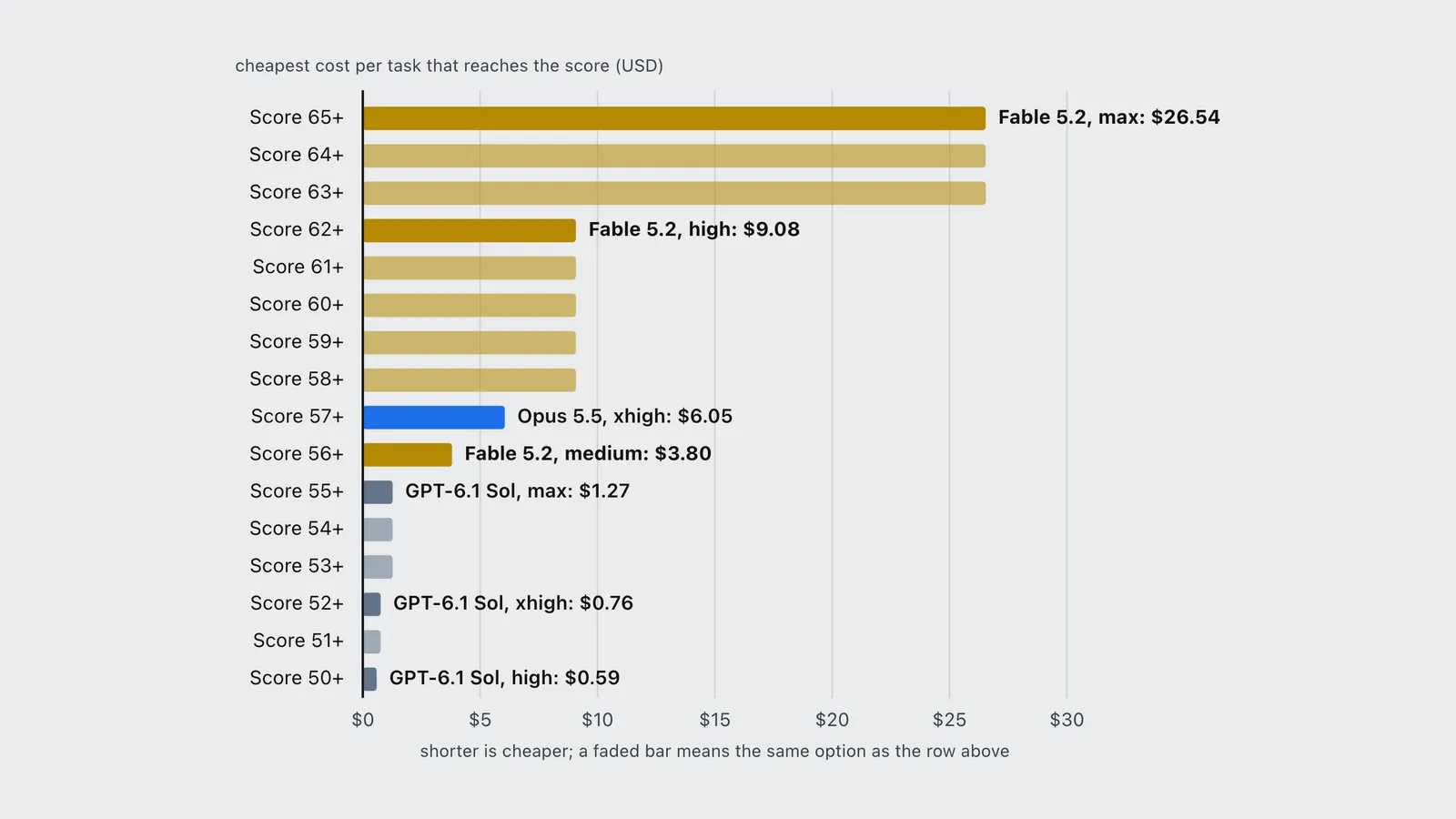
Claude Fable 5.2 costs $8 per million input tokens and $40 per million output, 20% less than Fable 5.1, and anyone with a Claude API key can call it today. At its default high effort it scores 62 on the independent Artificial Analysis index for $9.08 a task, above Claude Opus 5.5 at max effort (59, $10.04).
Anthropic released Claude Fable 5.2 and Claude Mythos 5.2 on November 9, 2026, ten weeks after Fable 5.1. The two are the same model. Fable ships with cybersecurity and biology safeguards and is open to everyone; Mythos drops them and is limited to verified organizations.
| Claude Fable 5.2 | Rate or status |
|---|---|
| Input, per Mtok | $8.00 (Fable 5.1: $10.00) |
| Output, per Mtok | $40.00 (Fable 5.1: $50.00) |
| Cache read, per Mtok | $0.20 (Fable 5.1: $0.25) |
| Batch input / output | $4 / $20 |
| Fast mode input / output | $16 / $80 |
| Who can use it | Every Claude API customer; Bedrock, Google Cloud, Foundry |
| Claude Mythos 5.2 | Same price; verified organizations only |
| Context, max output | 1M tokens, 128K tokens |
| Cost per AA index task | $9.08 at high (default), $26.54 at max (Artificial Analysis) |
How much does Claude Fable 5.2 cost?
$8 per million input tokens and $40 per million output, read from the Claude Platform pricing documentation. Every line of the Fable 5.1 card fell by the same 20%: the 5-minute cache write from $12.50 to $10, the 1-hour write from $20 to $16, and the cache read from $0.25 to $0.20. The cache read keeps Fable’s unusual multiplier, 0.025 times base input, where most Claude models charge 0.1 times.
| Rate | Claude Fable 5.2 | Claude Fable 5.1 | Claude Opus 5.5 |
|---|---|---|---|
| Input | $8.00 | $10.00 | $4.00 |
| Output | $40.00 | $50.00 | $20.00 |
| 5 minute cache write | $10.00 | $12.50 | $5.00 |
| 1 hour cache write | $16.00 | $20.00 | $8.00 |
| Cache read | $0.20 | $0.25 | $0.20 |
| Batch input / output | $4 / $20 | $5 / $25 | $2 / $10 |
| Fast mode | $16 / $80 | not offered | $8 / $40 |
The cache read is now identical to Opus 5.5’s $0.20. For a coding agent whose input is mostly cache hits, the input side of a Fable 5.2 bill costs about the same as Opus. The gap that remains is output, where Fable still charges twice the Opus rate.
There is no introductory rate and no expiry. Fast mode, which Anthropic says generates output up to 2.5 times faster, costs double the standard card and cannot be combined with batch.
What does a task cost on Claude Fable 5.2?
It depends almost entirely on the effort setting. Artificial Analysis, an independent benchmarking service, ran its Intelligence Index on Fable 5.2 at all five effort levels and published a cost per task for each. Read on November 10, 2026:
| Fable 5.2 effort | Index score | Cost per task | Time per task |
|---|---|---|---|
| low | 54 | $3.10 | 6.5 min |
| medium | 56 | $3.80 | 8.3 min |
| high (default) | 62 | $9.08 | 17.7 min |
| xhigh | 62 | $14.83 | 26.3 min |
| max | 65 | $26.54 | 44.1 min |
Two steps in that ladder decide the budget. Going from medium to high adds six points for $5.28 a task. Going from high to max adds three more points for $17.46, almost three times the cost. And xhigh buys nothing on this index: the same 62 as high, for 63% more.
Anthropic’s own guidance says the same thing in plainer words. Its What’s new in Claude Fable 5.2 documentation says “most of the gain in capability is already present at high” and reserves max “for measuring the model’s ceiling and for the rare task where time and tokens don’t matter.” The 65 that tops the leaderboard is the max-effort number. The one to budget on is the 62.
The token count explains why max is so expensive. At max effort Fable 5.2 produced 275 million output tokens to finish the index, against 218 million for Opus 5.5 at max, per the Artificial Analysis Fable 5.2 page. Ranked by cost per task at that setting, it is the most expensive model on the board.
Is Claude Fable 5.2 better than Claude Opus 5.5?
Yes, and on the independent index it is now also cheaper at the top end. At its default high effort Fable 5.2 scores 62 for $9.08 a task. Claude Opus 5.5 at max effort, its best setting, scores 59 for $10.04. So Fable 5.2 delivers three more points for about 10% less, even though its per-token rate is double.
Lower down, Opus 5.5 is still the cheaper way to buy a given score. Opus at xhigh reaches 57 for $6.05, and nothing else that is publicly callable gets there for less. Fable 5.2 at medium scores 56 for $3.80, against 52 for $3.46 from Opus at high.
Anthropic’s vendor-reported claims point the same way. Its announcement says Fable 5.2 at high effort scores 45.3% on FrontierCode 2.0, “about the same as Opus 5.5’s best score (45.3% vs. 45.5%) for roughly half the cost per task”, and that at low effort it matches Opus 5.5’s top Humanity’s Last Exam score “for less than one-tenth of the cost per task.” Those are Anthropic’s measurements, not reproduced.
Anthropic still does not tell most people to switch. The same announcement recommends that “users start with Claude Opus 5.5, our strongest daily driver” for most coding and knowledge tasks, and keeps Fable for the most demanding open-ended work.
| Score at least | Cheapest option | Its score | Cost per task |
|---|---|---|---|
| 65 | Fable 5.2, max | 65 | $26.54 |
| 64 | Fable 5.2, max | 65 | $26.54 |
| 63 | Fable 5.2, max | 65 | $26.54 |
| 62 | Fable 5.2, high | 62 | $9.08 |
| 61 | Fable 5.2, high | 62 | $9.08 |
| 60 | Fable 5.2, high | 62 | $9.08 |
| 59 | Fable 5.2, high | 62 | $9.08 |
| 58 | Fable 5.2, high | 62 | $9.08 |
| 57 | Opus 5.5, xhigh | 57 | $6.05 |
| 56 | Fable 5.2, medium | 56 | $3.80 |
| 55 | GPT-6.1 Sol, max | 55 | $1.27 |
| 54 | GPT-6.1 Sol, max | 55 | $1.27 |
| 53 | GPT-6.1 Sol, max | 55 | $1.27 |
| 52 | GPT-6.1 Sol, xhigh | 52 | $0.76 |
| 51 | GPT-6.1 Sol, xhigh | 52 | $0.76 |
| 50 | GPT-6.1 Sol, high | 50 | $0.59 |
The ladder is the shape of the market a day after launch. Below 56, OpenAI’s GPT-6.1 Sol is in a different price class, at about $1 a task. From 58 up, every step belongs to Fable 5.2, and the last three points cost almost three times what the previous five did.
Which Fable 5.2 effort level matches your Opus 5.5 setting?
If you run Opus 5.5 at medium, its API default, switch to Fable 5.2 at low. It is the closest match on cost and scores six points higher. The right setting depends on the Opus effort you use today, so here is each swap on the Artificial Analysis index, read November 10, 2026:
| If you run Opus 5.5 at | Opus score, cost per task | Use Fable 5.2 at | Fable score, cost per task | What changes |
|---|---|---|---|---|
| low | 35, $0.98 | stay on Opus | low is 54, $3.10 | Fable costs 3.2x as much |
| medium (API default) | 48, $2.45 | low | 54, $3.10 | +6 points, +$0.65 (+27%) |
| high | 52, $3.46 | medium | 56, $3.80 | +4 points, +$0.34 (+10%) |
| xhigh | 57, $6.05 | high | 62, $9.08 | +5 points, +$3.03 (+50%) |
| max | 59, $10.04 | high | 62, $9.08 | +3 points, $0.96 less (-10%) |
Three of those swaps deserve a note:
- Opus at medium to Fable at low is the “slightly better for slightly more” trade: 65 cents more per task. Fable at medium is the next step, 8 points above Opus at medium for 55% more.
- Opus at max to Fable at high is the only swap that is both better and cheaper. If you run Opus at max, there is no reason on this index to stay.
- Opus at low has no Fable equivalent. Nothing on the Fable ladder costs under $3.10 a task, so cheap high-volume work stays on Opus, or moves to GPT-6.1 Sol.
Once you are on Fable 5.2, the same data says how far to climb:
- From low to medium: 2 more points for 70 cents. A small, cheap step.
- From medium to high: 6 more points for $5.28, about 88 cents a point. This is the step with the most capability in it, and high is where Anthropic says to start.
- Above high: there is no small step. xhigh scores the same 62 for 63% more, and max adds 3 points for 2.9 times the cost of high.
Three things to check before you switch:
- Set the effort explicitly. On the API, Fable 5.2 defaults to high and Opus 5.5 defaults to medium. If you change only the model ID from Opus at its default, the cost per task goes from $2.45 to $9.08, about 3.7 times as much.
- Watch for early stops at low and medium. Anthropic’s documentation says that on long multistep tasks Fable 5.2 sometimes ends a turn with a list of what remains, more often at low and medium effort. If you see that, move up one level.
- On a subscription, the cost is usage, not dollars. Anthropic’s announcement says medium is the default effort in the Claude apps and Claude Code, and that Fable is included for up to 50% of weekly usage limits on Pro plans and standard Team seats.
These are scores on one composite index. A short effort sweep on your own tasks (low, medium and high) will tell you more than the table does.
Is Claude Fable 5.2 better than GPT-6 Astra?
On every measure published so far. Artificial Analysis scores GPT-6 Astra 57 at max effort for $6.24 a task. Fable 5.2 at high scores five points more for $2.84 more. Astra still lists at $10 and $50 per million tokens, so Fable 5.2 is now the cheaper of the two on the rate card as well.
Anthropic’s launch table is vendor-reported, and none of it has been reproduced yet. It puts Fable 5.2 first on 10 of these 12 rows:
| Benchmark (vendor-reported) | Fable 5.2 | Fable 5.1 | Opus 5.5 | GPT-6 Astra | Gemini 4 Carbon |
|---|---|---|---|---|---|
| FrontierCode 2.0 (agentic coding) | 49.1% | 32.4% | 45.5% | 42.8% | 41.1% |
| FrontierSWE v2 (agentic coding) | 69.9% | 56.3% | 62.3% | 65.5% | 61.2% |
| Terminal-Bench-Science 0.1 | 74.6% | 52.6% | 58.7% | 68.1% | 64.8% |
| OSWorld 2.1, offline set (computer use) | 89.3% | 83.5% | 87.2% | 79.5% | 81.5% |
| WANDR, relaxed score (agentic search) | 82.1% | 68.7% | 72.3% | not reported | not reported |
| RoboDojo Sim (robotics) | 64.9% | 27.6% | 39.4% | 29.8% | not reported |
| AA-Briefcase v1.1, rubric (knowledge work) | 66.1% | 61.5% | 61.2% | 52.0% | 61.8% |
| AA-Briefcase v1.1, Elo (knowledge work) | 1785 | 1669 | 1800 | 1569 | 1611 |
| Remote Labor Index (knowledge work) | 41.3% | 17.9% | 21.3% | 20.8% | not reported |
| Humanity’s Last Exam (with tools) | 74.2% | 65.6% | 67.7% | 57.2% | not reported |
| Chartography, no tools (chart reading) | 73.4% | 44.8% | 64.4% | 71.0% | 72.5% |
| AutomationBench (business workflows) | 51.4% | 31.4% | 42.5% | 41.4% | 53.9% |
Two rows go against Fable 5.2, and both are on Anthropic’s own table. On AutomationBench, Gemini 4 Carbon leads 53.9% to 51.4%. On AA-Briefcase, Fable 5.2 has the best rubric score but Opus 5.5 has the higher Elo, 1800 to 1785. The Artificial Analysis AA-Briefcase leaderboard, which Anthropic’s table does not include in full, puts Claude Sonnet 5.5 at max effort first at 1813, so Fable 5.2 is third on that measure.
Some rows can be checked independently. On FrontierSWE v2, which its maker Proximal runs itself, Fable 5.2 leads at 69.9% with the same figures Anthropic reports. On Scale’s Remote Labor Index leaderboard, Fable 5.2 is first at 41.30%, nearly double Opus 5.5’s 21.25%. Fable 5.2 is not yet on the independent Terminal-Bench-Science or Chartography boards, and Anthropic’s WANDR “relaxed score” is not a metric the WANDR paper defines. Every benchmark here, with its maker and how it is scored, is in the AI benchmarks directory.
The biggest jumps over Fable 5.1 are the agentic rows: Remote Labor Index went from 17.9% to 41.3% (run at high effort), RoboDojo Sim from 27.6% to 64.9%, and Chartography from 44.8% to 73.4%. Scores are at each model’s highest available effort unless Anthropic notes otherwise; the FrontierCode Fable figure is at xhigh and the Carbon one at medium. Anthropic ran RoboDojo Sim itself.
What about Gemini 4 Carbon?
On Artificial Analysis, Gemini 4 Carbon at high effort scores 60 for $7.76 a task, two points under Fable 5.2 at high for $1.32 less. If you could buy it, it would be the cheapest route to 59 and 60. You cannot: Carbon is still limited to cyber defenders in Google’s Fairwind Program, with no public date, so it is left out of the chart above.
What is Claude Mythos 5.2, and can you use it?
Mythos 5.2 is Fable 5.2 without the cybersecurity and biology safeguards. It shares Fable 5.2’s specifications and pricing, and its API ID is claude-mythos-5-2. Access goes through Anthropic’s verification programs, such as the Cyber Verification Program, or through your account team; the announcement adds that enterprise customers get Mythos 5.2 inside Claude Security without verification.
The Mythos-only results in the announcement are about security work. Anthropic reports that on an internal run over 1,829 CVEs, Mythos 5.2 found 10.2% more vulnerabilities than Opus 5.5 and 14.4% more than Mythos 5.1, and that Mozilla saw it roughly double Mythos 5.1’s discovery metrics. Both are vendor-reported.
| Benchmark (vendor-reported) | Mythos 5.2 | Mythos 5.1 | Opus 5.5, no safeguards | GPT-6 Cyber |
|---|---|---|---|---|
| CyScenarioBench (cybersecurity) | 76.3% | 61.7% | 67.6% | 61% |
| CVE Rediscovery (cybersecurity) | 89.6% | 78.3% | 81.3% | not reported |
| De novo binder design, 24 hours | 85.1% | 79.1% | 82.6% | not reported |
Anthropic notes that CyScenarioBench uses different tasks for each lab, so the GPT-6 Cyber figure is not a like-for-like comparison.
For everyone else, Anthropic says Fable 5.2’s safeguards now block about 55% fewer requests than Fable 5.1 did, with fewer false blocks in cybersecurity (about 60% fewer) and biology (about 40% fewer). A blocked request can fall back to Claude Opus 4.8 or Claude Opus 5.
What changes when you move from Fable 5.1?
The model ID becomes claude-fable-5-2, and four changes can break existing code, per Anthropic’s What’s new documentation:
- Editing earlier turns returns an error on every account. If anything before a thinking block changes (system prompt, tools or an earlier message), the request fails with a 400 unless you opt into dropping the block. On Fable 5.1 this applied only to accounts created on or after August 31, 2026.
- Only Fable 5.2 and Mythos 5.2 can read Fable 5.2 thinking blocks. A router that hands a conversation to Opus 5.5 or Fable 5.1 loses the reasoning for those turns.
- The older
computer_20251124computer use tool returns an error everywhere except Amazon Bedrock. Use thecomputer_toolset_20260801toolset. - The advisor tool needs a Fable 5.2 or Mythos 5.2 advisor when Fable 5.2 is the executor.
Claude Code, claude.ai, Claude Managed Agents and the Claude Agent SDK handle the first two for you. Anthropic also notes that at medium effort and above, a prompt line asking the model not to deliberate no longer stops it from thinking. To cut cost on easy turns, lower the effort instead.
Should you switch to Claude Fable 5.2?
If you run Fable 5.1, yes: it is cheaper per token, Anthropic now lists 5.1 as a legacy model, and on Artificial Analysis Fable 5.2 at medium effort (56, $3.80) already outscores Fable 5.1 at max (49, $12.99).
If you run Opus 5.5, it depends on the score you need:
- Need the top independent score you can buy? Fable 5.2 at high effort. It beats Opus 5.5 at max on both score and cost per task.
- Fine at about 57? Stay on Opus 5.5 at xhigh, $6.05 a task.
- Running high volume at about 55? GPT-6.1 Sol at max reaches it for $1.27, under half the price of any Claude option at that score.
- Tempted by max effort? Measure first. Three extra index points cost $17.46 more per task, and Anthropic’s own docs reserve max for the rare task where time and tokens don’t matter.
Rates for every model are on the AI model tracker, and the AI coding cost calculator prices a workload at a chosen rate card. October’s releases, including Gemini 4 Carbon, are in new AI models released in October 2026. Index scores drift between readings; the scores here are from November 10, 2026, and how the index moved last time is in which models dropped on Artificial Analysis Index v5.
Frequently asked questions
- How much does Claude Fable 5.2 cost?
- Claude Fable 5.2 costs $8 per million input tokens and $40 per million output tokens, 20% less than Fable 5.1. Cache reads cost $0.20 per million tokens, batch requests are half price, and fast mode costs $16 and $80. There is no introductory rate.
- Is Claude Fable 5.2 available to everyone?
- Yes. Since November 9, 2026 Fable 5.2 is available to all Claude API customers as claude-fable-5-2, and on Amazon Bedrock, Google Cloud and Microsoft Foundry. Claude Mythos 5.2, the same model without cybersecurity and biology safeguards, is limited to organizations verified through Anthropic programs.
- Is Claude Fable 5.2 better than Claude Opus 5.5?
- On the Artificial Analysis Intelligence Index, yes. Fable 5.2 at its default high effort scores 62 for $9.08 a task, against 59 for $10.04 from Opus 5.5 at max effort. Anthropic still recommends Opus 5.5 as the starting point for most coding and knowledge work.
- What effort level should I use with Claude Fable 5.2?
- Start at high, the API default. On Artificial Analysis, high scores 62 for $9.08 a task, xhigh scores the same 62 for $14.83, and max scores 65 for $26.54. Anthropic recommends xhigh only where you have measured a gain and reserves max for rare tasks.
- Which Claude Fable 5.2 effort level replaces Claude Opus 5.5 at medium?
- Fable 5.2 at low. On the Artificial Analysis index it scores 54 for $3.10 a task, against 48 for $2.45 from Opus 5.5 at medium: six more points for 27% more. From Opus at high, use Fable at medium; from Opus at xhigh or max, use Fable at high.
- What is the difference between Claude Fable 5.2 and Claude Mythos 5.2?
- They are the same model at the same price. Fable 5.2 runs cybersecurity and biology safeguards and is open to everyone; Mythos 5.2 removes them and is available only to verified organizations, for example through the Cyber Verification Program.
Sources
Anthropic (2026). Introducing Claude Fable 5.2 and Claude Mythos 5.2. Anthropic announcement, November 9, 2026: access, fast mode, vendor-reported benchmarks and effort-cost claims, safeguard and security results. https://www.anthropic.com/claude-fable-and-mythos-5-2 Read 2026-11-10.
Anthropic (2026). Pricing. Claude Platform documentation: Fable 5.2, Mythos 5.2, Fable 5.1 and Opus 5.5 rates, cache multipliers, batch and fast mode. https://platform.claude.com/docs/en/about-claude/pricing Read 2026-11-10.
Anthropic (2026). Claude Fable 5.2 model page and What’s new in Claude Fable 5.2. Claude Platform documentation: specifications, availability, data retention, breaking changes, effort guidance. https://platform.claude.com/docs/en/models/fable-5-2/overview and https://platform.claude.com/docs/en/models/fable-5-2/whats-new-fable-5-2 Read 2026-11-10.
Anthropic (2026). Cyber Verification Program. Claude Help Center article. https://support.claude.com/en/articles/14604842
Artificial Analysis (2026). Models leaderboard and Claude Fable 5.2, Claude Opus 5.5 and Claude Fable 5.1 model pages. Independent benchmarking service, Intelligence Index scores and cost per task by effort setting. https://artificialanalysis.ai/leaderboards/models and https://artificialanalysis.ai/models/claude-fable-5-2 Read 2026-11-10.