Gemini 4 Carbon: Pricing, Benchmarks, Access
Gemini 4 Carbon tops the Artificial Analysis index at 59 and lists $2/$10 per million tokens, then $4/$20. Only Fairwind cyber defenders can use it so far.
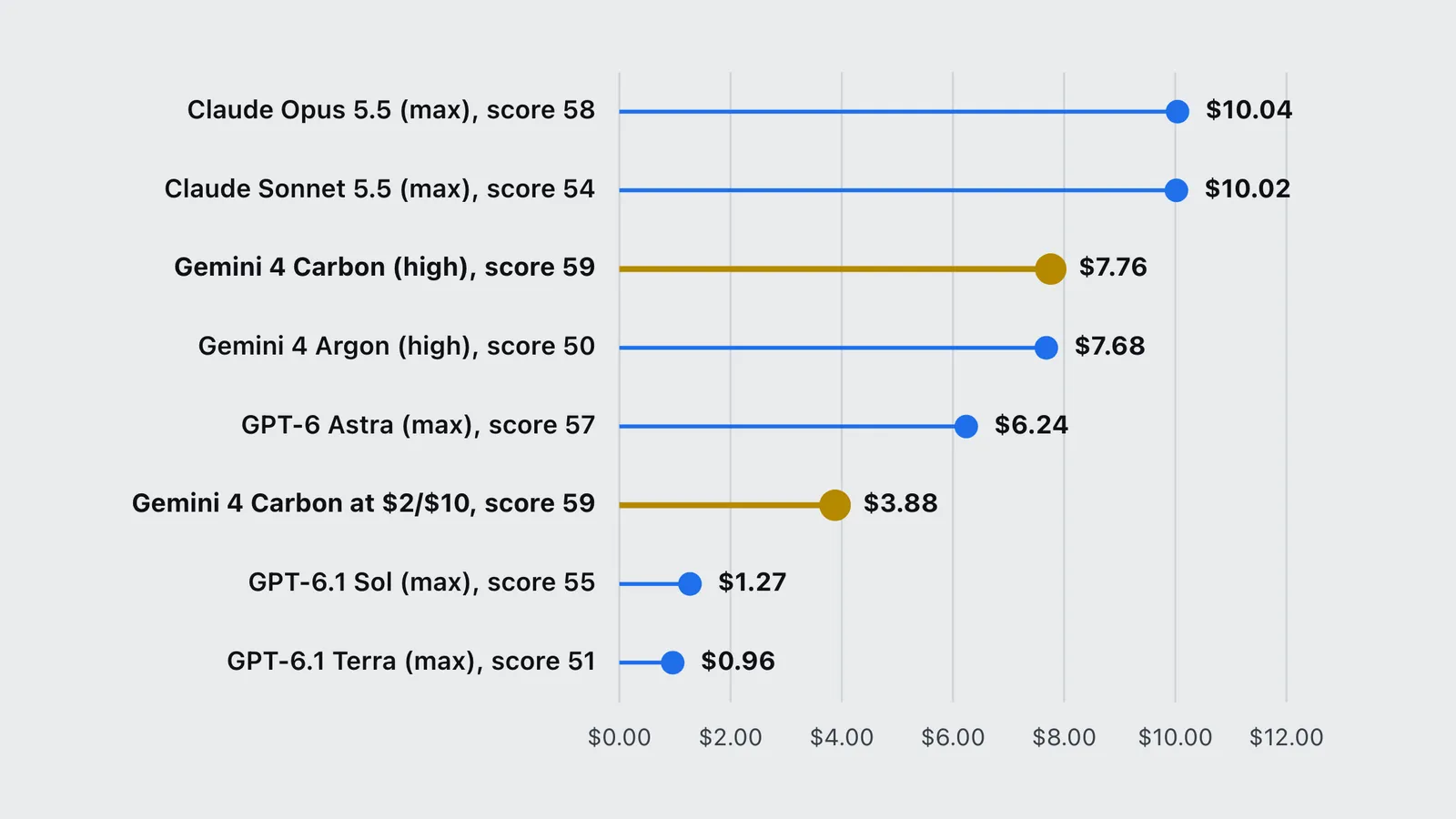
Gemini 4 Carbon is the highest-scoring model on the independent Artificial Analysis index, 59 against 58 for Claude Opus 5.5, and Google lists it at $2 and $10 per million tokens, then $4 and $20. You cannot buy it yet: since October 28 it runs only for cyber defenders in Google’s Fairwind Program, with no public date.
Google announced Gemini 4 Carbon on October 28, 2026, two weeks after Gemini 4 Argon opened to every paid developer, and calls it “our strongest model”. It is the second model of the Gemini 4 generation, and it carries exactly Argon’s rate card.
| Gemini 4 Carbon | Introductory rate | Standard rate |
|---|---|---|
| Input, per Mtok | $2.00 | $4.00 |
| Output, per Mtok | $10.00 | $20.00 |
| Cached input, per Mtok | $0.10 (95% off) | $0.20 (95% off) |
| When it applies | Not dated by Google | After the introductory one |
| Who can use it | Fairwind Program cyber defenders only | Not announced |
| Public API, AI Studio | Not yet, “as soon as possible” | Not announced |
| Cost per AA index task | $3.88 (derived) | $7.76 (Artificial Analysis) |
How much does Gemini 4 Carbon cost?
The same as Argon, on paper. Google’s announcement lists an introductory $2 per million input tokens and $10 per million output, with cached input “95% off input token price”, which is $0.10. It then gives $4 and $20 as the rate that follows. That is the Argon card line for line, and the standard rate is also exactly the Claude Opus 5.5 rate card.
What Google has not published is the date. Argon’s introductory rate runs through November 30, 2026, a date that appeared on the Gemini API pricing page only once Argon went public. Carbon is not on that page yet (checked October 29). So there is no way to know whether Carbon, when it opens, will get its own introductory window or arrive at $4 and $20. Batch, Flex and Priority prices are not announced either.
The safe budget assumption is the standard rate. Artificial Analysis and Vals both already price Carbon at $4 and $20, and Argon’s discount ends a month from now regardless.
When can you use Gemini 4 Carbon?
Not yet, unless you defend critical systems for a living. Google says Carbon is available this week to “a subset of cyber defenders”, then to “additional trusted partners through our Fairwind Program”, the same gate that Gemini 3.8 Flash Cyber ships behind and that Argon launched behind on September 30. Developers, businesses and consumers get it “as soon as possible”, with no date. As reported by VentureBeat, Antigravity head Varun Mohan said access widens through Fairwind before broader Antigravity availability, also without a date.
Argon’s path is the only precedent: Fairwind on September 30, every paid API account on October 13, thirteen days later. Nothing in Carbon’s announcement commits Google to the same gap. Google has also not published an API model ID, a context window, an output limit or a knowledge cutoff for Carbon. Artificial Analysis lists a 1M-token context, which matches Argon.
This site’s AI model tracker carries Carbon as announced, so it stays out of the cost calculator until a reader can call it.
What does a task cost on Gemini 4 Carbon?
At the standard rate, $7.76 per Artificial Analysis index task. Artificial Analysis, an independent benchmarking service, ran its new Intelligence Index v5 on Carbon at high effort, priced it at $4 and $20, and recorded 200 million output tokens. Every line of Carbon’s introductory card is half the standard one, so at the same token mix the introductory cost halves too, to $3.88. That figure is derived, not measured.
The number to read is not the $7.76 itself but where it sits. Carbon finishes an index task for 23% less than Claude Opus 5.5 at max effort ($10.04) and scores a point higher. It costs 24% more than GPT-6 Astra at max ($6.24) for two more points. And it costs 1% more than Argon ($7.68) while scoring nine points higher, on the same rate card.
| Item | Value |
|---|---|
| Claude Opus 5.5 (max), score 58 | $10.04 |
| Claude Sonnet 5.5 (max), score 54 | $10.02 |
| Gemini 4 Carbon (high), score 59 | $7.76 |
| Gemini 4 Argon (high), score 50 | $7.68 |
| GPT-6 Astra (max), score 57 | $6.24 |
| Gemini 4 Carbon at $2/$10, score 59 | $3.88 |
| GPT-6.1 Sol (max), score 55 | $1.27 |
| GPT-6.1 Terra (max), score 51 | $0.96 |
Carbon is a heavier model than Argon. It generated 200 million output tokens on the index against Argon’s 110 million, 1.8 times as many, yet the cost per task moved by eight cents. Artificial Analysis does not publish the input side of the bill, so the per-task figure, not the token count, is the one to budget on.
The cheap end of the ladder still matters. GPT-6.1 Sol scores 55 for $1.27 a task, a sixth of Carbon’s standard cost, and you can buy it today. Four index points is what the extra $6.49 a task pays for.
Is Gemini 4 Carbon better than Gemini 4 Argon?
Yes, on every measure Google published and on both independent boards. Google’s launch table, as transcribed by VentureBeat, puts Carbon ahead of Argon on all 17 rows. On the Artificial Analysis index the gap is 59 to 50, and Google’s own text claims more than twice Argon’s success rate on secure code generation and about half as many unsupported claims, from internal tests.
That leaves Argon in an awkward spot once Carbon opens. At the same $4 and $20 rate, Carbon does the same index task for eight cents more and scores nine points higher. Unless Google prices Carbon above Argon at release, there is little reason to choose Argon at the standard rate except availability. Today, availability is the whole reason.
Is Gemini 4 Carbon better than Claude Opus 5.5?
On the composite indexes, narrowly, and per task it is cheaper. Carbon leads Opus 5.5 on Artificial Analysis by one point, 59 to 58, with Opus at max effort. Both list at $4 and $20, so the 23% cost-per-task gap comes from how many tokens each model spends.
The independent Vals Index tells a closer story. Vals ranks Carbon second of 29 at 70.36%, behind Claude Sonnet 5.5 at 70.85%, at $10.51 per test and nearly 48 minutes of latency. Carbon ranks first on the Vals Finance Index (66.35%) and on Legal Research Bench. Google’s table reports Carbon at 70.4% on Vals Index v2.2 against 70.2% for Opus 5.5, which is inside Vals’ own ±0.97 margin.
Google’s rows also show where Opus still wins. All of these figures are vendor-reported, as transcribed by VentureBeat.
| Benchmark (vendor-reported) | Gemini 4 Carbon | GPT-6 Astra | Claude Opus 5.5 |
|---|---|---|---|
| GraphWalks (long context) | 96.2% | 71.8% | 66.8% |
| FrontierSWE 2 | 61.2% | 65.5% | 62.3% |
| OSWorld-2.1 offline | 81.5% | not reported | 87.2% |
| SWE-sweep | 9.6% | 9.5% | not reported |
| Vending-Bench 2 (balance) | $16,484 | $15,515 | not reported |
| Vals Index v2.2 | 70.4% | not reported | 70.2% |
Opus 5.5 keeps computer use (OSWorld, 87.2% against 81.5%) and edges Carbon on FrontierSWE 2. Carbon’s long-context lead on GraphWalks is the largest gap in the table. For a full comparison of how the two independent boards weigh work differently, see why the Vals Index and Artificial Analysis rank models differently.
How does Gemini 4 Carbon compare with GPT-6 Astra?
Two points higher on Artificial Analysis, 59 to 57, and 24% more per index task. Astra’s rate card is far higher, $10 and $50, but it spends fewer tokens, so it ends up cheaper per task. On Google’s table Astra keeps the lead on FrontierSWE 2 (65.5% against 61.2%), the long open-ended engineering benchmark, while Carbon wins long context and Vending-Bench 2 and ties SWE-sweep within a tenth of a point.
The security rows are where Carbon is built to lead. Google reports 88.2% on SEC-bench Pro for finding vulnerabilities, 54.8% on ExploitGym for exploiting them and 71.0% on CWE-bench for patching, up from Argon’s 68%. It reports a 0.0% attack success rate on Gray Swan’s indirect prompt-injection benchmark, against 0.7% for Argon, and 0.0% successful cheating on Terminal-Bench 4.0. All are vendor-reported, and Google publishes no Astra or Opus scores for these rows in its text.
Should you wait for Gemini 4 Carbon?
Plan for it, do not wait for it. Nothing Google has said gives a release date, and the one thing a budget can rely on is the $4 and $20 standard rate. At that rate Carbon is the strongest model per dollar at the top of the index: cheaper per task than Opus 5.5, and within a quarter of Astra’s cost for a higher score.
For work that has to ship this month, the choice is still among buyable models. Claude Opus 5.5 holds the top independent score you can call today. GPT-6 Astra is the cheaper route to 57. GPT-6.1 Sol reaches 55 for a sixth of Carbon’s cost. Argon is cheap until November 30 and, at 50 on the v5 index, the weakest of the four once its rate doubles.
What should you do until Carbon opens?
- Cost the workload at $4 and $20. It is the only Carbon rate with no date problem attached, and both independent boards already use it.
- Build on the Gemini API now if you expect to switch. Argon runs on the same API under
gemini-4-argon; moving to Carbon should be a model-ID change once Google publishes one. - Check whether you qualify for Fairwind. Google’s Fairwind Program admits cyber defenders and trusted partners, and it is the only route to Carbon today.
- Watch the pricing page, not reseller pages. Carbon’s real rates and any introductory end date will appear on Google’s Gemini API pricing page first.
Live rates for every model are on the AI model tracker, which will move Carbon from announced to released when the API opens. The release day is logged in the AI model release timeline and in new AI models released in October 2026. How the v5 recalibration moved every score, including Argon’s drop from 53 to 50, is in which models dropped on Artificial Analysis Index v5.
Frequently asked questions
- How much does Gemini 4 Carbon cost?
- Google lists Gemini 4 Carbon at an introductory $2 per million input tokens and $10 per million output tokens, with cached input 95% off, followed by a standard $4 and $20. That is the same rate card as Gemini 4 Argon. Google has not said when Carbon's introductory period ends, and Carbon is not yet on the Gemini API pricing page.
- Is Gemini 4 Carbon available to the public?
- Not yet. Since October 28, 2026 Gemini 4 Carbon is available only to a subset of cyber defenders, expanding to trusted partners in Google's Fairwind Program. Google says developers, businesses and consumers will get it as soon as possible but has given no date, and has not published an API model ID.
- Is Gemini 4 Carbon the best AI model?
- It is first on the Artificial Analysis Intelligence Index v5 at 59, ahead of Claude Opus 5.5 at 58 and GPT-6 Astra at 57. On the Vals Index it ranks second at 70.36%, behind Claude Sonnet 5.5 at 70.85%. Google reports Opus 5.5 ahead on OSWorld computer use and Astra ahead on FrontierSWE 2.
- Is Gemini 4 Carbon better than Gemini 4 Argon?
- Yes. Google reports Carbon ahead of Argon on all 17 benchmarks in its launch table, and Artificial Analysis scores Carbon 59 against Argon at 50. Both list $4 and $20 per million tokens at the standard rate, and Carbon costs $7.76 per index task against $7.68 for Argon.
- What does a task cost on Gemini 4 Carbon?
- Artificial Analysis measures $7.76 per Intelligence Index task at the $4 and $20 standard rate, 23% less than Claude Opus 5.5 at max effort ($10.04) and 24% more than GPT-6 Astra at max ($6.24). At the $2 and $10 introductory rate the same work would cost about $3.88.
Sources
Google (2026). Gemini 4 Carbon: our next frontier model. Google blog announcement, October 28, 2026: access, introductory and standard rates, vendor benchmarks. https://blog.google/innovation-and-ai/models-and-research/gemini-models/introducing-gemini-4-carbon/ Verified 2026-10-29.
Google (2026). Gemini Developer API pricing. Google AI for Developers documentation; Carbon not listed, Argon introductory rate through November 30, 2026. https://ai.google.dev/gemini-api/docs/pricing Checked 2026-10-29.
Google DeepMind (2026). Fairwind Program. Program page. https://deepmind.google/fairwind-program/
Artificial Analysis (2026). Gemini 4 Carbon (high) and Gemini 4 Argon (high) model pages, and the models leaderboard, Intelligence Index v5.0. Independent benchmarking service. https://artificialanalysis.ai/models/gemini-4-carbon and https://artificialanalysis.ai/leaderboards/models Read 2026-10-29.
Vals AI (2026). Gemini 4 Carbon benchmarks, cost and capabilities. Independent evaluation, Vals Index. https://www.vals.ai/models/google_gemini-4-carbon Read 2026-10-29.
VentureBeat (2026). Google unveils Gemini 4 Carbon, retaking the world’s no. 1 spot on updated, harder benchmarks, but access is limited. Secondary transcription of Google’s benchmark table. https://venturebeat.com/technology/google-unveils-gemini-4-carbon-retaking-the-worlds-no-1-spot-on-updated-harder-benchmarks-but-access-is-limited