DeepSeek Harness: What It Is and What It Costs
DeepSeek open sourced its agent harness under MIT on August 13, then repriced the API three days later. What it does and what it costs to run.
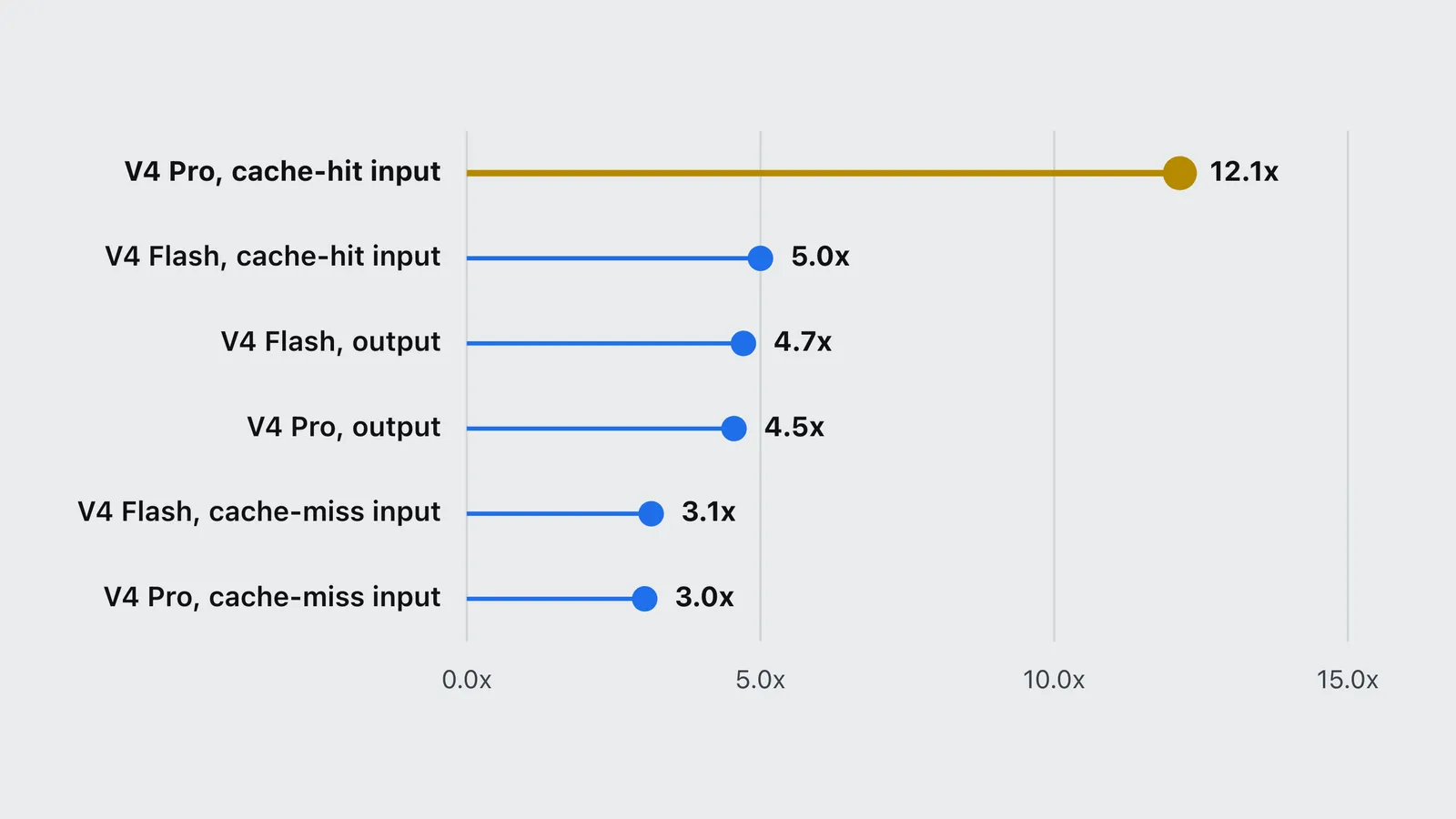
DeepSeek published its agent harness on August 13, 2026 under an MIT licence, and it is free. Three days later the company repriced the API that harness runs on, and the line item it raised hardest is the one a harness leans on hardest: cached input on deepseek-v4-pro went from $0.003625 to $0.044 per million tokens at peak hours, a rise of 1,114%.
Those two facts belong in the same sentence. DeepSeek Harness is a genuine piece of engineering, and the pricing move is a genuine repricing rather than a discount scheme dressed up as one. But the harness is the razor.
What DeepSeek Harness actually is
A harness is the runtime around a model that turns one prompt-and-response into an agent that can do work. DeepSeek states the premise directly on the project page: “The model is the soul of an agent. A harness lets an agent understand its environment, use tools, and keep working in real-world settings.”
The organising idea is that everything is a plugin. Models, tools, skills, sessions, sandboxes, storage, loops, scheduling and the web UI are all mounted as plugins on a kernel called Cordis, which handles mounting, unmounting and dependency resolution. That is a stronger claim than the usual extension point, because it means the loop itself and the session store are replaceable rather than fixed.
The second design decision is the one worth copying. Everything the model sees is written to an append-only session log: system prompts, reasoning, tool calls, and context injections. Sessions can be resumed, forked, searched and replayed. Most harnesses treat context as ephemeral and leave you inferring what the model was looking at when it went wrong. Recording the whole event stream turns that into a query.
Running it is one command, npx @deepseek-ai/dsh web, which serves a web UI on http://127.0.0.1:3080. From source it is a clone, pnpm install, pnpm run build, pnpm dsh web. The repository is explicit that this is a developer preview iterating rapidly, with compatibility-breaking changes expected, so treat the API surface as unstable.
The four modes
The four presets are the clearest statement of what the project thinks a harness is for.
| Mode | What it exposes | When it fits |
|---|---|---|
| Standard | Full coding agent: file editing, shell, file and web search, skills, planning, goals, subagents, workflows | Day-to-day agent work |
| Code | Model-generated TypeScript programs for multi-step operations | Batch or repetitive multi-step jobs |
| Minimal | Two tools only: a persistent bash session and str_replace_editor |
Baselines, benchmarks, cheap loops |
| Creator | Custom preset development with runtime inspection | Building your own harness on top |
Minimal is the interesting one. A persistent shell plus a string-replace editor is the smallest tool surface that can still do real work, and shipping it as a first-class mode rather than a curiosity is an admission that a bigger tool surface is not free. That matches the argument in how to scaffold an agent harness without wasting tokens: a few sharp tools beat fifty overlapping ones the agent will choose between badly, and every tool definition is a token you re-send on every turn.
What changed on 16 August
DeepSeek’s official pricing page now carries a peak and off-peak card. Off-peak is exactly half of peak. The card it replaced, still readable in an archived capture from 1 August 2026, was flat.
All figures are USD per million tokens.
| Line item | Until Aug 16 | Off-peak | Peak |
|---|---|---|---|
| V4 Pro, cache-hit input | $0.003625 | $0.022 | $0.044 |
| V4 Pro, cache-miss input | $0.435 | $0.66 | $1.32 |
| V4 Pro, output | $0.87 | $1.98 | $3.96 |
| V4 Flash, cache-hit input | $0.0028 | $0.007 | $0.014 |
| V4 Flash, cache-miss input | $0.14 | $0.22 | $0.44 |
| V4 Flash, output | $0.28 | $0.66 | $1.32 |
Two things happened at once, which is why the increase is larger than the headline “2x at peak” suggests. The base rate itself moved up by roughly 2.3x, and then peak hours double that base. DeepSeek had pre-announced only the second half: the archived August card promised that “during peak hours, prices will be 2x the regular prices,” with no hint that the regular price was about to move as well. The company framed the result as scheduling flexibility, saying off-peak rates are “50% lower than peak, enabling more flexible workload scheduling.”
| Item | Value |
|---|---|
| V4 Pro, cache-hit input | 12.1x |
| V4 Flash, cache-hit input | 5.0x |
| V4 Flash, output | 4.7x |
| V4 Pro, output | 4.5x |
| V4 Flash, cache-miss input | 3.1x |
| V4 Pro, cache-miss input | 3.0x |
Why the cache line is the harness line
The cache-hit rate looks like the least important number on a price card. It is the smallest figure, and it only applies to tokens the provider has seen before. For an agent harness it is the most important number on the card.
An agent does not answer once. It reads, acts, observes, folds the result back into its context, and goes again. Every turn re-sends the whole accumulated context: the system prompt, every tool definition, the files it has opened, and the transcript of what it already tried. By turn twenty it is paying to send turn one for the twentieth time. That is why the harness, not the model, sets the bill, and it is the mechanism at the centre of the token-waste argument this site has been making since June. Prompt caching is what makes that re-sending affordable. Raise the cached-read rate and you raise the cost of the loop itself.
The cheapest token on the card was the one an agent buys most, and it went up twelvefold.
Modeling a session makes the shape visible. Under the old flat card, cached reads were 12.2% of a twenty-turn session’s cost. Under the peak card they are 31.2%. The session total rises 4.74x at peak and 2.37x off-peak, both steeper than the 4.55x and 2.28x that the headline output rate alone would predict, because the cache line rose faster than the output line.
Peak hours are Beijing office hours
The archived price card states the peak window in the timezone that explains it: “Peak hours: 9:00-12:00 and 14:00-18:00 (Beijing Time, UTC+8) daily.” That is 01:00 to 04:00 and 06:00 to 10:00 UTC, seven of twenty-four hours, with the gap in the middle sitting exactly over the Beijing lunch break.
Which means the surcharge is not distributed evenly across DeepSeek’s users. It is aimed at the working day of the market it serves first.
| Location | UTC offset | Working day, local | Working day, UTC | Crosses midnight UTC | Hours at peak rate | Share at peak rate |
|---|---|---|---|---|---|---|
| Beijing | UTC+8 | 09:00-18:00 | 01:00-10:00 | No | 7 of 9 | 78% |
| London | UTC+1 (BST) | 09:00-18:00 | 08:00-17:00 | No | 2 of 9 | 22% |
| New York | UTC-4 (EDT) | 09:00-18:00 | 13:00-22:00 | No | 0 of 9 | 0% |
| San Francisco | UTC-7 (PDT) | 09:00-18:00 | 16:00-01:00 | Yes | 0 of 9 | 0% |
| Hour, UTC | Rate band | deepseek-v4-pro output | Beijing | London | New York | San Francisco |
|---|---|---|---|---|---|---|
| 00:00 to 01:00 | Off-peak | $1.98 | Office hours | |||
| 01:00 to 02:00 | Peak | $3.96 | Office hours | |||
| 02:00 to 03:00 | Peak | $3.96 | Office hours | |||
| 03:00 to 04:00 | Peak | $3.96 | Office hours | |||
| 04:00 to 05:00 | Off-peak | $1.98 | Office hours | |||
| 05:00 to 06:00 | Off-peak | $1.98 | Office hours | |||
| 06:00 to 07:00 | Peak | $3.96 | Office hours | |||
| 07:00 to 08:00 | Peak | $3.96 | Office hours | |||
| 08:00 to 09:00 | Peak | $3.96 | Office hours | Office hours | ||
| 09:00 to 10:00 | Peak | $3.96 | Office hours | Office hours | ||
| 10:00 to 11:00 | Off-peak | $1.98 | Office hours | |||
| 11:00 to 12:00 | Off-peak | $1.98 | Office hours | |||
| 12:00 to 13:00 | Off-peak | $1.98 | Office hours | |||
| 13:00 to 14:00 | Off-peak | $1.98 | Office hours | Office hours | ||
| 14:00 to 15:00 | Off-peak | $1.98 | Office hours | Office hours | ||
| 15:00 to 16:00 | Off-peak | $1.98 | Office hours | Office hours | ||
| 16:00 to 17:00 | Off-peak | $1.98 | Office hours | Office hours | Office hours | |
| 17:00 to 18:00 | Off-peak | $1.98 | Office hours | Office hours | ||
| 18:00 to 19:00 | Off-peak | $1.98 | Office hours | Office hours | ||
| 19:00 to 20:00 | Off-peak | $1.98 | Office hours | Office hours | ||
| 20:00 to 21:00 | Off-peak | $1.98 | Office hours | Office hours | ||
| 21:00 to 22:00 | Off-peak | $1.98 | Office hours | Office hours | ||
| 22:00 to 23:00 | Off-peak | $1.98 | Office hours | |||
| 23:00 to 00:00 | Off-peak | $1.98 | Office hours |
For a developer in the Americas this is close to a non-event, and for one in China it is a doubling. For a European team it is a two-hour window at the start of the day. Anyone running scheduled agent work rather than interactive sessions has an obvious lever: batch jobs moved outside 01:00 to 10:00 UTC halve in price, which is exactly the behaviour the pricing is designed to produce.
Flash or Pro for harness work
DeepSeek’s own cheaper tier is the better harness engine, and the repricing did not change that. V4 Flash scores above V4 Pro on the Artificial Analysis Intelligence Index at max reasoning effort, a result covered in the V4 Flash breakdown and tracked on the value leaderboard, while costing a third as much per token. Flash off-peak output at $0.66 is six times cheaper than Pro at peak.
The repricing did change something else. At peak rates, DeepSeek V4 Flash is no longer the cheapest frontier-class API on the model tracker: GPT-5.6 Luna at $0.20 input and $1.20 output is now cheaper per token than Flash at $0.44 and $1.32. Off-peak, Flash is back in front at $0.22 and $0.66. The cheapest frontier-class per-token rate in the market now depends on the hour of the day, which is a strange sentence to be able to write and a real complication for anyone whose China-model cost advantage was the whole reason for the architecture.
2026-08-01
Flat card, with a warning
V4 Pro at $0.435 input and $0.87 output. The page notes a coming peak policy at 2x regular prices, with no effective date.
2026-08-13
Harness published, V4 Pro reaches GA
MIT licence, developer preview, Cordis kernel. V4 Pro leaves preview with three reasoning-effort levels and native Responses API support.
2026-08-16
Repricing takes effect at 16:00 UTC
Peak and off-peak billing begins. The base rate moved as well as the multiplier, so V4 Pro output lands at $1.98 off-peak and $3.96 peak.
2026-08-21
174,845 stars
Eight days after publication, against 18,907 forks. Attention, not yet adoption.
What this does not tell you
The star count is the weakest number in this piece. 174,845 stars in eight days measures attention and the reach of DeepSeek’s name, not whether anyone finished a task with it. The repository also reports zero open issues, which almost certainly means issues are disabled rather than that the tracker is clean, so it says nothing about quality either.
There is no independent benchmark result for Harness itself yet. Claims that it rivals or beats an established harness are, at the time of writing, claims about the model underneath plus a preset, not a measured comparison of scaffolds. That distinction matters more than usual here, because identical open weights can swing double digits on a coding benchmark purely on the harness around them, a pattern documented in why local models fail at agentic coding and the reason harness choice belongs in a coding-agent comparison at all.
The developer-preview label should be read literally. Breaking changes are promised, not merely possible.
Bottom line
DeepSeek Harness is worth running, and the plugin-first architecture plus the append-only session log are the two ideas most worth stealing from it. Price it honestly, though. The harness costs nothing and the loop it runs costs between 2.4x and 4.7x what the same loop cost before August 16, with the largest single increase falling on cached context, the token an agent buys most. If the work is schedulable, move it out of 01:00 to 10:00 UTC and halve the bill. If it is interactive and the team sits in China, the free harness arrived with a doubling attached.
Frequently asked questions
- What is DeepSeek Harness?
- An open-source agent harness published by DeepSeek on August 13, 2026 under an MIT licence, currently in developer preview. It is written in TypeScript and built on a plugin kernel called Cordis, where models, tools, skills, sessions, sandboxes, storage, loops, scheduling and the UI are all swappable plugins. Everything the model sees is written to an append-only session log that can be resumed, forked, searched and replayed.
- Is DeepSeek Harness free?
- The harness itself is free and MIT licensed, so it can be used and modified commercially. The model calls it makes are not free. Running it against the DeepSeek API costs per token, and those per-token rates rose between roughly 1.5x and 12x on August 16, 2026 depending on the line item and the hour.
- How do you install DeepSeek Harness?
- The quickest route is npx @deepseek-ai/dsh web, which serves a web UI on http://127.0.0.1:3080. From source, clone github.com/deepseek-ai/deepseek-harness, then pnpm install, pnpm run build, and pnpm dsh web. A DeepSeek API key is entered in the UI under Settings then Models.
- What changed in DeepSeek pricing on 16 August 2026?
- DeepSeek replaced a flat price card with peak and off-peak billing from 16:00 UTC on August 16, 2026, and raised the underlying base rate at the same time. V4 Pro output went from $0.87 per million tokens to $1.98 off-peak and $3.96 at peak. V4 Pro cache-hit input went from $0.003625 to $0.022 and $0.044, the largest rise on the card at 12.1x. V4 Flash moved the same way, from $0.14 and $0.28 to $0.22 and $0.66 off-peak and $0.44 and $1.32 at peak.
- When are DeepSeek peak hours in my timezone?
- Peak is 01:00 to 04:00 and 06:00 to 10:00 UTC, which DeepSeek states as 09:00 to 12:00 and 14:00 to 18:00 Beijing time. In British Summer Time that is 02:00 to 05:00 and 07:00 to 11:00, so only the first two hours of a 09:00 start are affected. In US Eastern Daylight Time it is 21:00 to 00:00 and 02:00 to 06:00, entirely outside a normal working day. In Pacific Daylight Time it is 18:00 to 21:00 and 23:00 to 03:00. Every other hour is off-peak at half the peak rate.
- Does DeepSeek Harness only work with DeepSeek models?
- No. It is designed around swappable model plugins and its documentation covers custom OpenAI-compatible endpoints alongside the DeepSeek API, so it is not locked to DeepSeek weights. That cuts both ways commercially: the harness works as distribution for whichever model you point it at, while the DeepSeek API is the default it ships configured for.
- Is DeepSeek Harness a replacement for Claude Code?
- Not on current evidence. It is a credible open-source alternative in the same category, and the standard mode covers comparable ground: file editing, shell, search, skills, planning, subagents and workflows. But it is a developer preview with breaking changes promised, and there is no independent benchmark of the harness itself yet, so any ranking against an established harness today is really a ranking of the model underneath.
Sources
DeepSeek (2026). DeepSeek Harness: Everything is a Plugin. Project page, developer preview. https://deepseek.com/harness/en/
DeepSeek (2026). deepseek-ai/deepseek-harness. GitHub repository, MIT licence. Star and fork counts read from the GitHub REST API on 2026-08-21. https://github.com/deepseek-ai/deepseek-harness
DeepSeek (2026). Models & Pricing. DeepSeek API documentation, current peak and off-peak card read 2026-08-21. https://api-docs.deepseek.com/quick_start/pricing
DeepSeek (2026). Models & Pricing. DeepSeek API documentation, archived capture of the flat card and the pre-announced peak policy, 2026-08-01. https://web.archive.org/web/20260801170952/https://api-docs.deepseek.com/quick_start/pricing/
DeepSeek (2026). DeepSeek-V4-Pro is now generally available. DeepSeek API news, 2026-08-13, announcing GA, reasoning-effort levels and the 2026-08-16 pricing change. https://api-docs.deepseek.com/news/news260813
Cordiverse (2026). Cordis: A Programming Paradigm for Spatiotemporal Composability. Paper repository. https://github.com/cordiverse/paper