Do AI Games Sell on Steam? What Next Fest 2026 Shows
About 35% of October 2026 Steam Next Fest demos disclose AI, but only 2 of the top 25 do. A controlled study puts the review penalty near 53%.
Mostly no. AI-disclosed games made up 34.6% of the October 2026 Steam Next Fest field but only 2 of the 25 most-played demos, and the best controlled study of 2025 releases found that disclosing AI cut a game’s first-month reviews by about 53%. A handful of AI-touched games earn millions. The median one does not earn back Valve’s $100 listing fee.
Do AI-generated games sell on Steam?
Some do, and they are the exception. Games carrying Steam’s AI disclosure grossed an estimated $660 million by late 2025, but 45 titles took most of it, and most disclosed games earned under $10,000. Controlled for studio experience and genre, disclosing AI cuts first-month reviews, the industry’s sales proxy, by roughly half.
That answer has two halves that the October 2026 Next Fest coverage keeps collapsing into one. The supply side is exploding. The demand side is not following. Kotaku called the fest “a massive disaster”, and if you scrolled the demo list that week it is easy to see why. But a store page is not a sale, and the numbers below separate the two.
The $660 million figure comes from Ichiro Lambe of Totally Human Media, in Games With AI Disclosures Have Grossed an Estimated $660M on Steam (November 2025). He counted 10,258 disclosed games, 8% of the Steam catalog at the time, and estimated revenue with the Boxleiter method (review count × price × 35), which he calls “the roughest back-of-the-envelope calculation.” Twelve titles grossed eight figures and 45 cleared $1 million. Summing his brackets, only 702 cleared $10,000, which leaves roughly 93% of AI-disclosed games below that line.
And the winners are not what the word “slop” implies. Lambe notes that Stellaris carries a disclosure because of updates shipped long after launch, and that most disclosures describe light, peripheral use. A 2016 grand strategy game that later added some AI-assisted art lands in the same bucket as a demo assembled in a weekend.
How many Steam Next Fest October 2026 demos use AI?
About a third, depending on who counted. Three counts circulated during the fest, and they differ because they measure different lists:
- 7,240 games, 34.6% AI-disclosed. Chris Zukowski scraped the live Next Fest page for How sloppy is the October 2026 Steam Next Fest on How To Market A Game (21 October 2026, updated 23 October). He counted 2,502 games with an AI disclosure.
- 7,145 titles, just over 36%. PC Guide reported SteamDB’s event listing at 2,593 titles with an AI disclaimer (updated 20 October 2026), against nearly 20% in June.
- “Over 8,000” demos. This press figure came from a preview list two weeks before the fest, which Zukowski notes was larger than what went live.
Whichever count you take, the growth is the story. Zukowski’s series, with history credited to GameDiscoverCo, runs from 887 games in June 2023 to 7,240 in October 2026, and the latest edition was up 65.2% on June.
| Date | Games in Next Fest |
|---|---|
| 2023-06-01 | 887 |
| 2023-10-01 | 972 |
| 2024-02-01 | 1,123 |
| 2024-06-01 | 1,805 |
| 2024-10-01 | 3,008 |
| 2025-02-01 | 2,337 |
| 2025-06-01 | 2,645 |
| 2025-10-01 | 2,963 |
| 2026-02-01 | 3,536 |
| 2026-06-01 | 4,382 |
| 2026-10-01 | 7,240 |
The jump also outpaces Steam itself. Zukowski projects about 29,300 Steam releases in 2026, a 41% rise on 2025’s 20,801. Sulka Haro’s census of 53,597 games released from July 2023 to July 2026, Three years of AI on Steam (July 2026), attributes 60% to 90% of Steam’s release growth to AI-flagged games, depending on the window. Monthly launches without the flag rose from about 1,030 to 1,320 over three years. Flagged launches went from about 13 to 530.
Do AI games get players during Next Fest?
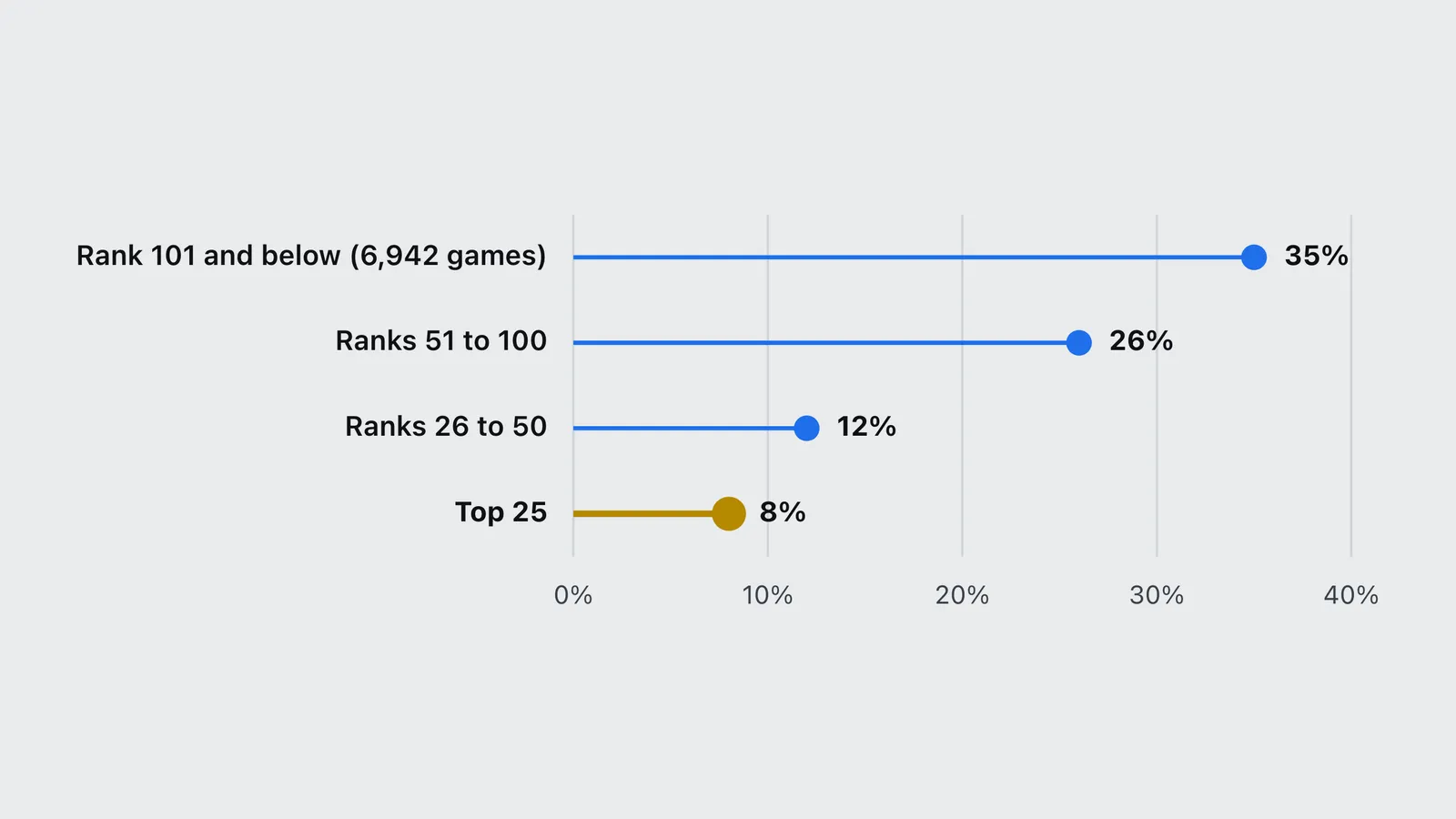
Very few of them. This is the number that should end the “AI is taking over Steam” framing. Zukowski ranked every demo by peak concurrent players and checked the disclosure rate in each band:
| Item | Value |
|---|---|
| Rank 101 and below (6,942 games) | 35% |
| Ranks 51 to 100 | 26% |
| Ranks 26 to 50 | 12% |
| Top 25 | 8% |
The top 25 demos peaked between 419 and 20,505 concurrent players. The 6,942 games below rank 100 peaked between 0 and 94, and only 7.6% of all demos reached even 10 concurrent players. Two disclosed games made the top 25. In the bottom band there were 2,427.
What predicted a top demo was not AI or its absence. It was an audience built before the fest started. The median top-25 game had 5,519 followers the day before Next Fest opened. The median game below rank 100 had 15. Zukowski measured a Spearman correlation of 0.55 between pre-fest followers and peak players, the strongest signal in his data.
So the field is a third AI, but the part of the field anyone actually plays is not. That squares with how Valve runs the event. As Aftermath reported in Steam Users Worry Good Next Fest Games Are Being Crowded Out By AI Slop, But The Real Problem Is More Complicated (2025), Steam shows a randomized selection for the first days, then switches to personalized picks driven by what people actually play. Zukowski’s description of it: “Give every game 15 minutes of fame and see who survives.” Most of the AI-disclosed field gets its 15 minutes and does not survive.
What do developers use AI for in their Next Fest demos?
Mostly art. Of the 2,502 disclosed games in Zukowski’s count (a game can list several uses):
| Disclosed AI use | Share of disclosed games |
|---|---|
| Art and visuals | 75.7% |
| Text, localization | 37.7% |
| Audio, voice | 37.6% |
| Marketing, store page | 25.0% |
| Code, dev tools | 23.1% |
| Live generation at runtime | 3.0% |
| Substantially AI-built | 0.3% (8 games) |
Two numbers in that table matter more than the rest. Only eight games described themselves as substantially AI-built, so the image of a fest full of fully generated games is wrong even on the developers’ own accounts. And 23.1% for code is almost certainly an undercount, because Valve does not ask for it.
Genre splits the field too. Strategy RPGs disclosed AI at 54.5% and real-time strategy at 50.4%, both content-heavy genres with lots of portraits, cards and unit art to fill. Precision platformers sat at 15.3%. Haro’s success-versus-flop comparison points the same way: 72% of flops that disclosed AI mentioned art, against 57% of successes, and AI voice appeared in 24% of flops but only 8% of successes. The art and voice that players see first are where the penalty concentrates.
Why is Steam flooded with AI games?
Because the economics of listing a game have not changed while the cost of making one has collapsed. Valve’s Steam Direct fee is $100 per product, recoupable once the game earns $1,000 in adjusted gross revenue. A developer also has to wait 30 days after paying and keep a “coming soon” page up for two weeks. Nothing in that gate scales with the effort that went into the game.
When art, voice, store copy and some of the code can be generated, the fixed $100 becomes the largest single cost of shipping a small game. A demo in Next Fest costs nothing extra. So the rational play for a low-budget developer is volume: list several cheap games, see which one finds players, abandon the rest. Each listing is a $100 lottery ticket.
The tickets mostly lose. Haro estimates the median Steam game that has any reviews earns about $300 (gross, Boxleiter method), and 28% have no reviews at all. That median game never reaches the $1,000 needed to get its $100 back. Across the whole store, Haro finds the top 1% of titles take about 94% of estimated revenue. AI did not create that power law, but it adds thousands of entries to the bottom of it every month.
This is the same incentive the AI slop in code research found among developers: when output becomes cheap, the cost moves to whoever has to sort it. On Steam that is the player scrolling the demo list, and the algorithm that decides which 15 minutes of fame turn into a second day.
Do games that disclose AI earn less on Steam?
On average, yes, and the gap survives the obvious objections. The most careful analysis so far is Ross Burton’s AI in Games: The Impact On Sales for Game Oracle (December 2025), a data company that sells Steam market analytics. It is a vendor’s blog analysis, not peer-reviewed research, but it publishes its method in detail.
Burton took paid games released on Steam from January to October 2025 and removed 1,932 titles from developers who publish more than one game every six months or price above $100, which filters most spam. That left 9,879 games, 17.9% of them AI-disclosed. Steam does not publish sales, so he used first-month review counts, the standard industry proxy.
The raw gap is modest:
- Median first-month reviews: 4 for AI-disclosed games, 7 for the rest.
- Games with zero reviews: 19.8% against 15.2%.
- Median positive rating, among games with at least 100 reviews: 84.6% against 88.3%.
The controlled result is not modest. Comparing games of the same type, released in the same month, with the same publisher backing and the same developer track record, disclosing AI predicted 52.6% fewer first-month reviews (a range of 47.7% to 57.6%). If a game without AI drew 100 reviews, a comparable AI-disclosed game would draw about 47.
The obvious objection is that weaker teams use more AI, so the penalty is really a skill penalty. Burton tested that with a sensitivity analysis. To erase the effect, an unmeasured factor would have to nearly triple the odds of using AI (2.7x) while also cutting reviews by 22%. And his more uncomfortable finding runs the other way. If that hidden factor is skill and marketing, the penalty for strong studios gets worse, an estimated 40% to 60% drop, while for inexperienced teams with no audience AI makes roughly no difference. His summary for that second group: AI likely won’t hurt them further, and it won’t save them either.
Haro’s census reaches a compatible result from a different direction. AI-flagged games reach the 100-review tier at about 55% of the rate of unflagged ones, and AI’s share of estimated sales (10% to 27% from late 2025 into 2026) sits below its roughly one-third share of launches.
Can you filter AI games out of Steam?
Not in Steam itself. The workaround players use is SteamDB, which since February 2025 treats “AI Content Disclosed” as a tag you can exclude from its lists (SteamDB now lets you filter out Steam games with AI Generation, GamingOnLinux). PC Guide used the same exclusion on SteamDB’s Next Fest event listing to get its 36% figure. The filter reads Valve’s self-reported disclosure, so it misses anything undeclared.
For players, the popularity data above is the practical filter. Sorting Next Fest by most played already pushes most AI-disclosed demos out of view, because players are already doing the filtering.
What this means if you are making a game
The data does not say “never use AI.” It says the market punishes AI where players can see it, and that the penalty grows with how good the game would otherwise have been. A few things follow:
- Build followers before Next Fest. Pre-fest followers were the strongest predictor of peak players (0.55 correlation). No tool choice comes close.
- Keep generated assets out of the first impression. Art and voice are where the flop-versus-success gap shows up, and the store capsule, trailer and first minutes are where players decide.
- Disclose accurately anyway. Hiding use is a policy risk with Valve, and Haro’s 22% retroactive-flag figure suggests disclosures get caught up with.
- Treat a $100 listing as a real bet, not a free one. The median game does not recoup it.
The same split shows up wherever AI output meets an audience: the tools that strip machine tells from text, which this site ranks in the best anti-slop AI skills, exist because readers discount anything that reads as generated. Steam players are doing the same thing with their clicks.
Frequently asked questions
- Do AI-generated games sell on Steam?
- A few do. AI-disclosed games grossed an estimated $660 million by late 2025, but 45 titles took most of it and roughly 93% earned under $10,000. Controlled for studio experience, publisher, genre and release month, disclosing AI cut first-month reviews by about 53% in a Game Oracle study of 9,879 paid 2025 releases.
- How many games in the October 2026 Steam Next Fest use AI?
- About a third. A scrape of the live Next Fest page counted 2,502 of 7,240 games (34.6%) with an AI disclosure, and SteamDB counted 2,593 of 7,145 (just over 36%). Both count only games that disclosed, so the true share is higher.
- Are the most-played Next Fest demos AI games?
- Rarely. Only 2 of the top 25 demos by peak concurrent players disclosed AI (8%), against 35% of the games ranked below 100. The strongest predictor of a top demo was the number of followers it had before the fest began.
- Why are there so many AI games on Steam?
- Listing a game costs a flat $100 through Steam Direct, recoupable after $1,000 in revenue, while AI has cut the cost of producing art, voice and store copy. That makes publishing many cheap games a rational bet for low-budget developers, even though most never earn back the fee.
- Does Steam require developers to disclose AI use?
- Yes. The Steamworks content survey asks developers to describe pre-generated AI content that ships with the game and live-generated content made at runtime, with guardrails for the latter. Valve says efficiency gains from AI tools are not the focus, so code assistants usually go undeclared.
Sources
Zukowski, C. (2026). How sloppy is the October 2026 Steam Next Fest. How To Market A Game, 21 October 2026, updated 23 October 2026 (independent analysis; participation history from GameDiscoverCo). https://howtomarketagame.com/2026/10/21/how-sloppy-is-the-october-2026-steam-next-fest/
Burton, R. (2025). AI in Games: The Impact On Sales. Game Oracle blog, 17 December 2025 (vendor analysis, not peer-reviewed). https://www.game-oracle.com/blog/ai-part2
Haro, S. (2026). Three years of AI on Steam. fragwyz (Substack), 13 July 2026 (independent analysis). https://fragwyz.substack.com/p/three-years-of-ai-on-steam
Lambe, I. (2025). Games With AI Disclosures Have Grossed an Estimated $660M on Steam. Totally Human Media, November 2025 (independent analysis). https://www.totallyhuman.io/blog/games-with-ai-disclosures-have-grossed-an-estimated-660m-on-steam
Valve (2026). Steam Direct. Steamworks documentation. https://partner.steamgames.com/steamdirect
Valve (2026). Content Survey: AI Generated Content. Steamworks documentation. https://partner.steamgames.com/doc/gettingstarted/contentsurvey
Goodall, J. (2026). Steam Next Fest has even more generative AI than last time, gamers say the event is “absolutely ruined”. PC Guide, updated 20 October 2026 (secondary report of SteamDB counts). https://www.pcguide.com/news/steam-next-fest-has-even-more-generative-ai-than-last-time-gamers-say-the-event-is-absolutely-ruined/
Grayson, N. (2025). Steam Users Worry Good Next Fest Games Are Being Crowded Out By AI Slop, But The Real Problem Is More Complicated. Aftermath, updated 27 October 2025 (secondary reporting). https://aftermath.site/steam-next-fest-demos-ai-disclosure-algorithm/
Squires-Hand, L. (2025). SteamDB now lets you filter out Steam games with AI Generation. GamingOnLinux, 25 February 2025 (secondary reporting). https://www.gamingonlinux.com/2025/02/steamdb-now-lets-you-filter-out-steam-games-with-ai-generation