Federal Reserve Interest Rates: Sept 2026 Hike
Fed hiked to 3.75-4% on Sept 16, 2026. Why Warsh acted, what the dot plot signals next, and what it means for mortgages, AI debt, and stocks.
Federal reserve interest rates moved for the first time in more than three years on September 16, 2026. The Federal Open Market Committee voted 12-0 to raise the target range by a quarter point to 3.75–4.00%, with new projections pointing to at least one more hike before year end.
What the Fed decided on September 16
Did the Fed raise interest rates? Yes. On September 16, 2026, the FOMC raised the federal funds target range by a quarter percentage point to 3.75–4.00%, effective September 17, in a unanimous 12–0 vote aimed at returning inflation to 2% on a faster timetable.
The decision is documented in the FOMC statement of September 16, 2026, a 2026 Federal Reserve policy release. In the same action the Board raised the interest rate paid on reserve balances to 3.90% and the primary credit rate to 4.0%, according to the implementation note of September 16, 2026, a 2026 Federal Reserve operational release.
The scale of the shift matters. This was the first increase since July 2023, reversing the cut delivered in December 2025. Three members had already dissented in favor of a hike at the July meeting, so the September move confirmed a direction the Committee had been leaning toward for months, as reported in CNBC coverage of the September 2026 rate decision, 2026 secondary reporting on the announcement.
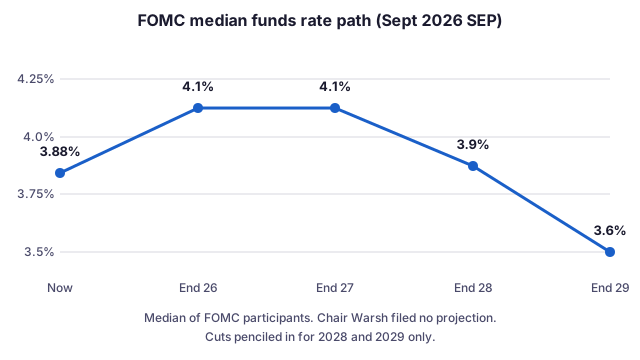
The projections tell the rest. The September 2026 Summary of Economic Projections, a 2026 Federal Reserve forecast release, puts the median funds rate at 4.1% at end of 2026 and 4.1% at end of 2027, easing to 3.9% in 2028 and 3.6% in 2029. Sixteen of eighteen participants expect at least one more hike this year. Chair Kevin Warsh filed no projection, continuing the practice he started in June.
Growth expectations moved up with rates. Median GDP growth is 2.3% in 2026 and 2.4% in 2027, unemployment sits near 4.1%, and total PCE inflation runs 3.7% this year before falling to 2.3% next year. Inflation risks skew to the upside while labor risks look roughly balanced.
Why the Fed hiked now
Warsh gave the logic in one sentence at the press conference: inflation has run too high for too long, and the standard for holding had not been met. The transcript of Chair Warsh’s September 16, 2026 press conference, a 2026 Federal Reserve communications release, records the test he set in Jackson Hole: confidence that underlying inflation is moving to target clearly and at sufficient speed. The Committee judged that test failed.
Three forces pushed prices away from target. Tariffs from the current administration lifted import costs across goods categories. An energy shock tied to the US-Israeli war with Iran pushed oil and fuel prices higher through the summer. And capital spending from the AI buildout kept domestic demand and investment strong even as borrowing costs rose, a mix described in Reuters reporting on the September 2026 hike, 2026 secondary reporting on the decision.
That last driver is the one most coverage skips past. The FOMC statement itself notes strong productivity growth and strong capital investment alongside elevated inflation. When businesses keep ordering chips, servers, and power equipment at this pace, demand stays warm enough to make rate restraint the binding constraint. Warsh said financial conditions did not look restrictive, a view he described as widely shared around the table, which is why the Committee removed what he called a dose of accommodation.
Politics sits in the background, not the foreground. President Trump selected Warsh expecting rate cuts, yet the new chair opened his tenure with a hike and language about delivering price stability. Axios reporting on the first Warsh-era move, 2026 secondary coverage of the meeting, frames it as a credibility play: a unanimous vote for tighter policy answers the question of whether the chair would defer to the White House.
What higher rates mean for AI data centers and tech debt
This is where the decision lands directly on the Capital & Compute thesis. AI infrastructure is now financed in large part with private credit priced between 10% and 15%, against 4–5% for investment-grade bonds, a spread documented in AI data center financing coverage. Every quarter point added to base rates widens the all-in cost of the Apollo/Blackstone-style SPVs, the Helix equity vehicles, and the bank facilities behind Stargate.
Two transmission channels count. First, floating-rate construction and bridge facilities reprice fast, so projects mid-build pay more interest before earning a dollar of revenue. With 30–50% of 2026 data center projects already facing delay or cancellation, carrying costs on idle capital rise. Second, refinancing math gets harder. The first wave of AI private-credit deals carries three- to seven-year maturities, and a 4.1% policy rate persisting through 2027 lifts the base over which credit spreads stack when that paper rolls.
The per-token link is direct. Higher financing costs raise the levelized cost of compute, which sets a floor under inference prices even as chip efficiency improves. Readers tracking what it costs to train AI models in 2026 should treat the September hike as a small but durable upward input to that cost stack, and the price reversal dynamic gets sharper: models that burn more compute per finished task carry more of the expensive balance-sheet infrastructure with them.
None of this stops the buildout. Hyperscaler capex near $700 billion and a multi-trillion pipeline through 2028 can absorb 25bp. The effect is at the margin and at refinancing: weaker projects face stricter underwriting, and sponsors with floating exposure feel it first.
What it means for mortgages, credit cards, and savings
Mortgage borrowers hoping for relief wait longer. Thirty-year fixed rates track the 10-year Treasury yield more than the funds rate, and the 10-year had already climbed above 4.6% into the meeting on hike expectations. A September hike plus a median path holding at 4.1% through 2027 keeps upward pressure on long yields, which delays the refinance window for anyone who bought near peak rates.
Credit cards and auto loans adjust faster. Most cards carry variable rates tied to prime, which moves with the funds rate within a billing cycle or two. Savers get the mirror image: high-yield savings and money-market yields stay elevated longer, and certificates of deposit roll at better levels than a cutting cycle would allow.
The practical read is timing, not panic. Fixed-rate borrowers with locked loans feel nothing directly. Adjustable-rate borrowers, home-equity lines, and anyone carrying revolving balances pay more starting with the next statement cycle. Anyone planning a home purchase or a hardware build financed on credit (see the buying-timing analysis in when RAM prices will drop) faces a higher hurdle rate for the next several quarters.
What it means for stocks and crypto
Higher risk-free rates compress equity valuations through the discount rate. Growth stocks with earnings far in the future, the large AI capex names included, lose present value arithmetic when the denominator rises. The Nasdaq and the QQQ complex typically absorb hikes faster than the Dow for exactly this duration reason.
Crypto has traded with the same liquidity sensitivity. Bitcoin tends to weaken when real yields rise and the dollar firms, since a 4%+ risk-free return raises the bar for holding a volatile non-yielding asset. A hawkish hold through 2027 extends that headwind rather than intensifying it: the September move was priced at over 90% odds in futures markets, so the surprise component sits in the dot plot path, not the 25bp itself.
One caveat cuts the other way. The Fed is hiking because growth is holding near 2.3–2.4% with unemployment steady at 4.1%. Earnings can outgrow multiple compression when nominal activity stays strong, which is why past hiking starts have not always meant immediate equity drawdowns. This post explains mechanics, not a forecast, and nothing here is investment advice (see the disclaimer).
What to watch next
Two meetings remain in 2026, in October and December, and the median projection embeds one more quarter-point hike across them. Four participants see two more hikes; two see none. The deciding inputs are the same ones Warsh named: whether PCE inflation bends clearly toward 2%, whether tariffs and energy pass through or fade, and whether expectations stay anchored.
Watch the labor market as the potential veto. If job gains stall or unemployment breaks above 4.1%, the balanced labor-risk assessment flips and the hiking consensus cracks. If hiring holds while inflation stays near 3.5% or higher, the December meeting likely delivers the second hike the dots promise.
Also watch long yields. The Committee controls overnight rates; markets control the 10- and 30-year rates that price mortgages and data center debt. A 10-year yield climbing well above 4.6% tightens conditions faster than the FOMC voted for, while a falling long end would loosen them. Warsh has said he watches market prices without being led by them, so the dialogue between the dots and the bond market is the story into year end.
FAQ
Did the Fed raise interest rates in September 2026?
Yes. The FOMC voted 12–0 on September 16, 2026 to raise the federal funds target range 25bp to 3.75–4.00%, effective September 17. It was the first hike since 2023.
What is the federal funds rate now?
The target range is 3.75–4.00%, with a midpoint near 3.88%. The interest rate paid on reserve balances is 3.90% and the primary credit rate is 4.0%.
Who is Fed Chair Kevin Warsh?
Kevin Warsh took office as Federal Reserve chair in late May 2026 after nomination by President Trump. The September 2026 hike was the first policy move of his tenure, and he has declined to submit personal economic projections while publishing the Committee median.
Will the Fed raise rates again in 2026?
The median projection implies one more 25bp hike this year, to 4.1%. Sixteen of eighteen participants expect at least one more increase across the October and December meetings, with four seeing two.
How do Fed hikes affect mortgage rates?
Indirectly and with a lag. Mortgages track long-term Treasury yields, not the funds rate. Hikes push up short rates immediately and influence long yields through growth and inflation expectations, so mortgage relief arrives only when markets believe the hiking cycle is done.
Bottom line
The September 2026 hike resets the cycle: rates are rising again, the median path holds near 4.1% through 2027, and cuts are a 2028 story at earliest. For tech-finance readers the consequence runs through borrowing costs on every layer of the AI stack, from data center SPVs to GPU leases to the mortgage on the house with the home lab in it. Track the dots, watch PCE prints, and price new debt against a higher-for-longer base.
Sources
- Federal Reserve (2026). FOMC Statement, September 16, 2026. Policy release. https://www.federalreserve.gov/monetarypolicy/files/monetary20260916a1.pdf
- Federal Reserve (2026). Implementation Note Issued September 16, 2026. Operational release. https://www.federalreserve.gov/newsevents/pressreleases/monetary20260916a1.htm
- Federal Reserve (2026). September 16, 2026: FOMC Projections Materials. Forecast release. https://www.federalreserve.gov/monetarypolicy/fomcprojtabl20260916.htm
- Federal Reserve (2026). Transcript of Chairman Warsh’s Press Conference Opening Statement, September 16, 2026. Communications release. https://www.federalreserve.gov/mediacenter/files/FOMCpresconf20260916.pdf
- Cox, J. (2026). Fed Approves Interest Rate Hike, Signals One More to Come This Year. CNBC, secondary reporting. https://www.cnbc.com/2026/09/16/fed-rate-decision-september-2026.html
- Schneider, H. (2026). Fed Hikes Rates in Search of Timelier Drop in Inflation. Reuters, secondary reporting. https://www.reuters.com/business/warshs-words-may-matter-more-than-anticipated-fed-rate-hike-2026-09-16/
- Irwin, N. (2026). Fed Raises Rates a Quarter Point in First Move of Warsh Era. Axios, secondary coverage. https://www.axios.com/2026/09/16/fed-rates-warsh-trump