Ex-OpenAI and Ex-Anthropic Startups: The Money
OpenAI and Anthropic alumni raised billions in pre-product seeds in 2026. Verified funding for every spinout, and what the money is buying.
Two researchers spent about a year inside Anthropic. They left in December 2025, and within weeks they had raised $200 million at a $1 billion valuation, led by Andreessen Horowitz and Kleiner Perkins with NVIDIA participating, for a company with no product. That is Mirendil, and by the standards of this cohort it is a mid-sized outcome.
Now the other half of the trade. In July 2025, Mira Murati raised $2 billion at a $12 billion valuation for Thinking Machines Lab on the strength of having been OpenAI’s chief technology officer. Four months later she went back to the market seeking $50 billion. The talks ran into January 2026 and collapsed without a deal. Thinking Machines is still valued at $12 billion, and it is one of the few companies in this group that has actually shipped software.
Put those two facts side by side and the pattern in frontier-lab departures stops being about who is leaving. A resume from OpenAI or Anthropic buys the entry round at close to any price the founder names. It does not buy the second one.
How much have OpenAI and Anthropic alumni raised?
The companies founded by people who left the two leading American labs have raised about $9 billion since late 2024, on the rounds that carry a disclosed number. That total is soft at the edges, and it is worth being precise about why before leaning on it.
Every number in this post comes from press reporting, not from a regulatory filing. None of these companies is public. A private valuation is not a market price; it is the number one syndicate of investors agreed to on one day, and it stays on the books until somebody negotiates a different one. Several of these rounds were reported by outlets working from sources rather than announcements, and at least one widely circulated figure is simply wrong (see the note below the table).
Here is the 2026 cohort, meaning companies founded by OpenAI or Anthropic alumni whose rounds were reported from late 2024 onward.
| Company | Came from | Founders named in coverage | Disclosed raise | Valuation | Product in market |
|---|---|---|---|---|---|
| Safe Superintelligence | OpenAI | Ilya Sutskever, Daniel Gross, Daniel Levy | ~$6B (contested) | $32B | No |
| Thinking Machines Lab | OpenAI | Mira Murati | $2B | $12B | Yes |
| Humans& | Anthropic, xAI, Google | Andi Peng, Georges Harik, Eric Zelikman, Yuchen He, Noah Goodman | $480M | $4.48B | No |
| Periodic Labs | OpenAI, DeepMind | Liam Fedus, Ekin Dogus Cubuk | $300M | ~$1B | No |
| Mirendil | Anthropic | Behnam Neyshabur, Harsh Mehta | $200M | $1B | No |
| Applied Compute | OpenAI | Rhythm Garg, Linden Li, Yash Patil | $20M | $100M | Yes |
| Egoist Machines | OpenAI | YC S26 batch | Undisclosed | Undisclosed | Yes |
| Eureka Labs | OpenAI | Andrej Karpathy | Undisclosed | Undisclosed | Not stated |
| Worktrace | OpenAI | Angela Jiang | Undisclosed | Undisclosed | Not stated |
| Softmax | OpenAI | Emmett Shear | Undisclosed | Undisclosed | Not stated |
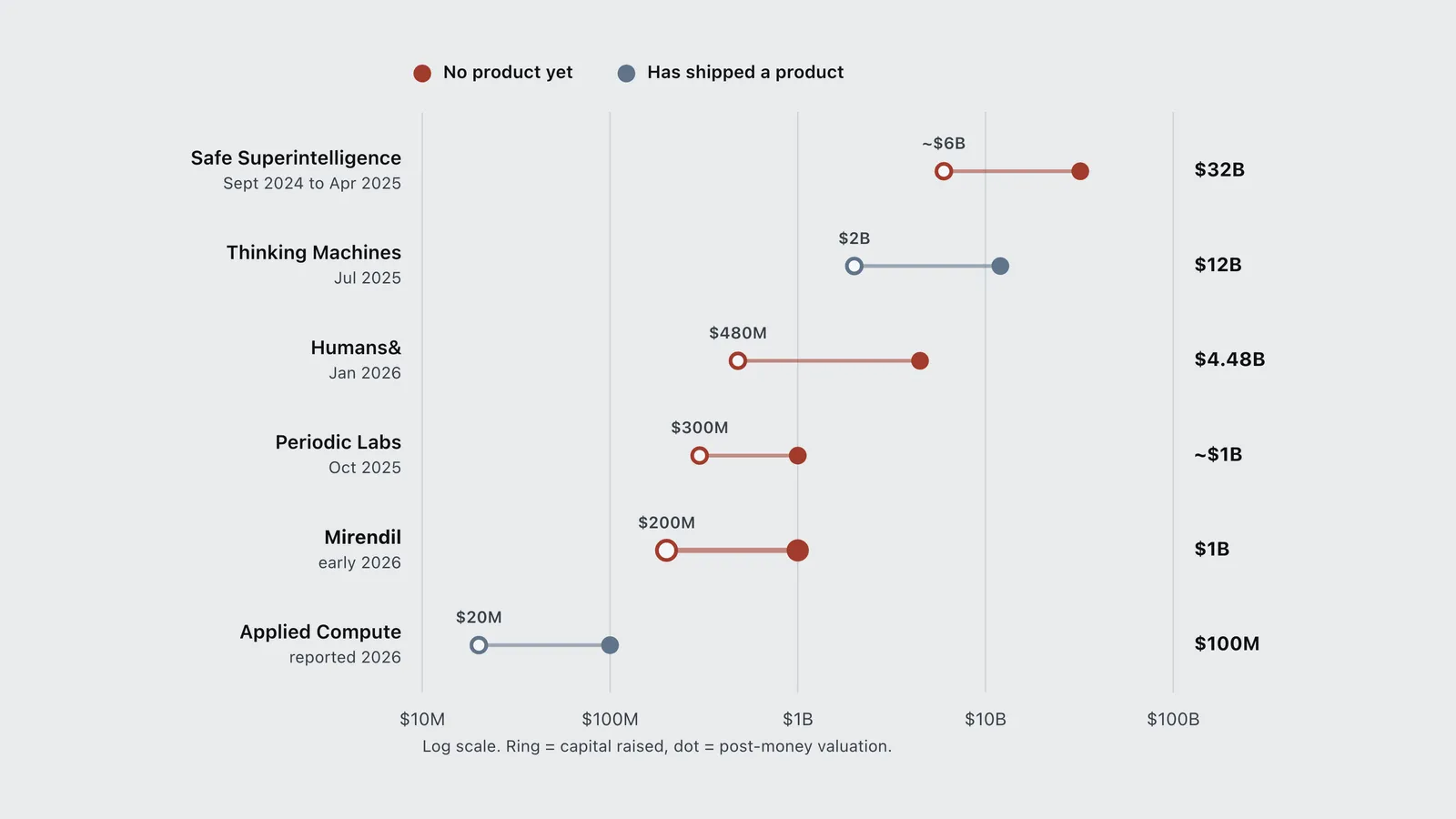
The shape of the money is easier to see than to describe. What follows plots each company’s disclosed capital against the price investors paid for it, on a log axis because the rows span from $20 million to $32 billion.
| Company | Capital raised | Post-money valuation | Product status |
|---|---|---|---|
| Safe Superintelligence | ~$6B | $32B | No product yet |
| Thinking Machines | $2B | $12B | Has shipped a product |
| Humans& | $480M | $4.48B | No product yet |
| Periodic Labs | $300M | ~$1B | No product yet |
| Mirendil | $200M | $1B | No product yet |
| Applied Compute | $20M | $100M | Has shipped a product |
The multiples cluster tightly. Dividing valuation by capital raised gives 5.3x for Safe Superintelligence, 6.0x for Thinking Machines, 5.0x for Mirendil, 5.0x for Applied Compute, and 9.3x for Humans&. Those are computed from the reported figures and are a crude ratio rather than a valuation method, but the consistency is the interesting part. Across three orders of magnitude of company size, investors are paying roughly five to nine times the money they put in. The pricing convention is stable. What varies is how much money the founder can get into the round at all.
The entry round is close to free
The conventional read on these rounds is that investors are buying famous people. That explains Sutskever and Murati. It does not explain Mirendil or Humans&.
Behnam Neyshabur and Harsh Mehta were research scientists, not executives. According to TechFundingNews, which covered the round under the headline “One year at Anthropic, then $200M at $1B”, they joined Anthropic in late 2024 and left in December 2025. Neyshabur had led a scientific AI reasoning team there and spent more than five years at Google DeepMind before that; the-decoder reported the round at $200 million on a $1 billion valuation, co-led by Andreessen Horowitz and Kleiner Perkins with NVIDIA participating. The founding team is 20 researchers and engineers drawn from Anthropic, xAI, DeepMind and OpenAI.
Humans& is the sharper case. TechCrunch reported in January 2026 that it raised $480 million in seed funding at a $4.48 billion valuation, with NVIDIA, Jeff Bezos, SV Angel, GV and Laurene Powell Jobs’ Emerson Collective in the round. Its co-founder Andi Peng is a former Anthropic researcher who worked on reinforcement learning and the post-training of Claude. The company had roughly 20 employees and no announced product when the round closed.
Two companies in this cohort raised at $1B and $4.48B with about twenty people each. The asset being priced is not a career. It is recent proximity to a frontier training run.
Divide the money by the headcount and the figure is hard to look away from. Humans& raised about $24 million per employee. Mirendil raised about $10 million per employee. Those are computed from reported headcounts, and they are only available for these two companies: Safe Superintelligence has never disclosed a headcount, and Thinking Machines has only been reported as a range.
The reason this pricing is rational, if it is rational, has to do with what cannot be written down. Training a frontier model is a craft with a large tacit component: which data mixtures work, which learning-rate schedules recover from a loss spike, what a run looks like three days before it goes wrong. None of that is in a paper. It lives in the people who were in the room, and it goes stale as architectures change. On that reading, an investor is not buying a founder’s career. They are buying a perishable option on knowledge that currently exists in a few hundred heads worldwide, and paying early because the option decays.
That also explains the speed. Mirendil’s round closed within weeks of the founders’ departure, and the tenure that made it fundable was about twelve months long.
The markup is a different market
If pedigree alone set the price, Murati would be the richest data point in this cohort. She is instead the cautionary one.
Thinking Machines Lab raised $2 billion at a $12 billion valuation in July 2025, which was at the time the largest seed round on record. In November 2025 the company entered talks to raise at $50 billion, roughly a fourfold markup four months after the seed. Bloomberg reported the talks that month. They did not close. According to StartupHub’s June 2026 financial breakdown of the company, “by January 2026, those talks had collapsed without a deal,” and the outlet attributes the failure to prospective backers who “declined to support the valuation without a more substantial product record.” That reasoning is one outlet’s characterization of investor thinking rather than a documented fact, and should be read as such. The outcome is not in dispute: the company sits at its original $12 billion.
What makes this the interesting row is that Thinking Machines had shipped. Per the same reporting it had 140 to 169 employees as of April 2026, a finetuning API and the Tinker developer platform, and a model called TML-Interaction-Small released in May 2026. It has since put out Inkling, a 975-billion-parameter open-weight model under Apache 2.0, which is a more substantial release than most of this cohort has managed. The company with the strongest product record in the group is the one whose markup was refused.
Safe Superintelligence shows the same ceiling from the other direction. Ilya Sutskever left OpenAI in May 2024 and founded SSI a month later. It raised $1 billion at a $5 billion valuation in September 2024, then $2 billion at a $32 billion valuation in April 2025. That $32 billion is still the reference price more than a year later. Additional capital has gone in since; the valuation has not moved. Investors added money at the existing price rather than marking the company up, and SSI has no commercially available product and no revenue, a posture it has said it intends to hold until its stated goal is reached.
So the entry round and the markup are priced by different logic. The entry round prices the counterfactual: if this team is real and you are not in, you have no position in whatever they build. That fear supports almost any number, because the check is small relative to the fund and the downside is bounded at the check. The markup prices the company, and at that point somebody has to argue that $50 billion of enterprise value exists. Pedigree does not survive the transition.
| Stage | Tasks remaining | Percent of candidate pool kept |
|---|---|---|
| Companies nameable with a source (rounds reported from late 2024 on) | 10 | 100% |
| Disclosed a round and a valuation (the other four disclose neither) | 6 | 60% |
| Product a customer can use (shipped and generally available) | 3 | 30% |
What the cohort is actually building
Read the ten companies by what they are pointed at and one category dominates in a way that is easy to miss when they are listed alphabetically. The largest single group is building tools to automate AI and scientific research, which is to say the job the founders just left.
| What it targets | Companies | Disclosed capital |
|---|---|---|
| Automating AI or scientific research | Mirendil, Periodic Labs, Softmax, Eureka Labs | $500M+ |
| Building superintelligence directly | Safe Superintelligence, Thinking Machines Lab | ~$8B |
| Agents and enterprise automation | Applied Compute, Worktrace | $20M+ |
| Personal AI and user-owned data | Egoist Machines, Humans& | $480M+ |
Mirendil’s stated aim is systems that automate AI research itself, positioned as “AI for AI for Science,” with the goal of putting frontier research within reach of universities rather than only the largest labs. Periodic Labs, founded by Liam Fedus, OpenAI’s former VP of post-training research, and Ekin Dogus Cubuk, who led materials and chemistry work at Google Brain and DeepMind, raised a $300 million seed to build AI scientists and the automated laboratories to run their experiments, starting with superconductors and semiconductor materials. Forbes reported in May 2026 that Fedus was raising a further $500 million, which if it closes would make Periodic Labs one of the better-capitalized companies in the group.
There is a self-referential quality to this that is worth naming. The people with the clearest view of how frontier AI research actually works are, on leaving, disproportionately starting companies to automate that work. Either they have concluded the bottleneck in AI progress is the research loop itself rather than compute or data, or they are building the tool they most wished they had. Both readings point at the same commercial bet, and it is a narrower bet than the diversity of company names suggests.
The Anthropic side nobody has indexed
The OpenAI diaspora has a name and a canon. TechCrunch’s “The OpenAI mafia,” published on 20 February 2026, catalogues 18 alumni-founded companies and reaches back to Anthropic itself, founded by Dario and Daniela Amodei after they left OpenAI in 2021, along with Perplexity, Covariant, Cresta, Pilot and xAI. Anthropic’s own $380 billion Series G valuation makes it, on any accounting, the most successful OpenAI spinout ever.
Anthropic’s outbound flow has no equivalent write-up, and it is younger and smaller: the company is newer, and its first significant wave of departures is only now producing companies. What exists so far is concentrated rather than broad. Mirendil is the clearest case, two researchers and a $1 billion valuation. Humans& is a hybrid, with an ex-Anthropic researcher alongside ex-xAI and Google people and a Stanford professor, and it is the larger round of the two by a wide margin.
The asymmetry is informative for anyone reading these departures as a signal about the labs. OpenAI has produced a decade of alumni across every function, including operations people who went and started accounting software. Anthropic’s leavers, so far, are researchers, and they are starting research companies. That is a younger organization losing a narrower slice of itself, and it does not yet support conclusions about relative retention at the two labs.
Why this is not the world-model funding wave
This site covered a structurally similar pattern two months ago, when Lin Junyang, Fei-Fei Li and Yann LeCun raised multibillion valuations for world-model labs with nothing shipped. That wave priced conviction about a paradigm, and the founders were among the most decorated people in the field. Four rounds in five months, all on the thesis that the next architecture predicts physical state rather than the next token.
The alumni cohort is a different trade. There is no shared thesis here; the companies point in four directions at once, as the table above shows. What is being priced is not a bet on an architecture but access to institutional knowledge from a specific building, and it is available to researchers with about a year of tenure rather than only to Turing Award winners. That is a broader and cheaper supply of fundable founders, which is why the cohort is larger and the individual rounds are smaller.
Where the two waves converge is on the destination of the money. Both are, at bottom, prepayments for compute. Frontier training runs cost upward of $1 billion, with GPU hours consuming 65 to 75 percent of the total, which sets a floor on what a credible frontier attempt has to raise before it can begin, and explains why these seeds arrive at sizes that used to be growth rounds. The money moves from venture funds through these companies to the same handful of chip and cloud vendors, on the same financing structures behind the wider buildout. It is also why NVIDIA appears as an investor in Mirendil, Humans& and Periodic Labs: the supplier is funding its own demand, a pattern visible in the cap tables of independent labs generally.
Bottom line
Leaving OpenAI or Anthropic in 2026 is close to a guaranteed first round, and the terms are set by proximity rather than seniority. Two researchers with roughly a year of tenure cleared $200 million at a $1 billion valuation in weeks. A twenty-person team with no product cleared $480 million at $4.48 billion. On the reported multiples, investors are paying five to nine times the capital they put in, consistently, across companies that differ in size by three orders of magnitude.
The second round is where the pedigree stops working. Thinking Machines, the best-capitalized and best-shipped company in the group, tried to move from $12 billion to $50 billion and was refused. Safe Superintelligence has held $32 billion since April 2025 while taking in more money at the same price. Three of the ten companies named here have a product a customer can use.
For anyone watching this as a market rather than a news cycle, the number to track is not the next departure announcement. It is the first time one of these companies clears a genuine markup on the strength of a product. That is the event that would tell you the entry prices were right.
Frequently asked questions
- How much have OpenAI and Anthropic alumni startups raised?
- About $9 billion since late 2024, counting only the rounds that carry a disclosed number. Safe Superintelligence accounts for roughly $6 billion of that and Thinking Machines Lab for $2 billion, so the other companies together make up around $1 billion. All figures are press-reported rather than drawn from filings, and the Safe Superintelligence total is contested depending on whether later tranches and a cloud compute commitment are counted.
- How much did Mirendil raise, and who founded it?
- Mirendil raised $200 million in seed funding at a $1 billion valuation, co-led by Andreessen Horowitz and Kleiner Perkins with NVIDIA participating. It was founded by Behnam Neyshabur and Harsh Mehta, former Anthropic research scientists who joined the company in late 2024 and left in December 2025. The founding team is 20 researchers and engineers from Anthropic, xAI, DeepMind and OpenAI.
- What is the OpenAI mafia?
- It is the informal name for the network of companies founded by OpenAI alumni, after the PayPal mafia. TechCrunch catalogued 18 such companies in February 2026, including Anthropic, Safe Superintelligence, Thinking Machines Lab, Perplexity, Covariant and xAI. Anthropic, founded by Dario and Daniela Amodei in 2021, is the most valuable of them.
- Which startups were founded by ex-Anthropic employees?
- Two are well documented as of August 2026. Mirendil was founded by ex-Anthropic research scientists Behnam Neyshabur and Harsh Mehta. Humans& was co-founded by former Anthropic researcher Andi Peng alongside ex-xAI researchers Eric Zelikman and Yuchen He, Google veteran Georges Harik and Stanford professor Noah Goodman. Anthropic itself was founded by OpenAI alumni, which makes it a spinout in the other direction.
- What is Humans& and why is it valued at $4.48 billion?
- Humans& is an AI collaboration platform described as an AI version of an instant messaging app, focused on long-horizon and multi-agent reinforcement learning, memory and user understanding. TechCrunch reported a $480 million seed round at a $4.48 billion valuation in January 2026, with NVIDIA, Jeff Bezos, SV Angel, GV and Emerson Collective participating. The company had around 20 employees and no announced product at the time.
- Did Thinking Machines Lab raise at a $50 billion valuation?
- No. It sought a $50 billion valuation from November 2025, and the talks collapsed without a deal by January 2026. The company remains at the $12 billion valuation set by its $2 billion seed round in July 2025. Claims that a $5 billion Series B closed at $50 billion in March 2026 are incorrect.
- Do any of these companies have products?
- Three of the ten named here, as of August 2026. Thinking Machines Lab has a finetuning API, the Tinker platform, a model called TML-Interaction-Small and the open-weight Inkling model. Applied Compute sells custom AI agents to enterprises. Egoist Machines has launched an AI Passport product for controlling personal data across AI assistants. Safe Superintelligence, Humans&, Mirendil and Periodic Labs had no generally available product at the dates covered by the reporting cited here.
Sources
TechCrunch (2026). The OpenAI mafia: 18 startups founded by alumni. TechCrunch, 20 February 2026. https://techcrunch.com/2026/02/20/the-openai-mafia-15-of-the-most-notable-startups-founded-by-alumni/ [Verified 2026-08-08. The roster spine, and the source for Applied Compute, Eureka Labs, Worktrace and Softmax.]
TechCrunch (2026). Humans&, a “human-centric” AI startup founded by Anthropic, xAI, Google alums, raised $480M seed round. TechCrunch, 20 January 2026. https://techcrunch.com/2026/01/20/humans-a-human-centric-ai-startup-founded-by-anthropic-xai-google-alums-raised-480m-seed-round/ [Verified 2026-08-08. Supports the $480M at $4.48B, the investor list, Andi Peng’s Anthropic role, and the ~20 headcount.]
TechFundingNews (2026). One year at Anthropic, then $200M at $1B: The researchers who just closed one of AI’s largest-ever seed rounds. https://techfundingnews.com/ex-anthropic-researchers-raise-200m-just-weeks-after-quitting-to-build-ai-that-creates-better-ai/ [Verified 2026-08-08. Supports the tenure timeline and the 20-person founding team.]
The Decoder (2026). Ex-Anthropic researchers launch AI startup Mirendil to tackle scientific research. https://the-decoder.com/ex-anthropic-researchers-launch-ai-startup-mirendil-to-tackle-scientific-research/ [Verified 2026-08-08. Supports the $200M at $1B, the a16z and Kleiner Perkins co-lead, and NVIDIA’s participation.]
StartupHub (2026). Mira Murati’s Thinking Machines: financial breakdown. 2 June 2026. https://www.startuphub.ai/ai-news/ai-figures/2026/figure-mira-murati-company-financial-breakdown-2026-06-02 [Verified 2026-08-08. Secondary aggregator. Supports the collapsed $50B talks, the $12B standing valuation, the 140-169 headcount and the live product list.]
Bloomberg (2025). Murati’s Thinking Machines in Funding Talks at $50 Billion Value. 13 November 2025. https://www.bloomberg.com/news/articles/2025-11-13/murati-s-thinking-machines-in-funding-talks-at-50-billion-value [Verified 2026-08-08 that the talks were reported. Paywalled; the headline corroborates the $50B approach independently of the aggregator above.]
StartupHub (2026). Ilya Sutskever’s SSI: $32B valuation, zero products. 6 June 2026. https://www.startuphub.ai/ai-news/ai-figures/2026/figure-ilya-sutskever-ssi-financial-breakdown-2026-06-06 [Verified 2026-08-08. Secondary aggregator. Supports the ~$6B total, the round history and the no product, no revenue posture.]
Built In San Francisco (2025). AI Innovator Safe Superintelligence Raises $2B at $32B Valuation. April 2025. https://www.builtinsf.com/articles/safe-superintelligence-raises-2b-32b-valuation-20250415 [Verified 2026-08-08. Independent corroboration of the April 2025 round that set the $32B mark.]
TechCrunch (2025). Top OpenAI, Google Brain researchers set off a $300M VC frenzy for their startup Periodic Labs. 20 October 2025. https://techcrunch.com/2025/10/20/top-openai-google-brain-researchers-set-off-a-300m-vc-frenzy-for-their-startup-periodic-labs [Verified 2026-08-08. Supports the $300M seed, the founders’ prior roles and the materials-science focus.]
Forbes (2026). Former OpenAI Researcher To Raise $500 Million For AI Science Startup. 7 May 2026. https://www.forbes.com/sites/iainmartin/2026/05/07/former-openai-researcher-to-raise-500-million-for-ai-science-startup/ [Verified 2026-08-08. Supports the reported follow-on raise, which is not treated as closed.]
Y Combinator (2026). Egoist Machines company directory entry. https://www.ycombinator.com/companies/egoist-machines [Verified 2026-08-08. Primary. Supports the YC S26 batch, the ex-OpenAI founder and the AI Passport product.]
Capital & Compute (2026). World Models: Why AI’s Biggest Names Bet Billions in 2026. /blog/world-model-funding-wave-2026/ [The earlier pre-product funding wave this cohort is compared against.]
Capital & Compute (2026). AI Training Costs 2026. /blog/what-it-costs-to-train-ai-models-2026/ [Supports the $1B+ frontier training cost and the 65-75 percent compute share.]