GitHub Copilot Fusion on Terminal-Bench 4.1: Score, Cost
GitHub Copilot Fusion tops Terminal-Bench 4.1 at 71.2%, 5.4 points ahead of Claude Code with Opus 5.5, for 43% of its run cost. What it is and what it costs.
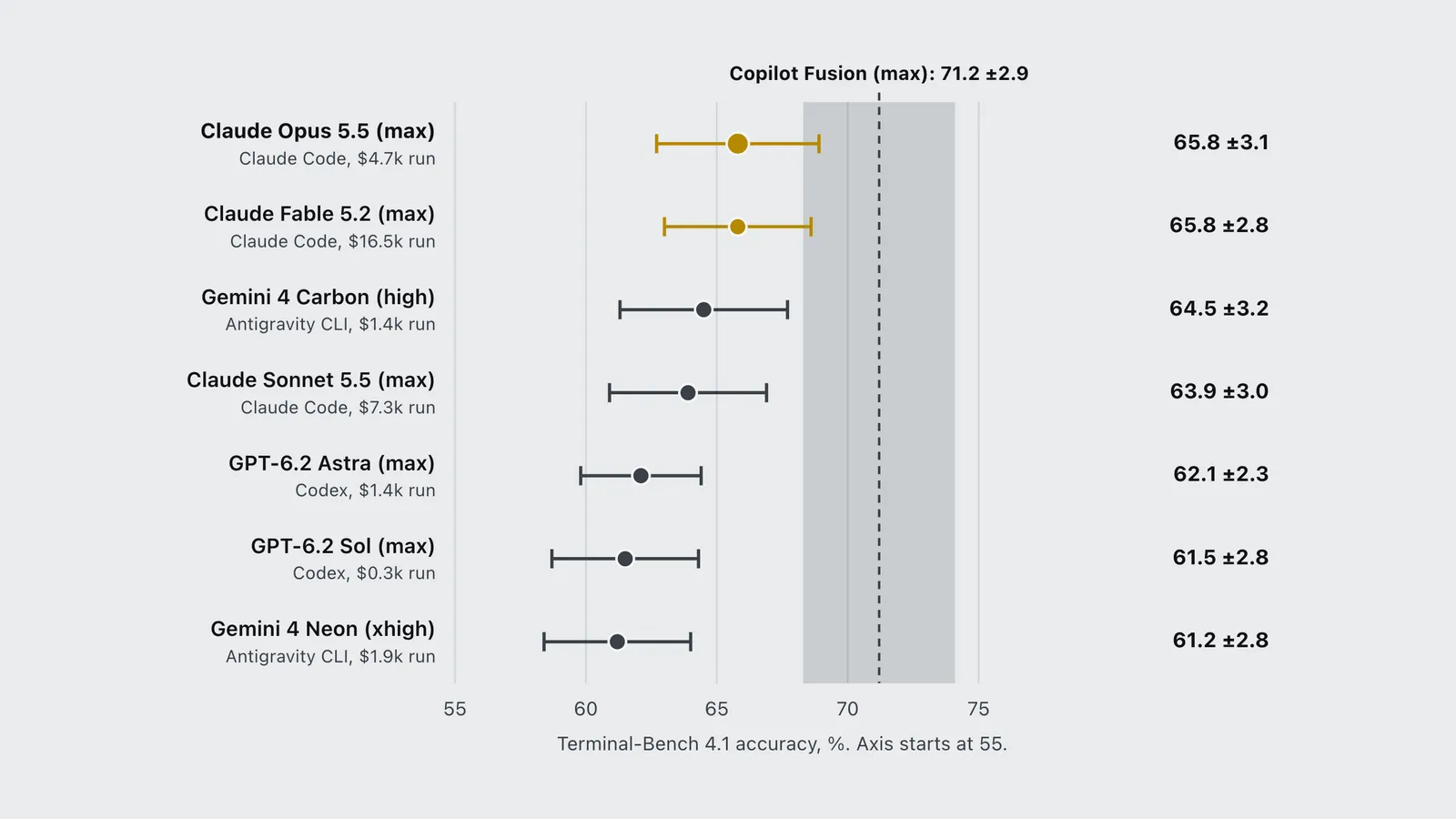
GitHub Copilot Fusion leads Terminal-Bench 4.1 at 71.2%, 5.4 points ahead of Claude Code running Opus 5.5 or Fable 5.2 (both 65.8%). Its run cost $2.0k against $4.7k and $16.5k. Fusion is not a model: it routes work between Claude and GPT models.
That last point is the story. The top of the most-cited terminal benchmark is now held by a product that calls Anthropic’s and OpenAI’s models, including the Opus 5.5 it beats, and decides per task which ones to use and how to combine them. The lead is real by the board’s own margins, but it is a lead on one benchmark. On Artificial Analysis’s broader coding-agent index, Fusion sits two points behind Claude Code with Opus 5.5.
| Terminal-Bench 4.1, top of board | Agent | Accuracy (95% CI) | Run cost | Tokens |
|---|---|---|---|---|
| Copilot Fusion (max) | GitHub Copilot | 71.2% ± 2.9 | $2.0k | 3.3B |
| Claude Opus 5.5 (max) | Claude Code | 65.8% ± 3.1 | $4.7k | 8.0B |
| Claude Fable 5.2 (max) | Claude Code | 65.8% ± 2.8 | $16.5k | 15.7B |
| Gemini 4 Carbon (high) | Antigravity CLI | 64.5% ± 3.2 | $1.4k | 3.8B |
| Claude Sonnet 5.5 (max) | Claude Code | 63.9% ± 3.0 | $7.3k | 19.4B |
| GPT-6.2 Astra (max) | Codex | 62.1% ± 2.3 | $1.4k | 1.1B |
| GPT-6.2 Sol (max) | Codex | 61.5% ± 2.8 | $0.3k | 1.1B |
| Gemini 4 Neon (xhigh) | Antigravity CLI | 61.2% ± 2.8 | $1.9k | 3.2B |
All figures are from the Terminal-Bench 4.1 leaderboard, read November 22, 2026. The board lists 54 entries; Fusion’s row is dated November 17, 2026. Run cost is the board’s total for the whole submission, shown rounded to the nearest $100.
What is Copilot Fusion doing on a benchmark task?
Routing and orchestrating models, not running one. GitHub’s documentation, About GitHub Copilot Fusion, calls it “an intelligent runtime model router and orchestrator.” You pick Fusion in the model picker instead of a named model, choose an effort level, and Fusion picks the models and an execution pattern for each prompt, returning one answer. GitHub chief product officer Mario Rodriguez put it more bluntly to VentureBeat: “It’s not a model. It’s an orchestration engine at runtime.”
The docs describe three execution patterns:
- Single: one model does the task.
- Cascade: an efficient model drafts, and a judge accepts the draft or escalates to a stronger model.
- Critique: one model drafts while several others critique it in parallel, then the original model revises.
Fusion chooses a pattern per prompt, so one session can mix all three. It also weighs live system health and availability, and tries to keep the main conversation on one model to preserve cached tokens. Intermediate drafts are not shown.
GitHub launched it as generally available on October 28, 2026 at its Universe conference, per the launch changelog, which says it combines the orchestration from the earlier Project HydraFusion research preview with Copilot’s auto model selection. Anyone who had auto, HydraFusion or HydraFusion Max switched on was moved to the matching Fusion level. The full explainer, with every plan, the effort levels and how billing works, is in GitHub Copilot Fusion: plans, pricing and how it works.
Which Copilot plans can run the configuration that scored 71.2%?
The leaderboard entry is Fusion at Max effort. Per GitHub’s documentation, About GitHub Copilot Fusion, Fusion Max is included on Copilot Pro+ ($39 a month), Max ($100), Business ($19 a seat) and Enterprise ($39 a seat); Free, Student and Pro get only Fusion Standard, which has no public Terminal-Bench score. GitHub Enterprise Cloud customers can also reach it through the newer Copilot access option, and GitHub Enterprise Server has no Copilot at all. Plan by plan, with credit allowances and the Enterprise terms, see GitHub Copilot Fusion: plans, pricing and how it works.
Which models does Copilot Fusion use?
GitHub’s docs do not publish a full list, and say the pool “may change over time.” The best public account comes from Artificial Analysis, the independent benchmarking service, whose October 28 write-up says Fusion orchestrates Anthropic and OpenAI models “including” Claude Opus 5.5, Claude Sonnet 5.5, GPT-6 Astra and GPT-6 Sol. GitHub’s November 17 changelog then added Claude Sonnet 5.5 to Fusion Max, GPT-6.1 Terra to Fusion High and Microsoft’s MAI-Code-2 to Fusion Standard.
So the name is accurate in one sense: on High and Max, Fusion can run more than one model on a single task. It is not a merged or distilled model, and nothing published says it uses Gemini. Which models a given task touched is not shown to the user, though enterprise admins can see the pool and remove models from it.
How big is Copilot Fusion’s Terminal-Bench 4.1 lead?
5.4 points over the joint second place, and 6.7 over the best Gemini entry. Fusion’s 71.2% sits against 65.8% for both Claude Code rows, 64.5% for Gemini 4 Carbon in Antigravity CLI and 62.1% for the best Codex entry, GPT-6.2 Astra.
Whether that is a real gap depends on the intervals, and the board publishes them. Fusion’s 95% interval runs from 68.3% to 74.1%. Opus 5.5’s runs up to 68.9% and Fable 5.2’s to 68.6%, so the two top Claude intervals overlap Fusion’s by 0.6 and 0.3 points. Overlapping intervals do not mean a tie, though. The uncertainty on a difference between two independent runs is about the square root of the summed squares, roughly ±4.2 points against Opus 5.5, and the 5.4-point gap clears it. Everything from Carbon down is clear of Fusion’s band.
| Model | Runs | Score | Uncertainty (±) |
|---|---|---|---|
| Copilot Fusion (max) (reference) | API | 71.2 | 2.9 |
| Claude Opus 5.5 (max) (Claude Code, $4.7k run) | Local | 65.8 | 3.1 |
| Claude Fable 5.2 (max) (Claude Code, $16.5k run) | Local | 65.8 | 2.8 |
| Gemini 4 Carbon (high) (Antigravity CLI, $1.4k run) | API | 64.5 | 3.2 |
| Claude Sonnet 5.5 (max) (Claude Code, $7.3k run) | API | 63.9 | 3.0 |
| GPT-6.2 Astra (max) (Codex, $1.4k run) | API | 62.1 | 2.3 |
| GPT-6.2 Sol (max) (Codex, $0.3k run) | API | 61.5 | 2.8 |
| Gemini 4 Neon (xhigh) (Antigravity CLI, $1.9k run) | API | 61.2 | 2.8 |
A second, independent measurement points the same way. Artificial Analysis ran Fusion Max in the Copilot CLI on Terminal-Bench 4.0 for its own coding-agent index and got 71, which it called “a slight lead” over the field. That is a different version of the benchmark run by a different team, landing on nearly the same number.
Version 4.1 itself is a regrade, not a new test. The Terminal-Bench 4.1 release note keeps 4.0’s task set and hardens the verifiers against reward hacking; regrading the 4.0 board moved about 1.16% of 11,550 trials and left every entry inside its old interval. Opus 5.5 in Claude Code rose from 64.85% to 65.76% in that regrade. The full version history is in Terminal-Bench 4.0: the $234 solved task and Terminal-Bench 4.1.
How much does Copilot Fusion cost per solved task?
About $8.50 on the leaderboard run, against about $21.70 for Claude Code with Opus 5.5 and $76 for Fable 5.2. Those are this site’s arithmetic, not figures the board publishes: the run cost divided by the solved trials, where solved trials are the accuracy times 330 (Terminal-Bench 4.x runs 66 tasks five times each). Because the board rounds run cost to $100, treat each figure as accurate to a few percent, and much less for the cheapest rows.
| Entry | Accuracy | Solved of 330 | Run cost | Cost per solved task (derived) |
|---|---|---|---|---|
| Copilot Fusion (max) | 71.2% | 235 | $2.0k | about $8.50 |
| Claude Opus 5.5 (max) | 65.8% | 217 | $4.7k | about $21.70 |
| Claude Fable 5.2 (max) | 65.8% | 217 | $16.5k | about $76 |
| Gemini 4 Carbon (high) | 64.5% | 213 | $1.4k | about $6.60 |
| Claude Sonnet 5.5 (max) | 63.9% | 211 | $7.3k | about $34.60 |
| GPT-6.2 Astra (max) | 62.1% | 205 | $1.4k | about $6.80 |
| GPT-6.2 Sol (max) | 61.5% | 203 | $0.3k | about $1.50 |
| Gemini 4 Neon (xhigh) | 61.2% | 202 | $1.9k | about $9.40 |
GitHub’s changelog says the run cost “88% less than Fable 5.2 and 57% less than Opus 5.5,” and the board’s totals support both: $2.0k is 12% of $16.5k and 43% of $4.7k. Fusion also used 3.3 billion tokens against 8.0 billion for Opus 5.5 and 15.7 billion for Fable 5.2, which is where the saving comes from. Cascade only escalates when a cheap draft fails its check.
Fusion is not the cheapest route to a good score, though. Gemini 4 Carbon and GPT-6.2 Astra each solve about 30 fewer trials for roughly $6.60 to $6.80 per solve, and GPT-6.2 Sol gets to 61.5% for about $1.50. Fusion is the cheapest way to the top of this board, and the only entry above 66%. The board does not say what rates it billed Fusion’s underlying models at, or whether GitHub’s launch discount applied.
Why does a harness, not a model, top the board?
Because Terminal-Bench scores the agent and the model together, and Fusion changes both the agent and how the models are used. Every row on the board is a pair: Opus 5.5 in Claude Code, Astra in Codex, Carbon in Antigravity CLI. The 4.0 board already showed how much the harness matters. Grok 4.7 scored 37.58% in xAI’s own Grok Build and 25.8% when Artificial Analysis ran the same weights on a standard harness, a gap covered in the Terminal-Bench 4.0 analysis.
Fusion pushes that one step further. A cascade that drafts with a cheaper model and escalates on failure, or a critique where several models review a draft, is extra checking per task, and long terminal tasks reward exactly that: catching a wrong turn before it compounds. It also means Fusion’s score borrows heavily from the models underneath it. Claude Code with Opus 5.5 is a single-model baseline; Fusion Max can call Opus 5.5 and then have GPT models check the work. The fair reading is not that GitHub out-built Anthropic’s model. It is that the right combination of frontier models in a well-tuned loop beats any one of them alone on this benchmark.
The same pattern is showing up outside GitHub. Artificial Analysis also lists Devin Fusion, Cognition’s pairing of Opus 5.5 at max with GPT-6 Luna at high, at 62 on its Coding Agent Index, the background to the Windsurf to Devin rebrand. How harness choices compound is covered in harness engineering techniques.
Is Copilot Fusion better than Claude Code or Codex?
On Terminal-Bench 4.1, yes. Across a broader coding mix, not clearly. Artificial Analysis’s Coding Agent Index v2.0 weights three benchmarks equally, and on its October 28 reading Fusion Max scored 60, two points behind Claude Code with Opus 5.5 at max. It led Terminal-Bench 4.0 at 71 but trailed on FrontierCode, 51 against 56 for Claude Code with Opus 5.5 and 54 for Devin Fusion, and scored 57 on SWE-Atlas-QnA-AA. Its cost per index task was $5.59 against $11.42 for Claude Code with Opus 5.5, at 7.2 million tokens per task, about half.
That index moves, and newer entries have arrived since. On November 18 Artificial Analysis put Gemini 4 Neon at xhigh, run in Antigravity CLI, top of the same index at 59, with Claude Code plus Fable 5.2 and Opus 5.5 at 58. Those readings are three weeks apart and Artificial Analysis recalibrates, so treat the ordering near the top as a cluster rather than a ranking.
| Measure | Copilot Fusion (max) | Claude Code + Opus 5.5 (max) | Source and date |
|---|---|---|---|
| Terminal-Bench 4.1 | 71.2% | 65.8% | tbench.ai, Nov 22 |
| Run cost, Terminal-Bench 4.1 | $2.0k | $4.7k | tbench.ai, Nov 22 |
| AA Coding Agent Index v2.0 | 60 | 62 | Artificial Analysis, Oct 28 |
| AA cost per index task | $5.59 | $11.42 | Artificial Analysis, Oct 28 |
| FrontierCode (AA) | 51 | 56 | Artificial Analysis, Oct 28 |
GitHub’s marketing reaches further than either board. Its launch changelog says Fusion Max finished about 40% faster per task, and GitHub’s Kyle Daigle posted “up to 77% lower cost.” As VentureBeat reported, the 40% time figure is GitHub-reported and absent from Artificial Analysis’s published data, and the 77% comes from GitHub’s own DeepSWE tests, whose configurations were not published. Neither is independently checked.
Does the benchmark cost match what you pay in Copilot?
Not necessarily. GitHub bills each model Fusion calls “at that model’s standard rate,” per its docs, in AI credits at one cent each, with no Fusion surcharge, and paid plans get 30% off Fusion model costs through November 30, 2026. Whether the board’s $2.0k run reflects list rates or that discount is not stated. What included credits buy on each plan, and when extra usage starts, is worked through in the Copilot Fusion plans and pricing guide.
Should you switch to Copilot Fusion?
If you already pay for Copilot Pro+, Max, Business or Enterprise, try Fusion Max on your hardest agent tasks. It is the top-scoring configuration on the most rigorous terminal benchmark, at well under half the run cost of Claude Code with Opus 5.5, and it costs nothing to switch on. On Pro, you get only Fusion Standard, which the leaderboard has not measured.
If you live in Claude Code, the case is weaker than the headline. Claude Code with Opus 5.5 is level or ahead on the broader index, and its leaderboard interval reaches Fusion’s. The saving is the stronger argument: about $8.50 per solved Terminal-Bench task against $21.70. If cost per task is all that matters, GPT-6.2 Sol in Codex or Gemini 4 Carbon in Antigravity CLI solve slightly fewer tasks for much less. Rates and models for all of them are on the AI model tracker, and modelled harness costs are on the coding-agent cost-per-task tracker.
How do you run Fusion Max yourself?
Select Copilot Fusion in the model picker and choose Max, on a plan that includes it (Pro+, Max, Business or Enterprise). Max is the configuration behind the 71.2%; High and Standard have no public Terminal-Bench score. Review diffs before committing, because edits from a discarded draft stay in your workspace. Admin setup and budgets are covered in the Fusion plans and pricing guide.
Frequently asked questions
- Has Copilot Fusion Standard or High been benchmarked?
- Not publicly, as of November 22, 2026. The Terminal-Bench 4.1 entry and the Artificial Analysis Coding Agent Index reading both use Fusion Max. Standard and High, the levels most Copilot users run day to day, have no published score on either board.
- What is Copilot Fusion's Terminal-Bench 4.1 score?
- Copilot Fusion at max effort scores 71.2% with a 95% interval of plus or minus 2.9 points on the Terminal-Bench 4.1 leaderboard, first of 54 entries as of November 22, 2026. Claude Code with Opus 5.5 and with Fable 5.2 tie second at 65.8%, and Gemini 4 Carbon in Antigravity CLI is fourth at 64.5%.
- Which models does Copilot Fusion use?
- GitHub does not publish a full list. Artificial Analysis reported that Fusion orchestrates Anthropic and OpenAI models including Claude Opus 5.5, Claude Sonnet 5.5, GPT-6 Astra and GPT-6 Sol. GitHub's November 17 update added Sonnet 5.5 to Fusion Max, GPT-6.1 Terra to Fusion High and MAI-Code-2 to Fusion Standard.
- Which Copilot Fusion level scored 71.2% on Terminal-Bench 4.1?
- Fusion Max, the highest user-selectable effort level, per the Terminal-Bench 4.1 leaderboard entry dated November 17, 2026. No score has been published for Fusion Standard or Fusion High, the levels on lower Copilot plans or used for everyday work.
- How much did the Copilot Fusion Terminal-Bench run cost?
- The board lists a total run cost of about $2.0k for Copilot Fusion (max), against $4.7k for Claude Code with Opus 5.5 and $16.5k for Claude Code with Fable 5.2. Divided by solved trials, that is about $8.50 per solved task for Fusion against about $21.70 for Opus 5.5, by this site's arithmetic.
- Is Copilot Fusion's Terminal-Bench lead statistically real?
- Yes, by the board's own margins. Fusion scores 71.2% plus or minus 2.9, and the next entries score 65.8% plus or minus 3.1 and 2.8. The intervals overlap slightly, but the 5.4-point gap exceeds the roughly 4.2-point uncertainty on the difference between two independent runs.
- Is Copilot Fusion better than Claude Code?
- On Terminal-Bench 4.1 it leads Claude Code with Opus 5.5 by 5.4 points for 43% of the run cost. On Artificial Analysis's broader Coding Agent Index, read October 28, 2026, Fusion Max scored 60 against 62 for Claude Code with Opus 5.5, at $5.59 per task against $11.42. It leads the terminal benchmark and trails on FrontierCode.
Sources
Terminal-Bench (2026). Terminal-Bench 4.1 leaderboard. Benchmark owner’s board (Stanford, Laude Institute, Harbor): accuracy, 95% intervals, run cost, tokens and dates for 54 entries. https://www.tbench.ai/leaderboard/terminal-bench/4.1 Read 2026-11-22.
Terminal-Bench Team (2026). Terminal-Bench 4.1. Release note: verifier hardening, 11,550 regraded trials, Opus 5.5 regrade from 64.85% to 65.76%. https://www.tbench.ai/news/terminal-bench-4-1 Read 2026-11-22.
GitHub (2026). About GitHub Copilot Fusion. GitHub Docs: execution patterns, effort levels, plan table (Fusion Max on Pro+, Max, Business, Enterprise), billing, limitations. https://docs.github.com/en/copilot/concepts/models/copilot-fusion Read 2026-11-22.
GitHub (2026). Route and orchestrate models with GitHub Copilot Fusion. GitHub Changelog, October 28, 2026: general availability, HydraFusion origin, 30% discount, vendor benchmark claims. https://github.blog/changelog/2026-10-28-route-and-orchestrate-models-with-github-copilot-fusion/
GitHub (2026). GitHub Copilot Fusion updates: more availability, benchmarks, and models. GitHub Changelog, November 17, 2026: Terminal-Bench 4.1 result and cost claims, new surfaces, model additions. https://github.blog/changelog/2026-11-17-github-copilot-fusion-updates-more-availability-benchmarks-and-models/
Artificial Analysis (2026). GitHub Copilot Fusion orchestrates Anthropic and OpenAI models to balance performance and cost. Independent benchmarking service, article, October 28, 2026: Coding Agent Index v2.0, cost and tokens per task, model pool. https://artificialanalysis.ai/articles/github-copilot-fusion-orchestrates-anthropic-and-openai-models-to-balance-performance-and-cost
Franzen, C. (2026). GitHub Copilot Fusion mixes models to achieve near-Opus 5.5 coding performance at half the per-task cost. VentureBeat, October 28, 2026. Secondary coverage: Rodriguez quote, provenance of the 40% and 77% claims. https://venturebeat.com/orchestration/github-copilot-fusion-mixes-models-to-achieve-near-opus-5-5-coding-performance-at-half-the-per-task-cost
Daigle, K. (2026). Post on X about Copilot Fusion cost and speed. https://x.com/kdaigle/status/2115478825928925349