Gemini 4 Neon: Pricing, Benchmarks, Cost per Task
Gemini 4 Neon costs a flat $3 and $15 per million tokens. It scores 60 on the Artificial Analysis index for $3.74 a task, half what Gemini 4 Carbon costs.
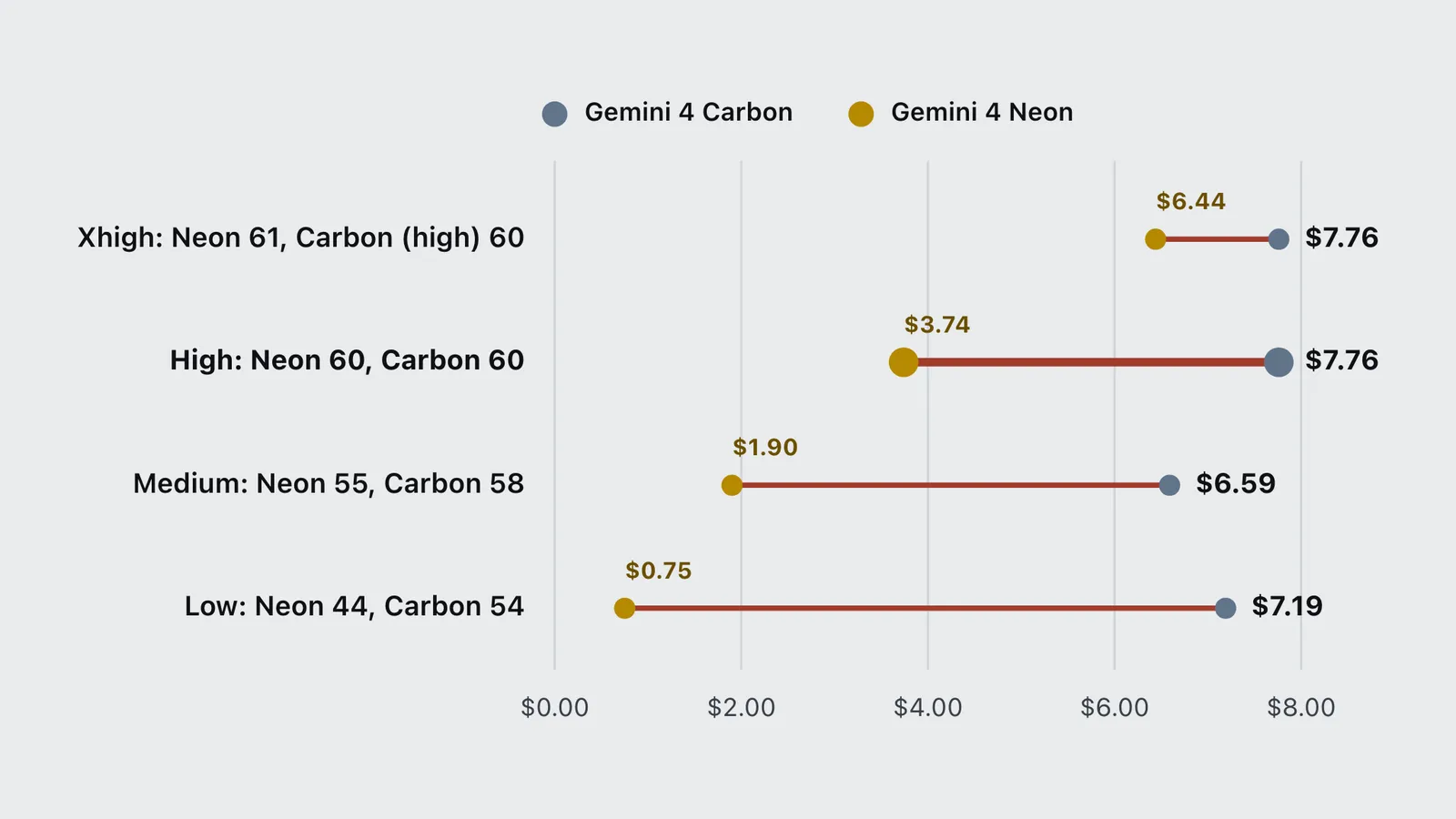
Gemini 4 Neon costs a flat $3 per million input tokens and $15 output, with no introductory rate. At its default high effort it scores 60 on the Artificial Analysis index for $3.74 a task, half Carbon’s cost.
That makes Neon the cheapest way to reach 60 inside Google’s lineup, and from December 1, when Carbon moves to $4 and $20, it is also 25% cheaper per token. It is not the cheapest route to 60 overall: GPT-6.2 Astra gets there for less per task. Neon’s other edge is speed, roughly twice Carbon’s output rate.
Google introduced Gemini 4 Neon on November 18, 2026, three weeks after Gemini 4 Carbon and six days after Gemini 4 Hydrogen. It sits between the two: Google says Carbon “tackles your hardest, long-horizon projects”, Hydrogen “handles fast, everyday execution”, and Neon “balances depth and efficiency”. Google’s model card says Neon is “adapted from Gemini 4 Carbon”.
| Gemini 4 Neon | Rate or status |
|---|---|
| Input, per Mtok | $3.00 |
| Output, per Mtok | $15.00 (thinking tokens included) |
| Cached input, per Mtok | $0.15 (implicit caching only) |
| Batch and Flex, per Mtok | $1.50 in, $7.50 out |
| Priority, per Mtok | $5.40 in, $27.00 out |
| Introductory period | None; no dated price change |
| Free API tier | None |
| Who can use it | Any paid Gemini API account, since November 18 |
| Apps | Gemini app and Antigravity for AI Pro and Ultra |
| Model ID | gemini-4-neon |
| Context | 1,048,576 tokens, shared by input and output |
| Cost per AA index task, high | $3.74 for a score of 60 (Artificial Analysis) |
How much does Gemini 4 Neon cost?
$3 per million input tokens and $15 per million output, per the Gemini API pricing page (checked November 21). Cached input is $0.15, a 95% discount, but only through implicit caching: Neon does not support explicit context caches. Batch and Flex halve the card to $1.50 and $7.50, and Priority costs $5.40 and $27. The page lists one rate for the whole window, with no long-context surcharge.
What Neon does not have is an introductory price. Argon and Carbon both list $2 and $10 through November 30, then $4 and $20 from December 1. So through November 30 Neon is 50% more expensive per token than its bigger sibling, and from December 1 it is 25% cheaper. It costs exactly twice Gemini 4 Hydrogen’s $1.50 and $7.50.
When can you use Gemini 4 Neon?
Now, on any paid account. Google’s announcement puts Neon on the Gemini API paid tier and in AI Studio from November 18, in Gemini for business through the API and the model picker, in Google Antigravity for paid AI Pro and Ultra subscribers, and in the Gemini app for Pro and Ultra subscribers. The pricing page confirms it is not on the free tier. A cyber-specialised version is reaching trusted defenders through Google’s Fairwind Program “over the next few days”, the gate Carbon and Argon launched behind.
The Gemini Enterprise Agent Platform model page lists Neon as generally available, with a March 2026 knowledge cutoff, text, image, audio and video input, and text output. A single non-streaming call can return up to 65,536 tokens, double Argon’s 32,768. Google’s developer guide calls Neon “the target upgrade for Gemini 3.1 Pro” and for general coding and reasoning work on Argon. As reported by 9to5Google, Neon also replaces Argon in the Gemini app.
What does a task cost on Gemini 4 Neon?
$3.74 at its default high effort, for a score of 60, and $6.44 at xhigh for 61. Those are Artificial Analysis figures, an independent benchmarking service that ran its Intelligence Index v5 at Neon’s $3 and $15. Carbon at high also scores 60 and costs $7.76 a task at its $4 and $20 standard rate. Same score, 52% less money.
Neon’s cost scales with effort. Carbon’s barely moves. Carbon costs between $6.59 and $7.76 a task at every setting Artificial Analysis tested, while Neon runs from $0.75 at low to $6.44 at xhigh. The catch is at the bottom: at low effort Neon scores 44 against Carbon’s 54, so the cheap settings are cheap partly because they do less.
| Item | Gemini 4 Carbon | Gemini 4 Neon |
|---|---|---|
| Xhigh: Neon 61, Carbon (high) 60 | $7.76 | $6.44 |
| High: Neon 60, Carbon 60 | $7.76 | $3.74 |
| Medium: Neon 55, Carbon 58 | $6.59 | $1.90 |
| Low: Neon 44, Carbon 54 | $7.19 | $0.75 |
Until November 30 the comparison is closer. Carbon’s introductory card is exactly half its standard one, so the same work at high would cost about $3.88, a derived figure, just above Neon’s $3.74. Neon at xhigh ($6.44) costs more than Carbon at its introductory rate. After December 1, Neon is cheaper at every setting.
The extra point at xhigh is expensive. It costs $2.70 more per task, 72% on top of high, and Artificial Analysis recorded 283 million output tokens at xhigh against 123 million at high. Google’s announcement claims Neon at high costs 32% less per task than Carbon; it does not say which Carbon rate or setting that compares against, and the independent figure at matched settings is larger.
Is Gemini 4 Neon better than Gemini 4 Carbon?
Faster and cheaper per task, about even on score. On Artificial Analysis, Neon at xhigh scores 61 against Carbon’s 60 at high, and at high both score 60. Neon writes about 106 output tokens a second against Carbon’s 56, and finishes an index task in 14.3 minutes at high against Carbon’s 36.6.
Carbon keeps some ground. In the same Artificial Analysis comparison it scores 69.0% on the CritPt physics evaluation against Neon’s 60.5% at xhigh, and 65.2% on Terminal-Bench 4.0 against 63.6%. At low effort it holds 54 where Neon drops to 44. Neon leads on HLE-Diamond (71.3% against 69.1%), FrontierCode-AA 2.0 (44.4% against 40.6%) and Terminal-Bench-Science (70.0% against 64.8%).
Google’s own security figures, all vendor-reported, point the same way. It reports 90.5% on SEC-bench Pro against 88.2% for Carbon at launch, 70.7% on CWE-bench v2, and says Neon writes more secure code than Carbon on every AutoBaxBench tier, with 76% on the hard tier.
Should Gemini 4 Argon users switch to Neon?
Yes, and Google says so. Its developer guide names Neon as the upgrade for general coding and reasoning work on Gemini 4 Argon. Argon scores 50 on Artificial Analysis at high and now costs $9.95 per index task at its $4 and $20 standard rate. Neon at high scores ten points more for $3.74. From December 1 Neon is also cheaper per token.
The migration is not just a model-ID swap. The guide says Neon ignores custom temperature, top_k and top_p, returns an error for frequency_penalty, presence_penalty, thinking_budget and the MINIMAL thinking level, and drops explicit caching. Argon defaults to medium thinking; Neon defaults to high, so a workload tuned for Argon’s latency should set thinking_level to medium explicitly.
How does Gemini 4 Neon compare with GPT-6.2 Astra?
Astra is cheaper per task, and Neon is faster. GPT-6.2 Astra lists $8 and $40 per million tokens, more than twice Neon’s card, but on Artificial Analysis it scores 62 at max for $4.00 a task, a point above Neon at xhigh for $2.44 less. At high effort Astra also scores 60, for $2.07 a task as read on November 18, against Neon’s $3.74. Astra spends far fewer tokens per task, and that outweighs its higher rate.
Speed is Neon’s case. Artificial Analysis measures Astra at about 48 output tokens a second against Neon’s 106. On the independent Zapier AutomationBench board (v1.0.6, read November 21), Neon at xhigh leads at 56.32% for $1.69 a task, ahead of Carbon at high (53.88%) and Astra at max (52.36%). The full Astra reading is in GPT-6.2 Astra and Sol: pricing, benchmarks, cost per task.
How does Gemini 4 Neon compare with Claude Fable 5.2 and Opus 5.5?
Fable 5.2 scores higher and costs far more. Claude Fable 5.2 tops Artificial Analysis at 65 at max effort for $26.54 a task, and scores 62 at its default high for $9.08. Neon at high gets within two points of that for 41% of the cost. Claude Opus 5.5 scores 59 at max for $10.04, below Neon at high for nearly three times the money.
On coding agents specifically, the Artificial Analysis launch note puts Neon at xhigh first on its Coding Agent Index at 59, run in the Antigravity CLI, against 58 for both Claude Code with Fable 5.2 at xhigh and Opus 5.5 at max. Neon costs $6.86 per task there, against $12.61 for Opus 5.5 and $15.47 for Fable 5.2.
The independent Vals Index ranks Neon second of 43 at 70.87% (±0.94), at $7.41 per test and about 31 minutes of latency. Vals ranks it first on its Finance Index (68.31%), its Legal Index, Legal Research Bench and Tax Agent Bench. How the two independent boards weigh work differently is in why the Vals Index and Artificial Analysis rank models differently.
| Model (AA highest-scoring setting) | AA index | Cost per index task | Rate card, per Mtok |
|---|---|---|---|
| Claude Fable 5.2 (max) | 65 | $26.54 | $8 / $40 |
| GPT-6.2 Astra (max) | 62 | $4.00 | $8 / $40 |
| Gemini 4 Neon (xhigh) | 61 | $6.44 | $3 / $15 |
| Gemini 4 Neon (high, default) | 60 | $3.74 | $3 / $15 |
| Gemini 4 Carbon (high) | 60 | $7.76 | $4 / $20 from Dec 1 |
| Claude Opus 5.5 (max) | 59 | $10.04 | $4 / $20 |
| GPT-6.2 Sol (max) | 57 | $1.01 | $2 / $10 |
| Gemini 4 Hydrogen (xhigh) | 54 | $3.16 | $1.50 / $7.50 |
| Gemini 4 Argon (high) | 50 | $9.95 | $4 / $20 from Dec 1 |
Which Gemini 4 model should you use?
Neon, for most work on Google’s stack. At high it matches Carbon’s score for half the cost per task and finishes in under half the time. Carbon is worth its price for the hard reasoning rows where it still leads, such as physics, and for workloads that need strong results at low effort. Hydrogen, at half Neon’s rate card and with a free tier, is the pick for high-volume everyday loops, which is also where Google’s guide points them. Argon has no remaining case once its rate doubles on December 1.
Outside Google, the choice depends on what you are buying. GPT-6.2 Astra reaches 60 to 62 for less per task if latency does not matter. GPT-6.2 Sol reaches 57 for $1.01. Fable 5.2 is the only route to 65.
How do you start using Gemini 4 Neon?
- Turn on billing for the Gemini API. Neon is not on the free tier, so a free AI Studio key will not reach it.
- Call
gemini-4-neon. It is the model ID on Google’s pricing page and Agent Platform model page. - Pick a thinking level on purpose. High is the default and the best value on the index; xhigh buys one point for 72% more per task; medium and low are cheap but give up 5 and 16 points.
- Strip unsupported parameters. Remove
frequency_penalty,presence_penalty,thinking_budgetand explicitcached_contentbefore switching from Argon or 3.1 Pro. - Budget at $3 and $15. There is no introductory window to expire, so today’s rate is the planning rate.
Live rates for every model are on the AI model tracker, and the release is logged in the AI model release timeline and in new AI models released in November 2026.
Frequently asked questions
- How much does Gemini 4 Neon cost?
- Gemini 4 Neon costs $3 per million input tokens and $15 per million output tokens on the Gemini API, with cached input at $0.15 through implicit caching. Batch and Flex cost $1.50 and $7.50, and Priority $5.40 and $27. There is no introductory rate, no dated price change and no free API tier.
- Is Gemini 4 Neon available to the public?
- Yes. Since November 18, 2026 Gemini 4 Neon is generally available to any paid Gemini API account as gemini-4-neon, in AI Studio, Gemini for business, Google Antigravity for paid AI Pro and Ultra subscribers, and the Gemini app for Pro and Ultra subscribers. It is not on the free API tier.
- Is Gemini 4 Neon better than Gemini 4 Carbon?
- It scores about the same and costs less per task. Artificial Analysis scores Neon 61 at xhigh and 60 at high, against Carbon at 60 at high. At high, Neon costs $3.74 per index task against $7.76 for Carbon at its $4 and $20 standard rate, and runs about twice as fast. Carbon still leads on CritPt physics and Terminal-Bench 4.0.
- What does a task cost on Gemini 4 Neon?
- Artificial Analysis measures $3.74 per Intelligence Index task at the default high effort, $6.44 at xhigh, $1.90 at medium and $0.75 at low. GPT-6.2 Astra reaches 62 at max for $4.00 a task, and Claude Fable 5.2 reaches 65 at max for $26.54.
- What is the Gemini 4 Neon context window?
- Gemini 4 Neon has a 1,048,576-token context window shared between input and output, with up to 65,536 output tokens in a single non-streaming call. Its knowledge cutoff is March 2026, and it accepts text, image, audio and video input with text output.
Sources
Google (2026). Introducing Gemini 4 Neon. Google blog announcement, November 18, 2026: availability, $3 / $15 rate card, vendor benchmarks. https://blog.google/innovation-and-ai/models-and-research/gemini-models/introducing-gemini-4-neon/ Verified 2026-11-21.
Google (2026). Gemini Developer API pricing. Google AI Studio documentation: Gemini 4 Neon standard, Batch, Flex and Priority rates, no free tier; Argon and Carbon $2 / $10 through November 30, then $4 / $20. https://aistudio.google.com/docs/pricing Checked 2026-11-21.
Google Cloud (2026). Gemini 4 Neon model page and Developer’s guide to Gemini 4 Neon. Gemini Enterprise Agent Platform documentation: GA status, token limits, knowledge cutoff, thinking levels, migration notes. https://docs.cloud.google.com/gemini-enterprise-agent-platform/models/gemini/4-neon and https://docs.cloud.google.com/gemini-enterprise-agent-platform/models/guides/gemini-4-neon Read 2026-11-21.
Google DeepMind (2026). Gemini 4 Neon model card. https://deepmind.google/models/model-cards/gemini-4-neon/
Artificial Analysis (2026). Gemini 4 Neon model page, Gemini 4 Neon vs Gemini 4 Carbon comparison, the models leaderboard (Intelligence Index v5), and Google continues to accelerate its release cadence with Gemini 4 Neon (article, November 18, 2026). Independent benchmarking service. https://artificialanalysis.ai/models/gemini-4-neon, https://artificialanalysis.ai/models/comparisons/gemini-4-neon-vs-gemini-4-carbon, https://artificialanalysis.ai/leaderboards/models and https://artificialanalysis.ai/articles/gemini-4-neon-intelligence-gain Read 2026-11-21.
Vals AI (2026). Gemini 4 Neon benchmarks, cost and capabilities. Independent evaluation, Vals Index. https://www.vals.ai/models/google_gemini-4-neon Read 2026-11-21.
Zapier (2026). AutomationBench leaderboard, v1.0.6. Benchmark owner’s board. https://zapier.com/benchmarks Read 2026-11-21.
9to5Google (2026). Google launches Gemini 4 Neon with Carbon quality at Flash speeds, live for AI Pro. Secondary coverage: Neon replacing Argon in the Gemini app. https://9to5google.com/2026/11/18/gemini-4-neon-announcement/