GLM-5.3-Flash: Price, Specs, and Benchmarks
GLM-5.3-Flash is Ox Alpha, officially: a 320B-A18B MoE model, 1M-token context, MIT license, and $0.15/$0.50 per million tokens. Specs, pricing, and benchmarks.
Z.ai confirmed on August 26, 2026 what tokenizer forensics and a leaked pre-embargo post had already pointed to: Ox Alpha, the free stealth model that absorbed billions of coding-agent tokens on OpenRouter and OpenCode, is GLM-5.3-Flash. The official launch post pairs the reveal with a full model card, benchmark table, and rate card, so the guessing game is over and the spec sheet is real.
Here is what it costs, what is actually inside it, how it benchmarks against the field, and what carries over from the Ox Alpha coverage.
How much does GLM-5.3-Flash cost?
Standard API pricing is $0.15 per million input tokens, $0.50 per million output tokens, and $0.03 per million cached input tokens, per Z.ai’s pricing, as listed on OpenRouter. That undercuts GLM-5.3, the text-only flagship it sits alongside, by roughly a factor of nine on input and output.
| Model | Input / Mtok | Output / Mtok | Cache read / Mtok | Position |
|---|---|---|---|---|
| GLM-5.3-Flash | $0.15 | $0.50 | $0.03 | new multimodal value tier |
| GLM-5.3 | $1.40 | $4.40 | $0.26 | text-only flagship |
| GLM-5.2 | $1.40 | $4.40 | $0.26 | prior open-weights flagship |
| DeepSeek V4 Flash | $0.44 | $1.32 | n/a | closest-priced competitor |
| Claude Opus 4.8 | $5.00 | $25.00 | $0.50 | US closed-frontier reference |
| Item | Standard rate | Launch-discount rate |
|---|---|---|
| Input $/Mtok | $0.15 | $0.075 |
| Output $/Mtok | $0.5 | $0.25 |
| Cached input $/Mtok | $0.03 | $0.015 |
For the dated, sourced rate card across every model this site tracks, the AI model tracker keeps GLM-5.3-Flash current alongside the rest, and the cost-per-task calculator prices it against Claude, GPT, and the rest of the open-weights field on your own workload shape.
What is GLM-5.3-Flash?
GLM-5.3-Flash is a mixture-of-experts model with 320 billion total parameters and 18 billion active per token, built on a 45-layer hybrid attention design that combines KDA linear-attention layers with NoPE sparse MLA layers, routing each token through 8 of 288 experts. Z.ai’s architecture notes, reported in detail by MarkTechPost, describe two specific optimizations: an “IndexPool” mechanism that compresses indexer key vectors for roughly 3x less attention compute and a 4.4x smaller KV cache than GLM-5.3, and “mHC” (manifold-constrained hyper-connections) that roughly halves both activated parameters and layer count against the older GLM-4.5 architecture for the same capability.
| Spec | GLM-5.3-Flash |
|---|---|
| Parameters | 320B total, 18B active (MoE) |
| Context window | 1,048,576 tokens (1M) |
| Maximum output | 131,072 tokens |
| Input / output | Text, image, video in; text out |
| License | MIT, weights on Hugging Face (zai-org/GLM-5.3-Flash) |
| Self-hosting | ~306 GiB FP8 checkpoint; Hopper-or-newer GPUs, 8-GPU node minimum |
| Released | August 26, 2026 |
It is the first natively multimodal model in the GLM-5 series: GLM-5.3, released August 14, stayed text-only. That gap is exactly what fueled the Ox Alpha attribution case in the first place, since the stealth listing advertised image and video input that GLM-5.3 did not have.
Benchmarks: close to Claude Opus 4.8, far cheaper
Z.ai’s own launch benchmarks, corroborated by the Hugging Face model card, put GLM-5.3-Flash within half a point of Claude Opus 4.8 on the company’s internal coding benchmark and comfortably ahead of GLM-5.2, the model it is priced to replace at the value tier.
| Benchmark | GLM-5.3-Flash | GLM-5.2 | Claude Opus 4.8 |
|---|---|---|---|
| Terminal-Bench 2.1 | 84.3 | n/a | 85.0 |
| Z.ai Code Bench v1.0 | 29.0 | n/a | 29.5 |
| DeepSWE v1.1 | 63.4 | 46.2 | n/a |
| AutomationBench | 48.8 | 26.2 | n/a |
| Humanity’s Last Exam (HLE) | 55.3 | n/a | n/a |
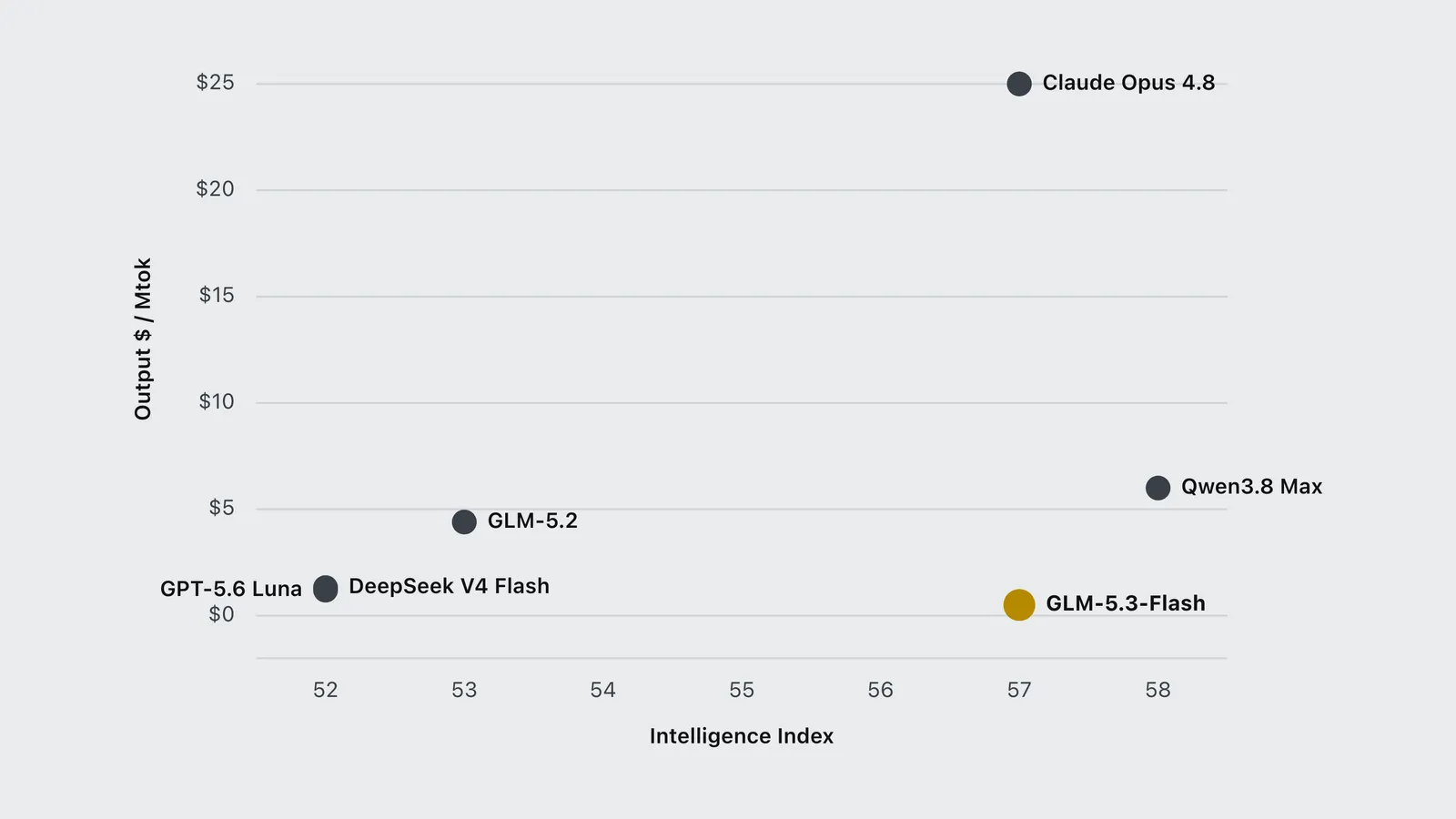
These are vendor-reported and self-selected comparison points, the same caveat that applies to any launch-day scorecard; treat them as a maker-set ceiling rather than an independent reproduction. The one third-party check available is the Artificial Analysis Intelligence Index, which scores GLM-5.3-Flash at 57, exactly level with Claude Opus 4.8 and just behind Qwen3.8 Max in a set of comparably priced models, at a small fraction of the price of any closed-frontier competitor in the set.
| Item | Intelligence Index | Output $ / Mtok |
|---|---|---|
| GLM-5.3-Flash | 57 | $0.5 |
| Claude Opus 4.8 | 57 | $25 |
| Qwen3.8 Max | 58 | $6 |
| GLM-5.2 | 53 | $4.4 |
| DeepSeek V4 Flash | 52 | $1.32 |
| GPT-5.6 Luna | 52 | $1.2 |
Z.ai’s own framing of the release, as reported by MarkTechPost, is that GLM-5.3-Flash beats GLM-5.2 across benchmarks and real-world workloads at roughly one-tenth the price, which is a stronger claim than “close to Opus 4.8” and the more useful one for anyone actually deciding what to run. Vision performance is the acknowledged weak point: the same reporting notes it trails Gemini’s flash-tier models on multi-image and video benchmarks, consistent with this being Z.ai’s first attempt at native multimodality rather than a mature strength.
This was Ox Alpha
The stealth phase is covered in full elsewhere on this site: a free, unclaimed listing that appeared on OpenRouter and OpenCode on August 20, 2026, served on Chinese-made AI chips through a custom SGLang-based serving stack Z.ai says delivered a threefold end-to-end efficiency gain, and identified in advance of the official reveal by tokenizer fingerprinting and a leaked, since-deleted post from an engineer at inference partner Nebius. That piece is the place to go for the identity-detective story; this one is the place to go for the finished spec sheet the detective work was chasing.
One practical carryover: anything sent to the free preview endpoint during the stealth week was, per OpenRouter’s own listing at the time, retained by an unnamed provider even though it was not used for training. Now that the provider has a name and the model has a rate card, that specific trust question is resolved, though the general advice to check a provider’s current retention terms before sending anything sensitive still applies.
Should you use it?
Three situations where GLM-5.3-Flash is worth a direct test:
- You are running high-volume coding-agent workloads on GLM-5.2 or a similarly priced open-weights model. The benchmark gap over GLM-5.2 is large enough (DeepSWE v1.1 up from 46.2 to 63.4, AutomationBench up from 26.2 to 48.8) that a straight swap is worth benchmarking on your own tasks, especially inside the discount window through September 9.
- You need multimodal input on a budget. It is the first GLM-5-series model that accepts images and video at all, at a price closer to a text-only budget model than to a multimodal frontier one.
- You are comparing against Claude Opus 4.8 on cost, not just capability. The two land on the same independent Intelligence Index score; the decision is then about ecosystem, tooling, and how much you trust vendor-reported coding benchmarks over the independent read, not about a capability gap.
It is also, on a same-day read of prices and coding composites, the strongest value pick for driving an agent harness: the best models for Hermes Agent in 2026 works out why it beats the model Hermes still ships as its default.
Where it is not yet the obvious pick: vision-heavy multi-image or video workloads, where the reporting above suggests it still trails purpose-built flash-tier multimodal models, and any workload where self-hosting matters, since the MIT license is generous but the ~306 GiB FP8 checkpoint needs a genuine multi-GPU Hopper-class node to run.
Frequently asked questions
- Is GLM-5.3-Flash the same model as Ox Alpha?
- Yes. Z.ai confirmed on August 26, 2026 that GLM-5.3-Flash is the official identity of Ox Alpha, the free anonymous stealth model that ran on OpenRouter and OpenCode starting August 20, 2026.
- How much does GLM-5.3-Flash cost?
- Standard pricing is $0.15 per million input tokens, $0.50 per million output tokens, and $0.03 per million cached input tokens. A launch promotion halves all three rates until September 9, 2026.
- Is GLM-5.3-Flash open weight?
- Yes. It ships under the MIT license with weights published on Hugging Face under zai-org/GLM-5.3-Flash, an FP8 checkpoint of roughly 306 GiB that requires a multi-GPU Hopper-class node to self-host.
- What is the context window of GLM-5.3-Flash?
- A 1,048,576-token (1M) context window with up to 131,072 tokens of output. It accepts text, image, and video input and produces text output, the first natively multimodal model in the GLM-5 series.
- How does GLM-5.3-Flash compare to Claude Opus 4.8?
- On the independent Artificial Analysis Intelligence Index, the two score identically at 57 as of August 27, 2026. GLM-5.3-Flash costs $0.50 per million output tokens against $25 for Claude Opus 4.8, though Z.ai's own coding benchmarks are self-reported and not independently reproduced.
Sources
- Z.ai (2026). GLM-5.3-Flash: Frontier Intelligence, Flash Cost. Official launch post. https://z.ai/blog/glm-5.3-flash (page is client-rendered; content corroborated below via MarkTechPost, Artificial Analysis, and the Hugging Face model card)
- Z.ai (2026). zai-org/GLM-5.3-Flash [model card, MIT license]. Hugging Face. https://huggingface.co/zai-org/GLM-5.3-Flash
- OpenRouter (2026). GLM 5.3 Flash: API Pricing & Providers (
z-ai/glm-5.3-flash). https://openrouter.ai/z-ai/glm-5.3-flash - MarkTechPost (2026). Z.ai Releases GLM-5.3-Flash: A 320B-A18B Natively Multimodal MoE With a 1M-Token Context. Published 2026-08-26. https://www.marktechpost.com/2026/08/26/z-ai-releases-glm-5-3-flash-a-320b-a18b-natively-multimodal-moe-with-a-1m-token-context/
- Artificial Analysis (2026). GLM-5.3-Flash: Intelligence, Performance & Price Analysis. Read 2026-08-27. https://artificialanalysis.ai/models/glm-5-3-flash
- Kingy.ai (2026). Ox Alpha Was GLM-5.3-Flash: Price, Specs and Open Weights. Published 2026-08-26. https://kingy.ai/blog/ox-alpha-free-opencode-stealth-model/