Ox Alpha Is Free: The Catch in the Data Policy
Ox Alpha lists $0 input and $0 output on OpenRouter and moves about 100 trillion tokens a day. Two data policies and an anonymous counterparty are the catch.
Ox Alpha is an anonymous AI model that appeared on the OpenRouter API marketplace on August 20, 2026, priced at zero, backed by more than a million tokens of context, and offered by a provider that refuses to say who it is. In its first days it absorbed billions of tokens of real coding-agent traffic, drew a public test from Stripe CEO Patrick Collison, and became the subject of a crowdsourced forensic effort that points, with real but unconfirmed confidence, at one specific Chinese lab. This piece covers what is confirmed, what the fingerprinting shows, how good the model appears to be, and the economics question nobody can answer yet: who pays for 100 trillion free tokens a day?
What is Ox Alpha?
Ox Alpha is what the industry calls a stealth model: a frontier-class system served through an API platform under an anonymous brand so the lab behind it can collect real-world traffic, feedback, and load data before putting its name on an official launch. The OpenRouter listing describes it as “a reasoning model designed for coding, sustained agentic work, and production workloads,” suited to long-horizon software engineering and workflows that mix text with visual context. OpenRouter states plainly that it only routes requests and is not the developer, owner, or operator.
The release was coordinated with OpenCode, the open-source coding agent, which announced the model would be free for about a week with near-unlimited usage, and that its provider had servicing capacity for 100 trillion tokens per day. For scale, Business Insider noted on August 22 that this is roughly 100 times the number of AI tokens Visa said it burns in an entire month. Stripe CEO Patrick Collison tried the model and posted that “it’s very impressive.”
This is also not a one-off. Ox Alpha is the fifth anonymous release on OpenRouter in roughly six months, and, as the tracker blog Coursiv documented, all four predecessors eventually turned out to come from Chinese labs.
February 2026
Pony Alpha turns out to be GLM-5
An anonymous listing that Zhipu AI (now Z.ai) claimed about five days after launch, establishing the stealth-release playbook the current wave follows.
Spring 2026
Hunter Alpha becomes MiMo-V2-Pro
Confirmed by Xiaomi at launch after weeks of anonymous preview traffic on OpenRouter.
Mid 2026
Owl becomes LongCat-2.0; Ling-2.6-flash surfaces
Meituan's LongCat-2.0 and Ant Group's Ling-2.6-flash complete the pattern: four anonymous drops, four Chinese labs.
August 20, 2026
Ox Alpha appears, unclaimed
Free, 1M context, multimodal, 100T tokens/day of claimed capacity. No lab has put its name on it as of August 23.
Confirmed specs, and what stays unconfirmed
| Spec | Value |
|---|---|
| Model ID | stealth/ox-alpha (OpenRouter), opencode/x-preview-f-free (OpenCode Zen) |
| Context window | 1,048,576 tokens (1M) |
| Maximum output | 131,072 tokens |
| Input | Text, images, video |
| Output | Text only |
| Tool calling / structured output | Yes; JSON response_format, no schema enforcement |
| Reasoning variants | low, high, max |
| Price during preview | $0 input, $0 output, $0 cache read |
These figures come from OpenCode’s model catalog and the OpenRouter model page, cross-checked by the review site Developers Digest against the live endpoint on August 21. Just as important is what no one has published: parameter count, architecture, training details, formal benchmarks from a named lab, or post-preview pricing. OpenCode’s first announcement pointed to “the next week” starting August 20, so the sensible planning assumption, per Developers Digest, is that the free window closes around August 27 unless extended.
At listing time the single Stealth provider showed median latency around four seconds and throughput in the mid-20s of tokens per second with better than 99 percent uptime, though those live numbers drift hour to hour. Early traffic was heavy anyway: OpenRouter’s apps tab already showed tens of billions of prompt tokens flowing through coding agents within the first two days, led by Claude Code at 36.2B tokens and Hermes Agent at 28.8B, according to a snapshot published by MoClaw.
Who built Ox Alpha? The fingerprint case
Z.ai confirmed to Bloomberg News that Ox Alpha “is a new iteration of its GLM series” and said it would release the model’s weights, in response to Bloomberg’s queries published August 26, 2026. Z.ai’s own launch post and Hugging Face model card, published the same day, went further and settled the exact variant name too: Ox Alpha is GLM-5.3-Flash, a 320B-A18B mixture-of-experts model released MIT-licensed. The “GLM-5.3-Flash” label that circulated before the official reveal, covered below, turned out to be exactly right.
Part of that leak is a since-deleted post from Roman Chernin, an engineer tied to inference partner Nebius, who named the model days ahead of the embargo:

Before that confirmation, the identity question had produced one leading theory, one serious counter-theory, and a lot of noise. The table sums up where things stand now that the parent lab is confirmed:
| Theory | Evidence cited | Status |
|---|---|---|
| Z.ai (Zhipu AI), GLM-5.3-Flash | Z.ai confirmed the GLM lineage to Bloomberg (Aug 26), then confirmed the exact model, GLM-5.3-Flash, in its own launch post and Hugging Face model card the same day; tokenizer counts had already matched GLM-5.3 exactly across 25 prompts (constant +75-token offset); 6 of 9 probes on the community modelprint tool matched |
Fully confirmed, officially, by Z.ai |
| Xiaomi MiMo V3 | Ran the stealth playbook before (Hunter Alpha); capacity claim resembles earlier MiMo promotions | Ruled out by Z.ai’s confirmation |
| Microsoft MAI / Phi lineage | One analysis argues the tokenizer is cl100k_base, which would match Microsoft’s models and rule out Chinese labs |
Ruled out by Z.ai’s confirmation |
| A router over several models | Would explain inconsistent behavior across prompts and censorship canaries | Ruled out by Z.ai’s confirmation |
The strongest single piece of pre-confirmation evidence was tokenizer forensics. Independent researcher Ben Davis ran 25 varied test prompts and found Ox Alpha’s raw token counts matched Z.ai’s GLM-5.3 exactly each time, apart from a fixed +75-token wrapper he attributed to hidden system prompting, a result reported by the fingerprinting writeup at OrcaRouter and by Local AI Zone, which put Davis at “99 percent certain” of GLM-5.x lineage. Tokenizer matching is hard to fake because a model cannot change how it segments text without retraining.
There is one honest wrinkle: GLM-5.3, released August 14 as a text-only model, has no public vision or video endpoints, while Ox Alpha advertises image and video input. If the theory holds, this is an unreleased multimodal upgrade of the GLM-5.3 line rather than the shipping model. That reading fits Z.ai’s stated push toward multimodality and its precedent of testing under a codename before claiming.
Wccftech highlighted a competing analysis circulating at the time, arguing that stealth/ox-alpha tokenizes like a cl100k_base model, which would point to Microsoft’s Phi/MAI family. And the analyst Andrew Curran captured the mood in a post Business Insider quoted on August 22: GLM was the leading theory Friday night, but “by Saturday morning, people seem less sure of anything.” Z.ai’s confirmation to Bloomberg on August 26 settled that back and forth in favor of the tokenizer evidence.
The fair summary now: everything is confirmed, on the record, by Z.ai itself. Parent lab, exact product name, parameter count, and architecture are all published, and the full spec sheet is broken down separately.
How good is it? Read the numbers with care
No official benchmark table exists, so everything here is third-party and should be weighted accordingly.
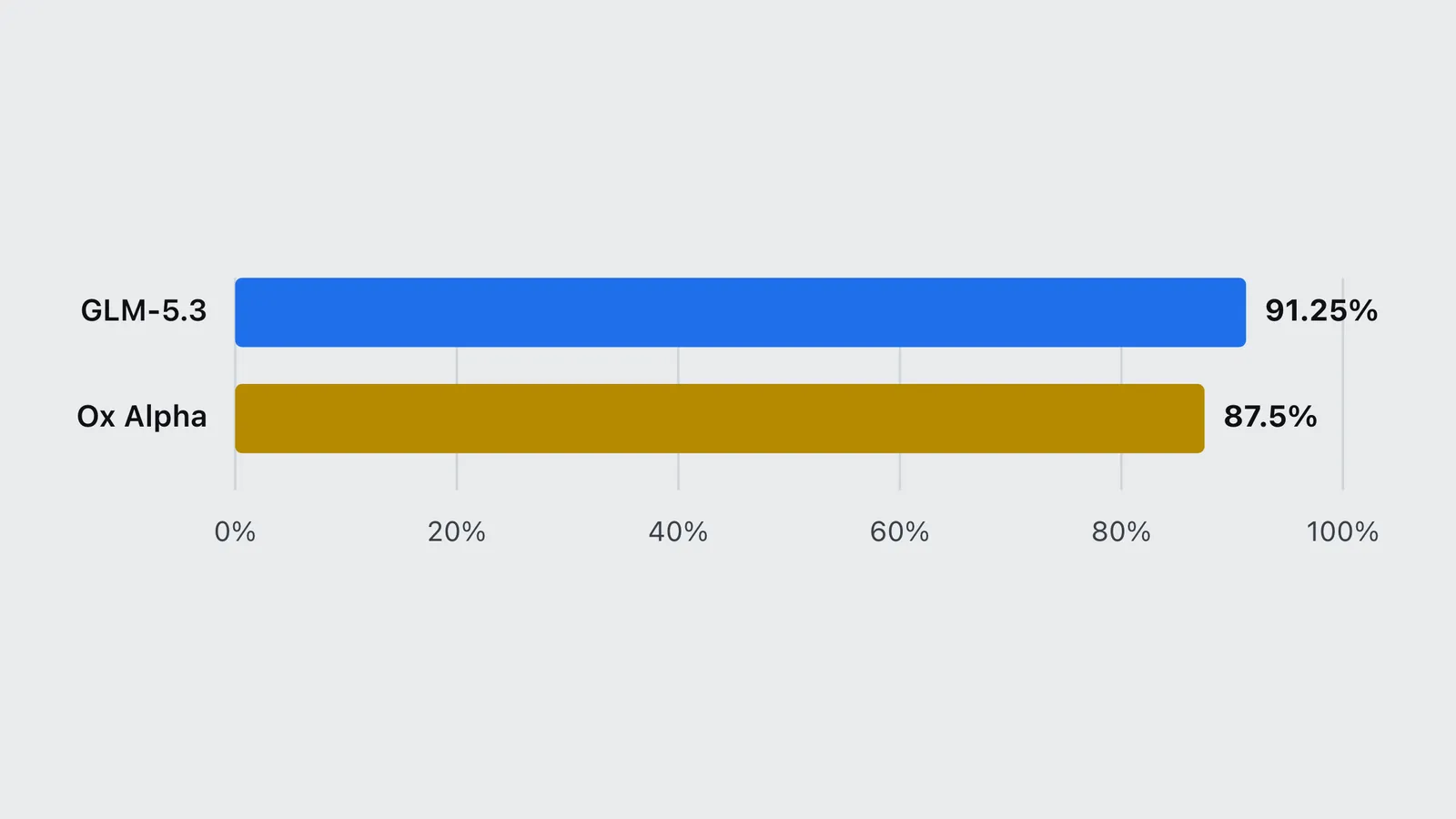
The most concrete data point is Kingbench, a third-party leaderboard, where Ox Alpha scored 87.5 percent against GLM-5.3’s 91.25 percent, per Wccftech’s August 22 report. That is consistent with the multimodal-upgrade theory: close to the GLM line it presumably descends from.
| Item | Value |
|---|---|
| GLM-5.3 | 91.25% |
| Ox Alpha | 87.5% |
Beyond that, the numbers are screenshots and social posts. A popular thread on r/singularity circulated results from one agentic SWE evaluation showing ox-alpha at 80 percent against 65 percent for Claude Fable 5 and 52 percent for GPT-5.6 Sol; the same set, retested by a community member, reportedly landed “more or less on par with GPT-5.6 Sol mid.” These are single-run, unaudited figures from anonymous testers, which is exactly how benchmarks get distorted. Our earlier coverage of DeepSWE versus FrontierCode explains why harness, sampling temperature, and run count matter as much as the headline percentage on agentic sets.
What is not in dispute is adoption. Within roughly two days, real agent traffic pushed well over 100 billion prompt tokens through the endpoint, with Claude Code, Hermes Agent, and other harnesses among the heaviest users per MoClaw’s snapshot of OpenRouter’s apps tab. Developers do not burn tokens like that on a model that cannot code at all.
The catch: two data policies and an anonymous counterparty
Free frontier compute comes with a privacy split that most coverage buries. OpenCode’s Zen documentation says the provider follows a zero-retention policy and does not train on user data. The OpenRouter listing says the opposite on retention: “Prompts and completions for this model are retained by the provider and are not used for training.” Both can be true at once, because they describe different doors into the same model, but they are not the same policy. Developers Digest traced the paperwork: OpenRouter’s default Stealth Program terms, dated July 6, 2026, are a training-data license that grants the unnamed provider rights to use prompts and completions; Ox Alpha’s model page walks back the training part, and does not walk back retention.
The anonymity is not just an aesthetic problem for European businesses. As The Next Web argued on August 22, EU data protection law requires a contract with a named processor, and the AI Act’s transparency obligations took effect on August 2 with penalties reaching 15 million euros or 3 percent of global turnover. An anonymous counterparty fails both tests by construction.
Community testing has also surfaced odd behavior relevant to trust. On the Hacker News thread tracking the model (245 points as of August 23), testers reported inconsistent answers to well-known censorship probes: some sessions refused questions about Tiananmen Square while others answered them in detail, and one reported refusal in Chinese alongside candor in English. Explanations range from host-level filtering to A/B variants to the model actually being a router over several systems. None is confirmed, and each is itself a reason to be cautious about what gets sent through the pipe.
Who pays for 100 trillion tokens a day?
This is the question worth asking after the identity speculation dies down, because free at this scale is not generosity; it is a budget line.
The default Stealth Program terms give away the business model: free access in exchange for rights to train on your traffic. Ox Alpha’s listing carves training out “this time,” which tells you what earlier stealth drops were for. Even without the data, an anonymous week buys three things money struggles to buy: load-testing at genuine production scale, a firehose of real-world task feedback before launch day, and a hype cycle timed to whatever announcement follows. Z.ai claimed Pony Alpha about five days after its February debut; if history repeats, the reveal lands when the free window closes.
The capacity claim itself signals who can play this game. Serving 100 trillion tokens per day requires serious inference infrastructure, which is why speculation concentrates on large Chinese labs rather than startups. It fits the pattern we documented in why Chinese AI models are so cheap: vertically integrated labs competing aggressively on price to buy Western developer mindshare. Now that Z.ai has confirmed the GLM lineage and said weights are coming, expect post-preview pricing aimed squarely at undercutting closed-frontier rates, continuing the dynamic described in why cheaper AI models sometimes cost you more. Whether Washington responds with access restrictions is the open question covered in will the US ban Chinese AI models.
Bottom line
Ox Alpha is real, free during its preview week, unusually capable by every unofficial reading at the time, and, as of August 26, 2026, officially confirmed by Z.ai to be GLM-5.3-Flash: MIT-licensed, benchmarked, and priced. The interesting question is no longer who built it or what it is called; it is whether the finished model holds up against Claude Opus 4.8 and the rest of the value tier now that the numbers are real, not vendor-teased or crowdsourced.
Frequently asked questions
- Is Ox Alpha really free?
- Yes, during the preview. OpenRouter lists it at $0 per million tokens in and out, and OpenCode offered roughly a week of near-unlimited usage starting August 20, 2026, which points to the window closing around August 27. There is no confirmed end date, so check the live listing before depending on it.
- Who made Ox Alpha?
- Z.ai (Zhipu AI). The company confirmed to Bloomberg News on August 26, 2026 that Ox Alpha is a new iteration of its GLM series, then confirmed the exact model the same day in its own launch post and Hugging Face model card: GLM-5.3-Flash, a 320B-A18B mixture-of-experts model released MIT-licensed. Full specs, pricing, and benchmarks are in our GLM-5.3-Flash pricing and benchmarks post.
- Does Ox Alpha train on my prompts?
- Not according to both platforms, though their policies differ on retention. OpenCode advertises zero data retention. OpenRouter states prompts and completions are retained by the provider but not used for training. Retention means an unidentified party holds your text either way.
- Can I use Ox Alpha in production?
- Technically yes through the OpenAI-compatible API with tool calling and structured output. Practically, sending customer code or regulated data to an unnamed provider is hard to square with contractual and, in the EU, legal obligations. Treat it as an evaluation sandbox until a named lab stands behind it.
Sources
- Z.ai (2026). GLM-5.3-Flash: Frontier Intelligence, Flash Cost [official launch post confirming Ox Alpha’s identity]. https://z.ai/blog/glm-5.3-flash
- Z.ai (2026). zai-org/GLM-5.3-Flash [model card, MIT license]. Hugging Face. https://huggingface.co/zai-org/GLM-5.3-Flash
- Bloomberg News (2026). China’s Z.AI Made Ox Alpha Stealth Model That Rivals DeepSeek. Bloomberg. https://www.bloomberg.com/news/articles/2026-08-26/china-s-z-ai-made-ox-alpha-stealth-model-that-rivals-deepseek
- Lakshmi Varanasi (2026). A mysterious free AI model is impressing developers. And nobody knows who made it. Business Insider. https://www.businessinsider.com/ox-alpha-ai-model-mystery-2026-8
- OpenRouter (2026). Ox Alpha: API Pricing & Providers (
stealth/ox-alpha), model listing and Stealth Model Terms. https://openrouter.ai/stealth/ox-alpha - Ana Maria Constantin (2026). A free AI model is winning over developers. And nobody knows whose servers it runs on. The Next Web. https://thenextweb.com/news/ox-alpha-stealth-model-openrouter-anonymous-provider
- Rohail Saleem (2026). A Mysterious AI Lab Is Offering 100 Trillion Free Tokens/Day For Its Ox Alpha Model… Wccftech. https://wccftech.com/a-mysterious-ai-lab-is-offering-100-trillion-free-tokens-day-for-its-ox-alpha-model-as-evidence-points-to-zhipus-unreleased-glm/
- OrcaRouter (2026). Ox Alpha likely GLM-5.3: the mystery model’s fingerprint. OrcaRouter blog. https://www.orcarouter.ai/blog/ox-alpha-stealth-model-what-we-know
- Developers Digest (2026). Ox Alpha on OpenCode: The Free Stealth Model, Specs, Privacy Split, and How to Run It. https://www.developersdigest.tech/blog/ox-alpha-opencode-guide
- MoClaw (2026). Ox Alpha: What We Know So Far. MoClaw blog. https://moclaw.ai/blog/ox-alpha
- Coursiv (2026). Ox Alpha: The Mystery AI Model Free This Week. Coursiv blog. https://coursiv.io/blog/ox-alpha-stealth-model
- Local AI Zone (2026). OX Alpha: The Anonymous Frontier Model. https://local-ai-zone.github.io/blog/ox-alpha-stealth-model-comprehensive-analysis.html
- Hacker News (2026). Ox Alpha discussion thread, 245 points. https://news.ycombinator.com/item?id=49381896