Grok Bot Pricing: The $120 Door and What It Buys
Grok Bot needs a $120, $200 or $300 per month plan while Claude Cowork ships from $20. What the seat price buys and where it breaks even.
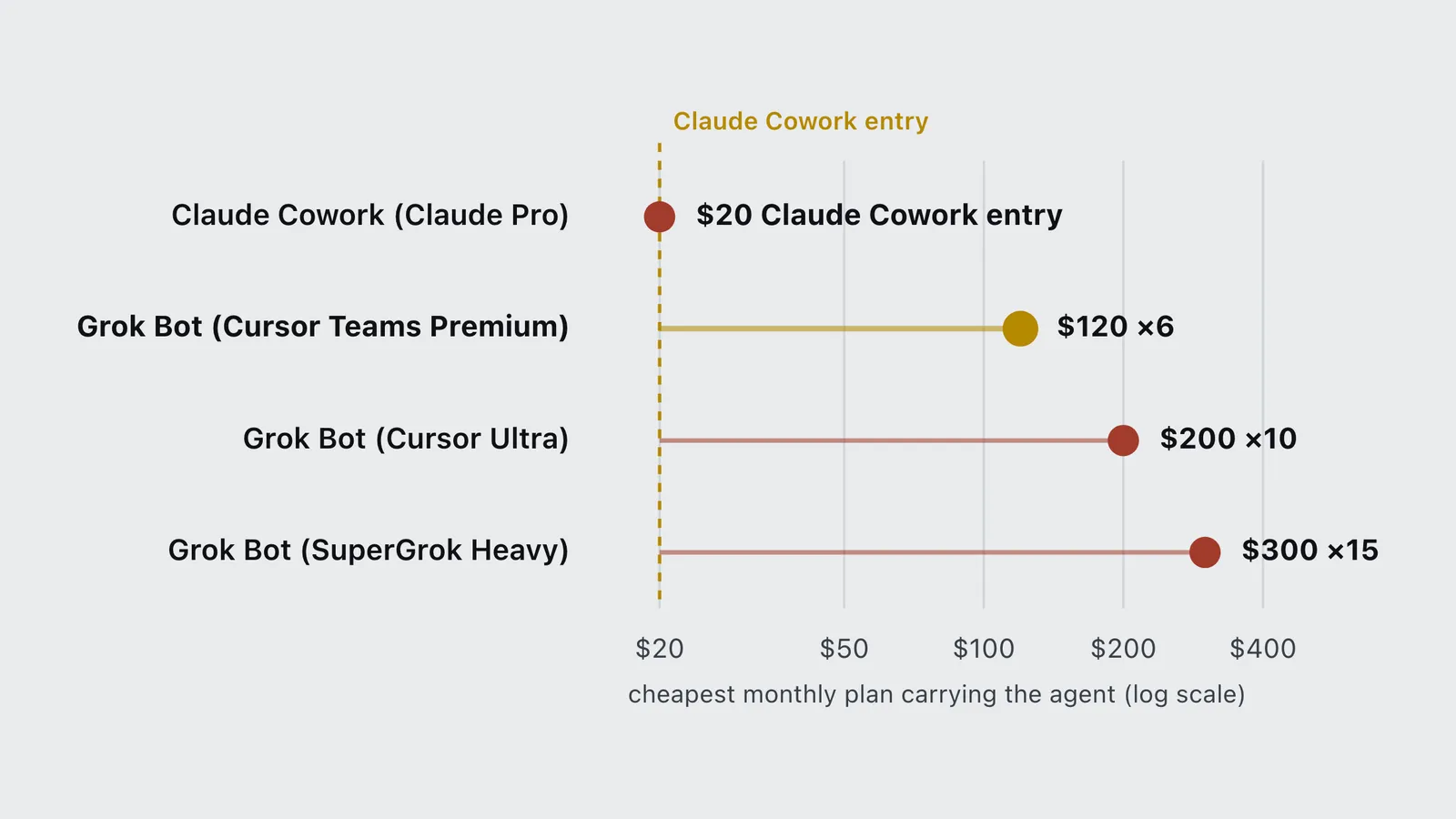
Grok Bot has no price of its own. It entered beta on August 11, 2026 behind three existing subscriptions: Cursor Teams Premium at $120 per user per month, Cursor Ultra at $200 per month, and SuperGrok Heavy at $300 per month. The cheapest door is $120 a seat, and only for teams. Anthropic ships the closest equivalent, Claude Cowork, from the $20 Pro plan.
That gap is the story. Two vendors shipped the same product category, an agent that signs into applications and works unsupervised, and priced entry to it six to fifteen times apart. The rest of this piece works out what the higher number is paying for, where it breaks even against paying SpaceXAI per token instead, and one architectural detail in xAI’s own documentation that belongs in the cost column.
What Grok Bot actually costs
There is no Grok Bot line item. SpaceXAI and Cursor shipped it as a feature of subscriptions that already existed, which means the honest way to state its price is the cheapest plan that carries it.
| Plan | Price | Grok Bot | What else the tier is for |
|---|---|---|---|
| Cursor Pro | $20 per month | No | The standard individual editor plan |
| Cursor Pro Plus | $60 per month | No | 3x Pro agent limits |
| Cursor Teams Standard | $40 per user per month | No | Team billing and shared settings |
| Cursor Teams Premium | $120 per user per month | Yes | 5x Standard agent limits, SAML and OIDC single sign-on |
| Cursor Ultra | $200 per month | Yes | 20x Pro agent limits, priority access to new features |
| SuperGrok Heavy | $300 per month | Yes | Highest xAI consumer rate limits, Grok 4 Heavy |
The Cursor figures come from Cursor’s own models and pricing documentation. The SuperGrok Heavy price is the tier xAI has charged since Heavy launched in July 2025 and is reported alongside the other two doors by Unite.AI; xAI’s consumer pricing page could not be read directly for this piece, so treat that one figure as reported rather than read from source.
Set against the closest competitor, the ladder looks like this.
| Tool | Cost per task | Multiple of baseline |
|---|---|---|
| Claude Cowork (Claude Pro) | $20 | 1.0x |
| Grok Bot (Cursor Teams Premium) | $120 | 6.0x |
| Grok Bot (Cursor Ultra) | $200 | 10.0x |
| Grok Bot (SuperGrok Heavy) | $300 | 15.0x |
Grok Bot did not get a price, it got a tier
The more useful way to read the launch is as a repricing of Cursor, not as a product launch with a number attached.
Before August 11 the two Cursor tiers that now carry Grok Bot were sold on usage limits. Teams Premium bought five times the agent limits of Teams Standard and enterprise single sign-on. Ultra bought twenty times the agent limits of Pro. Neither pitch was strong enough to make the price look inevitable: $120 against $40 for the same editor, or $200 against $20.
Grok Bot is what makes those numbers make sense. A team on Teams Standard that wants persistent agents pays $80 more per seat per month, a tripling. An individual on Cursor Pro pays $180 more, a tenfold increase. The product is genuinely new; the pricing is a tier migration dressed as one.
An individual on Cursor Pro who wants Grok Bot moves from $20 a month to $200. The editor does not change. The tier does.
This matters for the buying decision because the incremental cost is not the sticker price. If a five-person team already pays Teams Standard, the marginal cost of Grok Bot is $80 per seat per month, or $4,800 a year for the team. If the same team is on Cursor Pro individually, adding Grok Bot through Ultra costs $10,800 a year. Same feature, different starting point, and the second number is the one worth arguing about. The mechanics of how Cursor meters those agent limits, and what actually gets consumed inside them, are covered in Cursor pricing limits explained.
Grok Bot against Claude Cowork on price of admission
Both products are persistent agents that operate applications on the user’s behalf rather than returning text. That is a narrow enough category that entry price is comparable.
| Grok Bot | Claude Cowork | |
|---|---|---|
| Cheapest individual plan | $200 per month (Cursor Ultra) | $20 per month (Claude Pro) |
| Cheapest team seat | $120 per user per month | $20 per seat per month billed annually, $25 monthly |
| Highest consumer tier that carries it | $300 per month (SuperGrok Heavy) | $100 per month and up (Claude Max) |
| Status | Beta, August 11, 2026 | Shipping |
| Platforms | Desktop and iOS, Android stated as coming | Desktop and web |
Claude plan prices are read from Anthropic’s published pricing, where Cowork is listed as included across the paid plans rather than gated to the top of the ladder.
Two caveats keep this from being a pure verdict. Grok Bot is in beta, so today’s gating may be capacity management rather than final pricing, and beta gates have a habit of loosening. And the two products are not identical: Grok Bot’s pitch is a fleet of always-on Bots with their own machine, which is a heavier commitment than a session-scoped agent. But the comparison a buyer actually makes on day one is what it costs to find out, and on that question the answer is $20 against $120.
Why it is a seat and not a meter
SpaceXAI sells Grok 4.5 by the token. The xAI API prices it at $2 per million input tokens and $6 per million output, which is the rate underneath our cost-per-task analysis of Grok 4.5. So the company had a metered option available and chose a flat monthly seat instead. It is worth working out what that seat has to absorb before it is the cheaper side of the trade.
| Plan | Monthly price | Break-even usage (Output tokens per month) |
|---|---|---|
| Cursor Teams Premium | $120 | 20M |
| Cursor Ultra | $200 | 33M |
| SuperGrok Heavy | $300 | 50M |
| Metered at $6 / Mtok | $6 per unit, no floor | $360 at 60M |
Read off the crossings: the $120 seat is worth it past 20 million output tokens a month, the $200 seat past roughly 33 million, and the $300 plan past 50 million. Spread across a calendar month, those are about 667,000, 1.1 million and 1.7 million output tokens every single day, holidays included.
That is the trade the seat represents. Below the crossing, the buyer is overpaying for capacity they do not use. Above it, SpaceXAI is absorbing the difference. Flat pricing on an uncapped workload always transfers variance from the customer to the vendor, and vendors only accept that transfer when the variance is large enough that customers will not tolerate the meter. Sell an always-on agent per token and the first surprise invoice ends the relationship. Sell it per seat and the invoice is boring. The pricing choice is itself a statement about how much the product consumes. If usage were modest and predictable, metering it would have been the cheaper way to sell it.
For the general version of this arithmetic across coding subscriptions, the subscription versus API calculator runs the same crossing for whichever plan and rate a reader wants to test.
An always-on agent has no task boundary
Every cost model on this site rests on a task: a unit of work with a beginning, an end, and a token count in between. That is what makes cost per task comparable across harnesses.
Grok Bot is built to remove that boundary. xAI’s framing is a team of Bots that keep working while you sleep, returning only when they need approval or have finished. A Bot with a standing instruction to monitor an inbox or a CRM is not running a task; it is running continuously and occasionally producing one. The meter, if there were a meter, would never stop.
This is the part that is genuinely hard to price on either side, and it is the strongest argument for the seat. It also means the usual comparison shortcuts break. A prospective buyer cannot ask what a Grok Bot task costs, because the product is not sold in tasks and no per-task figure has been published. What can be asked is how many hours of human work the fleet removes per month, and whether that clears $120, $200 or $300 a head. That is a labour-substitution question, not a token question, and it is the question the pricing is designed to provoke.
One computer, every login
The technical detail with the largest hidden cost is in xAI’s own documentation, not in the press coverage.
Each Bot runs on what the docs describe as a persistent cloud VM with a browser, filesystem, and terminal. That is the part every outlet reported. The next part is not:
All of your Bots use the same persistent cloud computer. They share files, browser sessions, and app logins.
The documentation is explicit about the consequence, stating that the computer is isolated to the account rather than to an individual Bot, and instructing users to treat a login or file placed on the computer as available to all of their Bots.
That is a sensible engineering decision and a real security property, and it should be read plainly. Isolation is per account, not per Bot. A team that builds one Bot for CRM work, one for invoice processing and one for filing bug tickets has not built three sandboxes; it has built three job descriptions on one machine that holds every credential all three ever used. The blast radius of a single Bot going wrong, whether through a prompt injection on a page it browses or a mis-scoped instruction, is every application any Bot on that account has ever signed into.
This would be an abstract concern if the vendor had no track record on exactly this axis. It does. In July 2026, a researcher publishing as cereblab found that Grok Build, xAI’s coding CLI, was uploading entire tracked repositories to a Google Cloud Storage bucket rather than only the files a task needed. The Hacker News reported that version 0.2.93 sent roughly 5.10 GiB over the storage channel against 192 KB of actual model traffic, that a canary file the model never read turned up in the captured bundle, and that values including API_KEY and DB_PASSWORD were transmitted unredacted. As The Next Web reported at the time, the uploads continued with the model-improvement setting switched off. xAI disabled the behaviour server-side on July 13, Elon Musk said the previously uploaded data would be deleted, and a /privacy command was added.
The company fixed it, publicly and quickly. But the relevant question for a buyer handing over live application logins is not whether the last incident was fixed. It is what the default posture is when a data-handling decision is unforced, and the honest answer from the record so far is expansive. That is worth a discount, not a premium, and the Grok Bot tiers charge a premium. The same tension around data handling after the acquisition is worked through in what the SpaceX purchase of Cursor changed.
Who should pay it
| Dimension | Grok Bot | Claude Cowork | Stay on Cursor Pro |
|---|---|---|---|
| Cheapest way in | $120 seat, teams only | $20 Claude Pro | $20, no agent |
| Cost to add it | +$80 to +$180 / month | Included in plan | No change |
| Credential isolation | One VM for all Bots | Session scoped | No logins handed over |
| Maturity | Beta, one day old | Shipping | Stable |
| Runs unattended | Persistent, 24/7 | Session and scheduled | No |
Three positions are defensible right now.
Pay it if you are already on Cursor Teams Premium or Ultra. Then Grok Bot is free in the only sense that matters: the incremental cost is zero, the tier is already bought, and the beta is worth running against real work to find out whether the fleet metaphor holds. This is the only group for whom the price question does not arise.
Do not pay it to evaluate the category. Persistent computer-use agents are worth understanding, and $20 buys that understanding from Anthropic today. Paying $200 to form a first opinion on a one-day-old beta is a bad trade regardless of which product eventually wins. The alternatives to Cursor at various price points are worth a look before committing to a tier jump.
Wait if you are a team weighing the seat tripling. $40 to $120 per seat is a large enough move that it should be justified by measured hours saved, not by a demo. The measurement is straightforward: run the beta on the tier you already pay for if you have it, or wait for the enterprise tier that xAI has put a waitlist behind, and price it against loaded salary cost rather than against Claude Cowork. A fleet of Bots that genuinely closes out invoice processing is worth far more than $120 a seat. One that gets to ninety percent and hands back the last ten is worth considerably less than a Cursor Pro subscription.
For where all of this sits in the broader field, the AI coding agents comparison tracks each tool, its maker, and its pricing model side by side.
Frequently asked questions
- How much does Grok Bot cost?
- Grok Bot has no standalone price. Since August 26, 2026 it has been included with every paid Cursor plan, from Cursor Pro at $20 a month, with all Cursor Teams plans, and with every SuperGrok tier. At the August 11 beta launch it was limited to Cursor Teams Premium ($120 per user), Cursor Ultra ($200) and SuperGrok Heavy ($300).
- Is Grok Bot included in Cursor Pro?
- Yes, since August 26, 2026. Cursor Pro at $20 a month now includes Grok Bot with a smaller weekly usage allowance than Pro Plus or Ultra, and every member of a Cursor Teams plan gets access. Grok Bot usage is metered separately from Cursor editor usage. At the August 11 launch, Cursor Pro did not include it.
- Grok Bot or Claude Cowork: which is cheaper?
- Claude Cowork, by a wide margin on entry price. It is included in Claude subscriptions from the $20 per month Pro plan, against $120 per seat as the cheapest door to Grok Bot. That is a 6x gap at the cheapest tier on each side and 15x comparing SuperGrok Heavy against Claude Pro. The products are not identical, and Grok Bot is in beta.
- What platforms does Grok Bot run on?
- It launched on desktop and iOS, with Android stated as coming. xAI documentation notes that the same Bot is reachable from the desktop app and iOS, so a Bot started on one is resumable on the other.
- Is it safe to give Grok Bot my application logins?
- That depends on your tolerance for a shared credential surface. xAI documentation states that all of an account's Bots use the same persistent cloud computer and share files, browser sessions and app logins, and instructs users to treat any login placed on that computer as available to every Bot on the account. There is no per-Bot isolation at any price tier. In July 2026 a researcher also found xAI's Grok Build CLI uploading entire repositories including committed secrets, which xAI disabled after it was reported.
- When does the Grok Bot seat price beat paying per token?
- Modelled on the $6 per million output-token list rate for Grok 4.5, the $120 seat breaks even at 20 million output tokens a month, the $200 Ultra plan at about 33 million, and the $300 SuperGrok Heavy plan at 50 million. Those figures exclude input tokens, which a screenshot-driven agent consumes heavily, so the true break-even for each plan is lower.
Sources
- SpaceXAI. Grok Bot overview [official product documentation; the persistent cloud VM with browser, filesystem and terminal, the statement that all of an account’s Bots share one computer including files, browser sessions and app logins, the instruction to treat a login or file on the computer as available to all Bots, and desktop plus iOS reachability]. Verified August 12, 2026.
- Cursor. Models and pricing [official pricing documentation; Cursor Pro at $20 per month, Pro Plus at $60, Ultra at $200, Teams Standard at $40 per user, Teams Premium at $120 per user, and Grok 4.5 described as jointly trained by Cursor and SpaceXAI]. Verified August 12, 2026.
- Anthropic. Claude plans and pricing [official pricing documentation; Claude Pro at $20 per month billed monthly, Max from $100 per month, Team seats at $20 billed annually and $25 monthly, and Claude Cowork listed as included across paid plans]. Verified August 12, 2026.
- SpaceXAI. Grok 4.5 [official model announcement; the $2 and $6 per million input and output token list rates used for the break-even model]. Verified August 12, 2026.
- Constantin, Ana Maria (2026). SpaceXAI launches Grok Bot as the agent race moves to office work. The Next Web [secondary reporting; the August 11 beta launch, the tiers gating access, platform availability, the enterprise waitlist, and the internal xAI use cases]. Published August 11, 2026.
- Mercer, Evan (2026). xAI launches Grok Bot, always-on AI teammates with their own cloud computers. Unite.AI [secondary reporting; Cursor Ultra at $200 per month and Cursor Teams Premium at $120 per seat as the Grok Bot doors, and the SuperGrok Heavy tier, used to corroborate the plan gating]. Published August 11, 2026.
- The Hacker News (2026). Grok Build uploads entire Git repositories to xAI storage, not just files it read [secondary reporting; version 0.2.93, roughly 5.10 GiB over the storage channel against 192 KB of model traffic, the unread canary file recovered from the bundle, unredacted API_KEY and DB_PASSWORD values, and the July 13 server-side shutdown]. Published July 14, 2026.
- The Next Web (2026). Grok Build was uploading entire Git repositories to xAI’s cloud, including committed secrets [secondary reporting; that the uploads continued with the model-improvement setting disabled]. Published July 2026.
- Capital & Compute. Grok 4.5 Cost Per Task: The 4.2x Efficiency Test [this site’s verification of the $2 and $6 per million token list rates and the harness-contingent capability claims].
- Capital & Compute. SpaceX Bought Cursor: Your Bill, Your Code, Cost to Leave [this site’s coverage of the $60 billion acquisition and the data-handling questions it raised].