How Many Organizations Were Hit by the Optimizely Hack?
At least 178 organizations served malicious code through Optimizely on November 16, 2026, from 188 infected scripts. Why the real count is higher.
At least 178 organizations served malicious code to their visitors through Optimizely on November 16, 2026, from 188 infected scripts, per the security firm Report URI. That is a floor, not a total: it checked 1,611 Optimizely scripts, and Optimizely has not said how many customers it notified.
The count comes from World’s Largest Brands Infected With Malware Via Optimizely, a write-up by Scott Helme of Report URI published November 16 and updated November 17. Report URI sells script-monitoring products and says so in the post. Every other count in circulation traces back to it.
| Count | Number | Source |
|---|---|---|
| Organizations whose Optimizely script was infected | 178 | Report URI |
| Infected Optimizely scripts (snippets) | 188 | Report URI |
| Optimizely scripts Report URI checked | 1,611 | Report URI |
| Sectors the 178 fall into | 20 | Report URI |
| Affected sites independently confirmed by BleepingComputer | 11 | BleepingComputer |
| Organizations whose security policy blocked the code | 24 | Report URI |
| Other script vendors found serving the same injector | 3 | Hudson Rock |
| Customers Optimizely says it notified | not stated | Optimizely, via BleepingComputer |
How many organizations were hit by the Optimizely attack?
178 is the confirmed number, and it is a lower bound. Report URI fetched 1,611 distinct Optimizely snippets, mostly found through its own crawl data, and found the malicious code in 188 of them, belonging to 178 organizations. The post says the team only examined the snippets it could find in time and that it believes the number of victims is higher.
The attacker did not break into 178 companies. Optimizely Web is a testing service that runs a JavaScript snippet on its customers’ pages, and each customer project has a field for its own custom code. The attacker wrote malicious code into that field in customer projects, so it loaded from Optimizely’s own servers and every site using the project served it. Optimizely told BleepingComputer that an unauthorized party exploited a vulnerability in its Experimentation account signup flow, that it removed the injected code from affected projects, and that “we have notified all affected customers.” It gave no count.
So “178 organizations hacked” really means 178 organizations whose pages loaded the attacker’s code for part of one day. Optimizely’s own homepage and login page were among them.
Why do reports say 178, 186 and 188?
They count different things at different times, all from the same Report URI post:
- 188 is the number of infected Optimizely scripts. Some organizations ran more than one.
- 178 is the number of organizations those 188 scripts belong to.
- 186 is what Report URI’s sweep found between 19:24 and 19:59 UTC on November 16, while the attack was still live. The post’s timeline gives 186 at that point and 188 as the final total, and does not explain the difference of two.
Headlines that say “186 sites” took the sweep figure. The organization count, 178, is the one to use.
Which sectors were hit?
Banking and finance most of all. Report URI groups the 178 organizations into 20 sectors:
| Sector | Organizations | Examples named by Report URI or in coverage |
|---|---|---|
| Banking and finance | 32 | HSBC (several country sites), Equifax, ABN AMRO |
| Technology and software | 23 | Zoom, Salesforce, GitLab, Optimizely |
| Retail and fashion | 20 | IKEA, ASOS, Mattel |
| Streaming and entertainment | 12 | Peacock, Starz, SeaWorld |
| News and media | 10 | CNN, BBC, Fox News, NPR |
| Airlines and travel | 9 | Air France-KLM, Alaska and Hawaiian Airlines |
| Healthcare and pharma | 8 | Invisalign, Takeda |
| Industrial and manufacturing | 8 | Fluke, Vaillant |
| Telecoms | 7 | Virgin Media, Vodafone Australia, TalkTalk |
| Crypto and trading | 6 | Ledger, IG |
| Insurance | 6 | Mutual of Omaha, Admiral |
| Property and real estate | 6 | |
| Food and hospitality | 5 | Heineken, Starbucks Canada |
| Home and smart home | 5 | Resideo, Chamberlain |
| Nonprofit and civic | 4 | Change.org, UNICEF USA |
| Gambling | 4 | PokerStars, Betfred |
| Professional services | 4 | Freshfields |
| Logistics and shipping | 3 | ShipStation, Stamps.com |
| Automotive | 3 | Lucid Motors |
| Education | 3 | Walden University |
| Total | 178 |
Report URI’s own list is the complete one, and some of its rows bundle several brands or country domains of one company, so a count of names in it will not equal 178. Newsweek’s full list of organizations reproduces the same 20 sector counts.
BleepingComputer confirmed 11 of the sites itself, from urlscan.io scans that show the malicious script loading or trying to load: Zoom, KLM, GitLab, BBC, Scheels, CNN, American Girl, ManageBuilding, Smartsheet, Stamps.com and Salesforce. Salesforce said it was disabling Optimizely scripts across preview and production as a precaution.
How many sites did their own security settings protect?
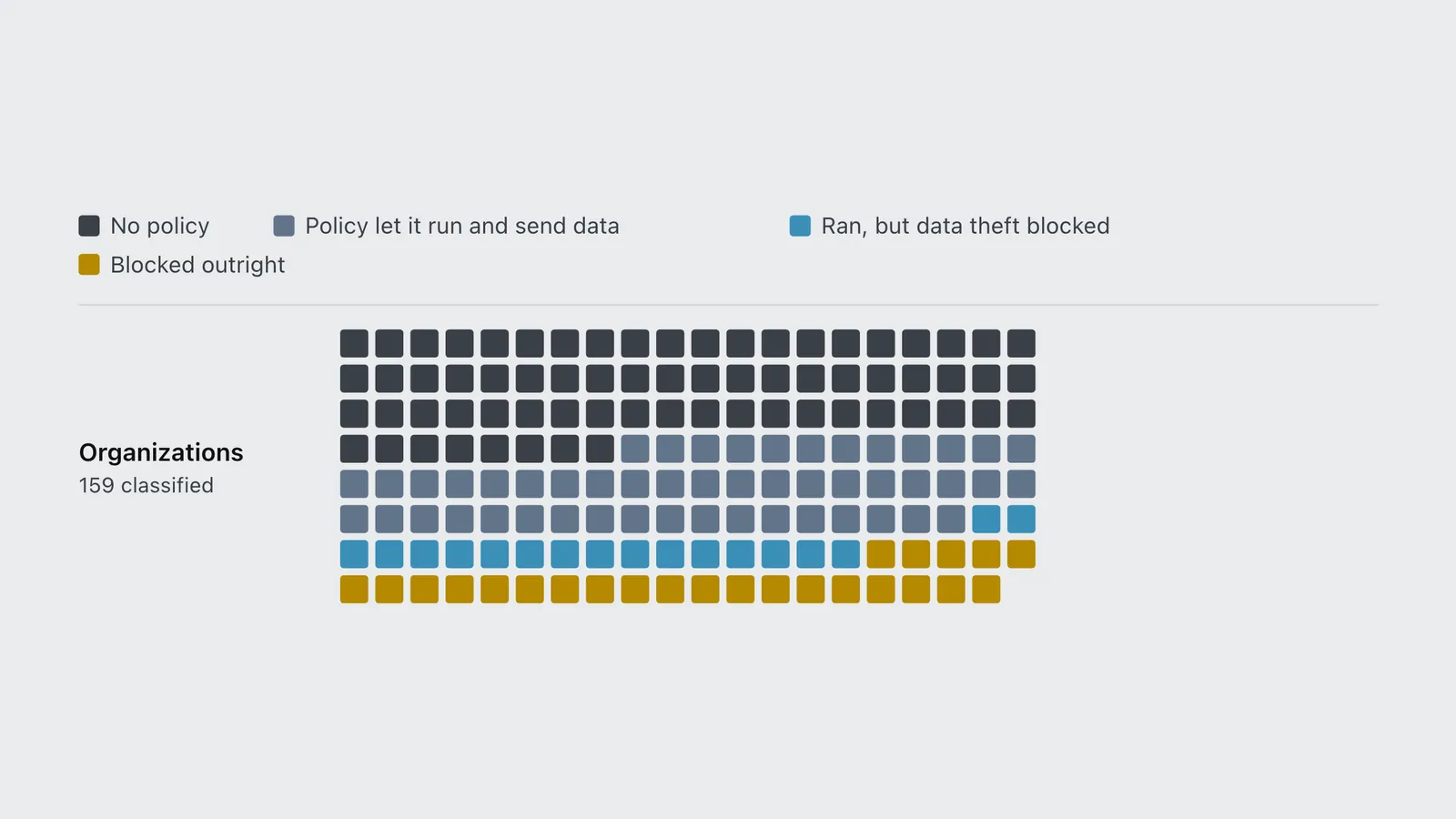
24 organizations, about 15% of those Report URI could test. A Content Security Policy (CSP) is a header a site sends telling the browser which servers its scripts may load from and send data to. Report URI crawled the affected organizations’ own sites and sorted what each policy did:
| Condition | No policy | Policy let it run and send data | Ran, but data theft blocked | Blocked outright |
|---|---|---|---|---|
| Organizations (159 classified) | 68 | 50 | 17 | 24 |
The four groups add up to 159, not the 178 affected organizations, and Report URI’s post does not say why the other 19 are not classified. The 24 that blocked the code had policies listing only the specific script hosts they needed, rather than allowing any script from anywhere.
Were companies outside Optimizely hit too?
Yes, but nobody has counted them. Hudson Rock, a threat-intelligence firm, traced the same injector through three other script vendors in Beyond Optimizely: Malicious Scripts Traced Across Four Web Services (November 17, 2026): Kissmetrics, StorifyMe and minute-ly, with the earliest record on November 13, three days before the Optimizely wave. Its examples are securitybank.com, faz.net and foxsports.com, and its combined report names 21 web properties, which it says is not an estimate of the full size. Report URI says these sites are not in its 178.
Hudson Rock is explicit that the numbers cannot be summed: “Provider, file, organization and visitor counts cannot be added together.” No verified total of affected visitors exists.
How long were the sites infected?
About 19 hours. Report URI’s timeline, in UTC on November 16:
| Time | What happened |
|---|---|
| 04:21 | First infected Optimizely snippet seen, on the BBC |
| 08:10 | First build of the crypto address-swapping code |
| 13:03 | Attacker moves stolen crypto to exchanges |
| 13:43 | Card skimmer added |
| 19:24 | Sweep finds 186 of 1,611 snippets infected |
| 21:52 | One of 188 still infected (TalkTalk) |
| 23:11 | All infected Optimizely files cleaned |
The attacker rebuilt the payload 26 times during the day. Smartsheet’s snippet was cleaned and then re-infected, which shows the attacker still had write access after the first clean-up.
What did the code do, and how much did it take?
It swapped cryptocurrency wallet addresses that visitors copied or pasted, tried to capture card details typed into a site’s own checkout fields, took cookies and screenshots, and sent older iPhones and iPads to exploit kits. Card forms in hosted payment frames such as Stripe were out of its reach, per Report URI.
The money was small. Report URI’s updated wallet table adds up to about $7,150 received across five wallets, mostly Bitcoin. Bitquery, a blockchain-analytics firm, puts the amount actual victims sent at about $2,260 in 19 payments in its on-chain investigation, because the larger figure includes 0.076 BTC that the attacker’s own stablecoin swap paid back to its Bitcoin wallet. Either way, 178 organizations were exposed for a haul in the low thousands of dollars.
Was it connected to the week’s outages?
No link has been found. The attack landed in the same week as outages at Apple, the NSA, JPMorgan Chase, Microsoft and the FAA, each of which its operator traced to an update, patch or upgrade, and none of the affected Optimizely customers’ sites went down. Every outage and its stated cause is in were the November 2026 outages a cyber attack?
Was your company one of them?
If you run Optimizely Web, check rather than assume. Report URI’s advice to customers is to review every project’s Project JavaScript and every experiment’s custom code for the attacker’s domain 1688360.cc, for atob( and for any script you did not write, and to rotate credentials. Optimizely says it has notified every affected customer.
Frequently asked questions
- How many organizations were hit by the Optimizely hack?
- At least 178, per Report URI, which found malicious code in 188 of the 1,611 Optimizely scripts it checked on November 16, 2026. Report URI says the real number is likely higher, and Optimizely has not published a count of affected customers.
- Is it 178 or 186 sites?
- 178 organizations. 186 is the number of infected scripts Report URI found during one sweep on the evening of November 16; its final total is 188 infected scripts belonging to 178 organizations.
- Which sector was hit hardest by the Optimizely attack?
- Banking and finance, with 32 of the 178 organizations, followed by technology and software (23) and retail and fashion (20), per Report URI.
- Were the 178 companies themselves hacked?
- No. The attacker wrote malicious code into Optimizely customer projects through a flaw in Optimizely’s signup flow, so the code loaded from Optimizely’s servers onto the companies’ pages. Report URI notes this does not mean each company was breached.
- How many sites blocked the Optimizely malware?
- 24 of the 159 affected organizations Report URI classified had a Content Security Policy that blocked the payload. 68 had no policy, 50 had one that let it run, and 17 stopped it from sending data out.
Sources
Report URI (Scott Helme) (2026). World’s Largest Brands Infected With Malware Via Optimizely. Company blog, November 16, 2026, updated November 17; Report URI sells the script-monitoring products the post describes. https://blog.report-uri.com/worlds-largest-brands-infected-with-malware-via-optimizely/ Read 2026-11-18.
BleepingComputer (2026). Optimizely hack infected CNN, Fox News, BBC, Salesforce sites with malware. News report with Optimizely’s and Salesforce’s statements and independent urlscan.io confirmation, November 16, 2026. https://www.bleepingcomputer.com/news/security/optimizely-supply-chain-attack-delivers-malware-to-cnn-fox-news-bbc-salesforce-sites/ Read 2026-11-18.
Hudson Rock (2026). Beyond Optimizely: Malicious Scripts Traced Across Four Web Services. Infostealers.com research post, November 17, 2026. https://www.infostealers.com/article/beyond-optimizely-malicious-scripts-traced-across-four-web-services/ Read 2026-11-18.
Bitquery (2026). Optimizely Hack: 19 Payments, $2,260 in Crypto Lost. On-chain investigation. https://bitquery.io/investigations/optimizely-hack Read 2026-11-18 (secondary analysis of Report URI’s wallet list).
Newsweek (2026). Cyber Attack Hits 178 Major Websites: Full List of Organizations. News report reproducing Report URI’s list, November 17, 2026. https://www.newsweek.com/cyber-attack-websites-affected-12725863 Read 2026-11-18.