Senate Blocks Data Center Bill
The Senate blocked the 417-3 data center power-bill fix on Sept 17, 2026. What the Ratepayer Protection Act required, why it stalled, and who pays next.
The Senate blocked the data center bill on September 17, 2026. Sen. Martin Heinrich (D-NM) denied unanimous consent to the Ratepayer Protection Act one day after the House passed it 417 to 3, then Sen. Bernie Moreno (R-OH) returned the favor by blocking Heinrich’s alternative. No federal protection against data center driven power costs can now reach the president before the November 3 midterms unless Senate leaders cut a broader deal.
What happened on September 17
Did the Senate block the data center bill? Yes. On September 17, 2026, Sen. Martin Heinrich (D-NM) objected to a unanimous-consent request from Sen. Jon Husted (R-OH) to pass the Ratepayer Protection Act, and Sen. Bernie Moreno (R-OH) then blocked Heinrich’s GRID Savings Act. Both measures stalled on the floor.
Unanimous consent is the Senate’s fast lane for uncontroversial bills, and any single senator can stop it. Husted, the Senate sponsor of the Ratepayer Protection Act, tried to ride the House’s near-unanimous vote straight to President Trump’s desk. He called the bill “the most meaningful, bipartisan step Congress could take to protect the American people from higher prices for electricity,” as reported in CBS News coverage of the Sept 17, 2026 floor fight, 2026 secondary reporting on the objection.
Heinrich, the ranking Democrat on Energy and Natural Resources, said the bill “falls short of what we need to do to respond,” per Roll Call reporting of Sept 17, 2026, 2026 secondary reporting on the proceedings. His line on the floor: “Congress needs to pass real legislation with real teeth.” He then asked for consent on his own GRID Savings Act, which Moreno killed with the complaint that Democrats had produced a “do-nothing” outcome, as quoted in The Hill’s Sept 17, 2026 account, 2026 secondary reporting on the exchange.
Politics explains the choreography. Husted faces former Sen. Sherrod Brown in a competitive Ohio race, and Punchbowl News noted Democrats had to choose between blocking a bill nearly every House Democrat backed and handing Husted a win on the defining issue of his reelection, as summarized in Political Wire’s Sept 17, 2026 roundup, 2026 secondary reporting on the strategy. Majority Leader John Thune said revisiting the bill depends on floor time and talks around an energy permitting overhaul, per the Roll Call account linked above.
Jun 18, 2026
H.R. 9340 introduced
Rep. Gabe Evans (R-CO) introduces the Ratepayer Protection Act; referred to Energy and Commerce.
Jun 2026
Committee advances 52-0
Energy and Commerce approves the bill and narrows large-load customers to IT infrastructure facilities.
Jul 16, 2026
Senate companion filed
Sen. Jon Husted (R-OH) introduces S.5028; referred to Energy and Natural Resources.
Sep 16, 2026
House passes 417-3
Roll Call 312 under suspension of the rules; only three Democrats vote no.
Sep 17, 2026
Dueling Senate blocks
Heinrich blocks the Ratepayer bill; Moreno blocks the GRID Savings Act.
Nov 3, 2026
Midterms
House stands adjourned until after the election; no pre-election path remains.
What the Ratepayer Protection Act would actually do
The Ratepayer Protection Act would add a federal standard to PURPA directing state utility regulators to consider rules making data centers of 100 megawatts or more pay the full incremental cost of the grid upgrades they trigger, with financial assurances posted upfront. States must open a docket within one year and decide within two. Adoption stays voluntary.
The mechanics come from the bill text of S.5028 (119th Congress), a 2026 primary legislative source. A covered large-load customer is a nonresidential buyer whose facilities run information technology infrastructure for data storage and computation at 100 MW or more of aggregate peak demand on one site or campus. Rates for such customers must recover the full incremental cost of generation, transmission, and distribution upgrades needed to serve them, including costs left behind if the customer signs, then walks away. Before building anything, the utility must collect financial assurances or contributions covering the upgrade.
Two details carry the politics. First, the House Energy and Commerce Committee adopted an amendment limiting coverage to IT infrastructure, so factories and other heavy industry sit outside the standard, as reported in Roll Call’s Sept 16, 2026 House-passage account, 2026 secondary reporting on the markup. Second, the three no votes were all progressive Democrats, Reps. Summer Lee (PA), Rashida Tlaib (MI), and Delia Ramirez (IL), who wanted a mandate rather than a suggestion, per CNBC reporting of Sept 17, 2026, 2026 secondary reporting on the vote. The lead House sponsors, Evans and Rep. Kathy Castor (D-FL), both face competitive November races, which is why the bill moved under suspension in the final pre-election work window.
Ratepayer Protection Act vs GRID Savings Act
Heinrich’s objection is not that rates are fine. It is that the House bill cannot move one. His GRID Savings Act (S.5199), a 2026 primary legislative source introduced in August 2026, takes the opposite design: federal jurisdiction first, binding payment second.
| Ratepayer Protection Act | GRID Savings Act | |
|---|---|---|
| Vehicle | H.R. 9340 / S.5028, House-passed 417-3 | S.5199, introduced Aug 2026 |
| Coverage line | 100+ MW per site or campus, IT facilities | 150+ MW behind one interconnection point, any large nonresidential load |
| Who writes the rule | State commissions and nonregulated utilities | FERC, by final rule within one year of enactment |
| Binding effect | Consider and decide within two years; adoption optional | Mandatory: interconnecting loads pay for needed facilities |
| Cost principle | Full incremental cost plus upfront assurances | Same pay-your-own-way principle, modeled on generator interconnection, with an option to fund backbone transmission for service |
| Status | Senate unanimous-consent bid blocked Sept 17 | Counter-bid blocked the same day |
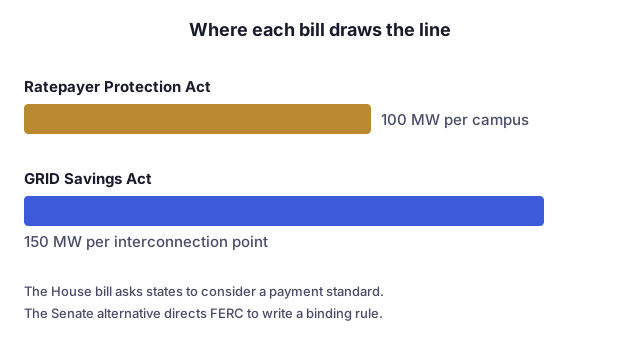
The gap between 100 and 150 MW matters less than the gap between “consider” and “require.” A 100 MW campus is already a large hyperscale building, and the current pipeline runs from there up to gigawatt-scale sites (for the physical reason campuses keep getting bigger, see what an AI data center is). Either threshold captures the projects that force new wires and new generation. The live question is who gets to say no: fifty state commissions, or one federal rulemaking.
What this means for power bills and data center costs
Strip out the procedure and the economics are simple. A new 100+ MW campus does not plug into spare capacity. It triggers substations, transmission feeds, and often new generation, built years before the servers earn revenue. If the utility folds that spending into its general rate base, every household and small business on the system pays a slice of a building they never used. If the data center pays the full incremental cost plus assurances, the subsidy runs the other way: neighbors are held harmless, and the developer carries the interconnection risk.
That is why the blocked bill still matters to anyone modeling AI infrastructure. The AI data center financing boom already prices capital at 10 to 15 percent in private credit against 4 to 5 percent for investment-grade bonds. Binding pay-your-own-way rules would add cost certainty for ratepayers while concentrating grid risk on developers and their lenders, which tightens underwriting on marginal projects. A voluntary state-by-state regime keeps the current patchwork: some commissions already assign incremental costs to large loads, others socialize them, and siting strategy follows the difference. For where the financed dollars land once committed, the layer-by-layer map in AI data center stocks shows which parts of the stack absorb interconnection costs first.
One caution. Neither bill caps the total cost of grid upgrades or speeds interconnection queues that stretch three to five years in congested regions. Payment rules decide who pays. They do not conjure transformers, permits, or transmission lines. Readers pricing exposure to the buildout should treat rate design as one input among several, alongside equipment lead times and local siting politics.
What happens next
The calendar now controls the story. The House left town until after November 3, so the 417-3 vote is frozen as a campaign data point rather than a law in motion. The Senate stays in session through the rest of September, with Thune tying any revisit to floor time and the permitting overhaul negotiation. A lame-duck compromise after the election remains possible, and state dockets grind on regardless: commissions can adopt incremental-cost rules today without Congress.
For the midterms, both parties banked their message. Republicans will say Democrats blocked relief that 206 House Democrats voted for (the Clerk’s Roll Call 312 breakdown records 206 Democratic yeas against 3 nays). Democrats will say Republicans offered a suggestion dressed as a shield and blocked the mandate with teeth. Voters in high-growth grid regions get to decide which story matches their electric bill.
FAQ
Did the Senate kill the data center bill?
No. One senator blocked fast passage by unanimous consent on Sept 17, 2026. The Ratepayer Protection Act stays alive on the Senate calendar, but with the House adjourned until after the Nov 3 midterms, it cannot become law before the election without a broader deal.
What is the Ratepayer Protection Act?
It is a 2026 bill (H.R. 9340 / S.5028) that directs state utility regulators to consider rules requiring data center campuses of 100+ MW to pay the full incremental cost of grid upgrades they trigger, with upfront financial assurances. States must open a docket within one year and decide within two years. The House passed it 417-3 on Sept 16, 2026.
Why did Heinrich block a bill most Democrats supported?
He argues the bill’s consider-but-need-not-adopt design lets states do nothing, so it protects no ratepayer. He wants his GRID Savings Act instead, which puts FERC in charge of binding payment rules for 150+ MW loads. Election timing around Husted’s Ohio race added a strategic edge both sides acknowledge.
Will data centers raise my electric bill?
They can, where regulators let upgrade costs spread across all ratepayers instead of assigning them to the campus that caused them. No new federal rule changes that allocation now. The practical check is local: read your utility’s large-load tariff docket and watch whether new transmission spending lands in general rates or in the data center’s contract.
Sources
- Congress.gov (2026). S.5028, Ratepayer Protection Act, bill text. 119th Congress (primary legislative source). https://www.congress.gov/bill/119th-congress/senate-bill/5028/text
- Congress.gov (2026). S.5199, GRID Savings Act of 2026, bill text. 119th Congress (primary legislative source). https://www.congress.gov/bill/119th-congress/senate-bill/5199/text
- Clerk of the U.S. House of Representatives (2026). Roll Call 312, H.R. 9340, Sept 16, 2026 (primary vote record). https://clerk.house.gov/Votes/2026312
- Sen. Martin Heinrich (2026). Press release introducing the GRID Savings Act, Aug 3, 2026 (primary sponsor statement). https://www.heinrich.senate.gov/newsroom/press-releases/heinrich-introduces-legislation-to-ensure-large-users-of-electricity-pay-for-grid-upgrades-protect-customers-from-costs-of-data-center-expansion
- Kaia Hubbard, CBS News (2026). Senate Democrat blocks House-passed bill to shield Americans from data center energy costs (secondary reporting, Sept 17, 2026). https://www.cbsnews.com/news/senate-data-center-energy-bill-martin-heinrich/
- Justin Papp, CNBC (2026). Bill to curb AI data center utility costs hits snag in Senate (secondary reporting, Sept 17, 2026). https://www.cnbc.com/2026/09/17/ai-data-center-utility-cost-senate.html
- The Hill (2026). Martin Heinrich blocks House-passed bill on data center electricity costs (secondary reporting, Sept 17, 2026). https://thehill.com/policy/energy-environment/6096398-heinrich-blocks-husted-data-center-bill/
- David Jordan, Roll Call (2026). Ratepayer bill aimed at data center buildout blocked in Senate (secondary reporting, Sept 17, 2026). https://rollcall.com/2026/09/17/ratepayer-bill-aimed-at-data-center-buildout-blocked-in-senate/
- David Jordan, Roll Call (2026). Bill aimed at voter anger over data centers passes House (secondary reporting, Sept 16, 2026). https://rollcall.com/2026/09/16/bill-aimed-at-voter-anger-over-data-centers-passes-house/