How Much Does Cloudflare Pay Per Use Pay?
No public rate exists: the AI buyer sets the price and counts the uses. Ceramic sells searches at $0.25 per 1,000, which caps a citation near $0.000025.
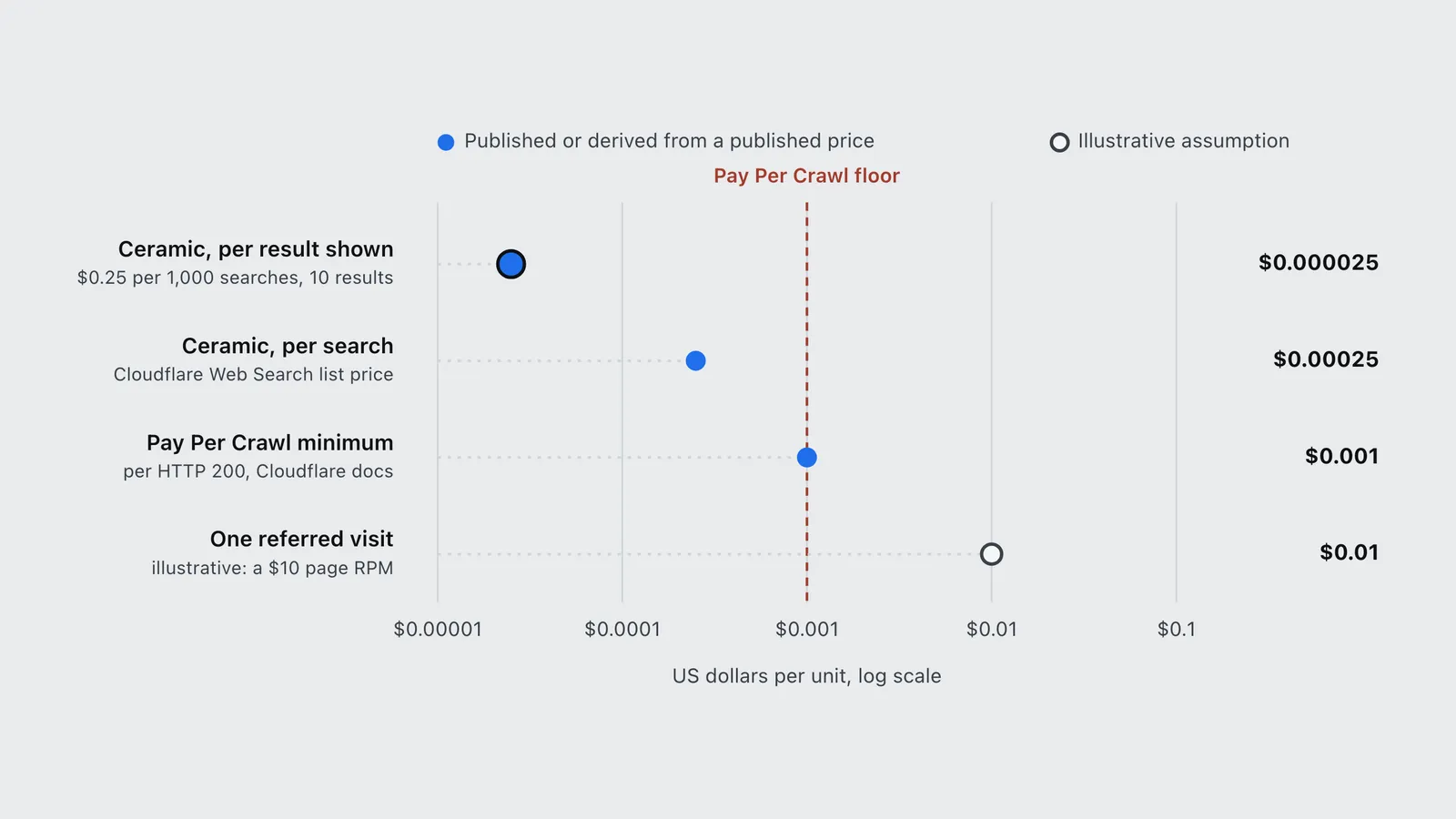
Cloudflare Pay Per Use has no published rate. The AI company buying your content proposes the price, defines what counts as a use, and reports how many uses happened; Cloudflare bills it and pays you monthly. The beta opened on 30 September 2026, and neither Cloudflare nor any buyer has disclosed a per-use price.
There is still a way to bound the number. Ceramic.ai, the first buyer Cloudflare named, sells its own web searches through Cloudflare at a list price of $0.25 per 1,000 requests, and each search returns 10 results by default. That is $0.000025 of revenue per result shown. Whatever Ceramic pays a publisher per appearance has to fit underneath that figure, which is one fortieth of the $0.001 minimum Cloudflare allows a site to charge for a single crawl. The verdict: opt in if you publish evergreen reference pages that are fetched once and shown for months, and expect cents, not a revenue line, if you publish fast news.
What is Cloudflare Pay Per Use?
Pay Per Use is a marketplace Cloudflare runs between AI companies and the sites behind its network. It was outlined in Cloudflare’s 1 July 2026 press release, which said Cloudflare “is evolving Pay Per Crawl into Pay Per Use, so publishers are paid when their content actually creates value.” It opened as a beta three months later, in Pay Per Use: when AI uses your work, you should get paid, a 30 September 2026 Cloudflare blog post by Rúben Teixeira, Jack Galilee, Kayte Johnston and Sam Else.
The mechanics run in four steps, all taken from that announcement:
- The buyer sets up a program. The AI company identifies its crawler, defines the use it will pay for (Cloudflare’s examples include a search service returning an excerpt, or a shopping agent’s recommendation shaped by a review), sets a price and connects a payment account.
- The publisher opts in. Offers appear in the Cloudflare dashboard under Monetize → Pay Per Use, showing the buyer, the use and the price. No origin change or per-buyer integration is needed. Each program’s terms “also define what the AI company may do with the content, including any restrictions on training.”
- The buyer reports each use. Usage goes to a Cloudflare API as one JSON line per event, with a timestamp (
used_at), the source URL and an eventid. - Cloudflare settles. It aggregates usage, charges the buyer and pays publishers monthly through their connected payment account, with estimated earnings shown by buyer and domain.
Cloudflare’s one-line version of the difference from its older product: “Pay Per Crawl, which we launched in 2025, charges for access. Pay Per Use pays for what happens next.”
How much does one use pay?
Nobody has said. The announcement contains no rate, no Cloudflare fee, no revenue share, no minimum payout and no settlement currency. The buyer proposes the price, and Cloudflare says publishers will later be able to “counter on price, and price content differently by use,” arguing that “last week’s reporting may be worth more to an AI product than a ten-year-old archive page.” That capability is a roadmap item, not a feature of the beta.
The September announcement names no buyers either. The July press release did: Ceramic.ai, whose opted-in publishers “are paid every time their content appears in Ceramic’s AI search results,” and You.com, which “will let an agent pay on demand for a specific piece of premium content it needs.” Neither company’s price was disclosed.
Ceramic’s side of the ledger is public, though. Cloudflare’s Web Search API providers documentation, last updated 2 October 2026, lists Ceramic.ai as the default search provider at $0.25 per 1,000 requests, billed at the provider’s list price with no Cloudflare markup. Ceramic’s Search API reference sets maxResults to a default of 10 and a maximum of 20.
| Step | Value |
|---|---|
| Ceramic list price per 1,000 searches | $0.25 |
| Revenue per search | $0.00025 |
| Results per search (default) | 10 |
| Revenue per result shown | $0.000025 |
| Same, if a caller asks for the 20 maximum | $0.0000125 |
So a single appearance in a Ceramic result set brings Ceramic, at most, about a four-hundredth of a cent. A buyer can subsidise publishers for a while, so this is an economic ceiling rather than a contractual one, but it is the only grounded number in the market. A per-appearance payment above it means Ceramic loses money on every search that shows your page.
| Unit | Value (USD) | Basis |
|---|---|---|
| Ceramic, per result shown | $0.000025 | $0.25 per 1,000 searches, 10 results |
| Ceramic, per search | $0.00025 | Cloudflare Web Search list price |
| Pay Per Crawl minimum | $0.001 | per HTTP 200, Cloudflare docs |
| One referred visit | $0.01 | illustrative: a $10 page RPM |
Pay Per Use vs Pay Per Crawl: which pays more?
The two products price different events, and Cloudflare says publishers can choose whichever model suits them. Here is how they compare on price and availability as of 24 November 2026.
| Product | Who sets the price | Price published? | Status | Who counts |
|---|---|---|---|---|
| Pay Per Crawl | Publisher | Yes: $0.001 minimum per crawl | Closed beta | Cloudflare, at the edge |
| Pay Per Use | AI buyer | No | Beta since 30 September 2026 | The buyer, self-reported |
| Monetization Gateway | Seller | Seller-set, per request | Closed beta, US sellers and buyers | Cloudflare, per paid request |
Pay Per Crawl’s floor comes from Cloudflare’s Set a pay per crawl price documentation: “The minimum price is $0.001 USD per crawl,” charged on each HTTP 200. The What is Pay Per Crawl? page, last updated 28 July 2026, still says “Pay per crawl is currently in closed beta.” Some third-party guides quote a $0.01 minimum; the documentation says $0.001.
Which pays more comes down to how many uses one fetch produces. If a buyer pays p per use and a page generates U uses for every crawl, Pay Per Use beats a $0.001 toll when p × U is greater than $0.001. At the Ceramic ceiling of $0.000025, that takes 40 appearances per crawl, and more than that at any realistic price below the ceiling. An evergreen page that is fetched once and shown for months can clear it. A news page fetched daily and shown for a day cannot.
Cloudflare’s own data points toward the second case being common. Its July press release said “over 50% of crawl traffic from AI crawlers is spent re-fetching unchanged pages.” Cloudflare’s argument runs the other way, and it is a fair one: “AI products fetch far more than they use,” so a per-crawl toll makes the buyer pay before it knows what it needs, and many buyers will not pay at all. A toll nobody pays earns nothing. This site’s earlier breakdown of what an AI crawl is worth found the same gap from the other side: at the $0.001 floor, every major AI operator’s crawl-to-refer ratio puts tolling far ahead of waiting for referrals, but the toll booth is still closed to most sites.
Against a human visit, the arithmetic is starker. At an illustrative $10 page RPM, one pageview is worth $0.01, which equals 400 Ceramic appearances at the full ceiling. Plug in your own RPM; the order of magnitude will not move much.
Who holds the meter?
The buyer does. The announcement is direct about it: “Usage is self-reported: the program terms require complete reporting, and Cloudflare checks that each reported use maps to an enrolled publisher.”
That check confirms a reported use points at a site that accepted the offer. It does not confirm the count is complete. Cloudflare sees every crawl at its edge, which is why Pay Per Crawl can bill on HTTP 200 without trusting anyone. It does not see what happens inside a search index or a model’s context window after the fetch, so for Pay Per Use the number that decides the payout comes from the party paying it. The terms create a contractual obligation, and Cloudflare’s crawl logs give a publisher a rough cross-check (a page fetched thousands of times and reported as used twice is worth a question), but there is no independent audit described.
Three things are missing from the beta that a publisher would normally want before trusting a meter: a published price, a dispute process, and use context. Cloudflare lists the last one as future work, saying it plans to show “citation keywords, request topic, or product” for each use, excluding personal data.
Where does x402 and the Monetization Gateway fit?
The Monetization Gateway is the per-request product. In Monetization Gateway beta: charge AI agents for consumption with HTTP 402, also published 30 September 2026, Cloudflare describes it as letting sellers “charge agents for any resource behind Cloudflare’s network, priced per use,” with settlement through Coinbase’s x402 Facilitator and “payments settle on the Base blockchain using USDC.” It is in closed beta for eligible US-based sellers and buyers.
The split between the two is about what counts as the use. For an API, a tool or a dataset, the request is the use, so charging at the request with HTTP 402 works. For an article, one fetch can feed thousands of answers, so Cloudflare charges on reported use instead. Pay Per Use’s announcement says the two share “identity, metering, pricing, and analytics” foundations. If your site sells data or an API, the Gateway is the relevant product. If it publishes articles, Pay Per Use is.
Should you opt in?
For most sites, yes, with low expectations. Accepting an offer changes no crawler rules and needs no code, and you can stop participating. The cost is the terms you accept, so read each program’s use definition and training restrictions before accepting, because that is the part with lasting effect.
- Evergreen reference content (guides, documentation, explainers): best fit. One crawl, many appearances, which is the only case where per-use beats a toll.
- Fast-moving news: weaker fit at today’s ceiling, since appearances per crawl are low. Cloudflare’s stated plan to price newer content higher is the feature to wait for.
- Sites that want referral traffic above all: opting in does not change that. Pay Per Use pays on top of whatever access you already allow; it does not block anyone.
- Sites already charging through Pay Per Crawl: keep the toll on crawlers that will pay it and treat Pay Per Use offers as a second line for buyers that will not.
One trap from earlier in 2026 still applies. Cloudflare’s crawler categories treat a multi-purpose crawler by its most restrictive matching rule, so a rule that blocks Training can also block Googlebot. That is covered in detail in the crawler economics breakdown. Pay Per Use does not change it, but it is worth checking before you touch AI crawler settings to join anything.
How to turn on Pay Per Use
- In the Cloudflare dashboard, open Monetize → Pay Per Use and review the offers listed for your account.
- For each offer, read the buyer, the defined use, the price and the program terms, including training restrictions.
- Accept the offers you want. Buyers identify themselves through Cloudflare’s Verified Bots program, so you are not admitting an unknown crawler. Whether to let verified bots through at all, category by category, is covered in should you allow verified bots on Cloudflare.
- Watch estimated earnings and reported uses by buyer and domain. Compare reported uses against crawl volume for the same buyer in Business Insights as a sanity check.
During the beta, Cloudflare says it is working directly with each buyer and opted-in publisher, so an empty offers list is the expected state for most accounts today. For the wider picture of how publishers are replacing lost clicks, see the publisher revenue playbook for the AI search era and Google’s own pilot paying publishers for AI answers, which puts a search engine on the same per-use model.
Common questions
Frequently asked questions
- Does Cloudflare Pay Per Use replace Pay Per Crawl?
- No. Cloudflare describes them as two options a publisher can choose between. Pay Per Crawl charges at access, priced by the publisher, and remains in closed beta. Pay Per Use pays per reported use, priced by the AI buyer, and has been in beta since 30 September 2026.
- Who are the buyers in Cloudflare Pay Per Use?
- Cloudflare's 1 July 2026 press release named Ceramic.ai, which pays opted-in publishers when their content appears in its AI search results, and You.com, for agents buying specific premium content on demand. The September beta announcement names no buyers and says Cloudflare is onboarding more.
- Does Cloudflare take a fee from Pay Per Use?
- The announcement does not state a fee, a revenue share, a minimum payout or a settlement currency. It says only that Cloudflare charges the buyer and pays publishers monthly through a connected payment account.
- How is a use counted in Pay Per Use?
- The AI buyer reports each use to a Cloudflare API with a timestamp, the source URL and an event ID. The program terms require complete reporting, and Cloudflare checks that each reported use maps to an enrolled publisher, but the count itself is self-reported by the buyer.
Sources
Teixeira, R., Galilee, J., Johnston, K. and Else, S. (2026). Pay Per Use: when AI uses your work, you should get paid. Cloudflare blog, 30 September 2026. Primary, vendor announcement. Source of the four-step mechanism, dashboard path, self-reporting rule and roadmap. https://blog.cloudflare.com/pay-per-use/ Verified 24 November 2026.
Cloudflare (2026). Cloudflare Allows the Agentic Internet to Flourish with a Simple Philosophy: Your Content, Your Rules. Cloudflare press release, 1 July 2026. Primary, vendor announcement. Source of the Pay Per Use plan, the Ceramic.ai and You.com partnerships and the re-fetch statistic. https://www.cloudflare.com/press/press-releases/2026/cloudflare-allows-the-agentic-internet-to-flourish-with-a-simple-philosophy-your-content-your-rules/ Verified 24 November 2026.
Cloudflare (2026). Providers. Cloudflare Web Search API documentation, last updated 2 October 2026. Vendor documentation. Source of the Ceramic.ai $0.25 per 1,000 requests list price. https://developers.cloudflare.com/web-search/providers/ Verified 24 November 2026.
Ceramic (2026). Search (API reference) and Agentic Payments. Ceramic documentation. Vendor documentation. Source of the 10-result default and 20-result maximum, and of x402 payment through the Monetization Gateway. https://docs.ceramic.ai/api-reference/search Verified 24 November 2026.
Cloudflare (2026). Set a pay per crawl price and What is Pay Per Crawl?. Cloudflare AI Crawl Control documentation, last updated 28 July 2026. Vendor documentation. Source of the $0.001 minimum and closed-beta status. https://developers.cloudflare.com/ai-crawl-control/features/pay-per-crawl/ Verified 24 November 2026.
Cloudflare (2026). Monetization Gateway beta: charge AI agents for consumption with HTTP 402. Cloudflare blog, 30 September 2026. Primary, vendor announcement. Source of the x402, USDC on Base and closed-beta details. https://blog.cloudflare.com/monetization-gateway-beta Verified 24 November 2026.