When Does the Anthropic IPO Lockup Expire?
Not on one date. The S-1 sets 23 release dates, from 315M employee shares on day one to the last 1.9B by Nov 18, 2027. The biggest wave follows FY26 results.
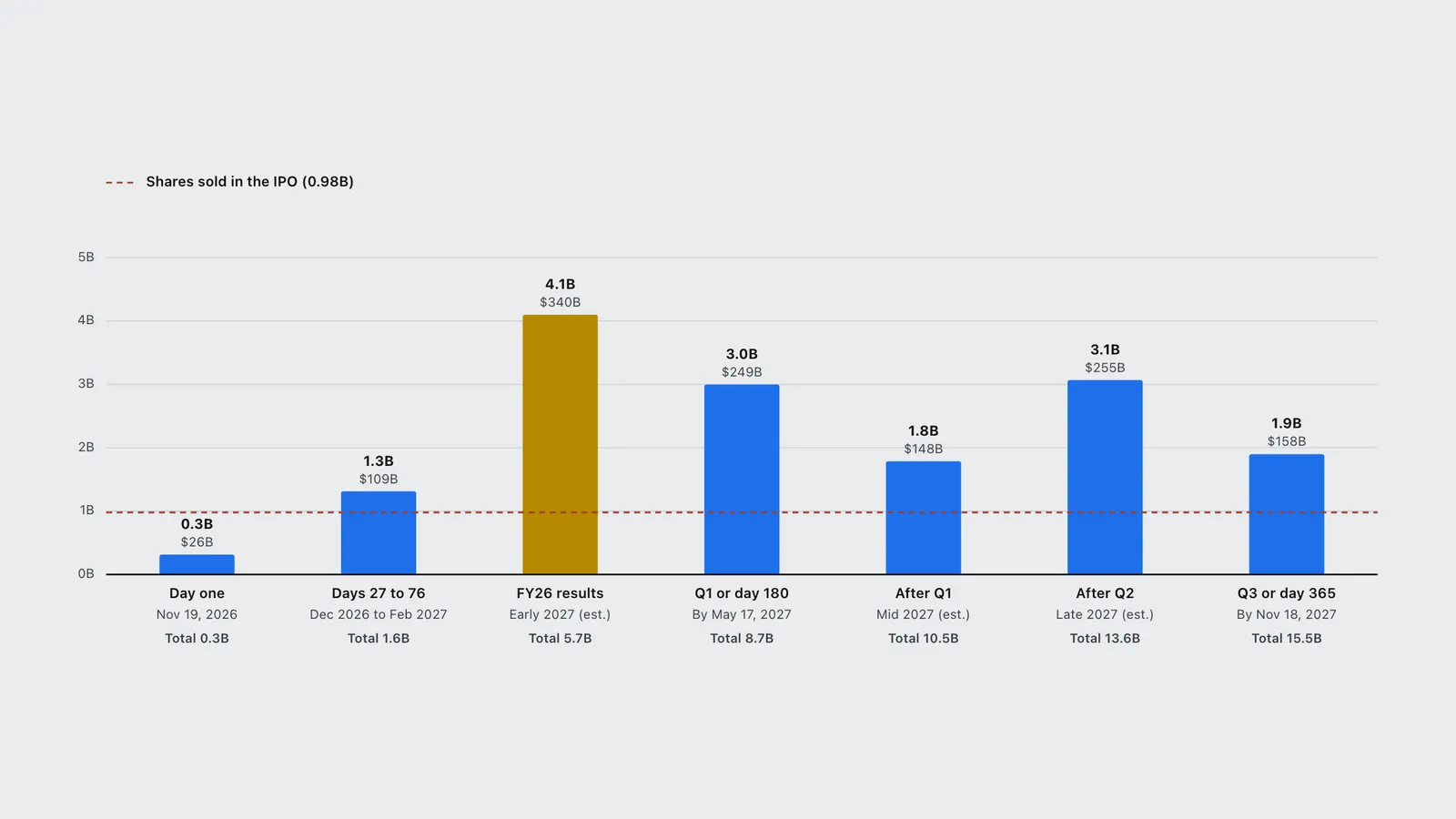
The Anthropic IPO lockup does not expire on one date. Anthropic’s final S-1 amendment sets 23 release dates: up to 315 million employee shares on day one (November 19, 2026), the largest wave after its full-year 2026 results, and the last 1.9 billion shares by November 18, 2027.
Anthropic priced its IPO at $83 a share on November 18 and starts trading on Nasdaq as ANT today. Most coverage of the lockup still assumes the standard 180-day cliff. The filing says otherwise: about 15.5 billion shares come free in steps, most of them tied to earnings releases that Anthropic has not yet scheduled. This page turns the schedule into calendar dates, puts a dollar value on each wave at the IPO price, and flags the $26 billion block of stock that sits outside the lockup altogether.
When does the Anthropic lockup expire?
In stages, over one year. Anthropic’s prospectus splits holders into four groups. Each group comes free on its own track, and most of the releases count from the prospectus date (November 18, 2026) or from an earnings release. The calendar dates below use the filing’s own rule: a day that falls on a weekend or holiday rolls to the next trading day. All 2026 and early 2027 dates in this table land on trading days.
| Release | Date | Shares (up to) | Value at $83 |
|---|---|---|---|
| First trading day | November 19, 2026 | 315 million | $26B |
| Day 27 | December 15, 2026 | 303 million | $25B |
| Day 48 | January 5, 2027 | 303 million | $25B |
| Day 62 | January 19, 2027 | 353 million | $29B |
| Day 76 | February 2, 2027 | 353 million | $29B |
| FY26 results + 2 days | Not set; early 2027 (estimate) | 1.7 billion | $141B |
| 13 to 69 days after FY26 | Five steps, every 14 days | 480 million x5 | $40B each |
| Q1 2027 results or day 180 | May 17, 2027 at the latest | 3.0 billion | $249B |
| 34 to 76 days after Q1 | Four steps, every 14 days | 447 million x4 | $37B each |
| Q2 2027 results + 2 days | Not set; mid 2027 (estimate) | 558 million | $46B |
| 27 to 83 days after Q2 | Five steps, every 14 days | 502 million x5 | $42B each |
| Q3 2027 results or day 365 | November 18, 2027 at the latest | 1.9 billion | $158B |
The value column is share count times the $83 IPO price, rounded, and it moves with the stock. It shows the scale of each step rather than a forecast of what holders will sell, because a release only makes stock sellable. Nobody is obliged to sell it.
| Phase | When | Shares released | Value at $83 | Running total |
|---|---|---|---|---|
| Day one | Nov 19, 2026 | 0.3B | $26B | 0.3B |
| Days 27 to 76 | Dec 2026 to Feb 2027 | 1.3B | $109B | 1.6B |
| FY26 results | Early 2027 (est.) | 4.1B | $340B | 5.7B |
| Q1 or day 180 | By May 17, 2027 | 3.0B | $249B | 8.7B |
| After Q1 | Mid 2027 (est.) | 1.8B | $148B | 10.5B |
| After Q2 | Late 2027 (est.) | 3.1B | $255B | 13.6B |
| Q3 or day 365 | By Nov 18, 2027 | 1.9B | $158B | 15.5B |
Which Anthropic shareholders can sell first?
Employees, by a wide margin. The lockup treats four groups differently, and the gap between the first and the last is a full year.
| Holder group | Day one | Before day 180 | At Q1 results or day 180 | Fully free |
|---|---|---|---|---|
| Non-founder employees, officers, directors, consultants | 10% | +35% after FY26 results | All of the rest | May 17, 2027 at the latest |
| Other stockholders (about 2.7 billion shares) | None | 6% on days 27 and 48, 7% on days 62 and 76, 60% after FY26 | All of the rest | May 17, 2027 at the latest |
| Holders above 0.5% (about 8.0 billion shares) | None | 1.8% to 2.85% steps, 25.8% in all | +4.2% | November 18, 2027 at the latest |
| The seven co-founders | None | None | 29% | November 18, 2027 at the latest |
The percentages for the large holders and the other stockholders apply to what each one held seven days before the prospectus date. For employees and the founders the base is what they held at the end of October. The founders’ 29% is a cap on what they may sell at day 180, not a plan to sell it. Each founder must also give the underwriters and Anthropic three business days’ notice before announcing a permitted sale.
Two more rules matter for the large holders. From day 195 (June 1, 2027), some of them may hedge up to 20% of their stock that is still locked, about 719 million shares in all, through derivatives. And the filing does not say which named investors sit in which group, so a claim that Amazon or Google unlocks on a particular date goes further than the document does.
Why is the biggest wave tied to Anthropic’s earnings?
Because the lockup counts from earnings releases, not just from the calendar. The step after full-year 2026 results is the largest single date in the schedule, about 1.7 billion shares, and the five steps that follow at 14-day intervals bring the phase to about 4.1 billion. That is more than four times the 980 million shares the IPO itself sold.
Tying a release to earnings is a choice about information. Insiders get to sell only after the market has seen a full audited year, so nobody unloads stock just before bad numbers come out. It also means the date of Anthropic’s first annual release sets the timing of about a quarter of the whole schedule.
Anthropic has not announced that date. One constraint does exist: the company registered as a non-accelerated filer (the box is ticked on its Rule 462(b) registration statement), and the SEC’s Form 10-K instructions give a non-accelerated filer 90 days after fiscal year end to file. That puts full-year 2026 results on the public record by March 31, 2027 at the latest. An earnings release before the 10-K would start the clock sooner.
Does the $26 billion private placement have a lockup?
No. Anthropic is selling $26.0 billion of non-voting Class N stock at the IPO price to seven of its chip and cloud suppliers, and the prospectus says these shares “will not be subject to the lock-up agreements or market standoff agreements.” The buyers are Google and Nvidia ($10.0 billion each), AMD ($2.5 billion), Broadcom, Micron and Microsoft ($1.0 billion each) and TSMC Partners (the balance, about $0.5 billion). At $83, $26.0 billion buys about 313 million shares, by this page’s arithmetic. The filing computed 351 million at the $74 range midpoint.
What holds those shares back is securities law rather than a contract. They are unregistered “restricted securities,” so a buyer that is not an Anthropic affiliate can resell under Rule 144 only after holding them for six months, once Anthropic has been a reporting company for 90 days. With the placement closing alongside the IPO on November 20, that points to late May 2027 at the earliest, close to the day-180 release. Google can also make Anthropic register its placement shares for resale under its own registration rights agreement. Separately, AMD’s $2.5 billion counts against an equity commitment tied to GPU deliveries, which is a supplier deal more than a trade. The money side of these placements is covered in how much Anthropic owes on compute.
Can the lockup end early?
Yes, in two ways, though not the way many recent IPOs do it. Goldman Sachs and Morgan Stanley, as the representatives of the underwriters, “may release the lock-up securities described above in whole or in part at any time,” and the filing adds that a release for some holders can trigger a pro rata release for certain others.
What the filing does not contain is a price trigger. Some IPO lockups let part of the stock come free early if the shares trade well above the offer price for a set run of days. No such clause appears in Anthropic’s lockup terms. A first-day jump does not bring any release forward: the dates stay tied to the calendar and to earnings.
How big is the float compared with the whole company?
Small. After the offering and the private placement the S-1/A counts about 7.4 billion Class A and 5.7 billion Class N shares outstanding, about 13.1 billion in all, before the 155 million extra shares added when the deal was enlarged. On day one, the tradable pool is the 980 million IPO shares plus up to 315 million employee shares. That is about 1.3 billion shares, roughly a tenth of the company. The underwriters’ option on 147 million more shares would add to it if exercised.
A thin float alongside a scheduled flow of new supply is the setup traders watch around unlock dates. Whether any step actually pushes the price down depends on who sells, and nobody can know that from a filing. What the filing settles is the supply side. By November 2027 the sellable pool grows from about 1.3 billion shares to almost 17 billion.
What did the Anthropic IPO raise?
Anthropic priced 980 million Class A shares at $83, above the $70 to $78 range it marketed. Of those, 956.4 million were new shares sold by the company and 23.6 million were sold by existing holders, whose proceeds go to them, not to Anthropic. The underwriters hold a 30-day option on 147 million more, and the deal is expected to close on November 20. At $83, the 980 million shares come to about $81.3 billion, which CNBC reported as the largest IPO on record, ahead of SpaceX’s June listing. The $26.0 billion placement comes on top.
The deal grew after the range was set. The Rule 462(b) filing of November 18 registered 178.25 million extra shares, including 23.25 million for the underwriters’ option. For where the revenue behind the $83 comes from, see how Anthropic makes money.
Frequently asked questions
- When does the Anthropic IPO lockup expire?
- In 23 steps rather than one date. Up to 315 million employee shares are free on November 19, 2026. The largest wave follows the full-year 2026 results in early 2027, the 180-day mark falls by May 17, 2027, and the last shares, including most founder stock, unlock by November 18, 2027.
- Is the Anthropic lockup 180 days?
- Only for some holders. Employees and most smaller stockholders are fully free at the earlier of the first-quarter 2027 results or day 180 (May 17, 2027). The seven co-founders and holders of more than 0.5% of the shares stay partly locked for up to 365 days.
- When can Anthropic employees sell their shares?
- Up to 10% from the first trading day, November 19, 2026, a further 35% two trading days after the full-year 2026 results, and the rest at the earlier of the first-quarter 2027 results or May 17, 2027. Insider trading windows can narrow those dates.
- When can the Anthropic founders sell stock?
- Not before the earlier of the first-quarter 2027 results or May 17, 2027, when each founder may sell up to 29% of their holdings. The rest stays locked until the earlier of the September-quarter 2027 results or November 18, 2027.
- Is there an early release if Anthropic stock rises?
- No. The lockup has no price-based early release. Only Goldman Sachs and Morgan Stanley, as the underwriters’ representatives, can release shares early, at their discretion.
Sources
- Anthropic, PBC (2026). Amendment No. 3 to Form S-1 Registration Statement (Shares Eligible for Future Sale; Underwriting, Lock-Up and Market Standoff Agreements; Concurrent Private Placement). U.S. Securities and Exchange Commission, filed November 17, 2026. https://www.sec.gov/Archives/edgar/data/2130357/000162828026074338/anthropicpbc-sx1ax3.htm
- Anthropic, PBC (2026). Form S-1 Registration Statement under Rule 462(b). U.S. Securities and Exchange Commission, filed November 18, 2026. https://www.sec.gov/Archives/edgar/data/2130357/000162828026074904/anthropic-sx1mef.htm
- Anthropic (2026). Anthropic prices initial public offering. Company announcement, November 18, 2026. https://www.anthropic.com/news/anthropic-prices-initial-public-offering
- U.S. Securities and Exchange Commission. Form 10-K General Instructions (filing deadlines). https://www.sec.gov/files/form10-k.pdf
- CNBC (2026). Anthropic IPO raises over $81 billion in largest offering on record, topping SpaceX. November 18, 2026 (secondary coverage). https://www.cnbc.com/2026/11/18/anthropic-ipo-ai-offering-price.html