Anthropic IPO: How Does Anthropic Make Money?
Anthropic's IPO filing: 80% of its $16.3B first-half revenue came from metered tokens, 48% via cloud marketplaces, and Q2 2026 was its first operating profit.
Anthropic’s IPO filing shows it makes most of its money selling Claude by the token. Of the $16.3 billion it booked in the first half of 2026, $13.1 billion (80%) was consumption revenue, metered per token used, and $3.2 billion (20%) was subscriptions, according to the audited revenue note in its Form S-1, filed publicly with the SEC on October 26, 2026. Nearly half of all revenue (48%) arrived through cloud marketplaces; the S-1 names AWS, Google Cloud and Microsoft Azure as its distribution partners. And the second quarter of 2026 was the first in which the business earned more than it spent to run: $974 million of operating income on $11.6 billion of revenue.
The net loss is a different story, and most of it is not cash. More on that below.
| Where the money came from | 2024 | 2025 | First half 2026 | Share, H1 2026 |
|---|---|---|---|---|
| Consumption (metered tokens) | $288M | $3.8B | $13.1B | 80% |
| Subscriptions | $98M | $0.8B | $3.2B | 20% |
| Total revenue | $386M | $4.6B | $16.3B | 100% |
| Sold through CSP marketplaces | 32% | 47% | 48% | |
| Billed outside the US | $123M | $1.2B | $4.5B | 28% |
Source: Anthropic, PBC Form S-1, Note 2 (Revenue) and Risk Factors. 2025 and 2024 are audited; the six months to June 30, 2026 are unaudited. “CSP” is the filing’s term for cloud service providers.
How does Anthropic make money from Claude?
Two ways, and the S-1 is plain about both. Customers either “pay for intelligence,” metered in tokens and priced by the model they pick, or they pay a subscription. The filing defines the first as revenue “recognized when customers use our intelligence service, based on the quantity of tokens consumed.” Subscriptions such as Claude Pro and Max are prepaid monthly or annually, come with usage limits that reset over short periods, and are recognized evenly over the term.
The split has barely moved while revenue went from $386 million in 2024 to $16.3 billion in six months of 2026. Consumption was 83% of revenue in 2025 and 80% in the first half of 2026. Subscriptions grew in dollars, from $789 million for all of 2025 to $3.2 billion in six months, but not as a share. This is a usage business that also sells plans, not a software-seat business with an API on the side.
The products that drive the meter are Claude itself through the API, and the agent applications built on it. The S-1 names Claude Code and Claude Cowork, the desktop agent it opened as a research preview in January 2026, and says Cowork’s adoption by September 30 had outpaced Claude Code’s at the same point after its own preview. Agents are expensive customers in the best sense: a long autonomous run burns far more tokens than a chat, and every one of them is billable.
How much of Anthropic’s revenue comes through Amazon, Google and Microsoft?
48% in the first half of 2026, up from 11% in 2023, 32% in 2024 and 47% in 2025. These are sales to Anthropic’s own customers that are billed through a cloud provider’s marketplace: the S-1 lists Amazon Bedrock, Google’s Gemini Enterprise Agent Platform and Microsoft Foundry. The S-1 says those platforms “bill end customers, collect payments on our behalf, and remit such amounts to us, net of applicable platform and other fees.”
That makes the clouds both distributor and debt collector. 58% of Anthropic’s net accounts receivable at June 30, 2026 was owed by these marketplaces. The filing also stresses that Anthropic keeps “separate contractual arrangements with end customers,” so losing one marketplace would not by itself cancel the customer relationship. It also concedes that customers may not move on acceptable terms if a channel breaks.
Cloud providers also sit on the other side of the ledger, as suppliers. Before 2026, the S-1 says, Anthropic bought “substantially all of its compute infrastructure from three cloud service providers.” What that compute costs, and what Anthropic has committed to spend on it, is covered in what the Anthropic IPO prospectus says about compute spending.
Who are Anthropic’s biggest customers?
The filing does not name them, but it does show how concentrated the money was. In 2025 two customers each made up 12% of revenue, roughly a quarter between them. In the first half of 2025 one customer alone was 18%. By the first half of 2026 only one customer cleared 10%, at 11%. Back in 2023 a single customer accounted for 43%.
| Customers above 10% of revenue | 2023 | 2025 | H1 2025 | H1 2026 |
|---|---|---|---|---|
| Customer A | - | 12% | - | - |
| Customer B | - | 12% | 18% | - |
| Customer C | 43% | - | - | 11% |
| Customer D | 11% | - | - | - |
A dash means below 10% in that period. Source: S-1, Note 1 (Significant Customers).
The base under those names has widened fast. As of September 30, 2026, Anthropic counted more than 11,900 customers paying $100,000 or more over the trailing twelve months, more than 1,900 paying $1 million or more, and about 250 paying $10 million or more. The S-1 uses the $100,000 group as its working definition of “enterprise” and says it does not track enterprise customers as a separate category.
Those customers are also spending more each year. The S-1 reports Net Revenue Retention of “approximately 900%” as of September 30, 2026: a customer that spent $1 in the third quarter of 2025 spent about $9 in the third quarter of 2026. The measure excludes Pro and Max subscribers, and the filing warns that its operating metrics “have not been independently verified by third parties.”
Is Anthropic profitable?
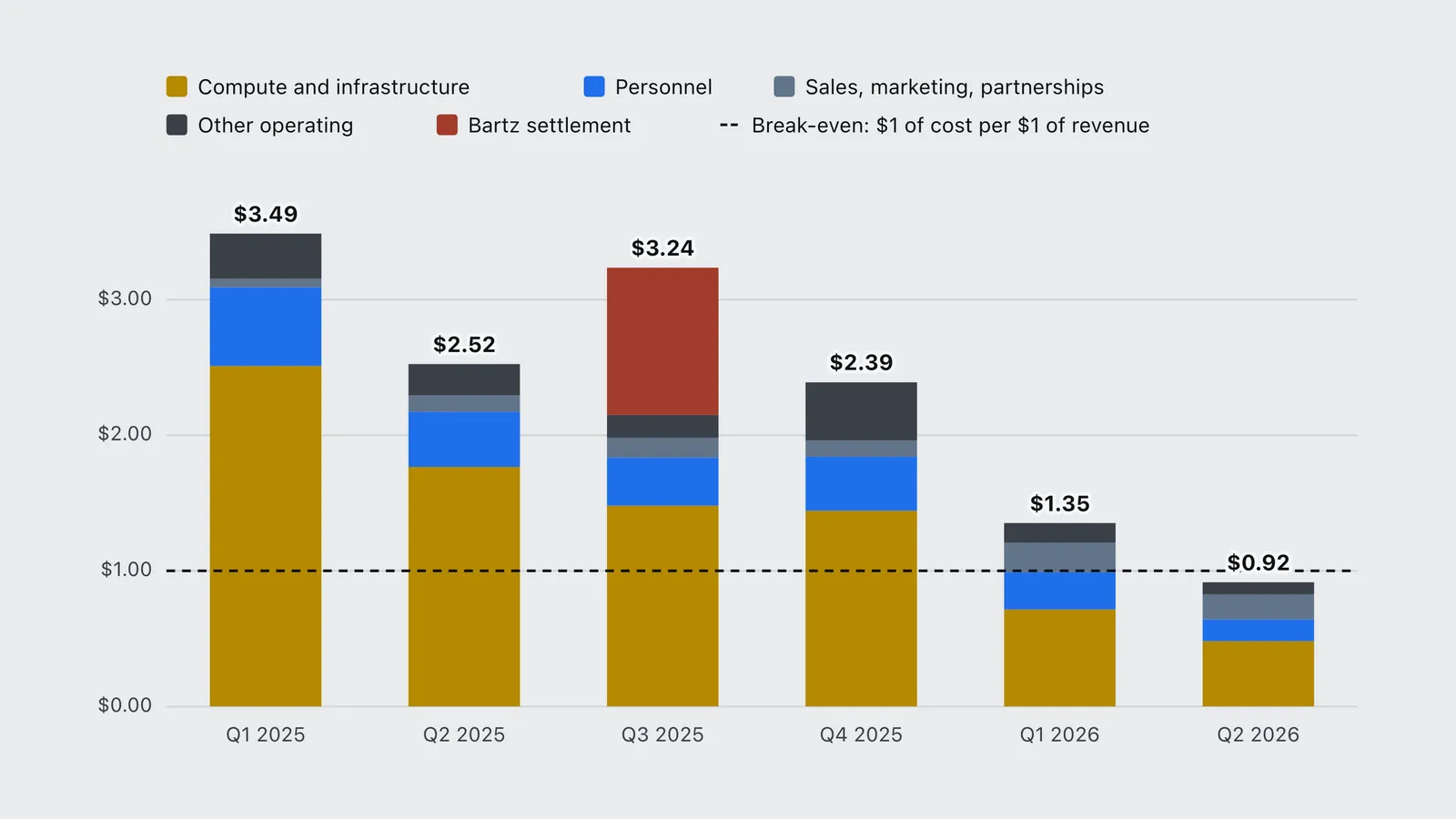
On an operating basis, for one quarter. The quarterly table in the S-1 shows operating losses every quarter through March 2026, then $974 million of operating income in the quarter ended June 30, 2026. The chart shows how it got there: what each dollar of revenue cost to earn, quarter by quarter.
| Period | Compute and infrastructure | Personnel | Sales, marketing, partnerships | Other operating | Bartz settlement | Total cost per $1 of revenue |
|---|---|---|---|---|---|---|
| Q1 2025 | $2.51 | $0.58 | $0.06 | $0.33 | $0.00 | $3.49 |
| Q2 2025 | $1.77 | $0.41 | $0.12 | $0.23 | $0.00 | $2.52 |
| Q3 2025 | $1.48 | $0.35 | $0.15 | $0.17 | $1.09 | $3.24 |
| Q4 2025 | $1.44 | $0.40 | $0.12 | $0.43 | $0.00 | $2.39 |
| Q1 2026 | $0.72 | $0.27 | $0.22 | $0.14 | $0.00 | $1.35 |
| Q2 2026 | $0.48 | $0.16 | $0.18 | $0.09 | $0.00 | $0.92 |
Here’s the mechanism. Compute spending kept rising in dollars, from $944 million in the first quarter of 2025 to $5.6 billion in the second quarter of 2026. Revenue rose much faster: 31-fold over the same six quarters, against roughly six-fold for compute. Most of a model’s cost is fixed when it is trained, and every additional customer on the same model is mostly marginal inference. Grow usage fast enough and the cost per dollar collapses, which is exactly what the bars show.
Below the operating line, the S-1 reports a net loss of $80.7 billion for the first half of 2026 and $42 billion for 2025. Nearly all of it is accounting for how Anthropic raised money, not money it spent. Convertible notes, derivative liabilities and SAFEs are carried at fair value, and as the company’s valuation climbed, their value rose and was booked as an expense: $59.6 billion in the second quarter of 2026 alone, and $72.4 billion across the first half. That charge is the company’s own rising valuation passing through its financing instruments, not cash leaving the business.
Does Anthropic earn money from customers who break its rules?
Yes, and the S-1 puts a number on it. Anthropic estimates that customers later found to be using its models “in violation of our usage policy or commercial terms” generated about 5% to 7% of its revenue in the first nine months of 2026. It books that revenue as the service is delivered, before detection and enforcement catch up, and says it “believe[s] this dynamic is common in our industry.”
The company expects the share to fall, having stepped up detection in August and September 2026, and says the timing and size of any hit to revenue growth “are uncertain.” For a business growing this fast, a 5% to 7% slice that could shrink on purpose is a disclosure worth watching in the next filing.
When is the Anthropic IPO, and what does the S-1 mean for it?
The S-1 sets no date. Anthropic filed it publicly on October 26, 2026, applying to list its Class A common stock on the Nasdaq Global Select Market under the ticker ANT, and it leaves the price range and share count blank, so it does not yet value the company either. Those numbers arrive in an amended filing before the shares are marketed and priced. It is also a public benefit corporation with two control features that public shareholders will not share. Its Long-Term Benefit Trust holds Class T stock that lets it elect the Class T directors, who “together will constitute a majority” of the board. And a single share of Class F common stock, for the founders, carries 50.1% of the total voting power.
For anyone pricing the shares, the revenue story in the filing comes down to four facts:
- It is a usage business. Four of every five dollars rise and fall with how many tokens customers run, so growth tracks agent adoption more than seat counts.
- Distribution is shared. Close to half of revenue flows through the same clouds that sell Anthropic its compute.
- Concentration has fallen, quality has not been audited. No customer above 11% now, but the 900% retention and run-rate figures are management metrics, not audited numbers.
- The profit is new. One quarter of operating income, on growth the company says will slow.
The cost side of the same filing, including the size of the compute commitments, is in the Anthropic prospectus compute breakdown. How the token rates behind that consumption revenue have moved is tracked on the AI model tracker, and why per-token prices keep falling is covered in why OpenAI and Anthropic keep cutting prices.
Frequently asked questions
- How does Anthropic make money?
- Mostly by selling Claude by the token. In the first half of 2026, $13.1 billion of its $16.3 billion revenue (80%) was consumption revenue, metered per token, and $3.2 billion (20%) was subscriptions such as Claude Pro and Max, according to its Form S-1. About 48% of revenue was billed through cloud marketplaces such as Amazon Bedrock and Microsoft Foundry.
- How much revenue does Anthropic make?
- Anthropic reported $4.6 billion of revenue for 2025 and $16.3 billion for the six months ended June 30, 2026, including $11.6 billion in the second quarter alone. Revenue was $386 million in 2024 and $41 million in 2023.
- Is Anthropic profitable?
- On an operating basis, for one quarter: it earned $974 million of operating income in the quarter ended June 30, 2026, after operating losses in every earlier quarter shown. Its net loss was $80.7 billion for the first half of 2026, mostly a non-cash charge from revaluing convertible notes and similar instruments as its valuation rose.
- Who are Anthropic’s biggest customers?
- The S-1 does not name them. It shows two customers at 12% of revenue each in 2025, and one customer at 11% in the first half of 2026, with no other customer above 10%. As of September 30, 2026, more than 1,900 customers paid Anthropic $1 million or more over the trailing twelve months.
- When is the Anthropic IPO?
- Anthropic has not set a date. It filed its Form S-1 publicly with the SEC on October 26, 2026, applying to list on the Nasdaq Global Select Market under the ticker ANT. The filing leaves the price range and share count blank; those come in an amended filing before the offering is priced.
- What is Anthropic’s stock ticker?
- Anthropic has applied to list its Class A common stock on the Nasdaq Global Select Market under the symbol ANT. Its S-1, filed October 26, 2026, leaves the price range and number of shares blank.
Sources
Anthropic, PBC (2026). Form S-1 Registration Statement. U.S. Securities and Exchange Commission, filed October 26, 2026: Note 2 (Revenue: by region, consumption-based and subscription-based), Note 1 (Significant Customers), Quarterly Consolidated Statements of Operations, Risk Factors (CSP marketplace share of revenue and receivables; usage-policy revenue), Prospectus Summary and Business (customer counts, Net Revenue Retention, Nasdaq listing under ANT, Long-Term Benefit Trust and Class T directors, Class F voting power, distribution through Amazon Bedrock, Gemini Enterprise Agent Platform and Microsoft Foundry). https://www.sec.gov/Archives/edgar/data/0002130357/000162828026067168/anthropicpbc-sx1.htm Accessed 2026-10-27.