Why Are OpenAI and Anthropic Cutting AI Prices?
OpenAI and Anthropic cut API prices 20% to 92% from July to October 2026. Open-weight models hosted by US clouds set the floor; cheaper serving did the rest.
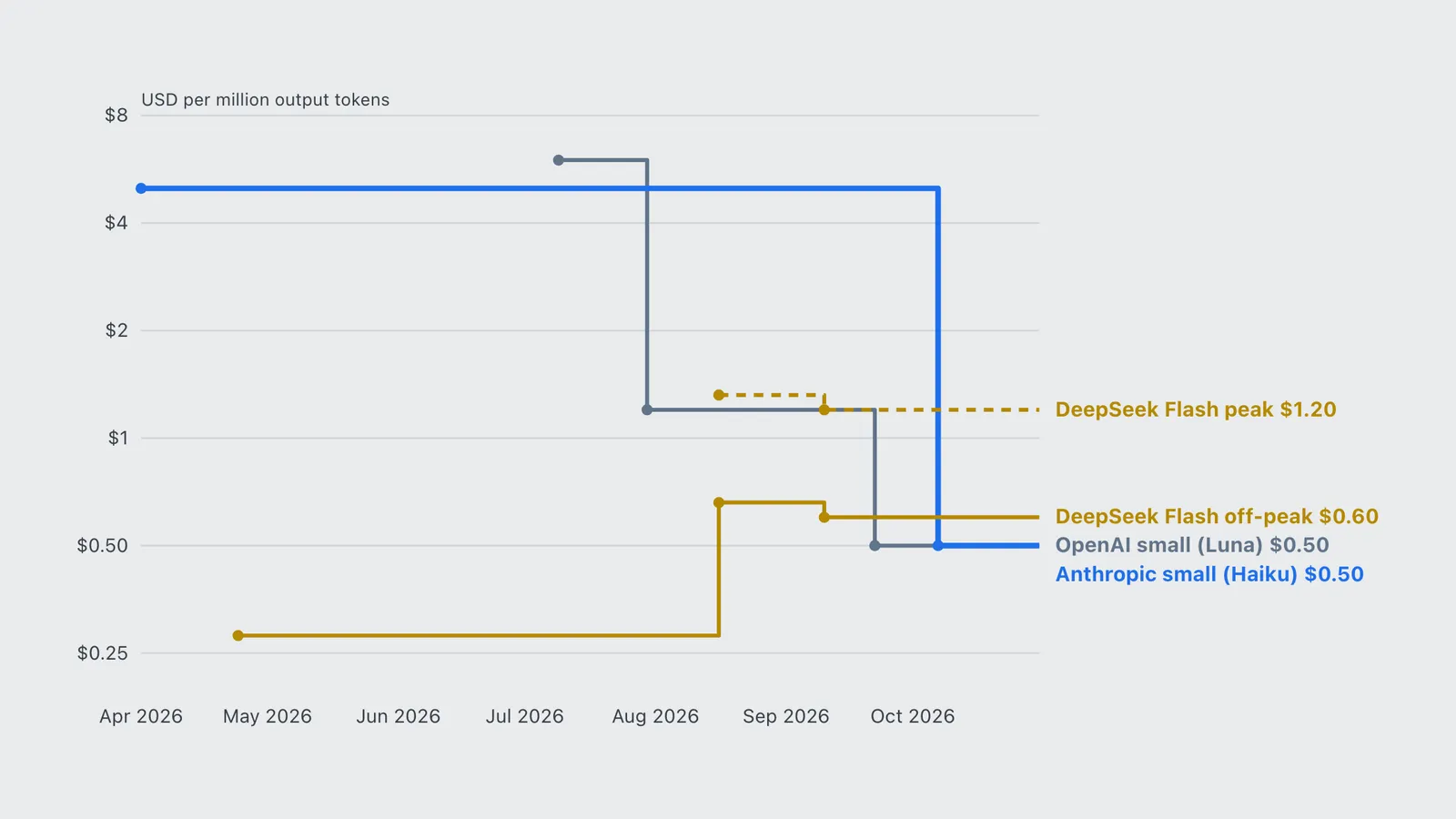
OpenAI and Anthropic cut API prices by 20% to 92% between July and October 2026 because Chinese open-weight models, served cheaply by US clouds, set a floor their small tiers had to meet.
The one-word answer on the Reddit thread was “China”, and it is mostly right. The useful version is narrower. The cuts landed hardest on the tiers where open-weight models compete: OpenAI’s and Anthropic’s small models now list $0.50 per million output tokens, below the $0.60 DeepSeek charges for its own Flash model off-peak. At the very top, where nothing open competes yet, the price went up. Cheaper serving hardware and the two labs undercutting each other explain the rest.
The question went around after Max Woolf’s October 25 post on minimaxir.com, OpenAI and Anthropic cut their LLM prices by up to 80% within a few months. Why?, which lists the cuts and calls them “weird”. This page checks each cut against the vendors’ own price pages as of October 26, 2026, and ranks the explanations by how much evidence backs them.
Why are OpenAI and Anthropic cutting prices?
Four forces, in order of evidence:
- The open-weight floor. Open-weight models now carry most of the traffic on at least one major gateway, and US clouds serve Chinese weights at prices close to DeepSeek’s own. Both labs cut their small tiers to that line.
- Each other. The cuts arrive in pairs, sometimes on the same day. A June report said OpenAI planned its cuts “in anticipation of similar cuts it expects at Anthropic.”
- Cheaper serving. Both labs say their new models cost less to run. That is a vendor claim, but the size of the cache-read cuts fits it.
- Enterprise bills and the IPO race. Customers pushed back on the bills, and both companies want growth numbers before they list.
“Up to 80%” undersells it. Measured from the July launch card, OpenAI’s small tier is 92% cheaper on output, and Anthropic’s small tier is 90% cheaper than Haiku 4.5.
Every price cut since July
Prices are per million tokens, as input / output / cache read, from OpenAI’s API pricing page and Anthropic’s pricing documentation, both read on October 26, 2026. Each model in the table is available on the API today.
| Date | Lab | Change | Before | After | Output change |
|---|---|---|---|---|---|
| Jul 30 | OpenAI | GPT-5.6 Luna repriced | $1 / $6 / $0.10 | $0.20 / $1.20 / $0.02 | -80% |
| Jul 30 | OpenAI | GPT-5.6 Terra repriced | $2.50 / $15 / $0.25 | $2 / $12 / $0.20 | -20% |
| Aug | Anthropic | Sonnet 5 launch price made permanent | $3 / $15 was scheduled | $2 / $10 / $0.20 kept | -33% vs plan |
| Aug 21 | OpenAI | GPT-5.6 Sol promotional rate | $5 / $30 / $0.50 | $4 / $20 / $0.40 | -33% |
| Sep 1 | Anthropic | Fable 5.1 replaces Fable 5 | $10 / $50 / $1 | $10 / $50 / $0.25 | 0% (cache -75%) |
| Sep 22 | Anthropic | Opus 5.5 replaces Opus 5 | $5 / $25 / $0.50 | $4 / $20 / $0.20 | -20% |
| Sep 22 | OpenAI | GPT-6 Sol replaces GPT-5.6 Sol | $4 / $20 / $0.40 | $2 / $10 / $0.20 | -50% |
| Sep 22 | OpenAI | GPT-6 Luna replaces GPT-5.6 Luna | $0.20 / $1.20 / $0.02 | $0.10 / $0.50 / $0.01 | -58% |
| Sep 28 | Anthropic | Sonnet 5.5 replaces Sonnet 5 | $2 / $10 / $0.20 | $2 / $10 / $0.10 | 0% (cache -50%) |
| Sep 29 | OpenAI | GPT-6.1 Sol replaces GPT-6 Sol | $2 / $10 / $0.20 | $2 / $10 / $0.10 | 0% (cache -50%) |
| Oct 7 | Anthropic | Haiku 5.5 replaces Haiku 4.5 | $1 / $5 / $0.10 | $0.10 / $0.50 / $0.01 | -90% |
Three things in that table matter more than any single row.
The small tiers fell furthest. Luna went from $6 to $0.50 output in ten weeks. Haiku went from $5 to $0.50 in one release. Anthropic’s Haiku 5.5 rate card for prompts under 100,000 tokens is identical to GPT-6 Luna’s, down to the $0.01 cache read. That is not a coincidence.
The cache read fell in nearly every release, even when the headline rate did not. Fable 5.1, Sonnet 5.5 and GPT-6.1 Sol all kept their input and output prices and cut only the cache read. An agent re-reads its context on every turn, so the cache read is the line an agent bill leans on hardest. Anthropic’s Opus 5.5 page says cache reads are “the majority of agentic and coding work costs.”
The top tier went the other way. OpenAI launched GPT-6 Astra on September 3 at $10 / $50, and Claude Fable 5.1 holds the same $50 output rate. The cuts are not a general price collapse. They hit the tiers where there is a cheaper substitute.
Is it China?
Mostly, yes. But the way China forced the cuts is not the way most people think.
DeepSeek did not undercut the US labs into submission. It raised its own prices. DeepSeek V4 Flash launched on April 24 at $0.14 input and $0.28 output. Since August 16 DeepSeek has billed by time of day, and its current Flash model, DeepSeek-V4.1-Flash-1017, lists $0.15 / $0.60 off-peak and $0.30 / $1.20 at peak, according to DeepSeek’s API pricing page. Off-peak output is up 114% since launch. Peak output is up 329%.
So the lines crossed. In July, OpenAI’s cheapest model charged more than 20 times DeepSeek’s output rate. By October, both US small tiers charged less than DeepSeek does at any hour.
| Series | Date | USD per million output tokens | Note |
|---|---|---|---|
| OpenAI small (Luna) | 2026-07-09 | $6 | GPT-5.6 Luna launch |
| OpenAI small (Luna) | 2026-07-30 | $1.20 | GPT-5.6 Luna cut 80% |
| OpenAI small (Luna) | 2026-09-22 | $0.50 | GPT-6 Luna |
| Anthropic small (Haiku) | 2026-04-01 | $5 | Haiku 4.5 |
| Anthropic small (Haiku) | 2026-10-07 | $0.50 | Haiku 5.5, prompts under 100K |
| DeepSeek Flash peak | 2026-08-16 | $1.32 | Time-of-day billing starts |
| DeepSeek Flash peak | 2026-09-10 | $1.20 | V4.1 Flash |
| DeepSeek Flash off-peak | 2026-04-24 | $0.28 | V4 Flash launch |
| DeepSeek Flash off-peak | 2026-08-16 | $0.66 | Time-of-day billing starts |
| DeepSeek Flash off-peak | 2026-09-10 | $0.60 | V4.1 Flash |
The real pressure comes from the hosts. DeepSeek publishes its weights under an MIT license, so anyone can serve them. On October 26 the Price Per Token provider index listed 36 endpoints for DeepSeek V4.1 Flash, including Cloudflare at $0.10 / $0.60, CoreWeave at $0.15 / $0.65 and DigitalOcean at $0.165 / $0.66. Max Woolf counted 13 OpenRouter providers for V4 Flash in May and 29 for the 1017 build in October.
That removes the objection that kept enterprise buyers on US models: data going to a Chinese company. Vercel’s AI Gateway Production Index for October 2026, published October 15, reports that nearly 70% of September’s gateway spend on Chinese models “went through US-based providers, up from less than 10% in December.” Open-weight models handled 71.5% of the gateway’s tokens but only 23% of its spend. In August they processed the majority of its tokens for the first time.
That gap between tokens and dollars is the threat in one number. Open models were taking volume without taking revenue, which meant the US labs were losing the workloads that would later become revenue. Vercel’s same report has Anthropic’s share of gateway spend falling from 63.7% to 43.9%, below half for the first time.
One caveat keeps this honest. Price parity is not quality parity. On the Artificial Analysis Intelligence Index, DeepSeek V4.1 Flash 1017 scores 45 at max effort, against 43 for Claude Haiku 5.5 and 38 for GPT-6 Luna, all read on October 26. The US labs matched the Chinese price, not the Chinese model. Why Chinese labs can charge so little in the first place is its own question, covered in why Chinese AI models are so cheap.
The pressure is not only DeepSeek. Moonshot’s Kimi K3.1 Pro, released October 23, lists $2 / $10, the same card as Claude Sonnet 5.5 and GPT-6.1 Sol, and scores 55 on the index, three points behind Claude Opus 5.5 at 58. Reuters’ July 30 report on the Luna cut, OpenAI cuts prices on smaller models as businesses scrutinize AI spend, named Z.ai’s GLM-5.2 as an open model that “nearly match[es] their performance at a lower cost.”
Are OpenAI and Anthropic just matching each other?
Yes, and the dates show it.
On June 10, as summarized by implicator.ai, the Wall Street Journal reported that OpenAI was weighing significant token price cuts “in anticipation of similar cuts it expects at Anthropic.” Seven weeks later OpenAI cut Luna and Terra. Anthropic’s next pricing move was to cancel the Sonnet 5 increase: the $2 / $10 launch price was due to rise to $3 / $15 on September 1, and Anthropic’s pricing page now says “the previously scheduled increase … will not occur.”
Then September 22. Anthropic released Opus 5.5 at 20% off Opus 5, and OpenAI released GPT-6 Sol and Luna the same day at half the GPT-5.6 rates. A week later each lab halved a cache read: Sonnet 5.5 on September 28, GPT-6.1 Sol on September 29. On October 7 Haiku 5.5 copied GPT-6 Luna’s rate card to the cent.
Two companies landing on the same price on the same day is what a market with two close substitutes looks like. Max Woolf’s point about switching costs applies: a developer on OpenRouter, OpenCode or Zed changes model by editing one string. With no lock-in, a price gap lasts until the other lab’s next release.
Is it actually cheaper to run these models now?
Partly, and the labs say so themselves. Anthropic’s Opus 5.5 announcement states that “Opus 5.5 requires less compute to serve than Opus 5, and its pricing reflects that,” and that at default settings it will cost “40% less than Opus 5 on typical workloads.” OpenAI attributed the July cuts to inference efficiency gains found while building GPT-5.6, as recorded in the site’s GPT-5.6 price-cut analysis.
Treat both as vendor claims. Neither lab publishes its serving cost. Two things make the claim plausible anyway. Serving cost per token has fallen for years (the long curve is in cost per token over time). And the cuts are concentrated in the cache read, the price of re-reading context a model has already stored. That is where a serving-side saving would show up first, and every US cache-read cut in the table above points the same way.
Efficiency explains why the labs can afford the cuts. It does not explain the timing. Cheaper serving lets a lab keep its margin at a lower price. A competitor at that lower price is what makes it cut.
Why cut prices before an IPO?
Max Woolf finds this the strangest part, and he has a point: lower prices mean less revenue per token just as both companies prepare filings. Reuters’ July 30 report quoted analysts warning that the cuts could raise usage but “strain their finances ahead of highly anticipated initial public offerings.”
The bet behind it is volume. Vercel reports that the median paid customer active in both December and September more than doubled its spend, and that total gateway spend in September was about 13 times December’s while the average price per token fell 47%. When volume grows that fast, a lab that keeps prices high loses share in a market that is still growing. An IPO prospectus rewards revenue growth and share more than it rewards price per token. The financing side of this is in Anthropic’s IPO and compute spending.
There is a second motive. Cuts move users off old models. Opus 5.5 at $4 / $20 now outscores the $10 / $50 Fable 5.1 on the Artificial Analysis index, 58 to 53. That pushes traffic onto a newer model that, by Anthropic’s own account, is cheaper to serve.
Did your AI bill actually go down?
Probably not by as much as the rate card suggests, and maybe not at all.
Vercel’s numbers are the clearest picture: price per token down 47%, spend up roughly 13 times. Teams moved to better models, ran more agents and sent more tokens. A newer model can also use more tokens per task: Artificial Analysis measured Kimi K3.1 Pro at about the same cost per task as Kimi K3 despite a one-third rate cut. A cheaper token does not guarantee a cheaper task, which is the price reversal effect.
Where you will feel it: high-volume small-model work (classification, extraction, routing) on Luna or Haiku is about a tenth of what it cost in July, and long agent sessions dominated by cached context got cheaper on every release. Where you will not: anything that needs the top tier. That costs more than it did a year ago.
Will AI prices go back up?
Some will, on a schedule. GPT-5.6 Sol’s $4 / $20 is promotional, and OpenAI’s pricing page says it runs “at least through November 21, 2026.” Gemini 4 Argon goes from $2 / $10 to $4 / $20 on December 1, when Google’s introductory price ends. DeepSeek has already raised its own rates once this year.
The broad trend is unlikely to reverse while open weights sit on dozens of hosts. Max Woolf’s argument holds: any provider with a positive margin per token has a reason to keep undercutting, and a model that cannot make money at the market price gets retired rather than repriced upward. The price that can rise is the one with no open substitute, the $50 output tier. Watch that line, and track live rates on the AI models price tracker. The other side of 2026, where costs climbed, is in AI price hikes in 2026.
Which model got cheapest?
- Small tier: GPT-6 Luna and Claude Haiku 5.5 tie at $0.10 / $0.50 with a $0.01 cache read. Haiku scores higher on the index, but its rate rises fivefold for prompts over 100,000 tokens; Luna’s surcharge starts at 272,000.
- Mid and flagship tier: GPT-6.1 Sol, Claude Sonnet 5.5 and Kimi K3.1 Pro all list $2 / $10. Sol and Sonnet 5.5 cache-read at $0.10, half of Kimi’s $0.20.
- Best model per dollar at the top: Claude Opus 5.5 at $4 / $20 scores 58, the top score on the index, for less than half the Fable 5.1 and GPT-6 Astra rate.
- Cheapest open option: DeepSeek V4.1 Flash off-peak through DeepSeek, or a third-party host such as Cloudflare at $0.10 / $0.60, with the best small-model index score of the group.
Frequently asked questions
- How much did OpenAI and Anthropic cut their prices in 2026?
- Between July and October 2026, OpenAI cut its small-tier output price from $6 to $0.50 per million tokens (92%) and its flagship from $30 to $10 (67%). Anthropic cut its small tier from $5 to $0.50 (90%) with Haiku 5.5 and its top general model from $25 to $20 (20%) with Opus 5.5.
- Are Chinese AI models cheaper than GPT-6 Luna and Claude Haiku 5.5 now?
- Not at first-party list price. DeepSeek V4.1 Flash costs $0.60 per million output tokens off-peak and $1.20 at peak on DeepSeek, above the $0.50 that GPT-6 Luna and Claude Haiku 5.5 charge. Some third-party hosts serve it for less, and it scores higher on the Artificial Analysis index than either.
- Did OpenAI and Anthropic cut prices on the same day?
- Yes. On September 22, 2026, Anthropic released Claude Opus 5.5 at 20% below Opus 5 and OpenAI released GPT-6 Sol and Luna at half the GPT-5.6 rates. On October 7, Claude Haiku 5.5 launched with the same rate card as GPT-6 Luna.
- Is the GPT-5.6 Sol price cut permanent?
- No. OpenAI lists the $4 and $20 rate for GPT-5.6 Sol as promotional pricing that runs at least through November 21, 2026. GPT-6 Sol and GPT-6.1 Sol, at $2 and $10, are standard prices.
Sources
- Woolf, M. (2026). OpenAI and Anthropic cut their LLM prices by up to 80% within a few months. Why? minimaxir.com (commentary). https://minimaxir.com/2026/10/cheap-llms/
- OpenAI (2026). API pricing. OpenAI developer documentation. https://developers.openai.com/api/docs/pricing
- Anthropic (2026). Pricing. Claude platform documentation. https://platform.claude.com/docs/en/about-claude/pricing
- Anthropic (2026). Claude Opus 5.5. Anthropic. https://www.anthropic.com/claude-opus-5-5
- DeepSeek (2026). Models and pricing. DeepSeek API documentation. https://api-docs.deepseek.com/quick_start/pricing
- DeepSeek (2026). DeepSeek-V4 Preview Release. DeepSeek API news. https://api-docs.deepseek.com/news/news260424/
- Vercel (2026). AI Gateway Production Index, October 2026: Open weight takes 71.5% of tokens and 23% of spend. Vercel blog. https://vercel.com/blog/ai-gateway-production-index-october-2026
- Artificial Analysis (2026). Model pages: DeepSeek V4.1 Flash 1017, Claude Haiku 5.5, GPT-6 Luna, Claude Opus 5.5, Kimi K3.1 Pro. https://artificialanalysis.ai/models/deepseek-v4-1-flash-1017
- Price Per Token (2026). DeepSeek V4.1 Flash provider prices. Price Per Token (aggregator, secondary). https://pricepertoken.com/
- Reuters (2026). OpenAI cuts prices on smaller models as businesses scrutinize AI spend. Via The Star. https://www.thestar.com.my/tech/tech-news/2026/07/31/openai-cuts-prices-on-smaller-models-as-businesses-scrutinize-ai-spend
- implicator.ai (2026). OpenAI weighs drastic token price cuts to blunt Anthropic’s enterprise run (summary of a Wall Street Journal report, secondary). https://www.implicator.ai/openai-weighs-drastic-token-price-cuts-to-blunt-anthropics-enterprise-run/