Is OpenAI Ultrafast Worth It? The $53-an-Hour Test
OpenAI Ultrafast runs GPT-6 Astra up to 8x faster at 6x the price. On a standard coding loop it pays off only if waiting costs you more than about $53 an hour.
Ultrafast is OpenAI’s premium speed tier. At DevDay on September 29, 2026, OpenAI said it generates GPT-6 Astra tokens up to eight times faster than standard in Codex, at about 300 tokens per second. The price is six times standard on the API: $60 per million input tokens and $300 per million output, against Astra’s usual $10 and $50, per OpenAI’s API pricing page.
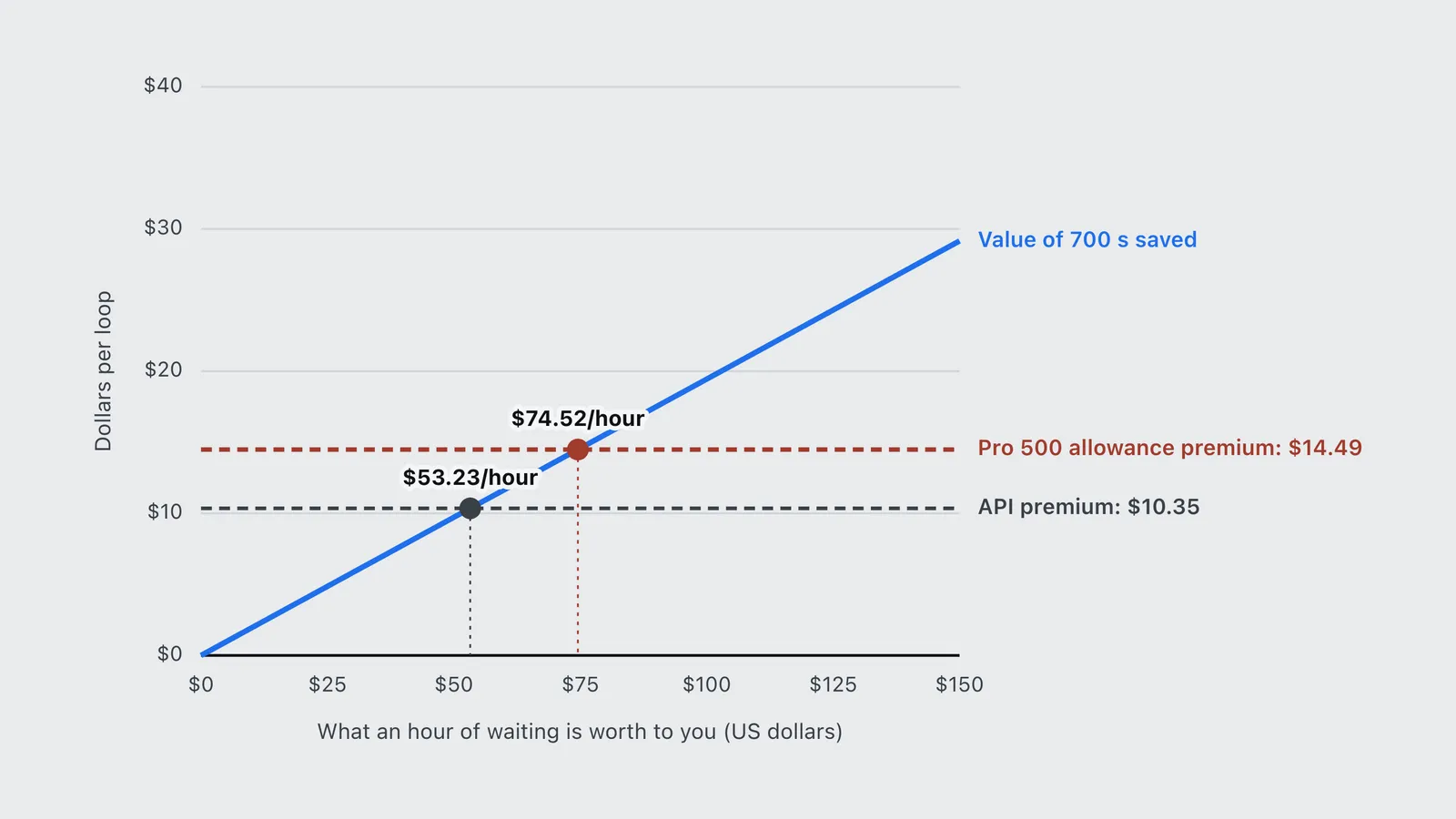
Short answer: Ultrafast is worth it when an hour of waiting costs you more than about $53. That is the break-even on a standard twelve-turn coding loop, where Ultrafast adds $10.35 and saves up to about 12 minutes of generation time. On a Pro 500 subscription the bar rises to about $75 an hour, because the plan’s allowance is charged at 8x for Ultrafast rather than 6x. If tool calls and test runs take half the wall clock, both numbers double.
The rest of this post shows the arithmetic, who can actually buy Ultrafast, and where the speed claim stops applying.
What Ultrafast costs
OpenAI prices Ultrafast in two places, and the two meters use different multipliers.
On the API, Ultrafast is exactly six times standard GPT-6 Astra on every line of the price list for prompts up to 272,000 tokens:
| GPT-6 Astra, per million tokens | Standard | Ultrafast |
|---|---|---|
| Input | $10 | $60 |
| Cached input | $1 | $6 |
| Cache writes | $12.50 | $75 |
| Output | $50 | $300 |
In Codex and ChatGPT Work, OpenAI’s speed documentation says Ultrafast “uses included subscription limits at 8x the Standard rate”, while “purchased credits and Enterprise pay-as-you-go usage are billed at 6x”. The same page adds that these multipliers “don’t describe speed increases”. So a subscriber pays a steeper rate for Ultrafast out of their plan than they would on credits or on the API.
To make that concrete, this site prices one fixed unit of agent work, first set out in its GPT-5.6 cost-per-task breakdown: a twelve-turn coding loop where each turn sends 25,000 input tokens at a 90 percent cache-hit rate and writes 2,500 output tokens. On API list prices:
- GPT-6 Astra, standard:
12 x (22,500 x $1 + 2,500 x $10 + 2,500 x $50) / 1,000,000= $2.07 per loop. - GPT-6 Astra, Ultrafast: six times that, $12.42 per loop.
The premium is $10.35 a loop on the API. Inside a Pro 500 allowance, the same loop drains 8x the standard 51.75 credits, or 414 credits’ worth, so the premium there is 362 credits, about $14.49 at the $0.04 per credit the rate card implies. The Codex cloud vs local cost breakdown walks through that credit arithmetic.
What Ultrafast saves
The loop writes 30,000 output tokens (twelve turns of 2,500). OpenAI’s keynote put Ultrafast at about 300 tokens per second. If that is eight times standard, as the speed documentation says at the top end, standard Astra in Codex runs near 37.5 tokens per second. That is a derived figure, not one OpenAI publishes.
- Standard: 30,000 tokens at 37.5 per second is about 800 seconds, or 13.3 minutes of generation.
- Ultrafast: 30,000 tokens at 300 per second is 100 seconds.
Ultrafast saves up to 700 seconds per loop, about 11.7 minutes. Divide the premium by the time saved and you get the hourly rate at which the two break even:
- API: $10.35 over 0.194 hours = about $53 an hour.
- Pro 500 allowance: $14.49 over 0.194 hours = about $75 an hour.
| Meter | Extra cost per unit of work | Break-even value of an hour |
|---|---|---|
| API premium | $10.35 | $53.23 per hour |
| Pro 500 allowance premium | $14.49 | $74.52 per hour |
The $53 figure is a floor on the bar, not a ceiling. It assumes every second of the loop is token generation. OpenAI is explicit that its eightfold figure “measures token generation speed, not billing rates or overall task completion time”. A real agent loop also waits on tool calls, file reads, builds and tests, none of which get faster. If half of the wall clock is spent outside generation, Ultrafast saves 350 seconds instead of 700, and the break-even doubles to about $106 an hour on the API and $149 on the plan.
Who can buy Ultrafast
Access depends on how you pay. Per OpenAI’s speed and API documentation:
- ChatGPT Pro 500 ($500 a month): the only self-serve plan with Ultrafast in Codex and ChatGPT Work. It spends included usage first, at 8x, then purchased credits at 6x. The site’s Pro 500 breakeven works out when the plan beats paying by the token.
- Eligible Enterprise and Edu workspaces: off by default for Enterprise; a workspace owner has to enable it, and per-user spend controls apply.
- Plus, Pro 100, Pro 200 and Business: no Ultrafast at launch, “even with purchased credits”, per the speed documentation.
- The API: Ultrafast for GPT-6 Astra is “available to all API users at low rate limits”, per OpenAI’s Ultrafast API guide. The default limit is 500,000 tokens per minute on usage tiers 1 to 3, 1 million on tier 4 and 5 million on tier 5.
The API route is the one most coverage missed. A developer who wants Ultrafast for a few hard sessions a month does not need a $500 plan. The trade is the rate limit: one twelve-turn loop moves about 330,000 tokens, so on a low tier a single agent at full speed already uses most of a minute’s allowance, and parallel agents will queue.
Two other constraints apply on every route. Ultrafast supports US data residency and global processing only, not EU or other regional endpoints. And OpenAI “strongly recommends” a WebSocket connection for agent work, because per-request network overhead eats into the latency gain.
When Ultrafast is worth it, and when it is not
It pays when a person is waiting on the output. Live pair-programming, a demo, an incident where each minute of diagnosis costs money, or a review queue where a developer sits idle until the agent finishes. In each case the hourly value of waiting is high, and the loop is mostly generation.
It does not pay for work nobody watches. A background refactor in Codex Cloud, an overnight batch job or a scheduled review runs while you do something else. The waiting costs nothing, so any premium is a loss.
Check GPT-6.1 Sol first. Sol launched at DevDay at one fifth of Astra’s standard price, $2 and $10 per million tokens, and OpenAI pitched it as close to Astra quality. The same loop costs about $0.39 on Sol. If Sol handles the task, the cheapest way to get faster answers per dollar is often a smaller model, not a faster tier. OpenAI says Ultrafast for Sol is “coming soon” but has not priced it.
Frequently asked questions
- Is OpenAI Ultrafast worth it?
- Only if waiting on the model costs you more than about $53 an hour. On a standard twelve-turn GPT-6 Astra coding loop, Ultrafast adds $10.35 on the API and saves up to about 700 seconds of generation. Inside a Pro 500 allowance, where Ultrafast is charged at 8x, the break-even rises to about $75 an hour. Time spent on tools and tests raises both figures.
- How much faster is OpenAI Ultrafast?
- OpenAI says GPT-6 Astra Ultrafast generates tokens up to eight times faster than standard Astra in Codex, about 300 tokens per second, and up to six times faster in the API. OpenAI notes that this measures token generation speed, not overall task completion time.
- Can you use Ultrafast without ChatGPT Pro 500?
- Yes, through the API. OpenAI makes Ultrafast for GPT-6 Astra available to all API users at low rate limits, starting at 500,000 tokens per minute on usage tiers 1 to 3, at $60 input and $300 output per million tokens. In Codex and ChatGPT Work, only Pro 500 and eligible Enterprise and Edu plans have it.
- Why does Ultrafast use more of a Pro 500 allowance than it costs in credits?
- OpenAI charges Ultrafast at 8x the Standard rate against included subscription usage but 6x on purchased credits and Enterprise pay-as-you-go. So a Pro 500 allowance covers about a quarter fewer Ultrafast loops than its credit value would suggest, and once it runs out, credits are the cheaper meter.
Sources
OpenAI (2026). Speed (Fast and Ultrafast modes in Codex). Product documentation. https://learn.chatgpt.com/docs/agent-configuration/speed Verified 2026-09-30.
OpenAI (2026). Ultrafast mode. API documentation. https://developers.openai.com/api/docs/guides/ultrafast-mode Verified 2026-09-30.
OpenAI (2026). API pricing (Standard and Ultrafast tables). Documentation. https://developers.openai.com/api/docs/pricing Verified 2026-09-30.
OpenAI (2026). Pricing (Codex credit rates). Product documentation. https://learn.chatgpt.com/docs/pricing Verified 2026-09-30.
OpenAI (2026). OpenAI DevDay 2026 Keynote. Keynote video, YouTube (Ultrafast at about 300 tokens per second). https://www.youtube.com/watch?v=Fls_onRviPM Viewed 2026-09-30.
OpenAI (2026). DevDay 2026 announcements and developer resources. OpenAI Developer Community post. https://community.openai.com/t/devday-2026-announcements-and-developer-resources/1402006 Verified 2026-09-30.