Is ChatGPT Pro 500 Worth It? Pro 500 vs API Breakeven
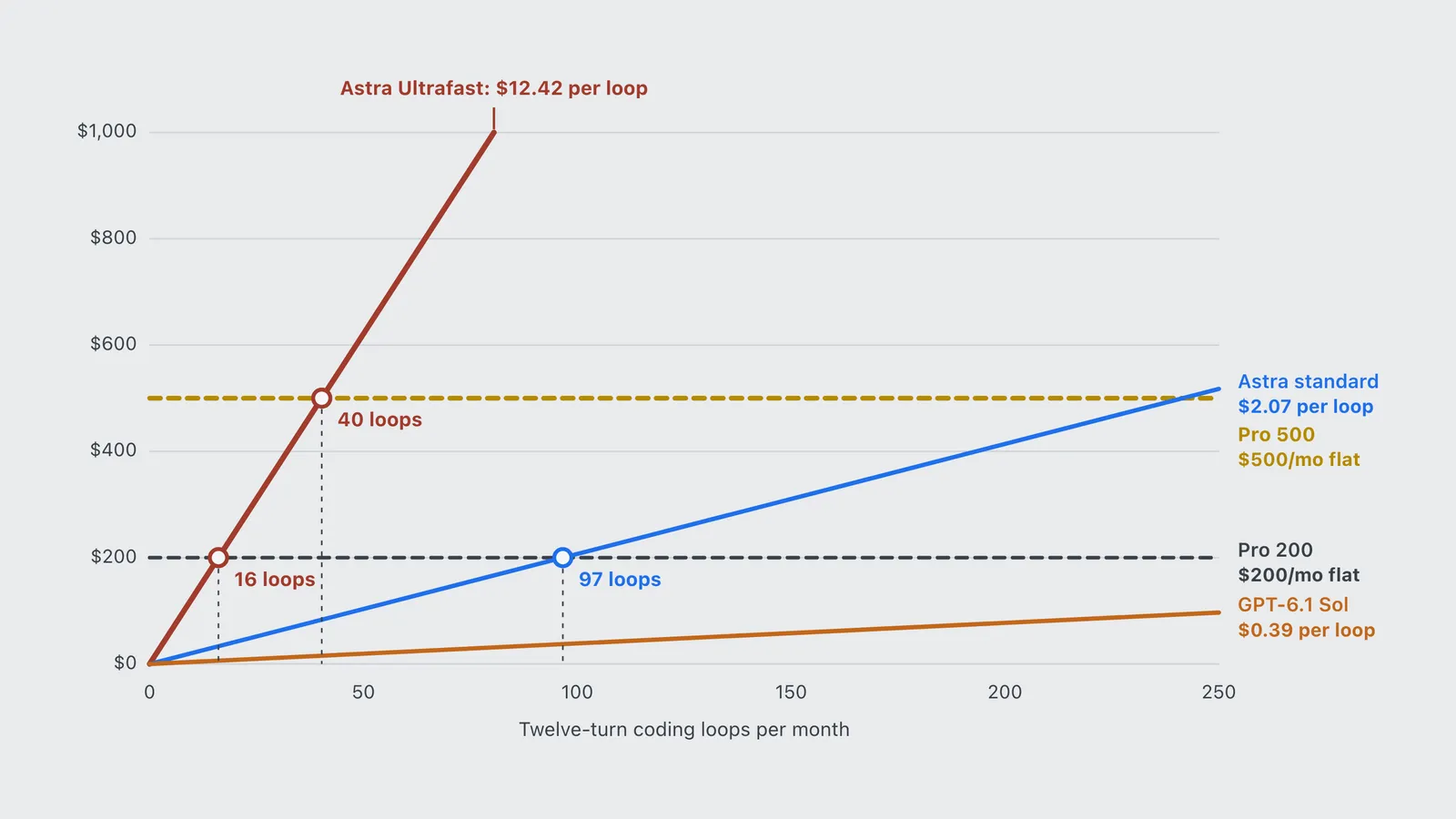
ChatGPT Pro 500 costs $500 a month for Ultrafast. At API rates that buys about 40 Ultrafast agent loops. The breakeven against Pro 200 and the API, worked.
OpenAI announced ChatGPT Pro 500 at its DevDay keynote on September 29, 2026. It costs $500 a month. For that you get 25 times the Plus usage allowance, no five-hour limit, the plan’s usage inside partner apps, and one thing no other ChatGPT plan has: Ultrafast, the tier OpenAI says generates up to 300 tokens per second, about eight times the standard speed in Codex.
Short answer: Pro 500 is worth it only if you run GPT-6 Astra on Ultrafast for about 40 or more agent loops a month. That is roughly two a working day. Below that, paying for Ultrafast by the token on the API costs less. If you don’t need Ultrafast at all, Pro 500 is the most expensive way to buy capacity OpenAI sells, because the new tiers carry no volume discount.
Every number below comes from OpenAI’s own price list and credit rate card, and the workload is stated so you can re-run it.
What Pro 500 actually buys
The keynote slide for Pro 500 lists four things: Ultrafast, no five-hour limit, use across partner apps, and 25 times the usage of Plus. The partner-app line is Sign in with ChatGPT, OpenAI’s new login that lets a subscriber spend their plan allowance in 16 launch-partner products instead of paying for each one separately.
The other half of the announcement changed Pro 200. OpenAI reopened it to new subscribers, but its included usage in Codex and ChatGPT Work drops from 20 times Plus to 10 times Plus on October 30, 2026, as reported by The Next Web, citing OpenAI’s Pro tiers help page. Engadget’s coverage of the same change also notes a cut to weekly GPT-6 Pro messages, from 200 to 100.
Put the three Pro tiers next to Plus and a pattern shows up:
| Plan | Price per month | Usage vs Plus | Price per Plus-sized allowance |
|---|---|---|---|
| Plus | $20 | 1x | $20 |
| Pro 100 | $100 | 5x | $20 |
| Pro 200 (from Oct 30) | $200 | 10x | $20 |
| Pro 500 | $500 | 25x | $20 |
| Pro 200 (until Oct 30) | $200 | 20x | $10 |
Every tier now charges exactly $20 for each Plus-sized block of usage. Until October 30, Pro 200 sold it at $10. The new ladder has no volume discount. Moving from Pro 200 to Pro 500 buys 2.5 times the allowance for 2.5 times the price, and the only things the extra $300 buys that more Pro 200 capacity would not are Ultrafast and the partner-app spending.
That matters because OpenAI does not publish what “25 times Plus” is in tokens. The allowance is a multiple of another allowance that is itself unpublished. So the breakeven has to be worked from the side that does have public numbers: the API.
What $500 buys on the API
OpenAI’s API pricing page lists GPT-6 Astra at $10 per million input tokens, $1 cached input and $50 output. Ultrafast on Astra is $60, $6 and $300: six times standard on every line. GPT-6.1 Sol, also launched at DevDay, is $2, $0.10 and $10, one fifth of Astra with a cached-input rate at 5 percent of fresh input.
OpenAI’s Codex pricing page states the same ratios in credits: Astra is 250 credits per million input tokens and 1,250 per million output, Astra Ultrafast is 1,500 and 7,500, and GPT-6.1 Sol is 50 and 250. Both tables imply one credit is worth $0.04 (250 credits against $10), which matches the 2,500-credits-for-$100 figure in OpenAI’s Business Premium launch terms. The plan and the API price the same work the same way, with one exception: inside a plan’s included allowance, Ultrafast is charged at 8x the Standard rate rather than 6x, per OpenAI’s speed documentation, so Pro 500’s allowance covers about a quarter fewer Ultrafast loops than its credit value suggests. The per-task arithmetic, local and cloud, is in what a Codex cloud task costs.
To turn rates into something you can count, use one standard unit of agent work. This site uses the same one in its GPT-5.6 cost-per-task breakdown: a twelve-turn coding loop where each turn sends 25,000 input tokens at a 90 percent cache hit rate and writes 2,500 output tokens.
- GPT-6 Astra, standard:
12 x (22,500 x $1 + 2,500 x $10 + 2,500 x $50) / 1,000,000= $2.07 per loop. - GPT-6 Astra, Ultrafast: six times that, $12.42 per loop.
- GPT-6.1 Sol, standard:
12 x (22,500 x $0.10 + 2,500 x $2 + 2,500 x $10) / 1,000,000= $0.39 per loop.
Output is 72 percent of the Astra loop’s cost, so a task that writes more code moves the bill faster than one that reads a bigger codebase. That is the input-heavy, output-priced shape of all agentic coding.
| Metered line | Cost per unit | Units to reach Pro 200 | Units to reach Pro 500 |
|---|---|---|---|
| Astra Ultrafast | $12.42 | 16 | 40 |
| Astra standard | $2.07 | 97 | 242 |
| GPT-6.1 Sol | $0.39 | 517 | 1,292 |
The breakeven, in loops a month
Divide each plan price by each loop cost:
| Meter | Cost per loop | Loops to match Pro 200 | Loops to match Pro 500 |
|---|---|---|---|
| Astra Ultrafast | $12.42 | 16 | 40 |
| Astra standard | $2.07 | 97 | 242 |
| GPT-6.1 Sol | $0.39 | 517 | 1,292 |
Read that three ways.
If you need Ultrafast, Pro 500 pays for itself at about 40 loops a month, which is under two a working day on a 22-day month. A developer who keeps an Ultrafast agent busy most of the day clears that before lunch on the first Monday. This is the case Pro 500 was built for, and for this user it is cheap: $500 buys about 1.67 million Ultrafast output tokens on the API, and a single long agent session can burn through that. Whether you need Ultrafast at all depends on what waiting costs you: the Ultrafast break-even puts it at about $53 an hour on the API.
If you don’t need Ultrafast, compare Pro 500 to Pro 200 plus the API, not to the API alone. The extra $300 a month over Pro 200 buys about 145 standard Astra loops on the API, or about 775 loops on GPT-6.1 Sol. Pro 500’s larger allowance only wins if you would otherwise overflow Pro 200 by more than that every month.
If GPT-6.1 Sol does the job, the plans barely matter. At 39 cents a loop, it takes nearly 1,300 loops a month to spend $500. Sam Altman pitched Sol on stage as a daily workhorse close to Astra quality. For most coding work, the cheapest move after DevDay is switching the default model, not upgrading the plan.
The catch: Ultrafast drains the allowance too
OpenAI’s Codex pricing page says purchased credits and pay-as-you-go usage bill Ultrafast at six times standard. It adds that included subscription usage “has different multipliers,” without stating them. So Ultrafast inside Pro 500 very likely uses up the 25x allowance faster than standard work does. The plan removes the per-token bill, but not the rate at which Ultrafast eats your capacity.
The Ultrafast mode developer guide adds two practical limits for anyone comparing the API route. Ultrafast is set per request with service_tier: "ultrafast". It is US data residency and global processing only, with no EU regional endpoint, and OpenAI recommends WebSocket connections because HTTP overhead eats into the latency gain. At launch it covers GPT-6 Astra. The keynote said GPT-6.1 Sol would get it “soon.” At the same six-times multiplier, that would be $12 input and $60 output, and about $2.32 per loop.
Who should buy which plan
- Buy Pro 500 if Ultrafast latency is your bottleneck (live pairing, incident response, long interactive agent sessions) and you run it most days. Past 40 loops a month the flat price wins, and every extra loop is effectively free until the allowance runs out.
- Stay on Pro 200 if you mostly run standard Astra or Sol and hit the cap rarely. Top up with API calls on heavy days. Just re-check your usage after October 30, when the allowance halves.
- Drop to Pro 100 or Plus plus the API if most of your work fits on GPT-6.1 Sol. At $0.39 a loop, a Plus subscription for chat plus Sol on the API for agent work costs less than either Pro tier unless you run hundreds of loops a month.
The subscription vs API calculator runs the same breakeven for other plans and models with your own task counts. For how Astra itself scores and what it costs per solved task, see the GPT-6 Astra pricing and benchmarks breakdown. The Sol line it builds on is covered in GPT-6 Sol and Luna pricing.
What else OpenAI announced at DevDay 2026
Pro 500 was one of more than 20 announcements; the full list with each one’s status and price is in the DevDay 2026 announcements recap. The ones that change costs:
- Dots. Always-on agents in ChatGPT, each running GPT-6 Astra on its own cloud computer, reachable in the ChatGPT apps, Slack, Microsoft Teams and by voice call. Per OpenAI’s DevDay announcements roundup, they are on Pro (excluding the EEA, Switzerland and the UK at launch), and Enterprise gets preview Specialist Dots. BGR reports that your first Dot is included, chatting with it does not count toward usage limits, and the tasks it runs in Codex or ChatGPT Work do.
- GPT-6.1 Sol. Near-Astra performance at one fifth of Astra’s standard token price, with a 1.05-million-token context window, per the model page.
- Decisions API. A limited preview that has the Luna model choose from a fixed set of options (routing, classification, next agent step) and answer in a fraction of a second. No pricing yet.
- Agents API with computer use. A public beta that brings Codex’s multi-agent tools and computer use to developers’ own products (computer-use docs).
- Codex in the cloud. Codex tasks keep running with the laptop closed and can be picked up on another device.
Frequently asked questions
- How much is ChatGPT Pro 500?
- ChatGPT Pro 500 costs $500 a month. OpenAI announced it at DevDay on September 29, 2026, with 25 times the ChatGPT Plus usage allowance, no five-hour limit, use of the plan inside Sign in with ChatGPT partner apps, and exclusive access to the Ultrafast speed tier in ChatGPT and Codex.
- Is ChatGPT Pro 500 worth it?
- Only for heavy Ultrafast users. On OpenAI API list prices, a twelve-turn coding loop on GPT-6 Astra Ultrafast costs about $12.42, so Pro 500 beats paying by the token at about 40 loops a month. Without Ultrafast, standard Astra needs about 242 loops to reach $500, and GPT-6.1 Sol about 1,292, so Pro 200 or the API is usually cheaper.
- What is the difference between Pro 200 and Pro 500?
- Pro 500 adds Ultrafast and 25 times the Plus allowance. From October 30, 2026, Pro 200 includes 10 times Plus in Codex and ChatGPT Work, down from 20 times, as reported by The Next Web citing OpenAI. Both tiers price usage at the same $20 per Plus-sized allowance, so Pro 500 carries no volume discount.
- How much does OpenAI Ultrafast cost on the API?
- Ultrafast on GPT-6 Astra costs $60 per million input tokens, $6 cached input, $75 cache writes and $300 output, six times the standard rate, per OpenAI API pricing. OpenAI says it runs up to eight times faster in Codex and up to six times faster in the API, at up to 300 tokens per second.
Sources
OpenAI (2026). OpenAI DevDay 2026 Keynote. Keynote video, YouTube (Pro 500 slide at about 21:35; Ultrafast slide and speed claim at about 20:30; GPT-6.1 Sol rate slide at about 19:45). https://www.youtube.com/watch?v=Fls_onRviPM Viewed 2026-09-30.
OpenAI (2026). API pricing. OpenAI developer documentation (GPT-6 Astra, Astra Ultrafast and GPT-6.1 Sol rates). https://developers.openai.com/api/docs/pricing Verified 2026-09-30.
OpenAI (2026). GPT-6.1 Sol. OpenAI developer documentation (model page: rates, context window). https://developers.openai.com/api/docs/models/gpt-6.1-sol Verified 2026-09-30.
OpenAI (2026). Ultrafast mode. OpenAI developer documentation (supported models, service_tier, data residency). https://developers.openai.com/api/docs/guides/ultrafast-mode Verified 2026-09-30.
OpenAI (2026). Pricing. ChatGPT and Codex documentation (credit rate card, Ultrafast 6x credit multiplier, five-hour limits). https://learn.chatgpt.com/docs/pricing Verified 2026-09-30.
OpenAI (2026). DevDay 2026 announcements and developer resources. OpenAI Developer Community announcement. https://community.openai.com/t/devday-2026-announcements-and-developer-resources/1402006 Verified 2026-09-30.
OpenAI (2026). Sign in with ChatGPT. OpenAI developer documentation. https://developers.openai.com/siwc
The Next Web (2026). OpenAI halves Pro 200 usage and launches a $500 ChatGPT plan at DevDay. Secondary coverage citing OpenAI’s Pro tiers help page. https://thenextweb.com/news/openai-devday-pro-200-usage-cut-pro-500-plan Verified 2026-09-30.
Engadget (2026). OpenAI adds $500 Pro subscription, nerfs its existing $200 tier. Secondary coverage. https://www.engadget.com/2272106/openai-adds-dollar500-pro-subscription-nerfs-its-existing-dollar200-tier/ Verified 2026-09-30.
BGR (2026). Everything OpenAI Announced At DevDay 2026. Secondary coverage (Dots usage terms). https://www.bgr.com/2272332/openai-devday-2026-announcements/ Verified 2026-09-30.