Muse Spark 1.2 Pricing: What a Task Really Costs
Muse Spark 1.2 at $1.25/$4.25 adds a $0.10/$0.20 contributor tier. Cost per task vs Claude Opus 5 and GPT-5.6 Sol, and what the data-for-discount really buys.
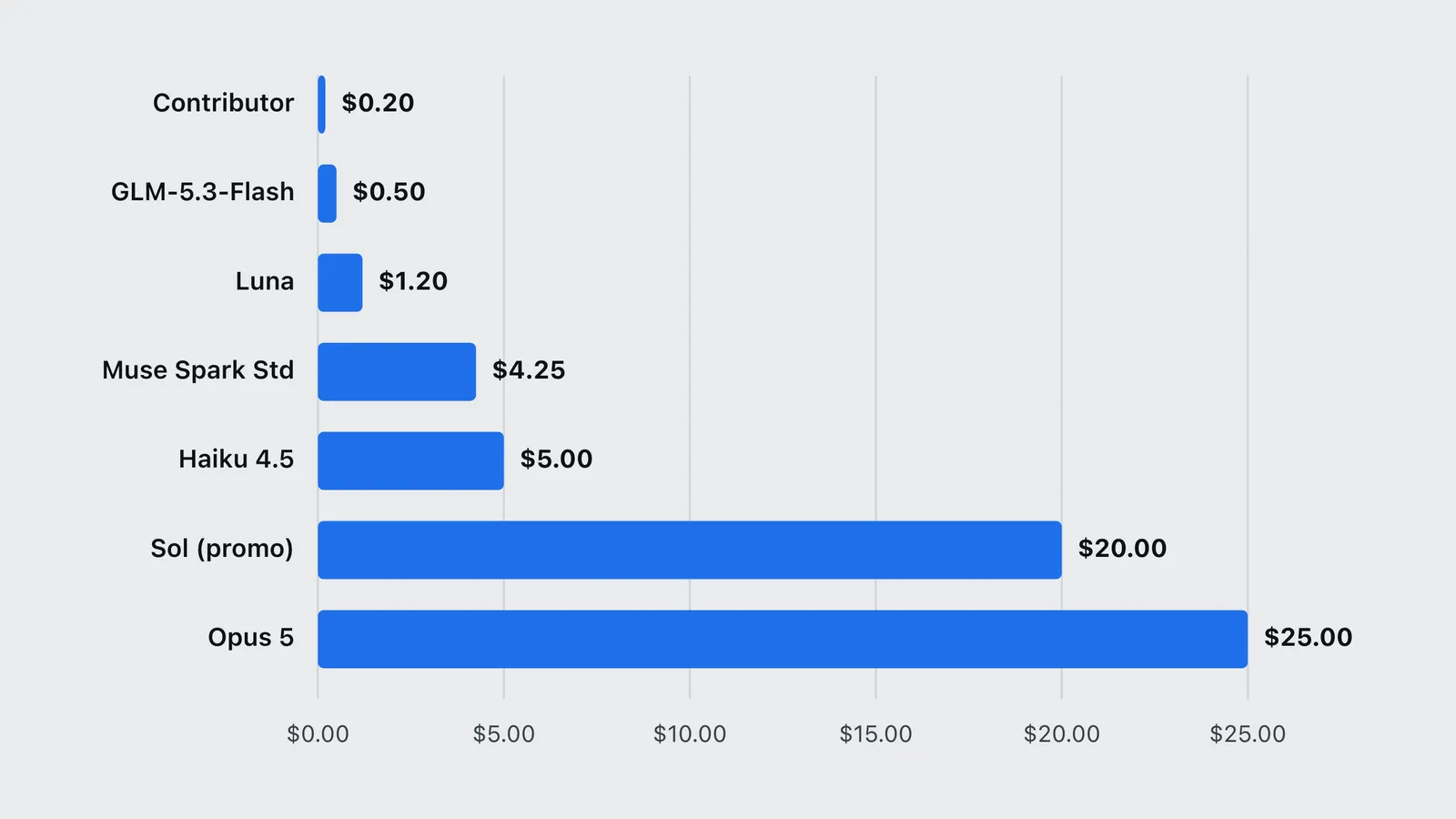
Meta kept the sticker and changed the deal. Muse Spark 1.2, released August 5, 2026 alongside the beta terminal agent Muse Code, costs the same as Muse Spark 1.1 on the standard tier at $1.25 per million input tokens and $4.25 per million output tokens, with cached input at $0.15. What is new is a second tier called Contributor at $0.10 input and $0.20 output, with cached input at $0.002, roughly 12 times cheaper on sticker in exchange for Meta using prompts and completions to train future models. On a modeled multi-file change (1.5 million input tokens, 90 percent served from cache, 40,000 output tokens, single pass) the Standard tier finishes at about $0.56, contributor at about $0.026, Claude Opus 5 at about $2.43, and GPT-5.6 Sol at about $1.94 at its current promotional rate. The cheapest way to run a confidential codebase is Standard; the cheapest way to run anything non-sensitive is Contributor by a wide margin.
Update, October 13, 2026: Meta’s next model, Muse Wonder, launched on October 12 at $4 and $20 per million tokens, with no contributor tier on the API. The $1.25 and $4.25 Spark rate card carries on in Muse Spark 1.3. What a task costs on Wonder is in Muse Wonder: pricing, benchmarks, cost per task.
The rate card, both tiers
Meta publishes Muse Spark 1.2 in two tiers on identical model access. Only the price and whether Meta uses your data differ. The Meta AI Research announcement establishes the August 5 release, the coding focus, the co-training with Muse Code, and that the model is proprietary and served through the Meta Model API.
| Tier | Input / Mtok | Cached input / Mtok | Output / Mtok | Data-use | Source |
|---|---|---|---|---|---|
| Muse Spark 1.2 Standard | $1.25 | $0.15 | $4.25 | Prompts and completions are not used to train Meta models | Meta Model API pricing, quoted identically by Layer3Labs and AIReiter, August 2026 |
| Muse Spark 1.2 Contributor | $0.10 | $0.002 | $0.20 | Prompts and completions are used by Meta to improve its products | Meta announcement establishes the tier; rates as reported by Layer3Labs, AIReiter, and llmtr |
| Muse Spark 1.1 (for reference) | $1.25 | $0.15 | $4.25 | Not used for training (paid tier) | Meta developer blog, July 9, 2026 |
The developer pricing page at dev.meta.ai returned 500 when checked on August 29, 2026, so the rates above are carried as reported consensus from three independent outlets that quote the card verbatim and agree to the cent. The underlying registry at /ai-models/ carries the same $1.25/$0.15/$4.25 and $0.10/$0.002/$0.20 figures verified August 14. When the pricing page is reachable again, re-derive the table against it.
| Item | Value |
|---|---|
| Contributor | $0.20 |
| GLM-5.3-Flash | $0.50 |
| Luna | $1.20 |
| Muse Spark Std | $4.25 |
| Haiku 4.5 | $5.00 |
| Sol (promo) | $20.00 |
| Opus 5 | $25.00 |
What Contributor costs beyond money
Ginger Labs, which published the earliest detailed analysis of the tier on August 6, 2026, frames the bargain plainly: Meta reportedly receives permission to use submitted prompts and completions to train future models, and the discount is the consideration. That makes the tier decision a data-boundary question before it is a price question. The boundary includes the first message plus retrieved documents, tool results, error messages, source files, screenshots, metadata, and the model output sent back in a later turn.
Contributor fits when every field below is true: the data is synthetic, public, or explicitly approved for the tier; the workflow has a measurable finish state; writes are isolated, reversible, or approval-gated; you can enforce external token, tool, time, and spend budgets; and you have a Standard or alternate-provider fallback. Route sensitive traffic to Standard and non-sensitive traffic to Contributor at the gateway, so a caller cannot accidentally send customer data to the training-eligible tier.
What Meta has not clarified in the public pages available without an authenticated developer session is whether Contributor data-use is training-only or extends to eval, red-teaming, and analytics, and the exact retention, deletion, and residency terms. Verify those in the current account documentation before treating the endpoint as production. For confidential work, Standard is the privacy-preserving default.
Cost per task, not per token
Sticker per token does not predict the bill. Output-heavy and long-horizon agentic work spends most of its tokens generating plans, tool calls, code, and verification output, so the output rate and how many output tokens the model emits dominate.
The figures below are modeled from verified per-token rates and a stated, reproducible task profile, not a benchmark measurement. The profile is the multi-file change from src/data/ai-models.schema.ts: 1.5 million input tokens with 90 percent served from the prompt cache, 40,000 output tokens, single pass. The math follows src/lib/costModel.ts: cost = cacheTokens * cacheRate + freshTokens * inputRate + outputTokens * outputRate, per million tokens.
Modeled cost on the multi-file profile, per model
- Muse Spark 1.2 Standard: 1.35M x $0.15 + 0.15M x $1.25 + 40k x $4.25 = $0.2025 + $0.1875 + $0.17 = about $0.56
- Contributor: 1.35M x $0.002 + 0.15M x $0.10 + 40k x $0.20 = $0.0027 + $0.015 + $0.008 = about $0.026
- Claude Opus 5 ($5/$0.50/$25): about $2.43
- GPT-5.6 Sol ($4/$0.40/$20): about $1.94
- GPT-5.6 Luna ($0.20/$0.02/$1.20): about $0.11
Both OpenAI tiers halved on September 22, 2026. On GPT-6 Sol at $2/$0.20/$10 the same task is about $0.97, and on GPT-6 Luna at $0.10/$0.01/$0.50 about $0.05.
- Claude Haiku 4.5 ($1/$0.10/$5): about $0.49
- GLM-5.3-Flash ($0.15/$0.03/$0.50): about $0.08
Run the same shape through the /ai-coding-cost-calculator/ or the ranking at /coding-agent-cost-per-task/ to change the assumptions. A one-file edit (150k input, 80 percent cached, 8k output) lands Standard near $0.09 and Contributor under half a cent; a long agentic session (3M input, 90 percent cached, 80k output) lands Standard near $1.12 and Contributor near $0.05, against $4.85 on Opus 5 and $3.88 on Sol.
| Tool | Cost per task | Multiple of baseline |
|---|---|---|
| Muse Spark Contributor | $0.026 | 0.0x |
| GLM-5.3-Flash | $0.083 | 0.1x |
| GPT-5.6 Luna | $0.105 | 0.2x |
| Claude Haiku 4.5 | $0.485 | 0.9x |
| Muse Spark 1.2 Standard | $0.560 | 1.0x |
| GPT-5.6 Sol (promo) | $1.94 | 3.5x |
| Claude Opus 5 | $2.43 | 4.3x |
| Model / tier | Cost on one-file edit | Cost on multi-file change | Cost on agentic task |
|---|---|---|---|
| Muse Spark 1.2 Contributor | $0.005 | $0.026 | $0.051 |
| GLM-5.3-Flash | $0.012 | $0.083 | $0.17 |
| GPT-5.6 Luna | $0.018 | $0.11 | $0.21 |
| Claude Haiku 4.5 | $0.082 | $0.49 | $0.97 |
| Muse Spark 1.2 Standard | $0.09 | $0.56 | $1.12 |
| GPT-5.6 Sol | $0.33 | $1.94 | $3.88 |
| Claude Opus 5 | $0.41 | $2.43 | $4.85 |
Standard is about 4.3 times cheaper than Opus 5 and 3.5 times cheaper than Sol on the headline task, which is the wedge Meta is selling. It is also about 5.1 times more than Luna and 6.8 times more than GLM-5.3-Flash before any accuracy adjustment. Contributor inverts that: at $0.026 it is about 21 times cheaper than Standard and 93 times cheaper than Opus 5 on the same task, which is why the tier exists. The honest comparison is not Standard vs Contributor on sticker. It is Standard vs the field on confidential work, and Contributor vs itself on work where the data is already public.
AIReiter reported a blended $0.78 per million tokens for Standard and $0.04 for Contributor on a 7:2:1 cache-hit:input:output mix. That is a different workload assumption from the site’s 90 percent cache multi-file profile, so do not compare the two blended figures directly. Use the calculator to put both tiers on the same profile you actually run.
What the benchmarks actually say
Every score below is vendor-reported from Meta’s own launch materials. The methodology page at research.meta.ai states the setup: each model is evaluated with its selected agent product (Muse Code for Muse Spark 1.2, Claude Code for Opus 5, Codex for GPT, Grok Build for Grok, Antigravity for Gemini, Kimi Code for Kimi), at maximum reasoning effort for each model (xhigh for Muse Spark, high for Grok and Gemini, max for Opus, GPT, and Kimi), with Terminal-Bench 2.1 and DeepSWE 1.1 each run in an isolated Daytona sandbox and the verifier grading the final container state, five attempts averaged. MCP Atlas comes from Scale AI and GDPVal-AA v2 from Artificial Analysis, not Meta. Meta notes that its setup may not be tuned for third-party proprietary models, so those comparison figures may understate rivals. Until a neutral reproduction lands, treat direction as real and margins as provisional, the same caution that applies to any launch-day scorecard.
| Benchmark (what it tests) | Muse Spark 1.2 | Best rival Meta compared | Muse Spark 1.1 (for delta) |
|---|---|---|---|
| MCP Atlas (scaled tool use, 36 servers / 220 tools) | 90.3% | 85.8% (Opus 5 xhigh) | 88.1% |
| Terminal-Bench 2.1 (agentic terminal, 89 tasks) | 82.9% | 86.7% (Opus 5 max, Claude Code) | 76.2% |
| DeepSWE 1.1 (long-horizon SWE, 113 tasks) | 59.3% | 65.0% (Opus 5) | 53.0% |
| GDPVal-AA v2 (general agentic, Elo) | 1,631 | 1,852 (Opus 5) | 1,371 |
| Meta Internal Coding Bench (440 tasks, internal harness) | 70.6% | internal only | not published |
The pattern is the same as 1.1 but tighter. Muse Spark posts the single highest MCP Atlas score Meta reports, ahead of every frontier model in the comparison set including Opus 5 at its own maximum reasoning setting — a genuine signal for tool-use-heavy agent workloads. On the raw coding-agent benchmarks that look like shipping software, it sits second behind Opus 5: 3.8 points back on Terminal-Bench 2.1 and 5.7 points back on DeepSWE 1.1, ahead of GPT-5.6 Terra (81.8% Terminal, 64.8% DeepSWE) and Grok 4.5. The generational delta over 1.1 is consistent: Terminal 82.9% from 76.2%, DeepSWE 59.3% from 53.0%, MCP 90.3% from 88.1%, GDPVal 1,631 from 1,371.
A Hacker News thread on the 1.1 launch alleged that Meta raised Terminal-Bench 2.1 resource limits (6 cores, 8 GB) above the benchmark spec and that this disqualifies the result, noting that Muse Spark does not appear on the official leaderboard. That allegation is unverified third-party commentary included here because the post leans on vendor-reported scores. Track the official board for a neutral run.
The harness that makes the score real
A model is not a product. Muse Code (beta) is Meta’s first answer to the gap noted in the Muse Spark 1.1 review that a cheap, tool-fluent engine needs a cockpit. As described in the same Meta blog that introduces 1.2, Muse Code is a terminal agent for macOS and Linux with a simple agent loop plus persistent async background agents, a replay-exact local event log in which every model call, tool run, approval, and edit is appended, and bundled skills /plan, /grill, and /goal. Install is curl -fsSL https://dev.meta.ai/install.sh | bash. Meta says the two were co-trained with rejection-sampled harness trajectories and recipe optimizations for goals, compaction, and subagents.
That co-training is the important caveat for anyone calling muse-spark-1.2 outside Muse Code. A score measured through Muse Code is a model-plus-harness result. A direct API caller must supply its own orchestration, tool environment, context policy, and verification, and should benchmark there rather than assuming the Muse Code number transfers. The safe pattern is a provider-neutral workflow contract around the model so the adapter can change without rewriting permission, tenancy, and correctness rules.
Which tier, which workload
- High-volume tool-use agents on confidential data: Standard. You keep the ~4 times advantage over Opus 5 without sending client code into a training-eligible tier. See the cost-per-task ranking and verify in the model release tracker.
- High-volume prototyping on public or synthetic data: Contributor. The 21 times gap vs Standard is the cheapest frontier-class token price on the board today, and the right place to run broad evals and repeated traces. Keep it on an evaluation project with no production credentials.
- Tightest budget on confidential work where Muse Spark is not eligible: GLM-5.3-Flash at $0.15/$0.50 per Mtok undercuts Standard by 6.8 times on the headline task and carries MIT weights, or Luna at $0.20/$1.20 where the lab’s data terms fit. Put them head to head in the AI model comparison.
- Hardest repo work where accuracy matters most: Opus 5 still leads the coding-agent benchmarks Meta reports. Budget it at $2.43 on the headline task and $4.85 on the long agentic profile, and measure whether the extra accuracy pays for the extra tokens. The price reversal phenomenon explains why the cheapest-listed model is not always the cheapest to finish.
For how Muse Code compares to Claude Code and the rest of the agent field, see the 2026 AI coding agent landscape and Claude Code vs Codex. Watch the model pricing hub for plan-price moves and the value leaderboard for the capability-per-dollar cut.
Frequently asked questions
- How much does Muse Spark 1.2 cost?
- Standard is $1.25 per million input tokens, $0.15 per million cached input, and $4.25 per million output. Contributor is $0.10 input, $0.002 cached, and $0.20 output. Both are per-million-token list rates before any batch or cache effects beyond the cached-input line.
- What is the Muse Spark 1.2 Contributor tier and can Meta train on my data?
- Contributor is the same Muse Spark 1.2 checkpoint at a roughly 12 times lower input price and 21 times lower output price. In exchange, Meta may use prompts and completions sent to the Contributor tier to train future models. Use it for public code, synthetic data, and prototyping. Keep customer records, credentials, and proprietary code on the Standard tier.
- Is Muse Spark 1.2 the cheapest frontier model to run?
- On sticker per output token, Contributor is the cheapest frontier-class rate in this comparison at $0.20, and Standard at $4.25 is about 4.3 times cheaper than Claude Opus 5 at $25. On modeled cost per multi-file task with the same tokens, Standard at about $0.56 sits between Luna at about $0.11 and Opus 5 at about $2.43; Contributor at about $0.026 is the lowest by far, but only on data you can let a lab train on.
- How does Muse Spark 1.2 compare to Claude Opus 5 and GPT-5.6 Sol?
- On Meta-reported benchmarks, Muse Spark 1.2 leads Opus 5 on MCP Atlas (90.3% vs 85.8%) but trails on Terminal-Bench 2.1 (82.9% vs 86.7%), DeepSWE 1.1 (59.3% vs 65.0%), and GDPVal-AA v2 (1,631 vs 1,852 Elo). On price, Standard at $1.25/$4.25 is about a fifth of Opus 5 at $5/$25 and about a third of Sol at $4/$20 promotional.
- Can I use Muse Spark 1.2 outside Muse Code?
- Yes, through the Meta Model API as muse-spark-1.2 and muse-spark-1.2-contributor. Muse Code is the beta terminal harness that Meta co-trained with the model; scores measured through it are model-plus-harness results. Direct API callers should benchmark in their own harness rather than assuming the Muse Code number transfers.
Sources
Meta AI Research (2026). Introducing Muse Code and Muse Spark 1.2 (August 5, 2026). https://research.meta.ai/blog/introducing-muse-code-and-muse-spark-1-2
Meta AI Research (2026). Muse Spark 1.2 and Muse Code Evaluation Methodology (August 5, 2026). https://research.meta.ai/static/muse-spark-1-2-methodology
Meta AI Developers. Muse Spark model page (rates, context window, tiers). https://developer.meta.com/ai/models/muse-spark/ — pricing page dev.meta.ai/docs/pricing-rate-limits returned 500 on 2026-08-29; rates carried via corroborated secondary as noted in ledger.
Layer3Labs (2026, August 22). Muse Spark 1.2 Pricing and Muse Spark 1.2 API Pricing (standard $1.25/$0.15/$4.25, contributor $0.10/$0.002/$0.20, scope and throughput notes). https://www.layer3labs.io/guides/muse-spark-1-2-pricing and https://www.layer3labs.io/guides/muse-spark-1-2-api-pricing
AIReiter (2026, August 9). Muse Spark 1.2 API Pricing: Standard vs Contributor (throughput 60 rpm / ~250K daily on Contributor, 12.5x input gap, blended $0.78/$0.04 illustration). https://aireiter.com/blog/muse-spark-1-2-api-pricing-guide
Ginger Labs (2026, August 6). Muse Spark 1.2 Contributor API: Performance, limits and risks (data-use bargain, harness coupling, decision framework). https://gingerlabs.ai/blog/muse-spark-1-2-contributor-api-performance-limits-and-risks
OpenAI (2026). API pricing (GPT-5.6 Sol $4/$20, Luna $0.20/$1.20, verified August 2026; both tiers halved by GPT-6 Sol and Luna on 2026-09-22). https://openai.com/api/pricing
Anthropic (2026). Claude API pricing (Opus 5 $5/$25, Haiku 4.5 $1/$5, cache-read rates). https://www.anthropic.com/pricing
BenchGen (2026, August 12). Muse Spark 1.2: Benchmarks, Pricing and Context Window (MCP Atlas 90.3%, Terminal 82.9%, DeepSWE 59.3%, GDPVal 1,631, and 1.1 deltas). https://benchgen.com/models/meta/muse-spark-1-2
AIReleaseTracker (2026, August 5). Muse Spark 1.2 — Benchmarks, Specs and Release Date (Terminal 82.9%, DeepSWE 59.3%, context 1M). https://aireleasetracker.com/model/meta/muse-spark-1-2