OpenAI DevDay 2026: Every Announcement and What It Costs
Everything OpenAI announced at DevDay 2026 on September 29: Dots, GPT-6.1 Sol, Ultrafast, Pro 500 and the Agents API, with the price and status of each.
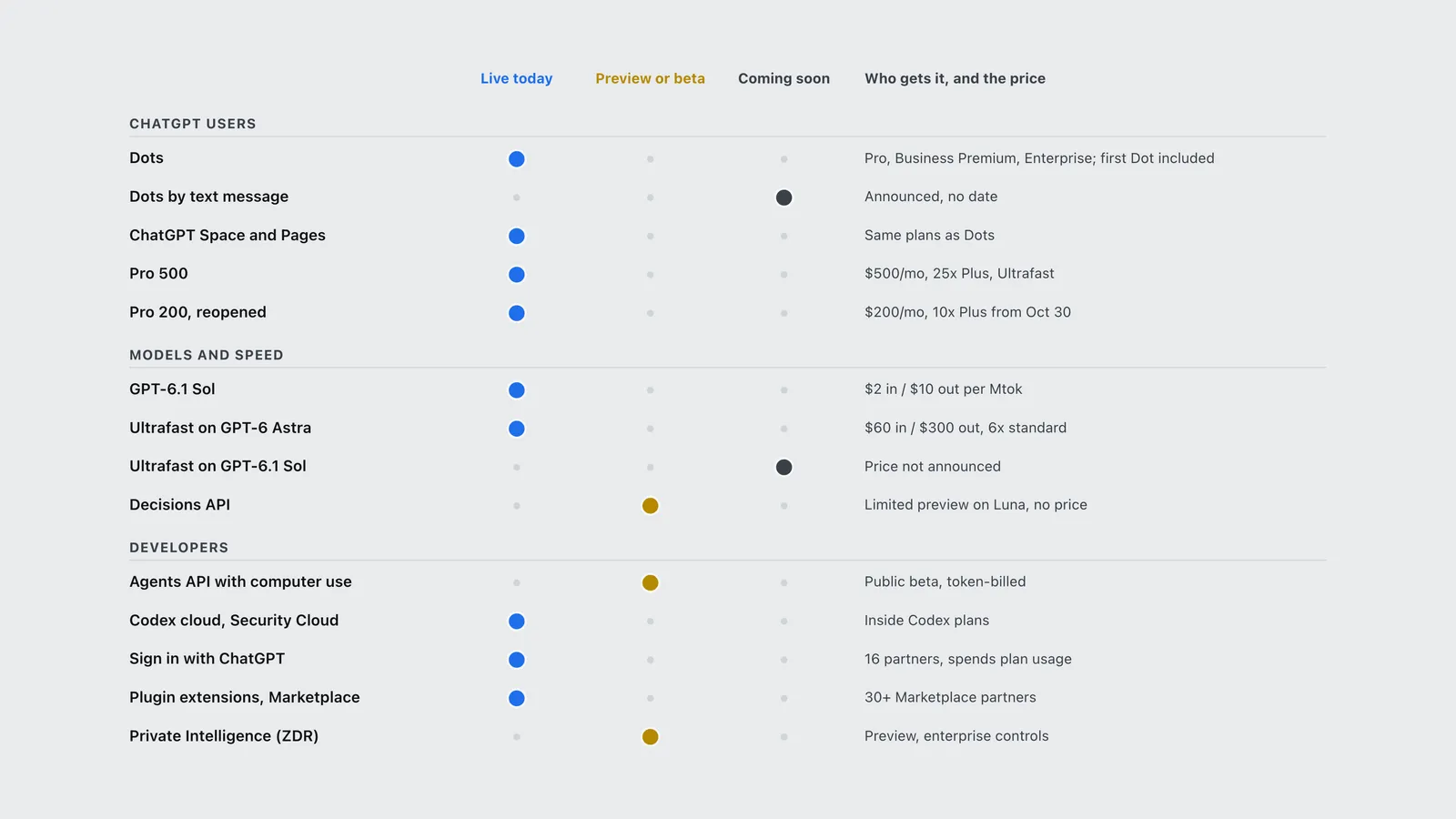
OpenAI held DevDay 2026 in San Francisco on September 29, 2026, and made more than 20 announcements in a 53-minute keynote. The headline was Dots, always-on agents inside ChatGPT. The rest split three ways: a cheaper model (GPT-6.1 Sol), a faster and much pricier speed tier (Ultrafast) with a $500 plan to go with it (Pro 500), and developer infrastructure (the Agents API with computer use, Codex in the cloud, plugin extensions and a marketplace).
If you searched for OpenAI Dev Day 2026 (the event’s own spelling is DevDay), this is the full list. Most recaps list what was announced. This one adds the two things you need before acting on any of it: whether you can use it today, and what it costs. Every price below comes from OpenAI’s own documentation or the keynote slides, read on September 30, 2026.
| Group | Announcement | Status on the day | Who gets it, and the price |
|---|---|---|---|
| ChatGPT users | Dots | Live today | Pro, Business Premium, Enterprise; first Dot included |
| ChatGPT users | Dots by text message | Coming soon | Announced, no date |
| ChatGPT users | ChatGPT Space and Pages | Live today | Same plans as Dots |
| ChatGPT users | Pro 500 | Live today | $500/mo, 25x Plus, Ultrafast |
| ChatGPT users | Pro 200, reopened | Live today | $200/mo, 10x Plus from Oct 30 |
| Models and speed | GPT-6.1 Sol | Live today | $2 in / $10 out per Mtok |
| Models and speed | Ultrafast on GPT-6 Astra | Live today | $60 in / $300 out, 6x standard |
| Models and speed | Ultrafast on GPT-6.1 Sol | Coming soon | Price not announced |
| Models and speed | Decisions API | Preview or beta | Limited preview on Luna, no price |
| Developers | Agents API with computer use | Preview or beta | Public beta, token-billed |
| Developers | Codex cloud, Security Cloud | Live today | Inside Codex plans |
| Developers | Sign in with ChatGPT | Live today | 16 partners, spends plan usage |
| Developers | Plugin extensions, Marketplace | Live today | 30+ Marketplace partners |
| Developers | Private Intelligence (ZDR) | Preview or beta | Preview, enterprise controls |
Dots: always-on agents in ChatGPT
A Dot is a persistent agent that keeps working between conversations. Each one runs GPT-6 Astra, gets its own computer and browser in OpenAI’s cloud, and uses the plugins and connectors you have already set up in ChatGPT. You can reach it in the ChatGPT apps, in Slack and Microsoft Teams, or on a voice call, and OpenAI said on stage that texting is “coming soon.” The keynote demo had a Dot fixing bugs from a feedback channel, opening pull requests and updating a board deck in the background.
Availability and price. Sam Altman said Dots and Space are available on ChatGPT Pro, Business Premium and Enterprise from launch day. Your Dot is included in the plan, and talking to it does not count against your usage. The work it does in Codex or ChatGPT Work does, as BGR reported. At launch you get one Dot per user. OpenAI’s DevDay announcements roundup lists the EEA, Switzerland and the UK as excluded for now. Enterprises also get a preview of Specialist Dots, company-configured agents shared across a team, with Microsoft integration planned.
The cheapest way into Dots is Pro 100 at $100 a month. That makes it a paid-tier, work-first product. Fortune framed it as OpenAI’s answer to Meta’s consumer-first Muse agent. For how Dots stacks up against Muse and Grok Bot on price, region and permissions, see Dots vs Muse vs Grok Bot.
ChatGPT Space and Pages
Space is a shared workspace where people and their Dots work on the same pages, charts, sheets and prototypes. Tag a Dot in a comment and it picks up the task, or give a page standing instructions such as updating it from a Slack channel every day. A slides format is coming later. It ships on the same plans as Dots. Fortune’s coverage called it a potential Google Workspace competitor. The difference is that it only makes sense with Dots attached.
GPT-6.1 Sol: near-Astra quality at a fifth of the price
GPT-6.1 Sol is an upgrade to the GPT-6 Sol that shipped a week earlier. OpenAI’s model page lists $2 per million input tokens and $10 output, a fifth of GPT-6 Astra’s standard rate, with a 1.05-million-token context window and five reasoning-effort levels. The one line that changed from GPT-6 Sol is cached input, which halved from $0.20 to $0.10 per million, a 95 percent discount on fresh input. For agents, which re-read their context on every turn, that is the rate that moves the bill.
OpenAI’s performance claim (“very near Astra level”) is vendor-reported, and independent scores are still coming in. For where the Sol line scored at launch, see GPT-6 Sol and Luna pricing and benchmarks.
Ultrafast and the new Pro 500 plan
Ultrafast is a new speed tier: up to 300 tokens per second, about eight times the standard speed in Codex and up to six times in the API, per the keynote. It costs six times standard. On GPT-6 Astra that is $60 per million input tokens and $300 output on OpenAI’s API pricing page. The existing Fast mode stays at twice the speed for twice the price. Ultrafast is live on Astra now. OpenAI said Sol would get it “soon.”
| Tool | Cost per task | Multiple of baseline |
|---|---|---|
| GPT-6 Luna | $0.50 | 1.0x |
| GPT-6.1 Sol | $10.00 | 20.0x |
| GPT-6 Astra | $50.00 | 100.0x |
| GPT-6 Astra, Fast | $100.00 | 200.0x |
| GPT-6 Astra, Ultrafast | $300.00 | 600.0x |
The top of that ladder is 600 times the bottom. DevDay stretched OpenAI’s price range at both ends in one afternoon: a model at a fifth of the flagship price, and a speed tier at six times it.
Pro 500 is the plan built around Ultrafast: $500 a month for 25 times the Plus allowance, no five-hour limit, Ultrafast in ChatGPT and Codex, and use of the allowance inside partner apps. OpenAI also reopened Pro 200 to new subscribers, but its Codex and ChatGPT Work allowance falls from 20 times Plus to 10 times on October 30, as reported by The Next Web. Worked in API terms, Pro 500 pays for itself at about 40 Ultrafast coding loops a month, and the new tiers carry no volume discount. The full math is in Is ChatGPT Pro 500 worth it?
Decisions API
The Decisions API, in limited preview, has OpenAI’s small Luna model choose from a fixed set of options you supply, such as routing a request, classifying an image or picking an agent’s next step. Narrowing the task to a choice is what lets it answer in a fraction of a second. OpenAI has not published pricing. On Luna’s current rates of $0.10 input and $0.50 output per million tokens, a routing call should be among the cheapest things on the platform, but that is an inference until OpenAI prices it.
For developers: agents, security and the API
- Agents API with computer use (public beta). OpenAI’s managed agent runtime, the same technology behind Codex and Dots, now opens browsers, clicks through interfaces and tests flows (computer-use documentation). It bills at the underlying model’s token rates, so a computer-use agent on Astra pays Astra prices for every screenshot it reads.
- Private Intelligence (preview). Zero data retention with what OpenAI calls private safety processing: safety checks without storing your content on OpenAI’s servers (documentation).
- API performance. OpenAI claimed more than 99 percent reliability, a 45 percent cut in time to first token and tool calls more than 30 percent faster. These are vendor figures, not independent measurements.
Codex at DevDay 2026: what changed
Codex got the longest run of the developer segment. In OpenAI’s words from its DevDay announcements roundup, “Codex Cloud runs tasks while your laptop is closed, with access across devices.” The headline items:
- Codex Cloud with reusable environments (live): set up once, then every task runs in its own VM and can be reviewed from the web, desktop or phone. See how Codex cloud environments work.
- No cloud surcharge: cloud and local work bill at the same per-token rates from one shared allowance, and cloud is not available with an API key (Codex cloud vs local cost).
- CLI refresh, code review view and Security Cloud: two-way voice, an
/agentsview, automatic cloud reviews and scheduled vulnerability scans. - Ultrafast in Codex: up to eight times faster on Pro 500, charged at 8x against the plan allowance. The break-even is in is OpenAI Ultrafast worth it.
Every Codex change, with its price and where the work runs, is in what’s new in Codex after DevDay 2026.
Distribution: Sign in with ChatGPT, plugins and a marketplace
The third part of the keynote was about helping developers reach ChatGPT’s audience, which Altman put at about 1.2 billion weekly users.
- Sign in with ChatGPT lets a user log into a third-party app with their ChatGPT account and spend their plan’s allowance there. It launched with 16 partners, including Notion, Vercel and Cognition’s Devin, per Decrypt. For a startup, this is a way to skip billing and ride OpenAI’s subscription. For the subscriber, it means the allowance is shared across more places than ChatGPT.
- Plugin extensions turn plugins into full apps inside ChatGPT and Codex, with sidebars, panels and file viewers. Figma and Adobe demoed on stage. Plugin submission also got a simpler review process.
- OpenAI Marketplace lets enterprise customers spend part of their existing OpenAI commitment on partner products. It launched with more than 30 partners, including CodeRabbit, Notion and Vercel, and with Baseten for open-weight models. For sellers, this is the real commercial hook: a customer’s pre-committed OpenAI budget becomes spendable on you.
The research claims
Research lead Tejal said OpenAI now has what Altman last year predicted as an AI research intern. As of July, per the keynote, OpenAI’s models were completing more than a third of day-long research tasks with no human intervention, and models like Astra have helped solve more than 100 long-open math problems. These are OpenAI’s own claims, shown without a methodology, and should be read that way until a paper or independent evaluation backs them.
What was not announced
No GPT-7 or new frontier model above Astra. No price cut to Astra itself. No token figure for what “25 times Plus” means, so plan buyers still cannot compare allowances directly. No price for Ultrafast on Sol, the Decisions API, or extra Dots beyond the first. Those are the numbers to watch for in the weeks after the event.
Frequently asked questions
- What did OpenAI announce at DevDay 2026?
- At DevDay on September 29, 2026, OpenAI announced Dots (always-on agents in ChatGPT), ChatGPT Space, GPT-6.1 Sol at $2 and $10 per million tokens, the Ultrafast speed tier at six times standard price, a $500 Pro 500 plan, the Decisions API preview, computer use in the Agents API, Codex in the cloud, Codex Security Cloud, Sign in with ChatGPT, plugin extensions and the OpenAI Marketplace.
- How much do OpenAI Dots cost?
- Dots have no separate price at launch. One Dot is included with ChatGPT Pro (from $100 a month), Business Premium and Enterprise, and chatting with it does not count against usage limits, though tasks it runs in Codex or ChatGPT Work do. OpenAI has not priced additional Dots.
- How much does GPT-6.1 Sol cost?
- GPT-6.1 Sol costs $2 per million input tokens, $0.10 per million cached input tokens and $10 per million output tokens, per OpenAI API pricing. That is one fifth of GPT-6 Astra standard rates, with long-context requests above 272,000 tokens billed at $4 input and $15 output.
- When is the next OpenAI DevDay event?
- OpenAI is running DevDay Exchange follow-up events later in 2026, starting in Bengaluru on October 16 and continuing through Tokyo, Seoul, Berlin, Paris, London and Sao Paulo to Mexico City on November 10, according to the OpenAI DevDay Exchange event page.
Sources
OpenAI (2026). OpenAI DevDay 2026 Keynote. Keynote video, YouTube. https://www.youtube.com/watch?v=Fls_onRviPM Viewed 2026-09-30.
OpenAI (2026). DevDay 2026 announcements and developer resources. OpenAI Developer Community announcement. https://community.openai.com/t/devday-2026-announcements-and-developer-resources/1402006 Verified 2026-09-30.
OpenAI (2026). API pricing. OpenAI developer documentation. https://developers.openai.com/api/docs/pricing Verified 2026-09-30.
OpenAI (2026). GPT-6.1 Sol. OpenAI developer documentation (model page). https://developers.openai.com/api/docs/models/gpt-6.1-sol Verified 2026-09-30.
OpenAI (2026). Pricing (Codex and ChatGPT Work usage, token rates and speed-mode multipliers). Product documentation. https://learn.chatgpt.com/docs/pricing Verified 2026-09-30.
OpenAI (2026). Codex Cloud and Cloud environments. Product documentation. https://learn.chatgpt.com/docs/cloud and https://learn.chatgpt.com/docs/environments/cloud-environments Verified 2026-09-30.
OpenAI (2026). Speed (Fast and Ultrafast modes in Codex). Product documentation. https://learn.chatgpt.com/docs/agent-configuration/speed Verified 2026-09-30.
OpenAI (2026). Code review. Product documentation. https://learn.chatgpt.com/docs/code-review?surface=app Verified 2026-09-30.
OpenAI (2026). Computer use. OpenAI Agents API documentation. https://developers.openai.com/api/docs/guides/agents-api/tools/computer-use
OpenAI (2026). Private safety processing. OpenAI developer documentation. https://developers.openai.com/api/docs/guides/private-safety-processing
OpenAI (2026). Sign in with ChatGPT. OpenAI developer documentation. https://developers.openai.com/siwc
OpenAI (2026). OpenAI DevDay Exchange 2026. Event page. https://events.openai.com/devdayexchange2026
The Next Web (2026). OpenAI halves Pro 200 usage and launches a $500 ChatGPT plan at DevDay. Secondary coverage citing OpenAI’s Pro tiers help page. https://thenextweb.com/news/openai-devday-pro-200-usage-cut-pro-500-plan Verified 2026-09-30.
BGR (2026). Everything OpenAI Announced At DevDay 2026. Secondary coverage. https://www.bgr.com/2272332/openai-devday-2026-announcements/ Verified 2026-09-30.
Fortune (2026). OpenAI unveils Dots to rival Meta’s Muse, plus a $500 monthly plan. Secondary coverage. https://fortune.com/2026/09/29/openai-takes-on-metas-muse-with-new-dot-agents-and-unveils-a-potential-google-workspace-competitor/
Decrypt (2026). OpenAI Gave AI Agents Their Own Computers at DevDay 2026. Secondary coverage (Sign in with ChatGPT partners). https://decrypt.co/379584/openai-ai-agents-computers-devday-2026-everything-announced