ChatGPT Business Premium Seats: $100 List, $120 Floor
OpenAI priced ChatGPT Business Premium exactly like Anthropic Claude Team Premium, but the 2-seat minimum pushes the real floor to $120, not $100.
OpenAI removed the five-hour usage cap on ChatGPT Business on August 10, 2026, the single most-requested fix from Business customers all year. It did not remove it for everyone. It shipped a new Premium seat at $125 a month billed monthly, or $100 a month billed annually, priced at exactly five times the $25 or $20 Standard seat, and that seat is the only way to get the cap lifted.
Here is the detail that did not make the announcement’s headline: ChatGPT Business has carried a two-seat minimum since the plan launched, and that rule did not go away. A workspace cannot buy one Premium seat and stop there. It has to buy at least one more seat to satisfy the minimum, which means the honest price of “the cap is gone” is never $100. It is whatever that second seat costs on top.
How much does ChatGPT Business Premium cost
A ChatGPT Business Premium seat costs $125 a month billed monthly, or $100 a month billed annually, five times the price of a Standard seat ($25 monthly, $20 annually). Premium gives five times the usage of Standard and removes the five-hour rolling usage limit that Standard seats still carry. Seat types can be mixed within one workspace.
That is the number OpenAI put in the announcement. It is not the number a workspace actually pays to get one person off the cap, because of a rule the announcement did not restate.
The 2-seat minimum was already there
ChatGPT Business has required at least two paid seats per workspace since the plan existed, well before Premium shipped. A single freelancer cannot buy ChatGPT Business at all; that tier is built for teams, and the floor is enforced at checkout regardless of which seat type fills it. Premium did not create this rule. It just made the rule expensive for the first time.
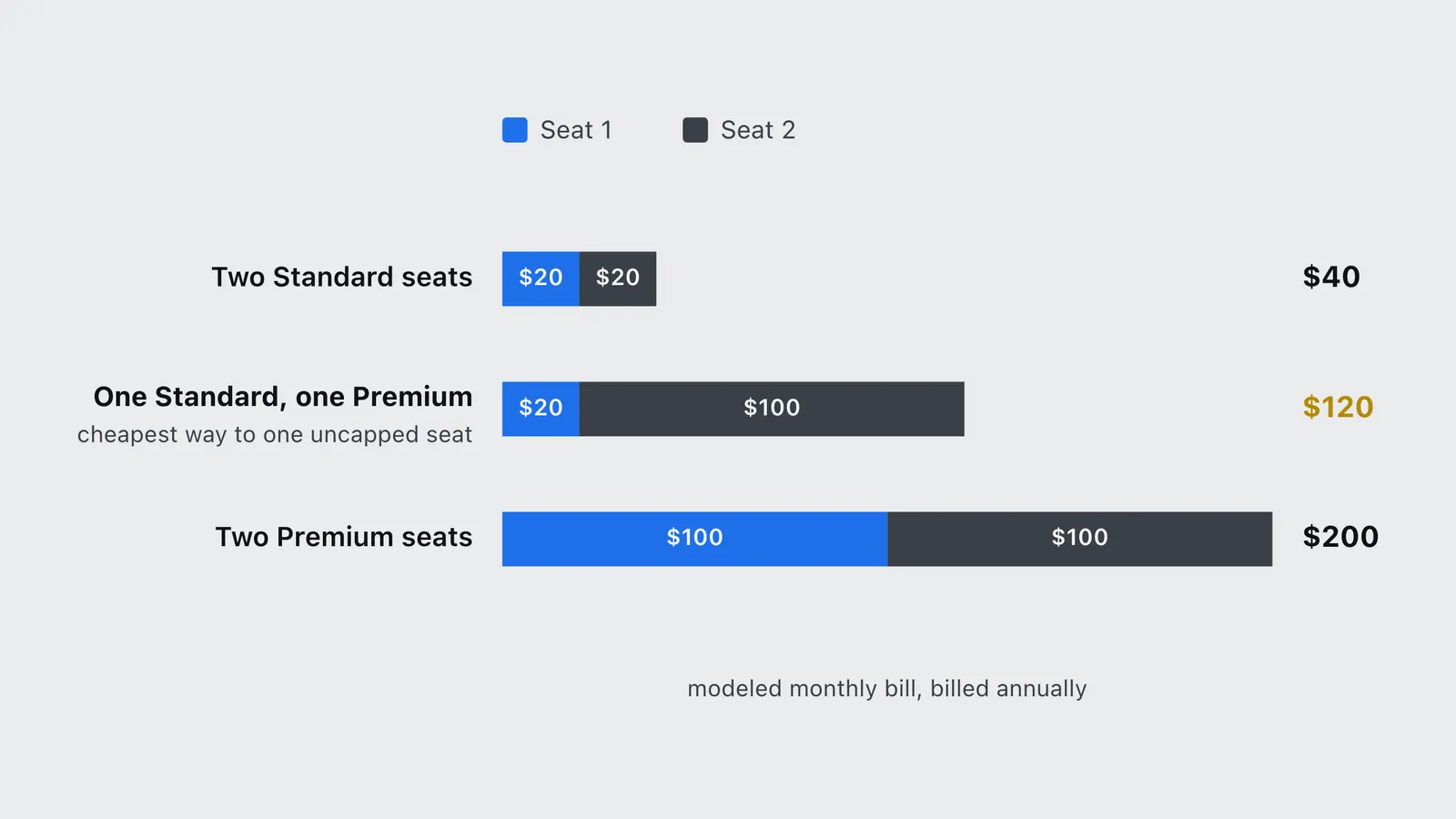
Before August 10, the cheapest way to satisfy the minimum was two Standard seats: $40 a month billed annually, $50 billed monthly. Nobody complained about that math, because nothing above it cost more. Now there is something above it, and the minimum decides what reaching it actually costs.
| Scenario | Seat 1 | Seat 2 | Total |
|---|---|---|---|
| Two Standard seats | $20 | $20 | $40 |
| One Standard, one Premium (cheapest way to one uncapped seat) | $20 | $100 | $120 |
| Two Premium seats | $100 | $100 | $200 |
Read the middle row. That is the actual purchase almost every small team makes: one heavy user who needs the cap gone, one teammate who does not, and a rule that will not let the second seat disappear. $120 a month, not $100. Scale it and the gap holds: five heavy users still need five teammates or placeholder seats sitting under them if a workspace wants to stay lean elsewhere, though larger teams usually have enough real Standard users that the minimum stops being the binding constraint. It binds hardest exactly where OpenAI’s own marketing aimed the seat: small teams and startups, the accounts most likely to have only one or two people who actually need the higher ceiling.
OpenAI just copied Anthropic’s price, not just the idea
The part of this launch worth pausing on is not that OpenAI added a higher tier. Every vendor eventually does that. It is that the tier landed on the exact same numbers Anthropic already charges for the exact same trade.
Anthropic’s Claude Team plan has sold a Premium seat for months: $100 a month billed annually ($125 billed monthly), five times the usage of the $20 Standard seat, covered in this site’s own breakdown of what Claude Code costs per task. OpenAI’s ChatGPT Business Premium seat matches every one of those figures. Same annual price, same monthly price, same multiplier, same shape: a Standard seat that stays put and a Premium seat priced at 5x it.
| Item | Premium seat | Standard seat |
|---|---|---|
| OpenAI ChatGPT Business | $100 | $20 |
| Anthropic Claude Team | $100 | $20 |
OpenAI's own framing calls the $100 Premium seat a game changer for small businesses and startups, giving lean teams capabilities once reserved for big companies. Anthropic sold the same seat, at the same price, first.
That is not evidence of collusion. It is evidence that two labs selling the same underlying product, a chat-and-agent subscription metered by usage headroom, independently converged on the same answer to “how much more should the uncapped tier cost.” Five times the base price is apparently where both companies decided the market would bear it. When two competitors land on identical numbers without coordinating, that is usually a sign the number is not arbitrary; it is close to what the market will actually pay before the higher tier stops selling. For what it is worth, OpenAI’s other pricing moves this year have mostly cut prices, not raised them, which makes a brand-new premium tier at parity with the competitor’s number look less like a cash grab and more like OpenAI simply catching up to a price point Anthropic had already validated.
This is also the second time in 2026 that OpenAI has touched ChatGPT Business pricing. On April 2, it cut the Standard seat from $30 monthly and $25 annually down to the current $25 and $20. Four months later, it added a tier five times more expensive than the seat it had just made cheaper. Both moves point the same direction: shrink the entry price, expand the ceiling, and let the workspace’s own usage sort people into whichever side of that gap they belong on.
The Codex catch nobody put in the press release
Premium seats bundle access to Codex, OpenAI’s coding agent, which is the detail most likely to pull a coding-agent budget into a ChatGPT Business decision instead of a dedicated tool like Claude Code or Cursor. It is worth one caveat before anyone budgets around it.
On OpenAI’s own community forum, users comparing the bundled allowance reported that the Codex quota attached to a Business Premium seat runs at roughly 40 to 50 percent of what a standalone ChatGPT Plus subscription gets for coding work alone. That is a forum account, not a number OpenAI has published or that this piece can independently verify, so treat it as a reported complaint rather than a confirmed spec. If it holds, it matters: a team buying Premium seats expecting Plus-grade Codex access as a side benefit is buying less coding headroom than the sticker implies, on top of a seat that already costs five times Standard. Anyone weighing Codex specifically against a dedicated coding agent should size that allowance with real usage before committing, using the modeled per-task cost math for agent harnesses as the comparison frame rather than either vendor’s marketing page.
The billing mechanics changed too
One more change shipped alongside Premium that has nothing to do with usage caps: since August 19, 2026, adding a seat mid-cycle triggers an immediate prorated charge instead of waiting until the next billing cycle. A workspace that adds a Premium seat on day 10 of a billing month now pays for the remaining 20 days right away, rather than seeing it folded quietly into next month’s invoice. It is a small operational change, but it means the true cost of testing Premium on one person shows up on the card immediately, not thirty days later when the decision is easier to have forgotten about.
Who this is actually for
The workspace that gets the best deal here is a small team that already runs two or more Standard seats and has exactly one or two people who are genuinely capping out on usage. For them, upgrading just those seats to Premium is cheap relative to hiring, and the marginal cost is the Premium-minus-Standard difference on the seats that need it, not a workspace-wide repricing. Uber and Walmart’s enterprise-scale token caps are the opposite end of this same problem: at thousands of seats, the fix is usage governance, not a per-seat upgrade tier.
The workspace that gets the worst deal is the one OpenAI’s own launch language was aimed at: a two-person startup where only one person needs the higher ceiling. That team pays $120 a month, not $100, to get one person uncapped, and the second seat’s cost is close to dead weight if that teammate barely touches ChatGPT. A true solo operator cannot buy ChatGPT Business at any tier; the 2-seat minimum routes them to Plus or Pro regardless of how much they would use a Business seat, which is worth checking against the general subscription-versus-API math before assuming Business is even the right door.
Bottom line
The $100 Premium seat is real, and removing the five-hour cap is a genuine fix for a limit Business users had been asking about for a while. But the number to budget from is not $100. It is $120 a month billed annually for the smallest workspace that can legally buy a single Premium seat, because the 2-seat minimum was never optional and Premium did not make it go away. And the price OpenAI landed on is not a number it discovered on its own; it is the number Anthropic already charges for the identical trade. Two labs, one price, and a standing rule that makes the sticker misleading for exactly the small teams the launch was pitched at.
Frequently asked questions
- How much does ChatGPT Business Premium cost?
- A Premium seat costs $125 a month billed monthly, or $100 a month billed annually, five times the price of a Standard seat ($25 monthly, $20 annually). Premium gives 5x the usage of Standard and removes the five-hour rolling usage cap.
- Does ChatGPT Business Premium really cost $100?
- The seat itself does, but ChatGPT Business has a standing 2-seat minimum that predates Premium. A workspace cannot buy a single Premium seat alone, so the real floor to get one person off the cap is one Standard plus one Premium seat: $120 a month billed annually, $150 billed monthly.
- Is the ChatGPT Business 2-seat minimum new?
- No. ChatGPT Business has required at least two paid seats per workspace since the plan launched. Premium seats did not change that rule; they made it more expensive to satisfy if a workspace wants even one uncapped seat.
- How does ChatGPT Business Premium compare to Claude Team Premium?
- They are priced identically. Anthropic’s Claude Team Premium seat is $100 a month billed annually ($125 monthly), 5x the usage of its $20 Standard seat. OpenAI’s ChatGPT Business Premium seat matches every one of those figures.
- Does ChatGPT Business Premium include Codex?
- Yes, Codex access is bundled into Premium seats. Users on OpenAI’s community forum have reported the bundled Codex quota runs at roughly 40 to 50 percent of a standalone ChatGPT Plus subscription’s coding allowance; that figure is a community report, not an OpenAI-published spec.
Sources
- OpenAI (2026). Premium seats are coming to ChatGPT Business [official product announcement; could not be rendered directly by this session’s fetch tools, which received HTTP 403]. Pricing, seat mechanics and launch date corroborated via OpenAI’s own community-forum mirror of the announcement text and independent launch coverage, verified August 26, 2026.
- OpenAI Developer Community (2026). Introducing ChatGPT Business Premium Seats [forum thread reproducing OpenAI’s announcement text, plus the community-reported Codex-quota comparison, attributed in this post to the forum rather than to OpenAI]. Read August 26, 2026.
- OpenAI (2026). Managing billing and seats in ChatGPT Business [official help center article on the 2-seat minimum and the August 19, 2026 prorated-billing change; could not be rendered directly this session, HTTP 403]. Verified via secondary reporting, August 26, 2026.
- Tech Times (2026). ChatGPT Business Adds $125 Premium Seat for Power Users Hitting Five-Hour Cap [secondary reporting; confirms the August 10, 2026 launch date and pricing]. Published August 11, 2026.
- CloudZero (2026). ChatGPT pricing in 2026: every plan, what it costs, and which one is worth it [secondary reporting; the April 2, 2026 Business Standard price cut history and ChatGPT Enterprise pricing figures]. Read August 26, 2026.
- Capital & Compute. Claude Code Pricing 2026: What It Really Costs Per Task [this site’s verification of Anthropic’s Claude Team Standard and Premium seat prices used for the comparison above].