How Much Does an AI Agent Cost Per Month?
Five meters bill AI agents: per-seat, per-token, per-conversation, per-action and per-minute. The same agent runs 2 to 1,339 dollars a month.
A working AI agent costs between about $2 and $1,400 per month, and the reason that range is so wide has almost nothing to do with which vendor you pick. It is set by which meter you are billed on, and by how much context each action drags along with it.
Five meters are in commercial use as of August 2026: per-seat, per-token, per-conversation, per-action, and per-minute. Every one of them hides a second meter underneath. The published figures that quantify this are unusually good right now, because Anthropic documents its own enterprise spend, Gartner surveyed what companies actually pay, and two large vendors changed meters this year.
The short answer
For one agent, running one workload, on published list rates:
| Agent profile | Monthly cost range | What it is |
|---|---|---|
| Light assistant | $1.55 to $70 | 40 shallow actions a day, mostly cached context |
| Working agent | $29 to $1,339 | 40 deep actions a day with tool loops and reasoning |
| Per-developer coding agent | $150 to $250 | Anthropic published enterprise average |
| Observed team spend | $200 to $500 | What 23% of tech leaders report paying per developer |
| Heavy tail | $2,000 and up | What about 6% of organizations report |
The rest of this piece shows where each of those numbers comes from, and which lever moves you between them. For the production-scale formula behind high-volume deployments, see the companion piece on what it costs to run an AI agent in production. For self-hosted personal assistants specifically, see what a personal AI agent actually costs.
The five meters you can be billed on
Start with the most revealing price on the market. Anthropic’s own Enterprise tier, listed on its pricing page, is not a seat price or a token price. It is “Seat price + usage at API rates” at $20 per seat. The seat buys access; the tokens are metered on top.
That is the direction the whole market is moving, and it is what Gartner means by the shift to consumption-based licensing. Seat versus token is collapsing into seat and token.
The five meters, and what each one conceals:
| Meter | Example, verified August 2026 | The second meter underneath |
|---|---|---|
| Per-seat | Claude Pro at $20 a month billed monthly, $17 on annual | Rate limits. You do not see a bill, you see a wall |
| Per-token | Claude Sonnet 5 at $2 in / $10 out per million | Cache state. A cache miss reprices your whole context |
| Per-conversation | Salesforce Agentforce, previously $2.00 per conversation | Conversation length, which you do not control |
| Per-action | Agentforce Flex Credits at 20 credits, about $0.10, per action | How many actions one user request becomes |
| Per-minute | ElevenLabs conversational agents at $0.080 per added minute | The model itself, billed separately |
The per-minute case is the clearest illustration. ElevenLabs prices conversational agents at $0.080 per additional minute, $0.160 during burst, on plans from $6 for 75 minutes up to $990 for 12,375 minutes. Its own pricing page then notes that “external LLM and telephony services incur separate charges based on usage.” The headline meter does not include the intelligence.
One agent, priced across the model range
Vague ranges are what make this question hard to answer, so here is one fully specified workload. Every number below is reproducible from it.
The executive-assistant agent. It triages an inbox, manages a calendar, and produces a daily briefing. Each action carries 15,000 input tokens (system prompt, tool definitions, recent thread, persistent memory), of which 90 percent hits the prompt cache, and returns 600 output tokens. It performs 40 actions a day, 30 days a month: 1,200 actions.
Priced against every released model with a verified rate in this site’s registry as of August 23, 2026:
| Tool | Cost per task | Multiple of baseline |
|---|---|---|
| GPT-5.6 Luna | $1.55 | 1.0x |
| DeepSeek V4 Flash | $1.97 | 1.3x |
| Gemini 3 Flash | $3.87 | 2.5x |
| Claude Haiku 4.5 | $7.02 | 4.5x |
| GLM-5.2 | $9.90 | 6.4x |
| Claude Sonnet 5 | $14.04 | 9.1x |
| Claude Opus 4.8 | $35.10 | 22.6x |
| Claude Fable 5 | $70.20 | 45.3x |
Two things fall out of this. The spread on identical work is 45x, which is far wider than any capability gap between these models on assistant-shaped tasks. And the absolute numbers are small: a competent personal agent on a mid-tier model costs about $14 a month in tokens.
That second point matters more than it looks, because $14 is less than a $20 seat.
The cache clock is part of the price
The 90 percent cache hit rate in that workload is not a property of the agent. It is a property of the billing relationship, and it is worth understanding because it moves the bill by more than a model upgrade does.
Forty actions spread across an eight-hour day arrive about twelve minutes apart. Anthropic’s documentation puts prompt-cache lifetime at one hour on a subscription, dropping to five minutes once usage credits are in play, and five minutes by default on an API key or a cloud provider. A twelve-minute gap sits comfortably inside the one-hour window and comfortably outside the five-minute one.
So the identical agent, doing identical work on the identical model, hits cache on a subscription and misses it on an API key:
| Model | Cache warm, subscription | Cache cold, API key | Difference |
|---|---|---|---|
| Gemini 3 Flash | $3.87 | $11.16 | 2.9x |
| Claude Sonnet 5 | $14.04 | $43.20 | 3.1x |
| Claude Opus 4.8 | $35.10 | $108.00 | 3.1x |
A cold cache costs more than moving up a model tier. Cache-cold Sonnet 5 at $43.20 is more expensive than cache-warm Opus 4.8 at $35.10, which means an agent invoked on a schedule through an API key can pay frontier-model prices for mid-tier intelligence.
There is a second denominator hiding in Anthropic’s own numbers. It publishes both $13 per developer per active day and $150-250 per developer per month. Those two only reconcile at 11.5 to 19.2 active days, not at 22 working days, which would give $286. The published monthly range is not a working month; it is a month in which developers use the agent on roughly half to four-fifths of working days. Any budget built by multiplying a daily rate by 22 overshoots.
Where a seat stops being cheaper
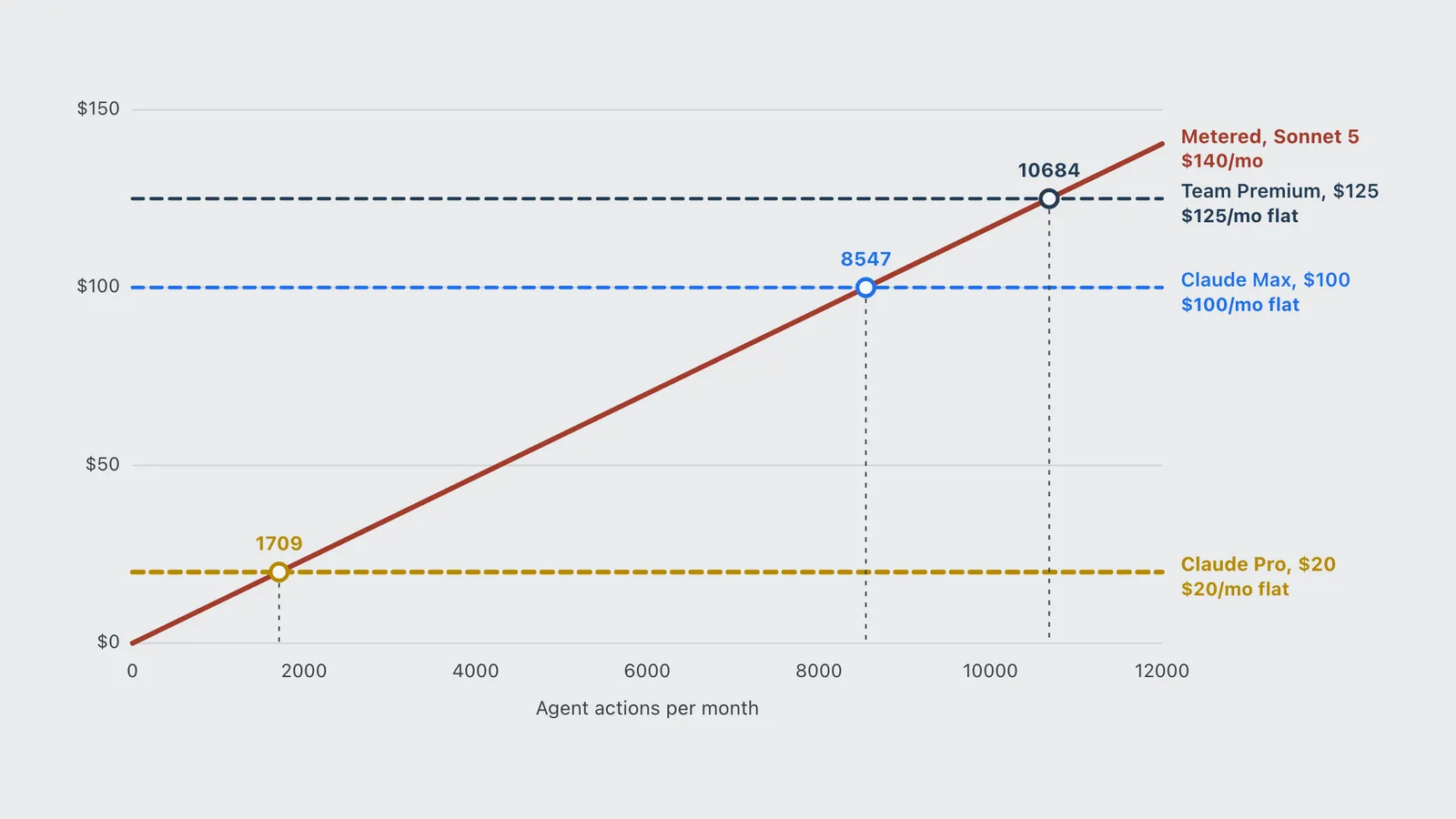
If metered tokens run $14 a month and a seat costs $20, the seat is the expensive option. The interesting question is at what volume that flips.
| Plan | Monthly price | Break-even usage (Agent actions per month) |
|---|---|---|
| Claude Pro, $20 | $20 | 1709 |
| Claude Max, $100 | $100 | 8547 |
| Team Premium, $125 | $125 | 10684 |
| Metered, Sonnet 5 | $0 per unit, no floor | $140 at 12000 |
A $20 Claude Pro seat starts paying for itself at roughly 1,709 agent actions a month, about 57 a day. The $100 Max tier needs about 8,547, or 285 a day. Below those lines, metered tokens are cheaper; above them, the seat is, and the gap widens fast because the seat is flat.
A seat can also be the only door on offer, priced well above what the work costs: xAI put its always-on assistant behind a $120 tier for an agent the same vendor meters per token. This is why the “subscription or API” argument never resolves in general. It resolves per workload. To run it on your own numbers, use the subscription versus API break-even calculator.
Action count is not what sets your bill
Here is the finding that reframes the whole question. Hold the action count completely fixed at 40 a day, change only what each action carries, and price it again.
The working agent profile: 60,000 input tokens per action at a 70 percent cache hit, 3,000 output tokens, and three tool loops per action. Same 40 actions a day. This is what an agent looks like when it reads files, calls tools, and reasons rather than answering from a cached prompt.
| Model | Light EA profile | Working agent profile | Multiple |
|---|---|---|---|
| GPT-5.6 Luna | $1.55 | $29 | 19x |
| Gemini 3 Flash | $3.87 | $72 | 19x |
| Claude Sonnet 5 | $14.04 | $268 | 19x |
| Claude Opus 4.8 | $35.10 | $670 | 19x |
| Claude Fable 5 | $70.20 | $1,339 | 19x |
The bill moved 19x on an unchanged task count. Nobody added work; the agent simply started doing each task properly.
And the composition shifts as it does. On the light profile, input-side costs are about 49 percent of the bill. On the working profile they reach 60 percent, and fresh input alone overtakes all output:
| Scenario | Cached input | Fresh input | Output | Total |
|---|---|---|---|---|
| Claude Opus 4.8 | $75.60 | $324.00 | $270.00 | $669.60 |
| Claude Sonnet 5 | $30.24 | $129.60 | $108.00 | $267.84 |
| Gemini 3 Flash | $7.56 | $32.40 | $32.40 | $72.36 |
| GPT-5.6 Luna | $3.02 | $12.96 | $12.96 | $28.94 |
Cache state is therefore a first-order cost input, not a technicality. Anthropic’s cost management documentation states that prompt-cache lifetime is one hour on a subscription, five minutes once usage credits are in play, and five minutes by default on an API key or cloud provider, and that a first message after a break longer than the lifetime “misses the cache and reprocesses your full context.”
The same documentation quantifies the other multiplier: agent teams “use approximately 7x more tokens than standard sessions” when teammates run in plan mode, because each teammate maintains its own context window. Parallelism is not free; it is roughly septuple.
If your bill has already moved in the wrong direction, the diagnostic causes are catalogued in why your AI API bill is so high.
What teams actually pay
Modeled numbers are only worth as much as their agreement with observed ones, so here are the observed ones.
Anthropic publishes its own: across enterprise deployments the average is “around $13 per developer per active day and $150-250 per developer per month, with costs remaining below $30 per active day for 90% of users.” Its guidance is to “budget more for a coding seat than a chat seat,” because a coding turn carries file contents, tool calls, and multi-step reasoning.
Gartner surveyed the wider market. Its Peer Insights data, as reported by DevOps.com, shows that nearly one quarter of technology leaders already spend $200 to $500 per developer each month on AI coding tokens, and that about 6 percent spend more than $2,000 per developer per month.
Those three sources triangulate. The modeled working-agent figure on Claude Sonnet 5, $268 a month, lands inside Gartner’s observed $200-500 band. Anthropic’s published $150-250 sits just below it, consistent with slightly lighter usage. A model built only from list rates and a stated token profile reproduces the distribution two independent sources measured in the field, which is a reasonable basis for trusting it on your own workload.
The tail is real but rare. Gartner senior principal analyst Nitish Tyagi, quoted by InfoWorld, says he has “heard scary numbers like ‘My developer consumed $20K last month,’ or ‘A business user consumed $32K’.” Those are anecdotes about outliers, not typical figures, and treating them as a forecast is how budgets get set wrong in both directions. Large deployers respond with caps rather than estimates: the approach Uber and Walmart took to per-employee token limits is the operational version of this section.
Business and voice agents pay on different meters
The coding case has the best data, but the same question is being asked of customer-facing agents, where the meters differ.
Meta moved its Business Agent from a free build-and-test window to commercial billing on August 1, 2026, charging $2.00 per million tokens across WhatsApp, Messenger and Instagram, with AI processing and message delivery bundled into the single rate. Further changes to service messages and utility templates take effect October 1, 2026. The reported detail worth pausing on: a typical message consumes 20,000 to 25,000 tokens, roughly 4 to 5 cents. Those figures come from secondary coverage, since Meta’s developer pricing documentation is not publicly retrievable.
Twenty thousand tokens for one message is enormous, and it is the clearest public evidence of context re-consumption. A message is a few hundred tokens. The other 20,000 are the system prompt, the tools, and the retrieved history, re-sent and re-billed on every turn.
Salesforce went the other way, from outcome-shaped to action-shaped billing. Its Flex Credits announcement replaced a $2.00-per-conversation model with credits sold at $500 per 100,000. A standard action costs 20 credits, about $0.10, and a voice action 30 credits, about $0.15, as reported across 2026 pricing guides. A per-action meter is honest about the fact that one user request becomes many agent actions, which per-conversation pricing hid.
Both changes point the same way as Anthropic’s hybrid Enterprise tier: vendors are moving from units the customer can predict toward units the agent actually consumes.
How to estimate your own bill
The arithmetic is not hard, and it beats any published range:
- Count actions per day, not tasks or users.
- Estimate input tokens per action, including the system prompt, tool definitions, and retrieved context. This is the number people underestimate, usually by an order of magnitude.
- Estimate your cache hit rate, and check your cache lifetime against how your agent is actually invoked. An agent woken every few hours on an API key never hits cache.
- Count loops per action. A tool-using agent rarely completes in one round trip.
- Multiply by list rates, then compare against the seat price using the break-even above.
Two calculators on this site do this interactively: the AI coding cost calculator for per-task and monthly projections, and the subscription versus API break-even calculator. Current per-token rates are tracked on the AI model tracker, and current seat prices on the AI coding plan pricing page.
One caveat on model selection: cheaper per token does not reliably mean cheaper per finished job, because a weaker model can take more attempts. That reversal is documented in why cheaper AI models sometimes cost more.
Bottom line
Anyone quoting a single monthly price for an AI agent is either selling something or has not specified the workload. The honest answer has three parts.
A light personal agent costs $2 to $70 a month in tokens, which is often less than the seat that would cover it. A genuinely working agent, same task count but real context and tool loops, costs $29 to $1,339 a month, and lands where Gartner and Anthropic both observe real teams landing: $150 to $500 per developer. Past that, the cost driver is not price per token but context per action, and the only reliable controls are cache discipline, model tiering, and caps.
The meter you are on determines which of those costs you can see. Pick the meter deliberately.
Frequently asked questions
- How much does an AI agent cost per month?
- Between about $2 and $1,400 a month for a single agent on published list rates, depending on the model and on how much context each action carries. A light assistant agent doing 40 shallow actions a day costs $1.55 to $70.20 a month across the model range. The same 40 actions a day with real tool loops and reasoning costs $29 to $1,339. For coding agents specifically, Anthropic publishes an enterprise average of $150 to $250 per developer per month, and Gartner finds 23 percent of tech leaders paying $200 to $500.
- Is an AI agent cheaper than hiring a developer?
- At current rates, yes for almost every individual deployment, but the margin is narrowing and the comparison is often stated misleadingly. Gartner predicts AI coding costs will surpass the average developer salary by 2028, which sounds decisive until you note the benchmark is a global average salary of roughly $2,000 per month, not a US salary. About 6 percent of organizations already exceed $2,000 per developer per month in token spend.
- Why did my agent bill spike without more usage?
- Most often cache misses or context growth rather than extra work. Anthropic documents that prompt-cache lifetime is one hour on a subscription but five minutes on an API key or when drawing on usage credits, and that a request after a longer gap reprocesses the full context. Agent teams are the other common cause: Anthropic states they use approximately 7x more tokens than standard sessions, because each teammate holds its own context window.
- Is a subscription or API access cheaper for an agent?
- It depends entirely on volume, and the crossover is computable. At a modeled $0.0117 per agent action on Claude Sonnet 5, a $20 Claude Pro seat breaks even at roughly 1,709 actions per month, about 57 a day. Below that, metered API access is cheaper. The $100 Max tier needs about 8,547 actions a month to pay for itself.
- What are the different ways AI agents are billed?
- Five meters are in commercial use as of August 2026: per-seat, such as Claude Pro at $20 a month; per-token, such as Claude Sonnet 5 at $2 in and $10 out per million; per-conversation, which Salesforce used at $2.00 per conversation; per-action, such as Agentforce Flex Credits at about $0.10 per action; and per-minute, such as ElevenLabs conversational agents at $0.080 per added minute. Hybrids are emerging: Anthropic Enterprise is a seat price plus usage at API rates.
- Does using more expensive models mean higher agent costs?
- Directly, yes: the same modeled workload costs 45 times more on Claude Fable 5 than on GPT-5.6 Luna. But per-finished-job the ranking can invert, because a weaker model may need more attempts to complete the same task. Model tiering, routing simple actions to a cheap model and reserving a frontier model for hard ones, is usually a larger saving than switching provider.
Sources
- Gartner (2026). Gartner Predicts AI Coding Costs Will Surpass Average Developer’s Salary by 2028 as Token Consumption Surges (press release, June 24, 2026). Primary source for the 2028 prediction. The page is bot-gated, so the survey figures below are attributed to named secondary coverage. Verified 2026-08-24.
- Anthropic (2026). Manage costs effectively (documentation). Primary, vendor documentation: the $13 per developer per active day and $150-250 per developer per month enterprise averages, the below-$30-per-active-day figure for 90 percent of users, the approximately 7x token multiplier for agent teams in plan mode, prompt-cache lifetimes of one hour on a subscription versus five minutes on an API key or usage credits, and background usage under $0.04 per session. Verified 2026-08-24.
- Anthropic (2026). Claude pricing (vendor pricing page). Primary: Pro at $17 per month on annual billing or $20 monthly, Max from $100 per month, Team seats at $20 and $100 per seat annually, and the Enterprise tier described as seat price plus usage at API rates. Verified 2026-08-24.
- InfoWorld (2026). AI coding token costs are on track to rival human payroll. Secondary reporting: the clarification that the Gartner prediction is benchmarked against a global average salary of $2,000 per month rather than a US salary, and the quoted anecdote from Gartner senior principal analyst Nitish Tyagi. Verified 2026-08-24.
- DevOps.com (2026). AI Coding Costs Could Exceed Developer Salaries, Gartner Warns. Secondary reporting: the Gartner Peer Insights breakdown of nearly one quarter of technology leaders spending $200 to $500 per developer per month, and about 6 percent above $2,000. Verified 2026-08-24.
- ElevenLabs (2026). Agents pricing (vendor pricing page). Primary: $0.080 per additional call minute, $0.160 burst, plan tiers from Free at 15 minutes to Business at $990 for 12,375 minutes, $0.003 per text message, and the note that external LLM and telephony services are charged separately. Verified 2026-08-24.
- Salesforce (2025). Salesforce Introduces New Flexible Agentforce Pricing (press release, May 15, 2025). Primary source for the introduction of Flex Credits, superseding per-conversation pricing. The page is bot-gated; the per-action credit figures are as reported across 2026 pricing guides and are labelled as secondary in this piece. Verified 2026-08-24.
- Capital & Compute. AI model tracker [this site’s dataset]: per-token list rates for every model priced in this piece, dataset as of 2026-08-23. All monthly figures here are this site’s arithmetic on those rates using the shared cost model, not vendor-published totals.
- Capital & Compute. How Much Does It Cost to Run an AI Agent in Production? [this site’s prior coverage]: the production-volume formula and the high-volume end of the range.
- Capital & Compute. What a Personal AI Agent Actually Costs in 2026 [this site’s prior coverage]: hosting and maintenance costs for self-hosted personal agents.