Which AI Agent Platforms Support BYOK?
Eight of 13 AI agent platforms checked in October 2026 support BYOK: Clay, Gumloop, n8n, Sim and more. Your own key rarely cuts the bill, and here is why.
BYOK, short for “bring your own key”, means the platform calls OpenAI, Anthropic or Google with your API key, and the model provider bills you directly. The pitch is that you stop paying the platform’s markup on tokens. The catch, which almost no pricing page puts in one place, is that most agent platforms either never marked tokens up, or they charge you a different fee once the tokens leave their bill.
Every row below was checked against the vendor’s own pricing page or documentation on October 8, 2026.
Which AI agent platforms support BYOK?
Eight of the 13 agent and automation platforms checked let you bring your own model key. Price and plan come first, because whether BYOK is on the cheap tier decides most choices.
| Platform | Cheapest plan with BYOK | BYOK? | What your key removes | What you still pay |
|---|---|---|---|---|
| n8n | Starter, €24/mo (€20 billed annually, as shown in EUR) | Yes, the default: every AI node uses your credentials | Nothing to remove. Gateway credits are an optional keyless path | Plan fee, priced per workflow execution |
| Dify Cloud | Sandbox (free); Professional $590 per workspace per year | Yes, on cloud plans | Trial message credits | Plan fee |
| Sim | Free; Pro $25 per user per month | Yes, any plan for workspace keys | The 1.1x multiplier on hosted model keys | $0.005 base charge per run |
| Gumloop | Pro, $37/mo | Yes, Pro and up | Model credits (to zero) | Tool calls, compute, and a 16% orchestration fee instead of 8% |
| Clay | Free per the pricing page; docs call it a paid feature | Yes, for enrichment and the Use AI feature | Data Credits | One Action per run, plus the plan fee |
| Relevance AI | Pro, $29/mo ($19 billed annually) | Yes, Pro and up | Vendor Credits | Actions, plus the subscription |
| Make | Plan tier not stated | Yes, for AI Agents | Make’s AI Provider usage | Credits per operation |
| Manus | Pro from $20/mo; Flex eligibility not stated | Yes, via Manus Flex (announced September 29, 2026) | Model inference | Manus credits for every other service in the task |
| Zapier Agents | n/a | No. Enterprise “Bring Your Own Model” runs through AWS Bedrock and is not tied to Agents | n/a | n/a |
| Lindy | n/a | No. Its credentials feature is for tools and code, not model inference | n/a | n/a |
| Genspark | n/a | No mention anywhere in its help center | n/a | n/a |
| Twin | n/a | No. Its pricing page says “No Credits” while its docs describe a credit system | n/a | n/a |
| Browse AI | n/a | No LLM key setting | n/a | n/a |
Two of these rows carry conflicts on the vendor’s own pages. Clay’s pricing page lists “Bring your own API key” on the Free card, while Clay’s integration docs call it a “paid feature.” And none of Clay’s primary pages says whether Claygent, its flagship research agent, runs on your key. Its newer Account Research Agents explicitly do not: Clay’s documentation says bringing your own model key “isn’t supported during open beta.” If Claygent is the reason you’re on Clay, ask before you plan around BYOK.
Does bringing your own key make an agent platform cheaper?
Usually not by much, and sometimes it makes it more expensive. The deciding question is whether the platform marked up tokens in the first place.
Gumloop’s credit documentation is unusually candid here, so it makes the cleanest example. Gumloop says model calls “bill at cost” at $0.005 per credit, and that BYOK agent chats “carry a 16% orchestration fee instead of 8%.” Its own worked example is a chat that spends 400 credits on the model, 10 on compute and 15 on tool calls. Gumloop’s docs total it at 459 credits standard and 93 credits with BYOK, and call BYOK “far cheaper.”
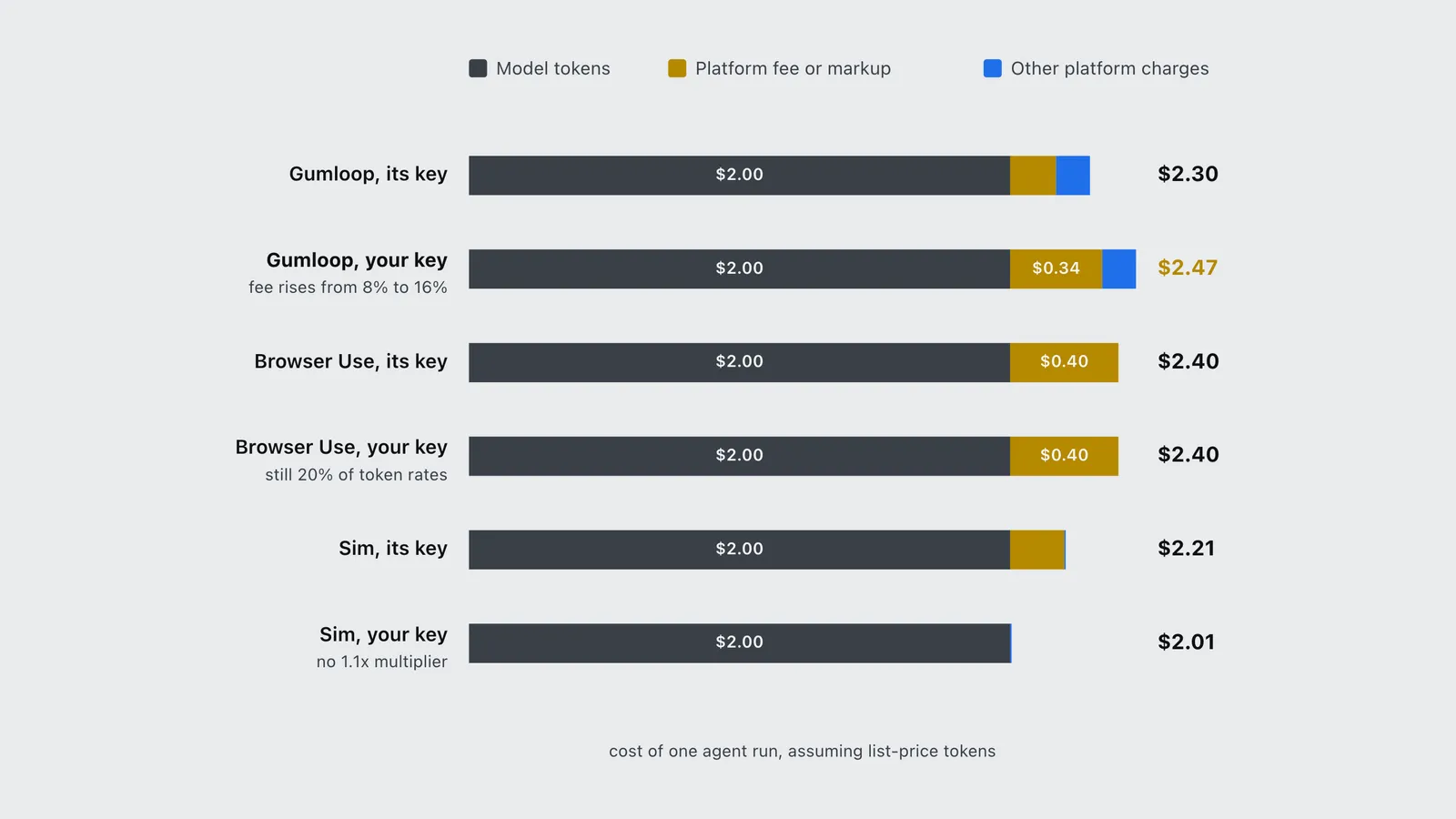
In credits, it is. In cash, it isn’t. Those 400 model credits are $2.00 of tokens at Gumloop’s at-cost rate, and with BYOK you still pay that $2.00, just to OpenAI or Anthropic instead. Add the 93 Gumloop credits ($0.47) and the run costs about $2.47, against $2.30 on Gumloop’s own key. The doubled orchestration fee is the difference.
| Scenario | Model tokens | Platform fee or markup | Other platform charges | Total |
|---|---|---|---|---|
| Gumloop, its key | $2.00 | $0.17 | $0.13 | $2.30 |
| Gumloop, your key (fee rises from 8% to 16%) | $2.00 | $0.34 | $0.13 | $2.47 |
| Browser Use, its key | $2.00 | $0.40 | $0.00 | $2.40 |
| Browser Use, your key (still 20% of token rates) | $2.00 | $0.40 | $0.00 | $2.40 |
| Sim, its key | $2.00 | $0.20 | $0.01 | $2.21 |
| Sim, your key (no 1.1x multiplier) | $2.00 | $0.00 | $0.01 | $2.01 |
Three platforms, three different answers:
- Gumloop: your key costs about 7% more per run at list prices, because the model was never marked up and the fee doubles. Gumloop’s Pro plan muddies this further in Gumloop’s favor: $37 buys 20,000 credits, of which 12,600 are bonus credits, so hosted model calls inside your allowance are cheaper than list. BYOK only wins past the allowance, and only if your provider rate is below list.
- Browser Use: no difference. Browser Use’s pricing page prices hosted models at “model cost + 20%”, and for your own key says it “charges 20% of published token rates, including cached rates, plus browser time and traffic.” The fee is the same either way.
- Sim: your key saves 10% on tokens. Sim’s cost documentation applies “a 1.1x multiplier” to model pricing on its hosted keys and says you “can avoid this multiplier by using your own API keys.” The $0.005 base charge per run stays.
Relevance AI sits with Gumloop on this. Relevance AI’s pricing documentation says Vendor Credits “cover LLM and tool usage costs at wholesale, with no markup,” so swapping in your key changes who sends the invoice, not the size of it. Clay adds a cost that isn’t money: its pricing page says “AI runs are 2x faster using Clay’s API keys,” because Clay negotiated higher rate limits than a typical customer account gets.
How does BYOK pricing actually work?
Every agent platform bills some mix of four things: model tokens, a per-run or per-action charge, compute time, and a percentage or credit fee for running the agent loop. BYOK only touches the first. Everything else stays on the platform’s invoice.
That’s why the honest way to read a BYOK offer is to ask what the platform charged for tokens before. Platforms land in three groups:
- Tokens were marked up. Sim (1.1x on hosted keys) and Browser Use (20% on hosted models). BYOK removes the markup on Sim. Browser Use keeps charging its 20% anyway.
- Tokens were at cost. Gumloop and Relevance AI. BYOK moves the token bill to your provider. Gumloop then raises its orchestration fee.
- Tokens were never the platform’s business. n8n and Dify treat your own credentials as the normal way to run AI nodes. You pay for the plan and the provider bills your tokens. This is the cleanest version of BYOK on the list.
The money case for BYOK is narrower than the marketing suggests. It pays off when your provider rate is below list (committed-use discounts, startup credits, an enterprise agreement), when you need a model the platform doesn’t host, or when your data terms with OpenAI or Anthropic have to cover the traffic. It also gives you one place to see and cap model spend across every tool, which matters more once several platforms are running agents on your behalf.
For the token side of that math, the guide to what an AI agent costs in production models real workloads at 2026 API rates. The OpenRouter explainer covers the gateway version of the same trade, where BYOK through OpenRouter carries its own 5% fee past a free allowance.
Which platforms charge more when you bring your own key?
Gumloop is the clear case: 16% instead of 8% on agent chats, stated in its docs. Warp, the agentic terminal, is a partial one. Warp’s BYOK documentation bills inference to your provider, but on Business and Enterprise plans BYOK runs “still consume platform credits for Warp’s platform infrastructure.” Manus does the same in a different shape: with Manus Flex, Manus’s announcement says model inference is billed by your provider while “other services and infrastructure used as part of a Manus task still consume Manus credits.”
Nobody in this list hides the fee. But only Gumloop states plainly that the fee itself goes up, and that’s worth knowing before you assume your key makes the platform a pass-through.
Does BYOK cover web scraping and browser keys?
Mostly no. BYOK on agent platforms almost always means model keys only. Sim is the exception in this check: its BYOK list includes web-data keys from Firecrawl, Exa, Parallel AI, Jina, Serper and Perplexity alongside the model providers, so a research agent’s search and scraping bills can land on your own accounts too.
The web-data and browser vendors themselves split into two kinds. Some are the key you bring. Others run their own LLM steps and decide who pays for them.
| Provider | Entry price | Uses your LLM key? | Who pays for the LLM steps |
|---|---|---|---|
| Browserbase + Stagehand | Developer $20/mo (100 browser hours) | Yes, Stagehand reads your OpenAI or Anthropic key | You, directly. Or Browserbase’s Model Gateway, billed at provider price with no markup |
| Browser Use Cloud | Credits from $5, no subscription | Yes | Your provider, plus Browser Use’s 20% of token rates either way |
| Firecrawl | Hobby $16/mo billed yearly | No | Firecrawl, inside credits (JSON extraction costs 4 extra credits per page) |
| Exa | Pay as you go, no minimum | n/a, Exa is the API you bring | Search is $7 per 1,000 requests |
| Parallel | Pay per request | n/a, Parallel is the API you bring | Search from $1 to $5 per 1,000; Task API $5 to $300 per 1,000 runs |
Browserbase is the counter-example to the whole BYOK pitch. Browserbase’s Model Gateway documentation says “Tokens are billed at the same price as going direct to the provider. No markup.” So on Browserbase, your own key is a convenience choice, not a discount. Prices above are from each vendor’s pricing page on October 8, 2026: Firecrawl billing, Exa pricing and Parallel pricing.
Do coding agents support BYOK too?
Some do, with the same pattern of partial pass-through. JetBrains AI Assistant lets you run its agents on your own provider key without a JetBrains AI subscription, though JetBrains notes some features may be unavailable on third-party models. Warp offers BYOK on its Free plan for OpenAI, Anthropic and Google models, with the platform-credit catch on team plans covered above. For the wider field, the AI agent harness comparison tracks which coding harnesses run on which models.
Is it safe to give an agent platform your API key?
It’s as safe as the platform’s key storage and your own blast-radius limits. You control the second part:
- One key per platform. Create a separate key for each tool, so revoking one doesn’t break the others and the provider’s usage page shows which platform spent what.
- Cap spend at the provider. Where your provider offers a spend limit or a prepaid balance, set it. A runaway agent loop on your key is your bill, not the platform’s.
- Scope the key. If the provider supports project-scoped or restricted keys, give the platform one that can only call models.
- Read the platform’s key page. Ask how the key is encrypted at rest and who on their side can read it. Platforms built for teams, like Sim’s organization-level keys, also control which members can use a stored key.
Long-running agents add one more risk: a crash halfway through a run can replay paid model calls on your key. Platforms that checkpoint each step avoid that, which is the case durable execution for agent harnesses makes.
How to get started with BYOK on an agent platform
- Price one real run both ways. Run the same agent task on the platform’s key, read the credit breakdown, then switch to your key and compare the total including your provider’s charge.
- Check which features your key covers. Clay’s research agents, Warp’s cloud agents and Manus’s non-model services all fall outside BYOK.
- Create a dedicated, capped key following the safety steps above.
- Re-check after any pricing change. Two vendors in this list (Clay and Twin) already contradict themselves across their own pages.
Frequently asked questions
- Which AI agent platforms support BYOK?
- As of October 8, 2026, n8n, Dify, Sim, Gumloop, Clay, Relevance AI, Make and Manus (via Manus Flex) let you run agents on your own model-provider key. Zapier Agents, Lindy, Genspark, Twin and Browse AI have no documented BYOK.
- Is BYOK cheaper than using the platform credits?
- Only when the platform marks up tokens or your provider rate is below list. Sim charges 1.1x on hosted keys, so BYOK saves about 10% on tokens. Gumloop bills models at cost and raises its orchestration fee from 8% to 16% with BYOK, so a run can cost slightly more in cash.
- Does Clay let Claygent use my own OpenAI key?
- Clay's pricing page says your own keys work for data enrichment and AI, with each run counting as one Action. None of Clay's primary pages confirms Claygent on your key, and its Account Research Agents do not support it during open beta.
- What does BYOK mean for an AI agent?
- BYOK means the agent platform calls the model provider with your API key, so the provider bills your account for tokens. The platform still bills its own plan, per-run or per-action charges, and any orchestration fee.
- Do browser automation tools support BYOK?
- Browserbase with Stagehand and Browser Use Cloud both accept your own model key. Browser Use still charges 20% of token rates when you do. Browserbase also offers a Model Gateway that bills tokens at provider price with no markup.
Sources
- Gumloop (2026). Credits. Gumloop documentation. https://docs.gumloop.com/core-concepts/credits
- Gumloop (2026). Pricing. https://www.gumloop.com/pricing
- Clay (2026). Pricing. https://www.clay.com/pricing
- Clay (2026). Managing integration accounts. Clay University documentation. https://university.clay.com/docs/managing-integration-accounts
- Clay (2026). Account Research Agents. Clay University documentation. https://university.clay.com/docs/account-research-agents
- Relevance AI (2026). Pricing. Relevance AI documentation. https://relevanceai.com/docs/get-started/pricing
- n8n (2026). Gateway credits. n8n documentation. https://docs.n8n.io/deploy/use-n8n-cloud/gateway-credits
- n8n (2026). Pricing. https://n8n.io/pricing/
- Make (2026). Pricing. https://www.make.com/en/pricing
- Dify (2026). Pricing. https://dify.ai/pricing
- Sim (2026). Cost calculation. Sim documentation. https://docs.sim.ai/platform/costs
- Manus (2026). Introducing Manus Flex. Manus blog. https://manus.im/blog/introducing-manus-flex
- Zapier (2026). Pricing. https://zapier.com/pricing
- Lindy (2026). Credentials. Lindy documentation. https://docs.lindy.ai/integrations/credentials
- Twin (2026). Pricing. https://twin.so/pricing/
- Browser Use (2026). Pricing. https://browser-use.com/pricing
- Browserbase (2026). Model Gateway. Browserbase documentation. https://docs.browserbase.com/platform/model-gateway
- Firecrawl (2026). Billing. Firecrawl documentation. https://docs.firecrawl.dev/billing
- Exa (2026). Pricing. https://exa.ai/pricing
- Parallel Web Systems (2026). Pricing. https://parallel.ai/pricing
- Warp (2026). Bring your own API key. Warp documentation. https://docs.warp.dev/support-and-billing/plans-and-pricing/bring-your-own-api-key
- JetBrains (2026). Bring your own key (BYOK). AI Assistant documentation. https://www.jetbrains.com/help/ai-assistant/bring-your-own-key-byok.html