How to Test LLM Apps Without Paying for Tokens
Test LLM apps for $0 in October 2026: the free LLM APIs that still work, their real limits and data catches, checked against each provider's own docs.
Use OpenRouter’s free models if you want many models behind one key, Groq if you want speed, and Google AI Studio if you need long inputs and are in the EU or UK. Run a model on your own computer with Ollama if your test data is private. All four cost $0 in October 2026, and none needs a credit card.
The catch is that free tiers are small and they change. Between July and October 2026 one popular free option, GitHub Models, shut down completely, and another, Cerebras, now asks for a card before its free credit unlocks. This guide lists what is actually free today, what each one limits, and how to test an app without running into those limits.
Which free LLM API should you use?
Pick by what you are testing. The table leads with what you get for free and who can get it, then the limits that will stop you first.
| Provider | What is free | Card needed | Main limit | Data and use terms |
|---|---|---|---|---|
OpenRouter (:free models) |
Free models from many labs, one API key | No | 20 requests/min; 50/day (1,000/day after $10 of credits) | Depends on each model’s provider |
| Groq | Open models such as gpt-oss-120b and qwen3.8-27b | No | 30 requests/min, 1,000/day, 8,000 tokens/min | Check Groq’s terms |
| Google AI Studio | Gemini models | No | Not published; shown inside AI Studio | Used to improve Google products, outside the EEA, Switzerland and UK |
| Mistral (Free plan) | $10 a month in API credits | No | Credits run out | Training on unless you opt out |
| NVIDIA build.nvidia.com | Hosted open models for prototyping | No (Developer Program sign-up) | Per model and account; not published as one number | Prototyping and testing only |
| Cloudflare Workers AI | 10,000 “neurons” a day | No | Daily allowance | Check Cloudflare’s terms |
| Cohere (trial key) | Command models | No | 20 chat requests/min, 1,000 calls/month | Trial keys only |
| Hugging Face | $0.10 a month in credits | No | Credits run out fast | Depends on the provider |
| Ollama (your own computer) | Any open model you can download | No | Your RAM | No, nothing leaves your machine |
| Retired July 30, 2026 | n/a | n/a | n/a | |
| Cerebras | $5 credit, expires after 30 days | Yes | 5 requests/min on the trial | Trial only |
If you only try one, try OpenRouter. It is the easiest way to test the same prompt against many models, and the one-time $10 credit purchase that unlocks 1,000 free requests a day is the best-value spend in this guide (free models do not use up the credits). The rest of its pricing and privacy settings are covered in OpenRouter AI explained, and a ranked list of the best free models is on the free AI models page.
What does each free tier actually give you?
OpenRouter: the most models for one key
OpenRouter puts hundreds of models behind a single API, and some of them carry a :free tag. According to OpenRouter’s limits documentation, free models allow 20 requests a minute and 50 a day. Buy $10 of credits once and the daily cap rises to 1,000. Free model availability changes week to week, so pin a specific model for tests instead of letting it pick one for you. Read each free model’s data policy too: the Ox Alpha case shows how a $0 model can be paid for with your prompts.
Groq: the fastest, with a token ceiling
Groq’s free plan, per Groq’s rate-limits page, allows 30 requests a minute and 1,000 a day on models such as gpt-oss-120b, gpt-oss-20b and qwen3.8-27b. The number that bites is the other one: 8,000 tokens a minute and 200,000 a day. That is enough for chat-style tests. It is not enough to paste in whole web pages or long documents, since a single raw page can be 100,000 tokens. Groq is the right choice when you want to see how fast your app feels. More on the company is in the Groq provider profile.
Google AI Studio: generous, with a data catch
Google no longer publishes its free limits. The Gemini API rate-limits page says they “can be viewed in Google AI Studio” after you sign in. The trade-off is in the Gemini API Additional Terms (last updated April 28, 2026): on the free tier Google uses your prompts and responses “to provide, improve, and develop Google products,” and “human reviewers may read, annotate, and process” them. Users in the EEA, Switzerland and the UK get paid-tier privacy even on free quota. Everyone else should test with made-up data, not real customer data.
Mistral: free credits, training on by default
Mistral’s pricing page lists $10 a month in API credits on its Free plan, enough to test Mistral’s own models properly. Model training is shown as “Opt-out” on that plan, which means your data can be used unless you switch it off. Do that before your first request.
NVIDIA, Cloudflare, Cohere and Hugging Face: useful extras
- NVIDIA offers free access to hosted models through its Developer Program, “for prototyping, research, development and testing purposes only,” per NVIDIA’s NIM API documentation. NVIDIA does not publish one rate limit. Developers on NVIDIA’s own forums report a default of about 40 requests a minute.
- Cloudflare Workers AI includes 10,000 neurons a day (Cloudflare’s unit of compute) on both free and paid plans, per Cloudflare’s pricing documentation. Free-plan users stop at that cap rather than being billed.
- Cohere trial keys get 20 chat requests a minute and 1,000 calls a month, per Cohere’s rate-limit docs.
- Hugging Face gives free users $0.10 a month in inference credits, per its Inference Providers pricing page. That is a handful of test calls, not a test suite.
What changed since summer
GitHub Models is gone. GitHub retired it on July 30, 2026: the playground, the model catalog and the API all stopped working. Many “free LLM API” lists still include it. Cerebras now gives new accounts a one-time $5 credit that expires after 30 days and needs a payment method, per Cerebras’s pricing page, with 5 requests a minute on that trial according to its rate-limit docs. That makes it a short trial, not a free tier.
How do you test an LLM app without hitting the limits?
Free tiers run out fast if every test sends a fresh request. Most of the savings come from simple habits, not from picking the perfect provider.
- Save answers and reuse them. If a test sends the same prompt as last time, return the saved answer instead of calling the API again. Your second test run then costs zero requests.
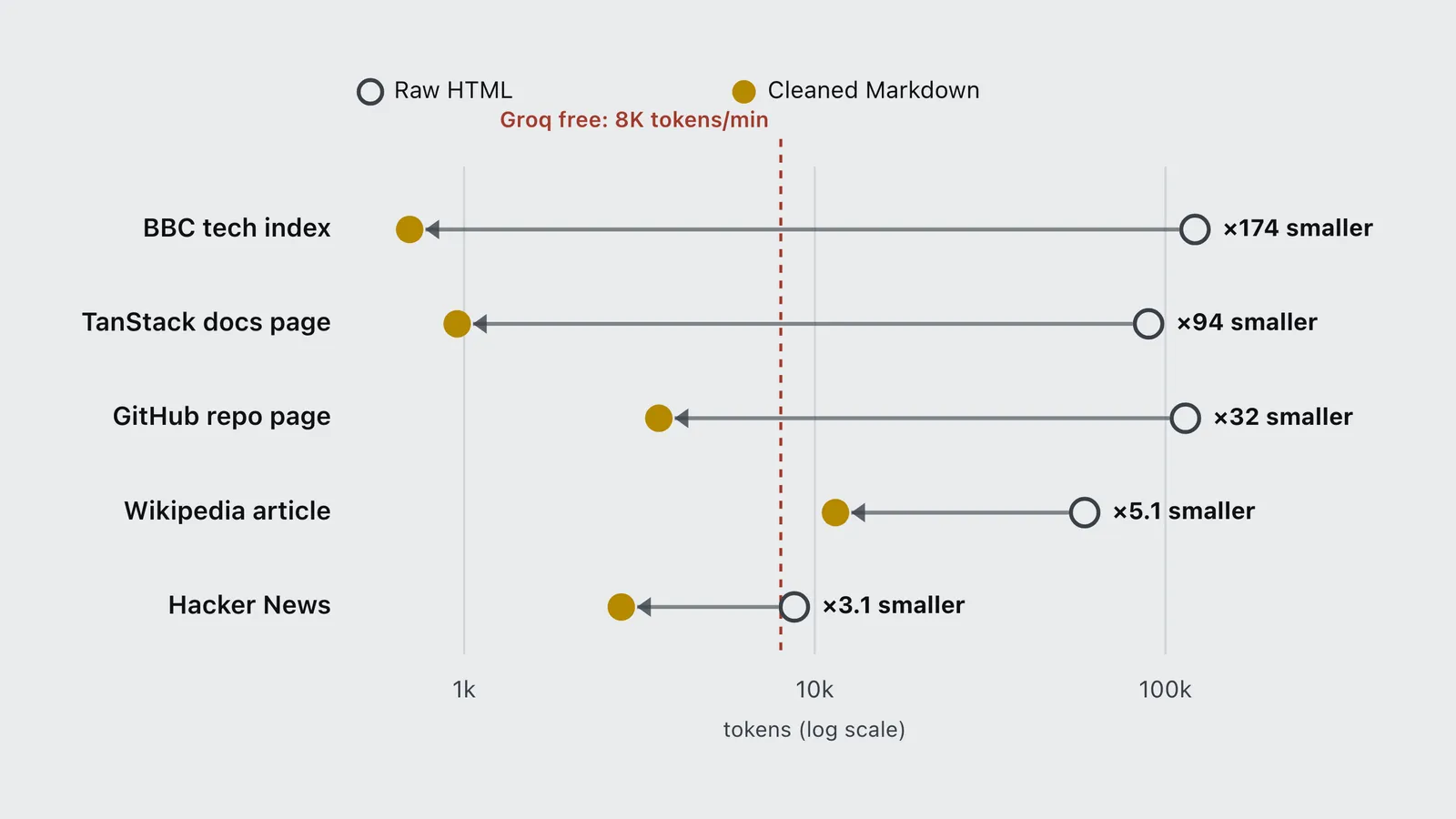
- Send less text. Strip pages and documents down to the words that matter before sending them. The chart below shows how much this saves.
- Develop against one provider, check against another. Do day-to-day work on one free tier, or a local model. Run your saved test cases through a second, bigger free model only when you want a comparison.
- Cap the answer length. Set a maximum output length so a confused model cannot write thousands of words into your daily allowance.
- Use fake data. It keeps the data-training catches above from mattering at all.
Number two matters more than it sounds. When an app reads web pages, sending the raw page wastes most of the allowance on code the model does not need. Here is what converting five real pages to plain text did, measured for this guide:
| Page | Raw page | Cleaned text | Reduction |
|---|---|---|---|
| BBC tech index | 121.5k | 699 | ×174 smaller |
| TanStack docs page | 89.5k | 955 | ×94 smaller |
| GitHub repo page | 114.1k | 3.6k | ×32 smaller |
| Wikipedia article | 58.9k | 11.5k | ×5.1 smaller |
| Hacker News | 8.7k | 2.8k | ×3.1 smaller |
One warning from the same test: on a sixth page, Ollama’s model library, the cleaner kept only 69 characters and threw away the table that mattered. Nothing showed an error. Always check that the cleaned text still contains what you need before blaming the model for a bad answer. The usual reasons a real bill climbs later are in why your AI API bill is so high.
Can you run an LLM for free on your own computer?
Yes, and it is the only option with no daily limit. Ollama downloads an open model and runs it locally, with nothing sent to anyone. Most AI app frameworks, including TanStack AI and other SDKs with provider adapters, can switch between a local model and a hosted free tier with a one-line change. So you can build against the local model all day and check against a bigger hosted one when it counts.
The limit is memory. On a 16 GB Mac, Ollama reported about 11.8 GB available for the model in a test for this guide, which fits a 4B to 9B model. Qwen3 8B (a 5.2 GB download) extracted structured facts from a Wikipedia article in about 22 seconds there: slower than Groq, but free and unlimited. Bigger models need more memory. See how much RAM a local LLM needs, or check your machine with the Can I Run This LLM? tool.
When should you start paying?
When a free tier starts getting in the way of testing. That happens when you need more than about 1,000 requests a day, when you need real customer data in your tests, or when a bigger model gets answers right that the free ones miss. Cheap paid models cost little for testing-sized workloads. Compare current per-token prices on the AI model price tracker before you pick one.
How to get started
- Create a free OpenRouter account and pick one
:freemodel to pin. - Add a Groq key as a second, faster option.
- Install Ollama if your test data is private or you want unlimited local runs.
- Turn on saved answers in your app from day one, and send cleaned text, not raw pages.
- Turn off model training in any provider dashboard that offers the switch (Mistral, and check each OpenRouter model’s policy).
Frequently asked questions
- What is the best free LLM API in October 2026?
- OpenRouter free models are the best all-rounder: many models behind one key, 20 requests a minute and 50 a day, or 1,000 a day after a one-time $10 credit purchase. Groq is the fastest, at 30 requests a minute and 1,000 a day but only 8,000 tokens a minute.
- Can you test an LLM app completely for free?
- Yes. Combine a free hosted tier such as OpenRouter or Groq with a local model through Ollama, and save answers so repeated tests do not send new requests. No credit card is needed for any of them.
- Is GitHub Models still free?
- No. GitHub retired GitHub Models on July 30, 2026. The playground, model catalog and inference API no longer work, and GitHub points users to Microsoft Foundry or GitHub Copilot instead.
- Does the Gemini free tier use your data?
- Yes, outside the EEA, Switzerland and the UK. Google says free-tier prompts and responses are used to improve its products and may be read by human reviewers. Users in those regions get paid-tier data handling on the free quota.
- Which free LLM API needs no credit card?
- OpenRouter, Groq, Google AI Studio, Mistral, NVIDIA build.nvidia.com, Cloudflare Workers AI, Cohere trial keys and Hugging Face all start without a card, as of October 5, 2026. Cerebras now requires a payment method for its $5 trial credit.
Sources
- OpenRouter (2026). Limits. OpenRouter documentation. https://openrouter.ai/docs/api/reference/limits
- OpenRouter (2026). Free LLM API in 2026: 13 Options Ranked and Compared. OpenRouter blog (vendor). https://openrouter.ai/blog/tutorials/free-llm-apis-compared/
- Groq (2026). Rate limits. Groq documentation. https://console.groq.com/docs/rate-limits
- Google (2026). Rate limits. Gemini API documentation. https://ai.google.dev/gemini-api/docs/rate-limits
- Google (2026). Gemini API Additional Terms of Service. Google. https://ai.google.dev/gemini-api/terms
- Mistral AI (2026). Pricing. Mistral AI. https://mistral.ai/pricing
- NVIDIA (2026). NIM API documentation: product FAQ. NVIDIA. https://docs.api.nvidia.com/nim/docs/product
- NVIDIA Developer Forums (2026). Request for NVIDIA Build API rate limit increase (40 RPM to 200 RPM). User forum (secondary). https://forums.developer.nvidia.com/t/request-for-nvidia-build-api-rate-limit-increase-40-rpm-200-rpm/373495
- Cloudflare (2026). Workers AI pricing. Cloudflare documentation. https://developers.cloudflare.com/workers-ai/platform/pricing/
- Cohere (2026). Rate limits. Cohere documentation. https://docs.cohere.com/docs/rate-limits
- Hugging Face (2026). Inference Providers pricing and billing. Hugging Face documentation. https://huggingface.co/docs/inference-providers/pricing
- GitHub (2026). GitHub Models is now retired. GitHub Changelog. https://github.blog/changelog/2026-07-30-github-models-is-now-retired/
- Cerebras (2026). Pricing. Cerebras. https://www.cerebras.ai/pricing
- Cerebras (2026). Rate limits. Cerebras inference documentation. https://inference-docs.cerebras.ai/support/rate-limits
- Ollama (2026). Ollama. https://ollama.com