What a Personal AI Agent Actually Costs in 2026
OpenClaw and Hermes Agent are free to download. Running one is not: hosting, tokens, and your time put a real personal agent at $10-300 a month.
Search “personal AI agent” and you will find software that costs nothing to acquire and wildly different amounts to operate. OpenClaw, the self-hosted assistant that became the fastest-growing repository in GitHub history, is MIT-licensed freeware. Hermes Agent, its closest rival, is also free, also open source, and promises to run on a $5 VPS. The downloads are free. The agents are not.
That gap between the license and the invoice is where most coverage stops, usually because the writer is selling you hosting. This piece maps the five flavors of personal AI agent as of August 2026 and prices each one honestly: infrastructure, model spend, and the line item nobody puts in the comparison table, your own hours.
The short answer
A useful personal AI agent costs $10 to $50 per month for most people: $5 to $20 of hosting plus $5 to $30 of API token spend at moderate usage. Heavy automation pushes past $150 per month, mostly in tokens. Managed hosting flattens the bill to roughly $29 to $59 per month but does not eliminate token costs unless the plan explicitly bundles credits. The largest hidden cost is maintenance time, which operators report at 5 to 15 hours per month.
What counts as a personal agent
The category has a specific shape, and it is worth separating from neighbors before pricing anything. A personal agent is a long-running harness that lives on infrastructure you control (or rent), connects to your messaging channels, holds persistent memory across sessions, and takes actions on your behalf: sending messages, running cron jobs, executing tools, browsing.
It is not a chatbot subscription. ChatGPT Plus and Claude Pro answer questions inside someone else’s sandbox; they were deliberately excluded from this taxonomy. It is also not a coding agent. Claude Code and its rivals share harness DNA with this category (the distinction is explained in our guide to AI coding agents compared), but their job ends at the repository. The personal agent’s job is everything else.
Two projects define the category. OpenClaw (387,000 GitHub stars, MIT license, verified August 23, 2026), built by Peter Steinberger and now governed by the non-profit OpenClaw Foundation, is a multi-channel messaging gateway: one assistant reachable across WhatsApp, Telegram, Slack, Discord, iMessage and more, with a single Gateway process as the local control plane. Hermes Agent, released by Nous Research in February 2026 and already past 230,000 stars according to the community-maintained Hermes Atlas directory (read August 21, 2026), leads with a different thesis: persistent memory plus a learning loop that writes and refines its own skills. We profiled its architecture separately in Hermes Agent explained; here it gets priced, not dissected.
The five flavors, and what each one bills you
Flavor 1: Self-hosted full assistants
The canonical setup. You install OpenClaw or Hermes on a virtual private server and bring your own API keys. The software is free under MIT. Your bill has exactly two mandatory lines:
Hosting. OpenClaw’s own documentation walks through installs on Hetzner starting around $5/month, with GCP options in the $5-12 range (docs.openclaw.ai). A workable floor is $5-20/month; operators running concurrent tasks report needing more headroom. One developer’s three-month ledger on DEV Community recorded upgrading from a $12/month VPS to $24/month after the smaller box choked on concurrent jobs (Helen Mireille, DEV, August 2026).
Tokens. This is the volatile line. Hostinger’s cost breakdown (updated August 6, 2026) models a typical interaction at roughly 1,000 input and 500 output tokens: trivially cheap on a budget model, meaningful on a frontier one. Its scenario table lands personal projects at $6-13/month total, small teams at $25-50, scaling teams at $50-100, and heavy automation above $100 (Hostinger, 2026). The same guide cites a GitHub discussion finding that forgotten test workflows account for 10-30% of monthly spend in real deployments.
Realistic envelope: $12-35/month light, $60-300+ heavy.
Flavor 2: Managed hosting of the same agents
A whole wrapper industry has grown up around people who want the agent without being the ops team. Third-party managed providers cluster between $29 and $59 per month: OpenClaw Provider starts at $29/month plus your server and API keys (pricing page); ClawCloud charges $39/month for an isolated container (clawcloud.im); SFAI Labs’ pricing breakdown lists the managed cloud route at $59/month ($29.50 the first month) with smart model routing included (SFAI Labs, March 2026).
The critical fine print: some plans bundle model access, others only the runtime. SFAI Labs’ verdict is the honest one, that Cloud does not eliminate token costs, only hosting and maintenance overhead. Whether the premium is worth it depends entirely on how you value flavor number five below: your time.
Flavor 3: Lightweight and containerized variants
A fork ecosystem has emerged for people who liked the idea but not the attack surface: NanoClaw (Docker-isolated), PicoClaw (a minimal Go runtime), IronClaw (security-focused Rust). These trade ecosystem breadth for isolation, and their economics match the self-hosted bucket: a small VPS plus your own keys. They are cheaper to secure, not cheaper to run. Treat their cost profile as identical to Flavor 1 and choose on security posture instead.
Flavor 4: DIY frameworks
LangGraph, CrewAI, AutoGen and friends are how engineers assemble a personal agent from parts. Nothing here is a monthly fee; everything is engineering time. Frameworks sit out of this post’s price tables because their bill is almost entirely labor, which is the same reason our build-vs-buy analysis treats them as a different purchasing decision. Name them so you can place them, then move on.
Flavor 5: Local-model routing
Swap the cloud API for a local model served by Ollama and the token line drops toward zero. Nothing is free: the hardware moves upfront (an 8GB-RAM Mac runs small models only, and agentic workloads punish weak hardware, which is why local LLMs still fail at agentic coding for many tasks), and you inherit electricity, cooling, and amortization. Our tracker posts cover the hardware side in depth: see how much RAM you need to run a local LLM and the best open-weight AI models in 2026. The hybrid pattern most operators converge on is routing: local or budget models for routine tasks, frontier models reserved for hard ones.
Where bills spiral: three failure modes
Whatever flavor you pick, the same three mechanisms turn $20 into $200:
- The heartbeat tax. Always-on assistants poll their model even when idle. SFAI Labs calculates OpenClaw’s half-hourly heartbeat cycle at 8,000-15,000 input tokens per cycle: about $2/month routed to a budget model, around $72/month pointed at Claude Opus class pricing, calling it the single most common cause of unexpected bills.
- Context accumulation. By late in a session, every call re-sends the entire conversation history. Turn 40 costs far more than turn 1 for an identical question. Compaction and fresh sessions are cost controls, not just tidiness.
- Retries and browser tools. Failed calls multiply silently, and a single browser action can pull tens of thousands of tokens of page content into context (Ampere token-control guide, June 2026). Both fail loud in logs and silent on invoices until the month closes.
The defense is unglamorous: provider-side hard spending caps, per-workflow API keys, alerts at 50/75/90% of budget. Every provider supports them; most operators set them after the first surprise, not before.
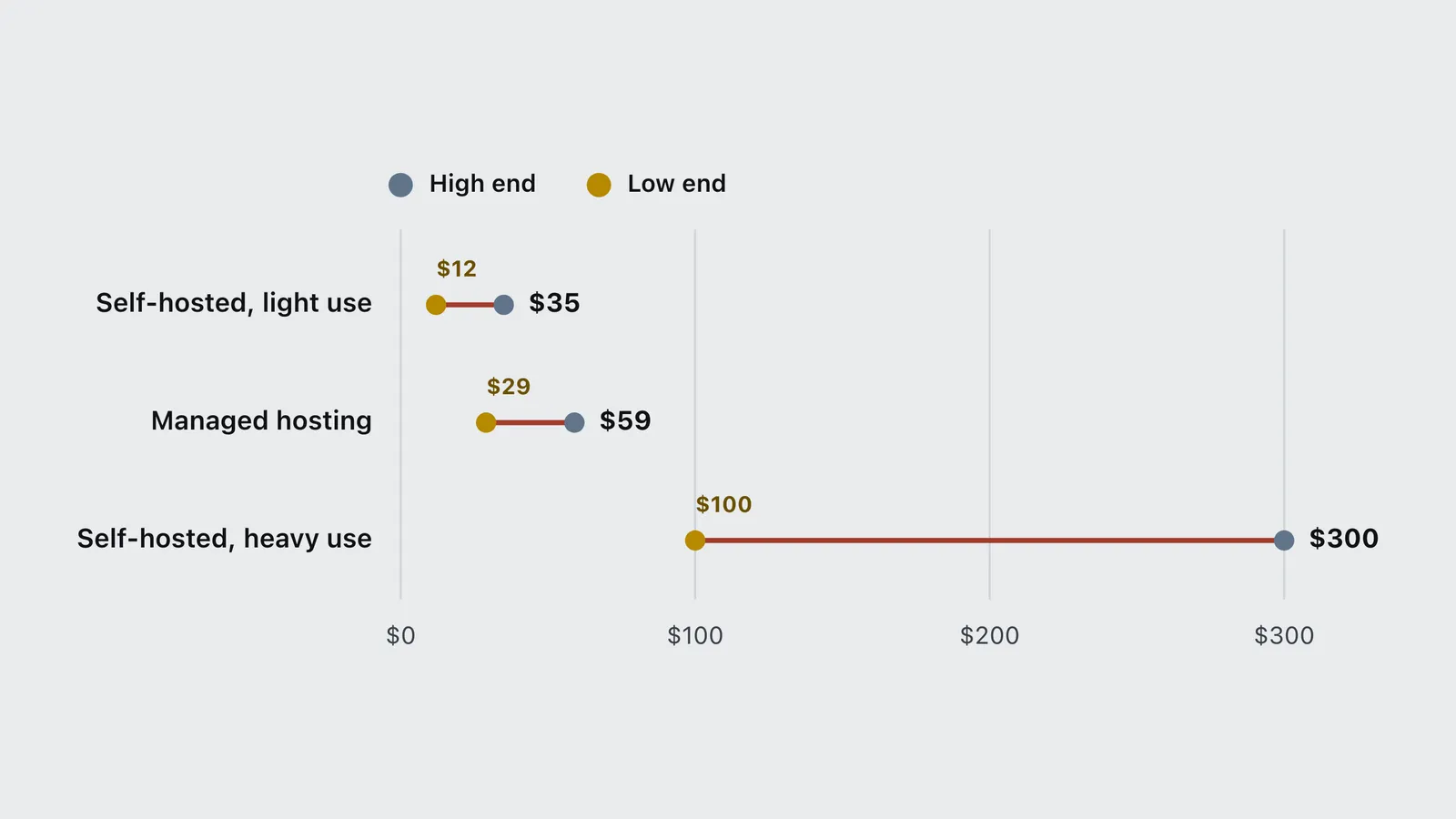
The chart: monthly cash cost by flavor
| Item | High end | Low end |
|---|---|---|
| Self-hosted, light use | $35 | $12 |
| Managed hosting | $59 | $29 |
| Self-hosted, heavy use | $300 | $100 |
How the ranges were built: the light self-hosted band pairs documented $5-24 VPS pricing with Hostinger’s $1-30 personal-use token estimates. Managed hosting uses the actual advertised prices of three independent providers. The heavy band reflects the DEV Community tracked ledger ($187/month average all-in) and Hostinger’s heavy tier. For scale: none of these belong on the same axis as a production deployment, where our companion cost model puts a 100-tasks-per-day workload at $2,700-4,500/month in tokens alone. Volume replaces hobby somewhere between these charts, not within either one.
First-year math: cash versus your hours
Cash understates the self-hosted case. Three independent estimates converge on time being the bigger line:
- The founder-focused comparison at getclaw.sh modeled first-year totals of $900-2,200 cash for OpenClaw against 8-14 hours of setup and maintenance, and $800-2,000 for Hermes at 6-12 hours, valuing founder time at $100/hour (getclaw.sh, March 2026).
- Cloudways’ hosting guide estimates ongoing self-hosting maintenance at 4-10 hours monthly, which it prices at $150-250/month in imputed engineering time (Cloudways, July 2026).
- The DEV Community ledger added a $25/month managed vector database and $15/month monitoring to reach its $187/month total, and concluded the managed alternative at $49/month won once cash was combined with the reported maintenance hours (DEV, August 2026).
These are modeled scenarios with stated assumptions, not benchmarks, consistent with how we build every cost model on this site. Swap in your own hourly rate and usage profile before repeating any of these numbers.
The 2026 state of play
Three developments since January changed the calculus and date this landscape:
The creator left. Peter Steinberger joined OpenAI on February 15, 2026, announced by Sam Altman, with OpenClaw moving to an independent foundation that OpenAI financially supports (TechCrunch; Reuters). Steinberger’s own announcement framed it as changing the world rather than building a company (steipete.me). Foundation governance de-risks single-maintainer abandonment; it does not answer who reviews the next 500 community skills.
Security got expensive to ignore. CVE-2026-25253, published February 1, 2026, scored 8.8 on CVSS 3.1: the Control UI auto-connected to an attacker-supplied WebSocket URL and leaked the stored auth token, enabling one-click remote code execution until version 2026.1.29 patched it (NVD; advisory GHSA-g8p2-7wf7-98mq). Coverage of the disclosure also reports Cisco’s security team demonstrating data exfiltration through a malicious third-party skill, though we could not verify that claim against a Cisco primary source and attribute it as reported. An agent holding your messaging accounts is not a toy threat model; treat skill installation like installing executables, because that is what it is.
The challenger matured. Hermes Agent shipped v0.1.0 on February 25, 2026 and compounded quickly: persistent cross-session memory, self-writing skills shared through the open agentskills.io standard, and a README claiming it runs happily on a $5 VPS (Nous Research documentation). For model choice on the token line, our companion piece covers the best models for Hermes Agent; routing a heartbeat to a budget model instead of an Opus-class one is the difference between a $2/month idle tax and a $72/month one.
Which flavor for which reader
- Tinkerer with cheap time: self-hosted, budget-model routing, hard caps set on day one. $12-35/month.
- Professional whose hours cost more than $25: managed hosting at $39-59 flat, read the plan’s credit terms twice.
- Privacy-first with hardware already owned: hybrid routing, local models for routine traffic, frontier API reserved for hard tasks.
- Rather not host anything: the big-lab agents now start free (Meta Muse) or at $20 a month (Grok Bot through Cursor Pro). Dots vs Muse vs Grok Bot compares them.
- Anyone about to connect real accounts: whichever flavor, start with the sandboxing guides and spend caps before the first channel comes online, not after the first incident.
Frequently asked questions
Frequently asked questions
- Is OpenClaw really free?
- The software is free under the MIT license with no usage fees. Operating it is not free: you pay for a VPS ($5-24/month typical), API tokens ($1-150+/month depending on model and volume), and optionally monitoring. Managed hosting providers charge $29-59/month and may or may not bundle model credits.
- Why is my OpenClaw or Hermes bill higher than expected?
- The usual culprits are the heartbeat polling loop pointed at an expensive model ($2-72/month depending on model alone), conversation history re-sent on every call as sessions grow, retry loops multiplying failed calls silently, and browser tools pulling tens of thousands of tokens into context per action.
- Can I run a personal AI agent entirely for free?
- Close to zero, not zero. Local models via Ollama eliminate token spend but require capable hardware you pay for upfront, and free-tier VPS options rarely survive real 24/7 operation. Budget at least $5-12/month for a serious self-hosted attempt.
- Self-hosted or managed hosting: which is cheaper?
- Light users spending under $35/month all-in usually save money self-hosting, paying with time instead. Once cash costs approach $50-60/month or your time is worth more than $25/hour, managed hosting typically wins the first-year math.
Sources
- OpenClaw Foundation (2026). openclaw/openclaw repository (stars, license, architecture). GitHub. https://github.com/openclaw/openclaw
- NVD (2026). CVE-2026-25253 Detail. National Institute of Standards and Technology. https://nvd.nist.gov/vuln/detail/CVE-2026-25253
- Ha, Anthony (2026). OpenClaw creator Peter Steinberger joins OpenAI. TechCrunch. https://techcrunch.com/2026/02/15/openclaw-creator-peter-steinberger-joins-openai/
- Reuters (2026). OpenClaw founder Steinberger joins OpenAI, open-source bot becomes foundation. https://www.reuters.com/business/openclaw-founder-steinberger-joins-openai-open-source-bot-becomes-foundation-2026-02-15/
- Steinberger, Peter (2026). OpenClaw, OpenAI and the future. steipete.me. https://steipete.me/posts/2026/openclaw
- Nous Research (2026). Hermes Agent documentation and README. https://hermes-agent.nousresearch.com/ and https://github.com/NousResearch/hermes-agent
- Hermes Atlas (2026). NousResearch/hermes-agent directory entry (star count). https://hermesatlas.com/projects/NousResearch/hermes-agent
- Hostinger (2026). OpenClaw costs: What running OpenClaw actually costs (updated August 6, 2026). https://www.hostinger.com/tutorials/openclaw-costs
- Mireille, Helen (2026). How Much Does It Actually Cost to Run an AI Agent 24/7? I Tracked Every Dollar for Three Months. DEV Community. https://dev.to/helen_mireille_47b02db70c/how-much-does-it-actually-cost-to-run-an-ai-agent-247-in-2026-i-tracked-every-dollar-for-three-3k4i
- SFAI Labs (2026). OpenClaw Pricing Breakdown (updated April 22, 2026). https://www.sfailabs.com/guides/openclaw-pricing-breakdown
- getclaw.sh (2026). OpenClaw vs Hermes Agent: Which Open-Source AI Agent Should Founders Bet On? https://getclaw.sh/blog/openclaw-vs-hermes-agent-open-source-ai-agent-comparison
- Cloudways (2026). AI Agent Hosting: Managed vs Self-Hosted (2026 Guide). https://www.cloudways.com/blog/managed-vs-self-hosted-ai-agents/
- Ampere (2026). OpenClaw Token Usage & Cost Control Guide. https://www.ampere.sh/blog/openclaw-token-usage-cost-control
- OpenClaw docs (2026). Token use and costs; Install on Hetzner. https://docs.openclaw.ai/reference/token-use and https://docs.openclaw.ai/install/hetzner