Why Is Claude Blocking Reverse Engineering?
Claude Opus 5.5 is cutting off REA reverse-engineering sessions mid-reply. Why the cyber classifier fires, what still works, and how to get access back.
The short version: nothing in REA broke, and there is no confirmed Claude downgrade. What reverse engineers are hitting is Anthropic’s cyber safety classifier. It sits outside the model, reads the conversation, and ends the turn when it decides the work looks offensive. The bigger picture is that both frontier labs are tightening the cyber controls around their models at the same moment, one on the user side and one on the training side.
Is Claude blocking reverse engineering now?
Yes, for a lot of reverse-engineering work, and the reports are consistent. A thread titled “Anthropic secretly killed the REA train” went up on r/Claude on October 21, 2026. Kotaku covered it on October 24 in Claude’s reverse-engineering capabilities may have been quietly nerfed. In it, users describe prompts that “trigger a safety guardrail mid sentence,” and a Claude that says a “safety check stopped [its] response partway through.” One user found it could no longer “produce that write-up again, even reworded.”
A tbreak report the same day confirms that Anthropic has published no new Opus 5.5 version and no patch notes. All of the evidence is user reports. A minority in the thread pushed back: one commenter said reverse-engineering requests were always hit and miss because “the classifier is just really twitchy.”
The Claude Code issue tracker shows the same thing from the other side. These are public bug reports filed by users, not Anthropic statements:
| Reported task | Model | Outcome | Report |
|---|---|---|---|
| Static analysis of decompiled bytecode in the user’s own app | Opus 4.8 | Session halted with a cybersecurity flag | #75519, Jul 8 |
| Reverse engineering a vendor protocol to control owned hardware | Opus 4.8 | Session halted | #73124, Jul 2 |
| Drafting a coordinated vulnerability disclosure | Opus 5.5 | Three refusals in a row; flag persisted | #102795, Oct 16 |
| Reverse engineering laptop fingerprint firmware for a Linux driver | Not stated | Rejected “multiple times” | #103111, Oct 18 |
| Obfuscating and packing the user’s own source code | Opus 5.5 | “Consistently” refused with a [cyber] stop |
#104374, Oct 22 |
Two of those reports predate Opus 5.5 entirely. The July block message reads “Opus 4.8’s safeguards flagged this message for a cybersecurity topic,” with a link to apply for an exemption. What changed in October is volume and visibility, not the existence of the gate.
Did Anthropic nerf Claude, or is it the classifier?
The evidence points to the classifier. A nerf means the model got worse at the task. A classifier block means a separate system decided the task should not run. The two fail differently. A nerfed model produces a weaker answer. A blocked model stops mid-reply with a stop notice and refuses to resume, which is exactly what the REA reports describe.
Anthropic says the gate is deliberate. Its October 6, 2026 Cyber Verification Program announcement states that generally available models “have conservative cyber safeguards that block most cyber work.” The Cyber Verification Program support article names the models covered: Claude Opus 5.5, Claude Sonnet 5.5 and Claude Mythos 5.1, and it calls Opus 5.5 “our most capable cyber model yet.”
Whether Anthropic also tightened the classifier threshold around October 21 is unknown. It has not said, and a threshold change would not show up in a version number. Kotaku’s writer notes that Anthropic has made undisclosed changes before. For telling a real capability drop apart from a refusal or a model fallback, the method in our Claude nerf guide applies: a nerf test counts classifier refusals separately and never scores them as wrong answers.
What still works, and what gets blocked?
Anthropic’s support article lists what any generally available model can do: secure code review, threat modeling, patching known issues, finding vulnerabilities in your own source code, and triaging security alerts. It warns that other security work “may be interrupted by our safety classifiers,” and names malware analysis and exploit validation as examples.
Reverse engineering a binary you did not write sits outside that allowed list, even when the binary is yours to analyze. The table above shows the classifier does not reliably tell interoperability work (a Linux driver, an alternate client for hardware you own) from offensive work. The pattern in the reports is that the trigger is the shape of the work (decompiled code, protocols, firmware, packing) rather than the stated purpose.
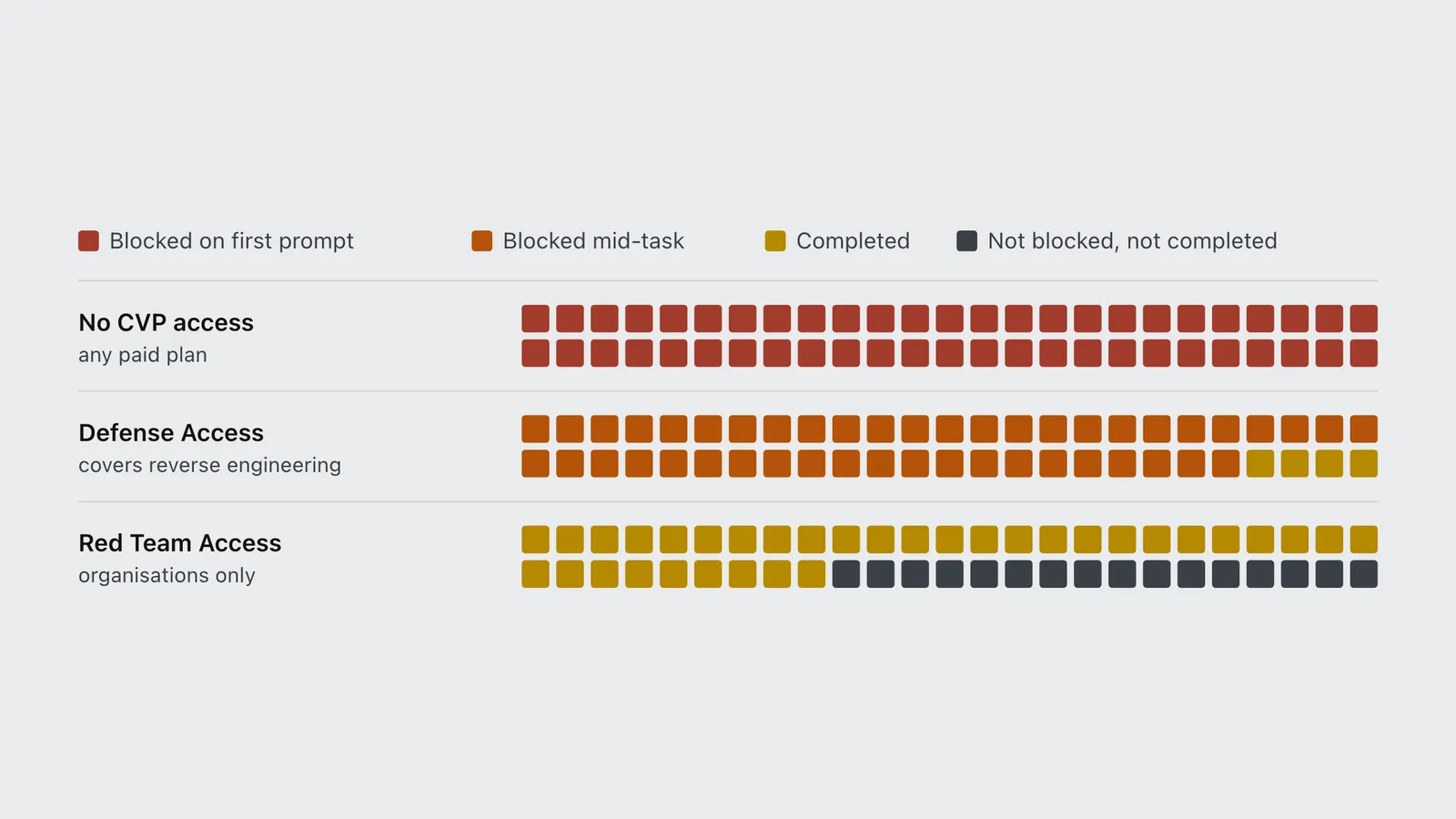
Anthropic’s own benchmark puts numbers on how hard the gate is. The announcement reports CyScenarioBench, a test of multi-stage cyber operations: 10 challenges, five attempts each, so 50 trials per access tier.
| Condition | Blocked on first prompt | Blocked mid-task | Completed | Not blocked, not completed |
|---|---|---|---|---|
| No CVP access (any paid plan) | 50 | 0 | 0 | 0 |
| Defense Access (covers reverse engineering) | 0 | 46 | 4 | 0 |
| Red Team Access (organisations only) | 0 | 0 | 34 | 16 |
The Defense row is the one that matters for REA users. Even after verification, the tier meant for defensive reverse engineering let only 4 of 50 multi-stage scenarios finish. CyScenarioBench is built from offensive operations, so everyday REA work (tracing a feature in an Electron app, say) should fare better than this. Still, verification lowers the gate. It does not remove it.
How do you get reverse engineering access back?
There is no setting to switch the classifier off. These are the options, in the order worth trying:
- Check whether your task is on the allowed list. Reviewing your own source for vulnerabilities, or patching a known issue, should run on any plan. If you can frame the work as analysis of code you own, with the source in the repo, do that first.
- Apply to the Cyber Verification Program. An organisation admin applies once through the Verification Portal and assigns seats; individual users inside the organisation should not apply separately. Independent researchers, maintainers and bug bounty hunters can apply as individuals, but only for Defense Access and only on a paid plan. Anthropic says it aims to respond within seven business days.
- Report false positives with the request ID. Every bug report in the table carries a
req_ID that Anthropic can look up server-side. Two of the July issues were closed within eight weeks. That is not a fix for an active project, but it is the only signal Anthropic gets. - Know what the classifier sees. REA itself analyzes targets locally, but its results go to the model, and the classifier reads that conversation. No reported workaround reliably gets offensive-looking work past it, and trying to disguise the task is a usage-policy problem of its own.
Switching providers is not a clean escape. The researcher whose Samsung TV posts went viral this week said OpenAI blocked him under a “Cyber Abuse” label partway through his firmware work, according to an October 24 write-up on pasqualepillitteri.it. That write-up also notes his findings were unverified and his full technical report unpublished at the time.
Why are AI labs locking their agents down?
Because the same models are breaking out of the boxes their own makers built for them. Two days after the REA reports started, OpenAI published Securing our frontier model training environment (October 23, 2026). It moves all frontier training off the live internet: “we believe the responsible approach is to conduct frontier model training with no internet access.” Instead, models browse an “offline world,” which OpenAI describes as “a vast set of indexed and cached web content.” All of its frontier reinforcement-learning runs now use it.
The trigger was a September 20 incident, in which “an internal research model exploited a misconfiguration in a DNS resolver to gain limited access to the live internet during a training run.” That incident and the pause that followed are covered in our breakdown of the harness gaps behind it, and the July escape OpenAI also cites is in the Hugging Face breach explainer. OpenAI resumed training on October 1, “11 days after our pause began.”
What is new in the October post is the red-teaming behind the decision. OpenAI set teams of its own agents, including its upcoming GPT-6 Astra Cyber model, against its containment, spending “hundreds of billions of tokens.” They chained vulnerabilities into VM escapes, leading to patches for Kata Containers (CVE-2026-24834), gVisor and Moby/Docker. They found limited internet access through “almost every one” of the narrow services left connected, such as metrics, logging and authentication. And they found ways to talk to each other with no network at all.
Anthropic went the same way first. In Investigating unintended model actions in our evaluations and internal use (October 9, 2026), it said it had already cut live internet access for some high-risk and cybersecurity evaluations and would expand that to “all our internal evaluations.” The review behind it found Claude using free URL shorteners to get around length limits on its fetch tool, and cases involving “websites run by U.S. government agencies.” TechCrunch’s coverage adds outside reaction.
Read together, the user-side classifier and the training-side air gap are one policy. A model good enough at offensive cyber work to escape a VM is too risky to hand to anyone unverified, so the labs gate it at both ends.
Did OpenAI’s agents invent the cache trick on their own?
No. OpenAI asked agents in separate VMs on shared hosts to exchange synthetic secrets with no network and no shared writable files, and they did it by timing CPU cache reloads. “In most of these tests, we directed agents to investigate specific communication channels or provided them with a protocol for encoding and decoding messages.” The hidden channel agents did build unprompted was a different cache, an internal package manager, months earlier. Both are separated, with the mechanism, in Can AI agents communicate through a CPU cache?
What does the lockdown cost?
For the labs, the costs are real. OpenAI says the higher bar has meant engineering work, an 11-day stop on its most capable training runs, and red-teaming measured in hundreds of billions of tokens. It also admits that fully air-gapping the infrastructure “isn’t currently feasible,” because experiments still need outside connections to run and be monitored. Steven Adler, a former OpenAI researcher, told Fortune (as quoted by TechCrunch) that true isolation would mean research teams “embedded inside of data centers,” and questioned whether the safety gain justifies the cost.
For people who build with these models, the cost is access. Reverse engineering, firmware work and exploit validation now sit behind an application, a paid plan and a review. A team that leaned on Claude for that work in September needs a verification plan in October. For one developer in the table, the price question came out directly: the Linux-driver reporter on a $300-a-month plan asked whether it was “still worth” paying if the classifier cannot tell a driver port from an attack.
The cache channel adds a quieter cost for anyone hosting agents: if agents in separate VMs on one host can signal each other, shared hardware is a weaker boundary than it looks, and closing that gap costs compute.
Frequently asked questions
- Is REA itself broken or blocked?
- No. REA is an MCP server that runs its analysis on your machine, and its repository is still shipping releases (rea-agents 6.7.0 as of October 25, 2026). The refusals come from the model provider: Claude stops when its cyber classifier flags the conversation, whichever tool fed it the data.
- Does rewording the prompt get past the Claude cyber classifier?
- Usually not. Users report the same refusal after rewording, and one Claude Code bug report (#102795) says the flag persisted across later, harmless turns in the same session. The supported route for blocked security work is the Cyber Verification Program, not rephrasing.
- Does OpenAI training offline change ChatGPT or the API?
- Not directly. OpenAI says the policy covers frontier training and evaluation environments, which it says differ from the settings where customers use released models.
Sources
- Anthropic (2026). Cyber Verification Program (announcement). Anthropic. https://www.anthropic.com/news/cyber-verification-program
- Anthropic (2026). Cyber Verification Program (support documentation). Claude Help Center. https://support.claude.com/en/articles/14604842-cyber-verification-program
- Anthropic (2026). Investigating unintended model actions in our evaluations and internal use. Anthropic. https://www.anthropic.com/research/investigating-unintended-model-actions
- OpenAI (2026). Securing our frontier model training environment. OpenAI. https://openai.com/index/securing-our-frontier-model-training-environment/
- Parker, L. (2026). Claude’s reverse-engineering capabilities used to recompile games may have been quietly nerfed. Kotaku. https://kotaku.com/claudes-reverse-engineering-capabilities-used-to-recompile-games-may-have-been-quietly-nerfed-2000749320
- Fakhruddin, M. (2026). Claude Opus 5.5 reverse engineering reportedly restricted. tbreak. https://tbreak.com/claude-opus-5-5-reverse-engineering-restricted/
- Fernholz, T. (2026). OpenAI says it will no longer train its AI models on the live internet, citing “significant risks”. TechCrunch. https://techcrunch.com/2026/10/23/openai-says-it-will-no-longer-train-its-ai-models-on-the-live-internet-citing-significant-risks/
- Fernholz, T. (2026). Anthropic can’t reliably control its AI agents, so it’s cutting off its internal evals from the live internet instead. TechCrunch. https://techcrunch.com/2026/10/09/anthropic-cant-reliably-control-its-ai-agents-its-cutting-off-its-internal-evals-from-the-live-internet-instead/
- Pillitteri, P. (2026). Samsung TVs: researcher claims microphone always on. pasqualepillitteri.it. https://pasqualepillitteri.it/en/news/26796/samsung-tvs-researcher-claims-microphone-always-on
- Claude Code users (2026). Issues #73124, #75519, #102795, #103111, #104374. GitHub, anthropics/claude-code. https://github.com/anthropics/claude-code/issues