Claude Opus 5.5 vs Sonnet 5: Which Model Should You Use?
Anthropic now starts most workloads on Claude Opus 5.5, at twice the Sonnet 5 token price. Compare cost per task, benchmarks, speed, and when Sonnet wins.
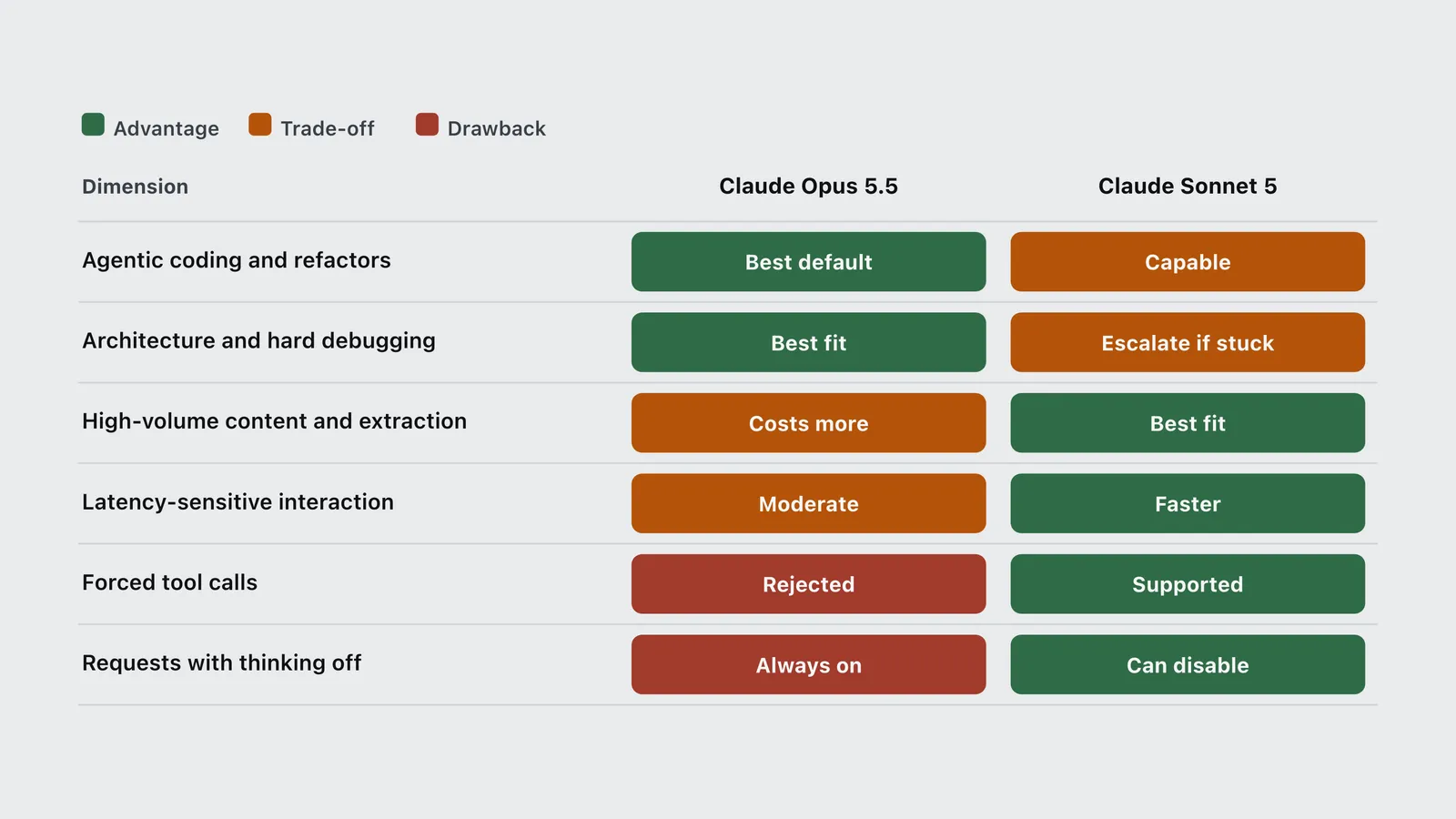
Claude Opus 5.5 is now the better default for most coding and agent work, and Anthropic says so directly: its model-selection guide states that “most workloads start with Claude Opus 5.5.” Claude Sonnet 5 is still the right pick when latency, request volume, or a hard budget matters more than the last increment of capability, and it is the only one of the two that lets you force a tool call or switch thinking off.
That reverses the advice this guide gave in August 2026, when the comparison was Opus 5 against Sonnet 5 and Sonnet was the sensible default. Three things changed on September 22, 2026: Opus 5.5 launched 20% cheaper than Opus 5, the independent capability gap to Sonnet widened, and Claude Code made Opus the default model on every paid plan. The Opus 5 comparison is kept below for anyone still running it.
- $4 / $20
- $2 / $10
- $0.20
- $0.20
- 58
- 38
- $8,708
- $6,998
- 1M tokens
- 1M tokens
- Jun 2026
- Jan 2026
Claude Opus 5.5 vs Sonnet 5 at a glance
| Difference | Claude Opus 5.5 | Claude Sonnet 5 |
|---|---|---|
| Anthropic’s positioning | long-running agentic coding and knowledge work | best combination of speed and intelligence |
| Input / output per Mtok | $4 / $20 | $2 / $10 |
| Cache read per Mtok | $0.20 | $0.20 |
| Batch input / output | $2 / $10 | $1 / $5 |
| AA Index, max effort | 58 | 38 |
| Comparative latency | Moderate | Fast |
| Default effort | medium | high |
| Thinking | adaptive, always on | adaptive, can be disabled |
| Forced tool choice | rejected | supported |
| Context / max output | 1M / 128k tokens | 1M / 128k tokens |
| Reliable knowledge cutoff | June 2026 | January 2026 |
Prices are from Anthropic’s pricing documentation. Positioning, latency, effort defaults, context, and knowledge cutoffs are from Anthropic’s models overview. The API restrictions are from the Opus 5.5 migration guide. Index scores are from the independent Artificial Analysis pages for Opus 5.5 and Sonnet 5. Everything was read on September 26, 2026.
How much more expensive is Opus 5.5 than Sonnet 5?
Per token, exactly twice as much. Opus 5.5 lists $4 per million input tokens and $20 per million output tokens; Sonnet 5 lists $2 and $10. Sonnet’s rate launched as an introductory price, but Anthropic’s pricing page now states that the scheduled rise to $3 / $15 “will not occur,” so $2 / $10 is the standard rate.
The gap narrows once caching is involved. Opus 5.5 bills cache reads at 0.05x its input price rather than the usual 0.1x, which lands at $0.20 per million tokens: the same figure as Sonnet 5. Artificial Analysis blends prices at seven parts cache hit, two parts input, and one part output, which gives $2.94 per million tokens for Opus 5.5 and $1.54 for Sonnet 5. On that cache-heavy mix, Opus costs 1.9x Sonnet rather than 2x.
Per finished task, the gap narrows further. Artificial Analysis reports that its full Intelligence Index run used 260 million output tokens on Opus 5.5 and 370 million on Sonnet 5, so Sonnet produced about 42% more output to complete the same evaluations. The total bill was $8,708 for Opus 5.5 against $6,998 for Sonnet 5. The model with twice the token price cost about 24% more to finish the job, and scored 20 index points higher doing it.
Is Opus 5.5 actually better than Sonnet 5?
On broad measured capability, clearly. At maximum effort, Artificial Analysis scores Opus 5.5 at 58 on its Intelligence Index and Sonnet 5 at 38, a 20-point gap on the rescaled index it now publishes. For Opus 5.5 that is the “adaptive reasoning, max effort, default fallback” variant; Sonnet 5 has a single max-effort entry. The index combines agentic work, terminal coding, science, knowledge, and long-context reasoning, so a gap of this size is hard to explain away as one lucky benchmark.
Anthropic’s own launch figures point the same way but need a different label. The Claude Opus 5.5 announcement reports gains over Opus 5 on eight of its evaluations, from 6% on Humanity’s Last Exam to a doubling on Terminal-Bench-Science. Those are vendor-reported results, not independent reproductions. The full scoreboard, and why the eight numbers disagree by 2x about the same step, is in the Claude Opus 5.5 pricing and benchmarks breakdown.
Speed is where Sonnet keeps an edge. Anthropic’s models overview rates Sonnet 5’s comparative latency as “Fast” and Opus 5.5’s as “Moderate.” Artificial Analysis measures Sonnet 5 at 84.9 output tokens per second at max effort, but it does not yet publish a measured speed for the Opus 5.5 variant, so there is no like-for-like tokens-per-second comparison. For chat, autocomplete-style coding help, and customer-facing flows, the latency difference is the one a user feels.
Which Claude model should you use for each task?
| Dimension | Claude Opus 5.5 | Claude Sonnet 5 |
|---|---|---|
| Agentic coding and refactors | Best default | Capable |
| Architecture and hard debugging | Best fit | Escalate if stuck |
| High-volume content and extraction | Costs more | Best fit |
| Latency-sensitive interaction | Moderate | Faster |
| Forced tool calls | Rejected | Supported |
| Requests with thinking off | Always on | Can disable |
Choose Opus 5.5 for the default lane
Opus 5.5 is the right starting point for multi-file coding, long agent runs, refactors, systems work, and research where a plausible but wrong answer would survive a quick review. Anthropic’s selection matrix lists it for “multihour autonomous coding agents, large-scale refactoring, complex systems engineering, vision-heavy workflows, computer use.” Its default effort is medium, not high, so a request that omits the setting already spends less thinking than Opus 5 did. Step effort up only where your evaluations show it pays.
Choose Sonnet 5 for speed, volume, and API control
Sonnet 5 earns its place where each request is short, well specified, and repeated many times: extraction, classification, summarization, content production, and interactive coding help where response time matters. It is also the practical choice for code that depends on two request shapes Opus 5.5 now rejects. Forcing a specific tool with tool_choice set to any or tool returns a 400 error on Opus 5.5, and so does thinking set to disabled. Sonnet 5 accepts both.
If most of your traffic is bounded work, a split still makes sense: Sonnet for the bulk, Opus 5.5 for the calls that decide something. Anthropic describes that executor-and-advisor pattern in its cost and intelligence guide.
Why Opus 5.5 became the default in Claude Code
If you use Claude Code, you may have seen the notice that Opus 5.5 is now your default model and draws down usage faster than Sonnet 5. The Claude Code changelog for version 2.1.280 records both halves of the change: Opus 5.5 was added as the default Opus model, and the default on Pro and Team Standard plans moved “from Sonnet to Opus, matching Max, Team Premium, and Enterprise.”
Each Opus 5.5 token costs twice as much as a Sonnet 5 token on the API, which is the practical reason the notice warns about faster draw-down. If you run out mid-week, switch to Sonnet 5 with /model for routine implementation and keep Opus for planning, debugging, and review. The same release notes that an effort level saved before /effort became per-model no longer carries over to newly released models, so Opus 5.5 starts at its own default until you pick a level. For a per-session view of what each model is costing you, see the Claude Code cost command explained.
What about Claude Opus 5 vs Sonnet 5?
Opus 5 is now a legacy model, still available, at $5 / $25 per million tokens against Sonnet 5 at $2 / $10, which makes it 2.5x the token price. There is little reason to choose it today: Anthropic’s pricing documentation lists Opus 5.5 lower on every line, and the models overview directs new work to Opus 5.5.
For the record, the August 2026 comparison read Opus 5 at 63 and Sonnet 5 at 55 on the Artificial Analysis Intelligence Index, with Sonnet generating 72.0 output tokens per second against 55.4 for Opus 5. Artificial Analysis has since rescaled the index and delisted Opus 5, so those two scores cannot be compared with the 58 and 38 above. The one lesson from that run still holds: Sonnet used three times the output tokens of Opus 5, and the cheaper model cost more to finish that evaluation ($4,010.51 against $3,836.05). Token price and task price are different numbers.
A routing policy that avoids overspending
- Start agentic and ambiguous work on Opus 5.5 at
mediumeffort. Define the acceptance test before the run. - Start short, repeated, latency-sensitive calls on Sonnet 5. Move them up only when an evaluation fails.
- Move task classes, not all traffic. If Sonnet holds quality on test generation, keep test generation there.
- Record cost per accepted result. Token cost, retries, latency, and human review time belong in the same comparison.
A rate card gives you the minimum cost of a request. It cannot tell you how many requests, tool calls, or review cycles a model needs to reach an acceptable result. The side-by-side model comparison tool covers the rate-card layer, and the AI coding cost calculator lets you plug in your own context, output, and cache mix.
Frequently asked questions
- What is the difference between Claude Sonnet and Opus?
- Opus is the more capable tier and Sonnet is the faster, cheaper one. In September 2026, Claude Opus 5.5 costs $4 and $20 per million input and output tokens and scores 58 on the Artificial Analysis Intelligence Index at max effort. Claude Sonnet 5 costs $2 and $10 and scores 38. Anthropic recommends starting most workloads on Opus 5.5 and using Sonnet 5 for speed-sensitive everyday work.
- Is Claude Opus 5.5 better than Sonnet 5?
- On measured capability, yes: 58 against 38 on the Artificial Analysis Intelligence Index at max effort, read September 26, 2026. Sonnet 5 is faster and half the token price, so it remains the better choice for high-volume, latency-sensitive, or tightly budgeted work.
- How much more expensive is Opus 5.5 than Sonnet 5?
- Twice the token price: $4 and $20 per million input and output tokens against $2 and $10. Cache reads cost the same $0.20 per million on both. On the Artificial Analysis index run, Opus 5.5 cost $8,708 in total against $6,998 for Sonnet 5, about 24% more, because Sonnet used more output tokens.
- Why does Opus 5.5 use my Claude Code usage faster than Sonnet 5?
- Each Opus 5.5 token costs twice as much as a Sonnet 5 token on the API, and Claude Code warns that Opus draws down plan usage faster. Claude Code 2.1.280 made Opus the default on Pro and Team Standard plans. Switch to Sonnet 5 with the /model command for routine implementation to stretch the allowance.
- Should I use Opus 5.5 or Sonnet 5 for Claude Code?
- Use Opus 5.5 for multi-file changes, debugging, refactors, and long agent runs. Use Sonnet 5 for quick edits, test generation, and interactive work where response time matters or your plan allowance is tight.
Bottom line
The best Claude Opus vs Sonnet policy in September 2026 is to start on Opus 5.5 and route down, not the reverse. Opus 5.5 costs twice as much per token but only about a quarter more per completed evaluation, and it carries a 20-point lead on the broadest independent index. Sonnet 5 buys lower latency, half-price tokens, and API behaviors Opus 5.5 no longer accepts.
If the work is agentic, ambiguous, or expensive to redo, choose Opus 5.5. If it is short, repeated, and easy to check, choose Sonnet 5. Then check the decision against cost per accepted task, not against the rate card.
Sources
- Anthropic. (2026). Choosing the right model [official documentation; “most workloads start with Claude Opus 5.5”, selection matrix, effort guidance]. Verified 2026-09-26. platform.claude.com/docs/en/about-claude/models/choosing-a-model
- Anthropic. (2026). Models overview [official documentation; positioning, latency, default effort, context, output limits, knowledge cutoffs]. Verified 2026-09-26. platform.claude.com/docs/en/about-claude/models/overview
- Anthropic. (2026). Pricing [official documentation; standard, cache, batch prices, Sonnet 5 standard-rate note]. Verified 2026-09-26. platform.claude.com/docs/en/about-claude/pricing
- Anthropic. (2026). Migrating to Claude Opus 5.5 [official documentation; rejected tool choice, always-on thinking, medium default effort]. Verified 2026-09-26. platform.claude.com/docs/en/models/opus-5-5/migration-guide
- Anthropic. (2026). Optimizing for cost and intelligence [official documentation; executor and advisor pattern]. Verified 2026-09-26. platform.claude.com/docs/en/about-claude/models/optimizing-for-cost-and-intelligence
- Anthropic. (2026). Claude Opus 5.5 [vendor launch page; release and vendor-reported evaluation claims]. Verified 2026-09-23. anthropic.com/claude-opus-5-5
- Anthropic. (2026). Claude Code changelog, version 2.1.280 [vendor release notes; Opus 5.5 default, Pro and Team Standard default changed to Opus]. Verified 2026-09-26. github.com/anthropics/claude-code/blob/main/CHANGELOG.md
- Artificial Analysis. (2026). Claude Opus 5.5 model analysis [independent; Intelligence Index 58 at max effort, 260M output tokens]. Verified 2026-09-26. artificialanalysis.ai/models/claude-opus-5-5
- Artificial Analysis. (2026). Claude Sonnet 5 model analysis [independent; Intelligence Index 38 at max effort, 84.9 tokens per second, 370M output tokens]. Verified 2026-09-26. artificialanalysis.ai/models/claude-sonnet-5
- Artificial Analysis. (2026). Claude Opus 5.5 vs Claude Sonnet 5 [independent; blended price $2.94 and $1.54, cost to run the index $8,708 and $6,998]. Verified 2026-09-26. artificialanalysis.ai/models/comparisons/claude-opus-5-5-vs-claude-sonnet-5
- Artificial Analysis. (2026). Claude Opus 5 model analysis [independent; August 2026 read: index 63, 55.4 tokens per second, $3,836.05 index cost; since delisted]. Verified 2026-08-09. artificialanalysis.ai/models/claude-opus-5