Claude Sonnet 5.5: Pricing, Benchmarks, Cost
Claude Sonnet 5.5 keeps the $2/$10 Sonnet 5 price. Below max effort it is cheaper per task; at max it costs more than Opus 5.5. The numbers by effort.
Anthropic released Claude Sonnet 5.5 on September 28, 2026, and left the price exactly where Sonnet 5 had it: $2 per million input tokens and $10 per million output. Its pitch is that the bill still falls, by “up to 30% less per task,” because the model needs fewer tokens and fewer tool calls to finish the same work.
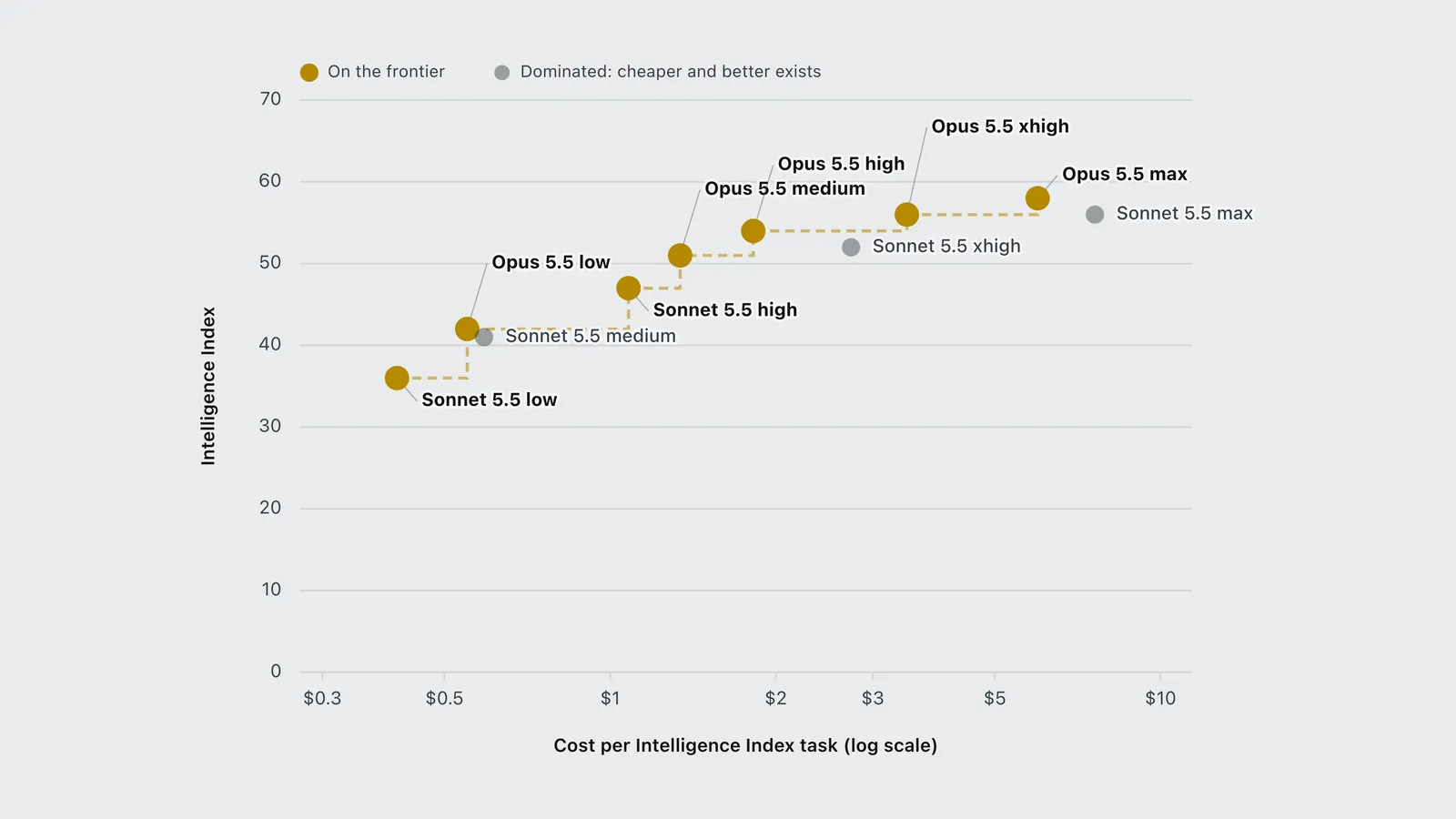
Independent numbers say the claim holds, but only at four of its five effort settings. At the fifth, max, Sonnet 5.5 costs more to run than Opus 5.5, the model it is supposed to be the budget option for. The effort setting you choose matters more than which model you pick.
| Model | Intelligence Index | Cost per index task | On the cost-efficiency frontier |
|---|---|---|---|
| Sonnet 5.5 low | 36 | $0.41 | Yes |
| Sonnet 5.5 medium | 41 | $0.59 | No |
| Sonnet 5.5 high | 47 | $1.08 | Yes |
| Sonnet 5.5 xhigh | 52 | $2.74 | No |
| Sonnet 5.5 max | 56 | $7.60 | No |
| Opus 5.5 low | 42 | $0.55 | Yes |
| Opus 5.5 medium | 51 | $1.34 | Yes |
| Opus 5.5 high | 54 | $1.82 | Yes |
| Opus 5.5 xhigh | 56 | $3.46 | Yes |
| Opus 5.5 max | 58 | $5.98 | Yes |
How much does Claude Sonnet 5.5 cost?
Claude Sonnet 5.5 costs $2 per million input tokens and $10 per million output tokens on the Claude API, with cache reads at $0.20, five-minute cache writes at $2.50 and one-hour writes at $4. Batch requests are half price, at $1 and $5. Every line is identical to Sonnet 5, according to Anthropic’s pricing documentation.
| Rate line (per million tokens) | Sonnet 5.5 | Sonnet 5 | Opus 5.5 |
|---|---|---|---|
| Input | $2 | $2 | $4 |
| Output | $10 | $10 | $20 |
| Cache read | $0.20 | $0.20 | $0.20 |
| Cache write, 5 minutes | $2.50 | $2.50 | $5 |
| Cache write, 1 hour | $4 | $4 | $8 |
| Batch input / output | $1 / $5 | $1 / $5 | $2 / $10 |
Two details on that page matter more than the headline rate. First, Sonnet 5.5 keeps the standard cache multiplier: a cache read costs 0.1x of input. Opus 5.5 got a special 0.05x multiplier, which is why the two models now read cached tokens at the same $0.20 despite a 2x gap on everything else. On a long agent session where most input is served from cache, Opus 5.5’s premium over Sonnet 5.5 is smaller than 2x.
Second, the fixed overhead of tool use dropped. The documentation lists a 286-token tool-use system prompt for Sonnet 5.5 against 354 for Sonnet 5. That is small per call and adds up on an agent that makes hundreds of calls. It is also one concrete mechanism behind the “fewer tokens” half of Anthropic’s pitch.
The usual modifiers apply. US-only inference through the inference_geo parameter bills at 1.1x on every line. The full 1M-token context window is billed at the standard rate, so a 900,000-token prompt costs the same per token as a short one. There is no Fast mode for Sonnet: Anthropic sells that premium tier on Opus only.
Does Sonnet 5.5 really cost 30% less per task?
Mostly yes, and by more than 30% at the settings most people run. Anthropic’s number comes from its own testing, which it does not publish in detail. The independent check is the Artificial Analysis models leaderboard, which runs each model through the same ten-evaluation Intelligence Index at every effort setting and reports the dollars spent per task. Read on September 29, 2026:
| Effort | Sonnet 5 score | Sonnet 5.5 score | Sonnet 5 cost per task | Sonnet 5.5 cost per task | Change in cost |
|---|---|---|---|---|---|
| low | 24 | 36 | $0.51 | $0.41 | −20% |
| medium | 28 | 41 | $1.00 | $0.59 | −41% |
| high | 32 | 47 | $1.79 | $1.08 | −40% |
| xhigh | 34 | 52 | $2.87 | $2.74 | −5% |
| max | 38 | 56 | $5.09 | $7.60 | +49% |
Read the rows one at a time and the pattern is clear. At low, medium and high effort, Sonnet 5.5 is cheaper per task than Sonnet 5 at the same setting, 20% to 41% cheaper, and scores 12 to 15 points higher. That is the claim, confirmed, with room to spare. At xhigh the saving shrinks to 5%. At max it reverses: $7.60 against $5.09, 49% more.
The mechanism is the token count. Artificial Analysis records 410 million output tokens to run the index on Sonnet 5.5 at max, against 370 million for Sonnet 5 at max. Given the room, the new model thinks longer, and the output line, $10 per million, is where a Sonnet bill lives.
The more useful comparison is across rows, not along them. Sonnet 5.5 at medium effort scores 41, above the 38 that Sonnet 5 managed at max, for $0.59 a task against $5.09. That is a higher score for about an eighth of the cost. If you ran Sonnet 5 at max because nothing lower was good enough, the move is not to Sonnet 5.5 at max. It is to Sonnet 5.5 at medium or high.
Sonnet 5.5 against Opus 5.5: where the cheaper model is not cheaper
Opus 5.5 lists at exactly twice the Sonnet 5.5 token price. You would expect Sonnet to be the cheaper way to reach any given score. On the independent index it is only sometimes.
The frontier chart above is the whole argument. Sort the ten effort settings by cost, keep only the points that no cheaper point outscores, and you get seven survivors. Only two are Sonnet 5.5: low and high. Every frontier point above $1.08 a task belongs to Opus 5.5.
- Sonnet 5.5 at max vs Opus 5.5 at xhigh. Both score 56. Sonnet costs $7.60 a task, Opus $3.46. The model with half the token price costs 2.2 times as much to reach the same score, because it takes more tokens to get there.
- Sonnet 5.5 at xhigh vs Opus 5.5 at high. Opus scores 54 for $1.82; Sonnet scores 52 for $2.74. Opus is higher and a third cheaper.
- Sonnet 5.5 at medium vs Opus 5.5 at low. Opus scores 42 for $0.55; Sonnet scores 41 for $0.59. Close, but Opus wins both columns.
- Sonnet 5.5 at high. 47 for $1.08, and nothing cheaper scores higher. This is the setting where Sonnet 5.5 earns its place.
Why does the cheaper model use so much more? Artificial Analysis measures Opus 5.5 at 260 million output tokens across the index at max effort, against Sonnet 5.5’s 410 million. A smaller model reaching the same answer by reasoning for longer is a familiar pattern, and here the extra length outweighs a 2x price gap.
That does not make Opus 5.5 the right default for everything. It generated 95.2 output tokens per second at max on Artificial Analysis’s measurement, against 141.9 for Sonnet 5.5, so Sonnet is about 50% faster to finish writing an answer. For interactive work, where a person is waiting, that is worth paying for. For a background agent billing by the task, it usually is not. The trade-offs between the two tiers are set out in Claude Opus 5.5 vs Sonnet 5, and the Opus side of the effort dial is in Claude Opus 5.5 pricing and benchmarks.
Is Sonnet 5.5 faster than Sonnet 5?
Yes, substantially. Anthropic says Sonnet 5.5 “generates outputs 30%+ faster than Sonnet 5” and calls it its fastest Sonnet. Artificial Analysis measures 141.9 output tokens per second at max effort against 81.3 for Sonnet 5 at max, which is about 75% faster, more than the vendor claims. Throughput varies by provider and time of day, so read it as a snapshot rather than a guarantee.
What do the benchmarks show?
Anthropic published a scorecard against Sonnet 5, Opus 5.5 and GPT-6 Sol. Every figure below is Anthropic reporting on Anthropic’s model, under settings it chose, and none has been reproduced independently in this post.
| Item | Sonnet 5.5 | Sonnet 5 |
|---|---|---|
| Terminal-Bench 4.0 | 70.6% | 10.3% |
| Chartography | 61.6% | 15.6% |
| CursorBench 4.0 | 55.5% | 34.1% |
| OSWorld 2.1 | 80.1% | 57% |
| Humanity's Last Exam | 64.5% | 54.9% |
| FrontierCode 1.1 | 46.2% | 42.4% |
| Benchmark (vendor-reported) | Sonnet 5.5 | Sonnet 5 | Opus 5.5 | GPT-6 Sol |
|---|---|---|---|---|
| Terminal-Bench 4.0 | 70.6% | 10.3% | 66.4% | not given |
| FrontierCode 1.1 Main | 46.2% | 42.4% | 54.4% | 49.3% |
| CursorBench 4.0 | 55.5% | 34.1% | 57.8% | not given |
| GDPval-AA v2.1 (Elo) | 1844 | 1449 | 1846 | 1487 |
| AA-Briefcase v1.1 (Elo) | 1811 | 1359 | 1822 | 1483 |
| Humanity’s Last Exam, tools | 64.5% | 54.9% | 67.7% | not given |
| OSWorld 2.1, partial credit | 80.1% | 57.0% | 81.8% | not given |
| Chartography, no tools | 61.6% | 15.6% | 64.4% | 53.6% |
The Terminal-Bench row is the headline, and it needs context. Sonnet 5’s 10.3% is not a typo. On the independent Terminal-Bench 4.0 board, Sonnet 5 at max inside Claude Code solved 41 of 330 trials, 12.42%, and burned 21.6 billion tokens doing it, the largest bill on the board. That run is worked through in Terminal-Bench 4.0 explained. A model that looped until it hit timeouts is exactly the model that “fewer tokens and tool calls” would fix. Until the 70.6% reproduces on the independent board, it is a vendor number.
Two rows cut the other way. On FrontierCode 1.1, Anthropic’s own table has Sonnet 5.5 at 46.2%, below GPT-6 Sol’s 49.3%, and Sol lists at the same $2 and $10. And outside FrontierCode, where it trails by 8 points, Sonnet 5.5 lands within about three points of Opus 5.5 on every percentage row, which is either a strong result for Sonnet or a sign that Opus 5.5 at the settings Anthropic tested is not far ahead. It even edges out Opus on Terminal-Bench, 70.6% to 66.4%.
Sonnet 5.5 against GPT-6 Sol: the same rate card
OpenAI’s GPT-6 Sol, released September 22, lists at $2 input and $10 output per million tokens, the same as Sonnet 5.5, with the same $0.20 cache read. On Artificial Analysis’s index, Sol at max effort scores 48 for $1.06 a task and uses 77 million output tokens to run the whole index.
Sonnet 5.5 at high effort scores 47 for $1.08. Those two points are, for practical purposes, the same point: the two labs have converged on one price and roughly one capability at that price. Where they differ is headroom. Sol’s max is 48. Sonnet 5.5 keeps climbing to 52 at xhigh and 56 at max, for 2.6 and 7.2 times the money. If your work needs an index score in the low 50s from a $2/$10 model, only Sonnet goes there, and you pay for it in tokens.
Cybersecurity requests fall back to Sonnet 5
Sonnet 5.5 is the first Sonnet to ship with the cyber safeguards Anthropic uses on Opus 5.5. In Anthropic’s words, “higher-risk cybersecurity tasks will visibly fall back to Sonnet 5,” while routine bug-finding and fixing in your own code is unaffected. That is why Artificial Analysis labels every Sonnet 5.5 row “with fallback.”
For most teams this changes nothing. For security tooling it changes the model: a pentest or exploit-analysis workflow built on Sonnet 5.5 will be served, in part, by the older and weaker Sonnet 5. Test your security prompts specifically before switching a pipeline over, and budget them at Sonnet 5 behaviour.
Where can you use Claude Sonnet 5.5?
Sonnet 5.5 is available in the Claude apps on web, iOS and Android, and through the API as claude-sonnet-5-5. It is also on Amazon Web Services, Google Cloud and Microsoft Foundry, per Anthropic’s Sonnet page. Sonnet 5 remains on the API, and the launch announcement gives no retirement date for it. Bedrock and Google Cloud price independently, and regional endpoints there carry a 10% premium over global ones.
Should you switch to Sonnet 5.5?
If you are on Sonnet 5, yes, and lower the effort setting when you do. At the same rate card, the new model beats the old one at every effort level on the independent index. At four of those five levels it is also cheaper per task. The one trap is carrying a max-effort setting over unchanged, which raises your bill by about half.
- Coming from Sonnet 5 at max: try Sonnet 5.5 at high first. It scored 47 against Sonnet 5’s 38, for $1.08 a task against $5.09.
- Coming from Sonnet 5 at low or medium: switch at the same setting. It is a 20% to 41% saving with a 12 to 13 point gain.
- Tempted by Sonnet 5.5 at xhigh or max: price Opus 5.5 at high or xhigh first. On the independent index it reaches the same score for less.
- Running security tooling: test the fallback before you migrate.
To turn the per-token rate into a monthly figure for your own task sizes, use the AI coding cost calculator. The modeled cost of every tracked model on the same job is in coding agent cost per task, and current rates for all of them are in the AI model tracker. Everything else Anthropic, OpenAI, Google and Meta shipped this month is in new AI models released in September 2026.
Frequently asked questions
- When was Claude Sonnet 5.5 released?
- Anthropic released Claude Sonnet 5.5 on September 28, 2026, as the second model in the Claude 5.5 family after Claude Opus 5.5 on September 22. The API model ID is claude-sonnet-5-5.
- Is Claude Sonnet 5.5 more expensive than Sonnet 5?
- Not per token. Both list at $2 per million input tokens and $10 per million output, with a $0.20 cache read. Per task it depends on effort: on the Artificial Analysis index Sonnet 5.5 is 20 to 41 percent cheaper than Sonnet 5 at low, medium and high effort, 5 percent cheaper at xhigh, and 49 percent more expensive at max.
- Is Claude Sonnet 5.5 cheaper than Claude Opus 5.5?
- Per token, yes: half the price. Per finished task, only at low and high effort. On the Artificial Analysis index, Sonnet 5.5 at max scores 56 for $7.60 a task, while Opus 5.5 at xhigh scores the same 56 for $3.46.
- What is the Claude Sonnet 5.5 context window?
- One million tokens, billed at the standard per-token rate across the whole window, so a very long prompt costs the same per token as a short one.
- Why do some Claude Sonnet 5.5 requests use Sonnet 5?
- Sonnet 5.5 ships with Opus 5.5-class cybersecurity safeguards. Higher-risk security tasks visibly fall back to Sonnet 5; routine bug fixing in your own code does not.
Sources
Anthropic (2026). Introducing Claude Sonnet 5.5. Anthropic announcement, including the vendor-reported benchmark table, the cost and speed claims and the cybersecurity fallback. https://www.anthropic.com/claude-sonnet-5-5 Verified 2026-09-29.
Anthropic (2026). Pricing. Claude Platform documentation: model rates, cache multipliers, batch rates, data residency, long context and tool-use system prompt token counts. https://platform.claude.com/docs/en/about-claude/pricing Verified 2026-09-29.
Anthropic (2026). Claude Sonnet. Anthropic product page: release date, context window, model ID and platforms. https://www.anthropic.com/claude/sonnet Verified 2026-09-29.
Artificial Analysis (2026). Models leaderboard. Independent benchmarking service, Intelligence Index v4.3.2 score and cost per task for every effort setting of Claude Sonnet 5.5, Claude Sonnet 5 and Claude Opus 5.5. https://artificialanalysis.ai/leaderboards/models Read 2026-09-29.
Artificial Analysis (2026). Claude Sonnet 5.5, Claude Sonnet 5, Claude Opus 5.5 and GPT-6 Sol model pages. Output tokens to run the index, output speed and blended price. https://artificialanalysis.ai/models/claude-sonnet-5-5 Read 2026-09-29.
Terminal-Bench (2026). Terminal-Bench 4.0 leaderboard. Independent agentic terminal benchmark; the Sonnet 5 result is as recorded in this site’s Terminal-Bench 4.0 post. https://www.tbench.ai/leaderboard/terminal-bench/4.0