Is Anthropic's Internal Claude Use Worth Its Payroll?
Anthropic's S-1 says internal Claude use, priced at list rates, passed its cash payroll in April 2026. That is about $186M a month, and list price is not cost.
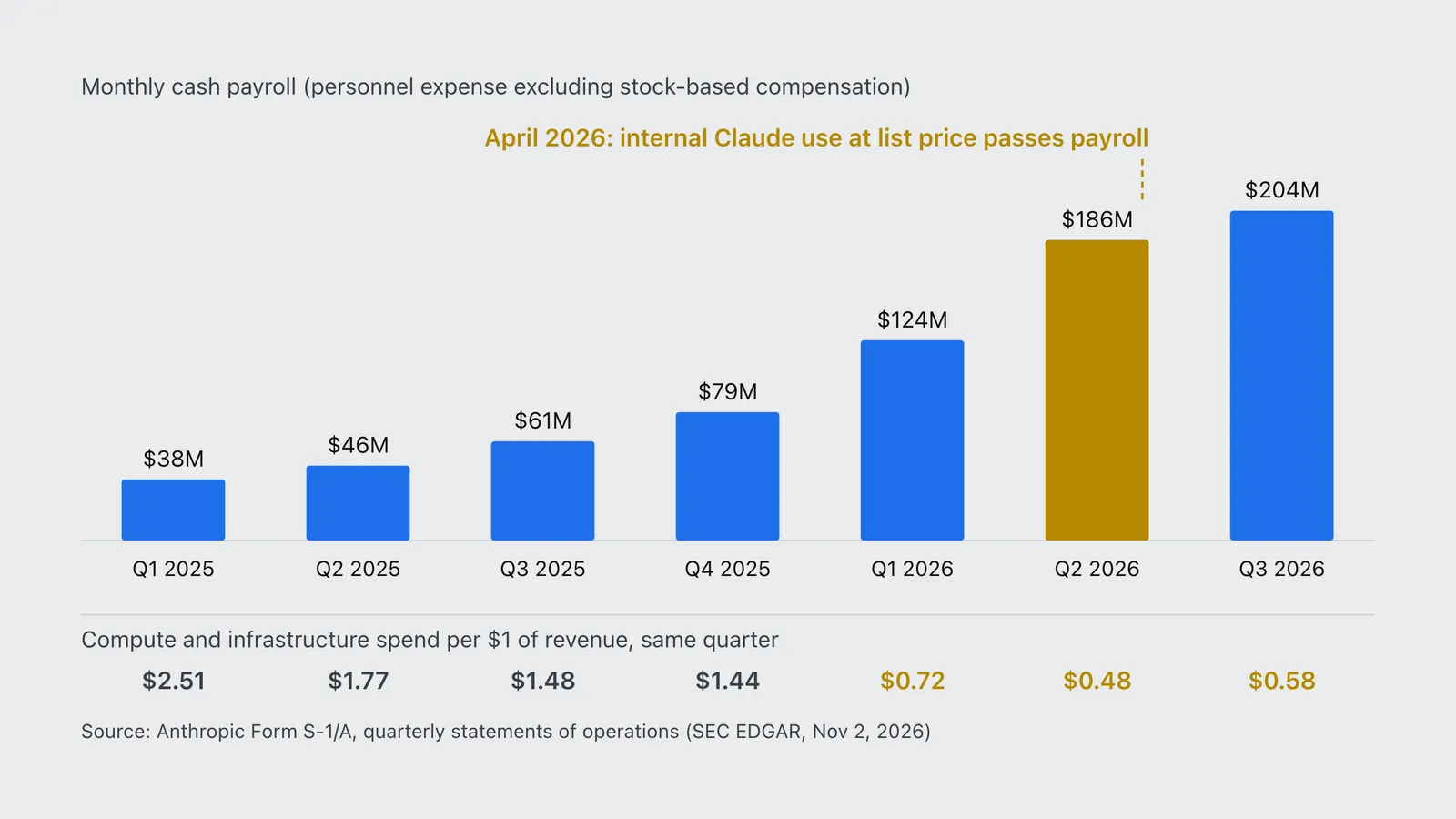
Yes, on Anthropic’s own measure: its IPO filing says internal Claude use, priced at list rates, first exceeded monthly cash payroll in April 2026. That bar was about $186 million a month. List price is what customers pay, though, not what the tokens cost Anthropic.
The disclosure sits in the business section of Anthropic’s Form S-1/A, filed with the SEC on November 2, 2026, and repeats language from the original S-1 of October 26. The coverage repeats the headline accurately. What it leaves out is the size of the number and what that usage cost Anthropic to run.
What exactly did Anthropic disclose?
Two sentences carry the whole story. In the S-1/A, Anthropic writes that “the value of our own internal Claude usage at list prices has grown by over 250 times from January 2026 to September 2026, and in April 2026, this monthly value first exceeded our monthly personnel expense, excluding stock-based compensation.”
The same filing adds two usage figures under a heading called “Internal Usage of Claude.” Over 90% of contributions to Anthropic’s codebase in September 2026 were written by Claude. The average daily volume of code contributed per engineer in the three months to September 30, 2026 was over 45 times the 2024 average.
Three things are missing, and they matter more than the headline:
- No dollar figure. The filing compares internal usage to payroll but never states either monthly number.
- No cost figure. Anthropic says it manages compute “as a single, fungible pool” across research, model development, serving customers and internal usage, so internal use has no separate cost line.
- No audit. These are management metrics in the business section, not audited financial statements.
How big is “more than payroll” in dollars?
The comparator can be rebuilt from the filing. The quarterly statements of operations give personnel expense each quarter, and a footnote gives the stock-based compensation inside it. Subtract one from the other and divide by three, and you get monthly cash payroll: salaries, bonuses, benefits and payroll taxes.
| Quarter | Monthly cash payroll ($M) | Compute per $1 of revenue |
|---|---|---|
| Q1 2025 | $38M | $2.51 |
| Q2 2025 | $46M | $1.77 |
| Q3 2025 | $61M | $1.48 |
| Q4 2025 | $79M | $1.44 |
| Q1 2026 | $124M | $0.72 |
| Q2 2026 | $186M | $0.48 |
| Q3 2026 | $204M | $0.58 |
Q2 2026 personnel expense was $1,857 million, of which about $1.3 billion was stock-based compensation. That leaves roughly $557 million of cash payroll for the quarter, or about $186 million a month. In Q3 it was $1,711 million less about $1.1 billion, roughly $204 million a month. (The stock figures are rounded in the filing, so treat both as approximate.)
So from April onward, Anthropic’s staff consumed more than about $186 million a month of Claude at the prices outside customers pay. Annualized, that is more than $2.2 billion of list-price usage. For scale, Anthropic’s total revenue in Q2 2026 was $11.6 billion, about $3.9 billion a month.
The 250-fold growth figure then implies January’s internal usage was a small fraction of that. The filing does not break down what drove the climb. It does note, about customers, that agentic sessions “consume significantly more compute per user interaction than single-turn API calls or chat-based interactions,” and agentic coding is exactly what the 90% codebase figure describes.
How does valuing usage at list price work?
List price is the rate card: what a customer is charged per million input and output tokens. Valuing internal use at list price means counting every token Anthropic’s employees and internal agents consume and multiplying by that rate card, as if Anthropic had bought them from itself.
That answers one question well: what would this work cost a company that is not Anthropic? An outside firm whose engineers ran the same agents would pay list price, or a negotiated discount from it. It answers a different question badly: what did it cost Anthropic? The rate card includes Anthropic’s margin, and internal use can run on spare capacity that would otherwise sit idle.
The filing gives one way to bound the gap. In Q2 2026, Anthropic spent 48 cents on compute and infrastructure for every dollar of revenue, and 58 cents in Q3. That compute line also pays for training and research, so serving a list-price dollar of tokens cost less than that. If internal usage cost what the average revenue dollar cost to make, $186 million of list-price usage was under $90 million of compute. That is an illustration, not a disclosed number.
Does this mean Claude replaced Anthropic staff?
No. The filing makes a leverage claim, not a replacement claim. Cash payroll rose from about $124 million a month in Q1 2026 to about $204 million in Q3, so Anthropic was still hiring as internal usage passed it. The S-1 frames the point as “enabling a comparatively small team to take on work that would traditionally require a far larger one.”
What it does show is the ratio a frontier lab now runs at: more than a dollar of list-price AI per dollar of cash wages, and rising. The filing also flags the risk in that loop. Using Claude to help build the next Claude “could also pose a considerable safety risk,” it says, under what it calls “recursive self-improvement,” and misaligned behavior in internal use “could undermine that work.”
Why is this number in an IPO filing at all?
It is a sales argument. Anthropic sells tokens, mostly metered per use, as covered in how Anthropic makes money. A company whose own staff spend more on its product than on salaries is telling investors where it expects enterprise budgets to move: from headcount toward tokens.
It also sits next to the compute bill. Anthropic reports $18.8 billion of compute and infrastructure spend in the first nine months of 2026 and large multi-year commitments ahead, covered in what Anthropic spends on compute. Internal usage draws on that same pool, so every internal token is one not sold to a customer. Anthropic’s bet, stated in the filing, is that internal use “compounds these gains.” Whether it does is now measurable: METR’s assessment of AI speeding up AI research at Anthropic finds the pace of model improvement roughly doubled.
What should a company budgeting AI against headcount take from this?
Anthropic is an outlier: it pays cost, not list, for its own model. A team copying the ratio pays the full rate card. Practical steps:
- Measure usage at the price you pay. Pull a month of API or seat billing per team, and set it next to that team’s cash payroll. Claude Code users can start with the
/costcommand. - Price per task, not per seat. Agentic sessions burn far more tokens than chat. The Claude Code cost-per-task breakdown shows how wide that range runs.
- Set a spend cap before you scale. The ratio Anthropic reports would be reckless at list price without a budget limit per person or per project.
- Track output, not spend. Anthropic pairs its spend figure with code volume per engineer. Spending more is only a result if output rises with it.
Frequently asked questions
Frequently asked questions
- Does Anthropic's internal AI use really exceed its employee pay?
- Yes, on two conditions. Anthropic's Form S-1 says the monthly value of its internal Claude use, priced at list rates, first exceeded its monthly personnel expense excluding stock-based compensation in April 2026. Valued at its real compute cost, or against total pay including stock, the comparison would look very different.
- How much does Anthropic spend on internal Claude use?
- The filing does not say. Derived from its quarterly statements, the payroll bar it passed was about $186 million a month in Q2 2026 and about $204 million in Q3, so internal use at list price exceeded those amounts. Its actual compute cost is not disclosed because Anthropic runs one shared compute pool.
- How fast did internal Claude use grow at Anthropic?
- More than 250 times from January 2026 to September 2026, measured at list prices, according to the S-1/A filed November 2, 2026. Over 90% of codebase contributions in September 2026 were written by Claude.
- Did Claude replace Anthropic employees?
- No evidence of that in the filing. Cash payroll rose from about $124 million a month in Q1 2026 to about $204 million in Q3 2026 while internal usage grew. Anthropic presents it as more output per person.
- Where is this in the Anthropic S-1?
- In the business section of the Form S-1 filed October 26, 2026 and the S-1/A filed November 2, 2026, alongside a subsection titled Internal Usage of Claude. Both are on SEC EDGAR under CIK 0002130357.
Sources
- Anthropic, PBC (2026). Form S-1/A Registration Statement. U.S. Securities and Exchange Commission, filed November 2, 2026. https://www.sec.gov/Archives/edgar/data/2130357/000162828026068676/anthropicpbc-sx1ax1.htm
- Anthropic, PBC (2026). Form S-1 Registration Statement. U.S. Securities and Exchange Commission, filed October 26, 2026. https://www.sec.gov/Archives/edgar/data/0002130357/000162828026067168/anthropicpbc-sx1.htm