Claude Ship Explained in Plain English, With Examples
Claude Ship is three agents that review, fix and approve GitHub pull requests. Plain-English examples, setup steps, and how its token billing works.
Claude Ship is three Claude agents that look after a GitHub pull request once you open it: one reviews the code, one fixes what breaks, and one checks the change against your team’s approval rules. You still decide what merges.
Anthropic launched it on 23 November 2026 for Claude Team and Enterprise organizations. The reviewer is generally available; the fixer and the approver are in beta. It is billed by the tokens it uses, on top of your plan, and Anthropic’s own warning is the right frame: it “may miss bugs, security vulnerabilities, or other issues.”
What is Claude Ship, in plain English?
Think of the work that happens after a developer says “my change is ready.” Someone reads the code and points out problems. Someone fixes the problems, and the broken tests, and the conflicts with other people’s changes. Then someone with authority says “yes, this can go in.” Claude Ship hands each of those three jobs to an agent.
Three terms make the rest of this page easier:
- Pull request (PR): a proposed change to a codebase on GitHub, waiting to be reviewed and merged.
- Checks (CI): the automatic tests and linters that run on every PR and show a green tick or a red cross.
- Branch protection: GitHub’s rules for what a PR needs before it can merge, such as “one approval and all checks green.”
Claude Ship plugs into those three things. It does not replace GitHub’s rules; it adds agents that work inside them.
What does each agent actually do?
Anthropic’s Claude Ship documentation describes the three agents this way:
- Code Review reads a change alongside the code around it and posts findings as inline comments on the lines concerned, ranked by severity. Teams pick a Quick, Standard or Deep review per repository.
- PR Steward works on failing checks, merge conflicts, and review comments from people and from review bots such as Code Review. It pushes commits with its fixes, and after each push it comments with what it changed and how to undo it. It is “designed not to approve or merge pull requests.” Type
@claude stopand it steps back. - Claude Approvals is a check that reports who still has to approve. You write its rules in a file in the repository,
.claude/approvals.yml. It can block a merge only if you make it a required check in GitHub.
A worked example
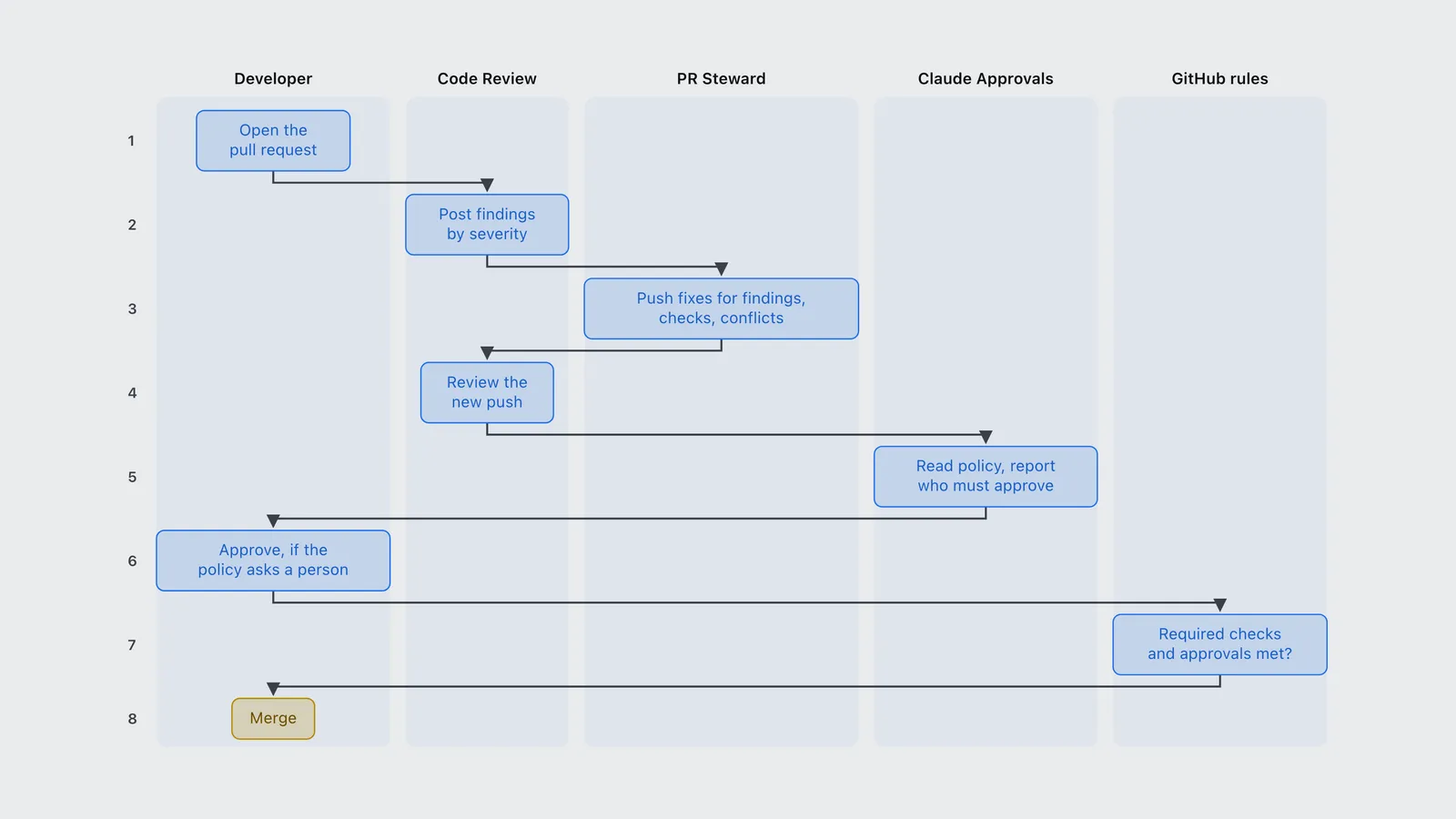
Here is one PR followed from open to merge. This is an illustrative scenario built from the documented behavior, not a recorded run.
- A developer opens a PR titled “Fix rounding in the checkout total.” It touches two files: the price calculation and its test.
- Code Review reads it and posts one important finding on the calculation line: an empty cart now returns
NaNinstead of0. - The linter check also fails, on an unused import.
- PR Steward picks up both. It adds the empty-cart case, deletes the import, pushes one commit, and comments: “Handled the empty cart and removed the unused import. Revert commit abc123 to undo.”
- The push triggers a fresh review. This time Code Review passes.
- Claude Approvals reads the policy. Under Anthropic’s starter policy, a change normally needs two people, but when Claude’s review passes, one person is enough and Claude approves. The PR’s author can count as that one person.
- The Claude Approvals check turns green, Claude posts an approving review, and GitHub’s branch rules allow the merge. The developer clicks merge.
The step a reader should notice is the sixth: with that starter policy enforced, a PR whose review passes can be merged by its own author with no second human. That is a choice your team makes in the policy file, not a default you are stuck with. The second starter policy keeps two people on every change and only lets Claude comment.
| Step | Owner | What happens |
|---|---|---|
| 1 | Developer | Open the pull request |
| 2 | Code Review | Post findings by severity |
| 3 | PR Steward | Push fixes for findings, checks, conflicts |
| 4 | Code Review | Review the new push |
| 5 | Claude Approvals | Read policy, report who must approve |
| 6 | Developer | Approve, if the policy asks a person |
| 7 | GitHub rules | Required checks and approvals met? |
| 8 | Developer | Merge (human sign-off) |
What is /ship, and how is it different?
/ship is a command inside Claude Code, the terminal coding tool. It is the do-it-yourself version for one developer and one change, and it works without an admin turning anything on. Anthropic’s /ship documentation lists what happens after you type it:
- It commits your work, pushes your branch and opens the PR, as you.
- Claude reviews the change with
/code-review(effortlowtomax, defaulthigh). - It starts a “watch”: for up to seven days, Claude keeps checking the PR from your session and pushes fixes for failing checks, conflicts and reviewer comments.
- When it is ready, you merge it yourself.
Example: you finish a change, type /ship low 41, and go to lunch. That runs a quicker review on PR #41 and starts the watch. /steward skips the review and only starts the watch; /ship stop ends it; /ship terms shows what Claude may do.
The differences from the org agents matter. /ship runs on your machine with your GitHub login, so its commits appear under your name. It counts against your own Claude Code usage, not the organization’s Claude Ship billing. It needs the CLI in a terminal (cloud sessions don’t have it), and no watch starts on native Windows.
Three warnings from the docs, in plain terms:
- It does not ask for confirmation. A line ending “Esc to cancel” appears before the commit and the push, and if you do nothing it continues after a few seconds.
- It can commit everything. All uncommitted changes go in, new files included. Run
git statusfirst. - Its secret check only looks at file names such as
.env. A password pasted intoconfig.jsis not caught.
How do you set up Claude Ship?
There are two separate tracks.
Track 1: a developer trying /ship
- Update Claude Code to v2.1.330 or later, the GitHub CLI to 2.63 or later (signed in with
gh auth login), and git to 2.38 or later. - Open Claude Code in your local clone, on the branch with your change.
- Run
git statusand remove or stash anything that should not be in the PR. - For unattended fixes, choose auto mode; in manual mode Claude waits at each prompt.
- Type
/ship. Keep the session open and the computer awake while the watch runs. - Optional: add
.claude/skills/steward/SKILL.mdwith your repository’s rules (which checks matter, how to run tests). Both/shipand PR Steward read it.
Track 2: an admin turning on the agents
The docs ask for one agent at a time, in one repository, in this order:
- Get access. You need the Owner role in your Claude organization. Go to Organization settings > Claude Ship and connect GitHub (the Claude GitHub App must be installed on the repository).
- Code Review first. Add a repository, pick a review level, and set when reviews run. Set a monthly spend limit at Organization settings > Usage.
- PR Steward second. Start with Manual (@claude steward) so it only works when someone asks. It has no spend limit of its own until you set one.
- Claude Approvals last, in observe mode. Commit a policy file in a PR of its own. This is Anthropic’s starter policy that lets Claude approve when its review passes:
# .claude/approvals.yml
version: 1
mode: observe
rules:
  - purpose: "A change takes two people. When Claude's review passes, one is enough and Claude approves."
    paths: ['**']
    verdict: { claude: comments, seats: 2 }
    override:
      - { if: 'claude/code_review = pass', verdict: { claude: approves, seats: 1 } }
  - purpose: 'A change to the review rules takes two people.'
    paths: ['**/.claude/**']
    nested: inherit
    verdict: { claude: comments, seats: 2 }
In plain English: every file needs two approvers and Claude only comments, unless Claude’s review passes, in which case one approver is enough and Claude approves. Changes to the rules themselves (anything under .claude/) always need two people. mode: observe means the check only reports what it would decide.
- Watch, then enforce. When the observe-mode results match what your reviewers would have decided, delete the
mode: observeline, then in GitHub require the Claude Approvals status check and set its source to the Claude app. Turn on “Dismiss stale pull request approvals when new commits are pushed.” Enforcing needs two people with write access, and a private repository needs a paid GitHub plan.
To turn it all off, go in reverse: Approvals first, because a policy file can keep starting billed reviews after Code Review is switched off.
What does Claude Ship cost?
There is no price list. Each agent is billed on token usage through your organization’s usage credits, separately from the usage included in your Team or Enterprise plan, and billed to the organization rather than to the developer. Anthropic’s Code Review costs page says the cost of a review scales with the review level, the size of the change, the complexity of the surrounding code and how many candidate issues need checking.
The setting that moves the bill most is how often reviews run:
| Review runs setting | Reviews per PR |
|---|---|
| After every push (default) | One per push |
| Once after PR creation | One, plus any you ask for |
Manual (@claude review) |
Only the ones you ask for |
A PR that gets five pushes costs about five reviews under the default. Anthropic’s suggested estimate: run a pilot with Once after PR creation or Manual, read each repository’s average cost per review in the Claude Ship settings, and multiply by your monthly PR count (and by pushes per PR if you keep the default). Code Review skips reviews once the spend limit runs out, and leaves a comment on the PR saying why.
Two other costs to know: Claude Approvals has no base charge, but a policy that reads Claude’s review starts billed reviews, and observe mode is billed too. /ship counts as ordinary Claude Code usage. For context on how far a Claude Code budget goes, see the Claude Code cost per task breakdown. Eligible Enterprise organizations can also claim promotional Claude Ship credits until 15 January 2027, to be used within 30 days of claiming.
What can go wrong?
- It misses things. Anthropic says so in the announcement. Code Review is one more reviewer, not a guarantee.
- Claude can approve something nobody reviewed. The policy reference says a rule that lets Claude approve “starts no review,” so if that rule does not read Claude’s review result, Claude can approve an unreviewed change. The starter policy avoids this by approving only when
claude/code_review = pass. - Unattended merges. The docs warn that with GitHub auto-merge or a merge queue, and a policy that needs no person, “a change can merge without anyone acting.”
- A watch runs code with your credentials. During
/ship, Claude merges the base branch and runs your tests on your computer. The docs advise running a watch only where you trust everyone who can merge to the base branch or push to your branch. - Some organizations cannot use it. It is not available with Zero Data Retention, the HIPAA configuration or customer-managed encryption keys, and it only works with GitHub.
The Claude Code team’s own numbers are the best case, and they are vendor-reported: Anthropic says the team’s merged PRs “more than doubled from June to September” while the share reverted fell by more than 40%. The Claude Code autonomous workflow guide covers the review process that team described before Claude Ship existed, which is the setup this product packages.
Who is Claude Ship for?
- A solo developer or a Pro/Max user: the org agents are not available to you. Use
/shipif you want the review-and-fix loop on your own PRs. - A small team on the Team plan: turn on Code Review with Once after PR creation, set a spend limit, and run Approvals in observe mode for a few weeks before deciding.
- An Enterprise organization: the same rollout, plus claim the promotional credits before 15 January 2027 so they offset the pilot (the announcement says at least $10,000 for eligible organizations).
- A team on GitLab, Bitbucket or Azure DevOps, or under HIPAA or ZDR: skip the agents for now.
/shipcan still watch a branch on other hosts, with fewer powers.
Common questions
- What are the three parts of Claude Ship?
- Code Review finds problems and posts them as comments, PR Steward pushes fixes for failing checks, conflicts and review comments, and Claude Approvals checks the pull request against an approval policy file. Code Review is generally available; the other two are in beta.
- Can Claude Ship merge pull requests by itself?
- The agents do not merge. Your GitHub branch rules decide what can merge. A change can merge with nobody acting only if you use auto-merge or a merge queue together with a policy that requires no person.
- Which plans include Claude Ship?
- Claude Team and Enterprise, for repositories on GitHub. It is not available to organizations with Zero Data Retention, the HIPAA configuration or customer-managed encryption keys. The /ship command works in Claude Code for individual developers.
- How is Claude Ship billed?
- By token usage through the organization's usage credits, separately from the plan's included usage. There is no flat price per review. Admins can set monthly spend limits, and /ship counts as ordinary Claude Code usage.
- What is the difference between /ship and PR Steward?
- The /ship command runs in your own Claude Code session with your GitHub login and watches your pull request for up to seven days. PR Steward is the organization-level agent an admin turns on per repository, billed to the organization.
Sources
- Anthropic (2026). Introducing Claude Ship. Claude resources, 23 November 2026. https://claude.com/resources/articles/introducing-claude-ship
- Anthropic (2026). Claude Ship. Claude Code documentation. https://code.claude.com/docs/en/claude-ship
- Anthropic (2026). Get a pull request ready with /ship and /steward. Claude Code documentation. https://code.claude.com/docs/en/ship-command
- Anthropic (2026). Set up Claude Approvals. Claude Code documentation. https://code.claude.com/docs/en/approvals-setup
- Anthropic (2026). Claude Approvals policy file reference. Claude Code documentation. https://code.claude.com/docs/en/approvals-policy
- Anthropic (2026). Code Review costs and usage. Claude Code documentation. https://code.claude.com/docs/en/code-review-costs