What Has REA Reverse Engineered? Adobe Clones Checked
REA did not decompile Adobe. The viral Photoshop clones are clean-room Rust apps built with Claude Opus 5.5. What REA really reverse engineered, app by app.
REA has not decompiled Adobe’s software. The viral free Photoshop, Illustrator and Premiere clones are ArtCraft’s clean-room Rust apps, built with Claude Opus 5.5, and nothing in their repositories mentions REA. REA’s own documented targets are five small case studies: Notion’s clipboard, an Android authenticator, a CTF binary and two 1990s games.
Why does everyone link REA to the Adobe clones?
Both went viral in the same week. REA, the MIT-licensed MCP server that connects coding agents to Ghidra, Hopper and IDA, went from under 10,000 GitHub stars on October 6 to 291,624 by October 17, 2026. In that same stretch, ArtCraft’s Brandon Thomas released free Rust apps that copy the look and shortcuts of Photoshop, Lightroom and Premiere.
The coverage then merged the two stories. Decrypt’s headline was From GTA V on iPhone to Free Photoshop: This AI Tool Is Upending Software (October 2026), yet its own body text says REA was not used for ArtCraft. Other aggregators dropped that caveat. Fabio Akita’s analysis, AI Reverse Engineering: Is Adobe Dead? (October 13, 2026), puts it plainly: REA “isn’t the ‘copy this app for me’ button.”
REA’s README doesn’t help matters. Its pitch line reads: “See a feature in an app that you want in your own product? Ask your agent to investigate it with REA. It can inspect the app without its source code, explain how the feature works, show the evidence, and build a version for your project.” That describes copying one feature. It has been read as copying whole apps.
What has REA itself reverse engineered?
The only primary record of what REA has been used on is its showcase page. It lists five case studies, all added to the repository between October 7 and 9, 2026 (pull requests #876, #1077 and #1266). Each one answers a single question about a single feature.
| Target | Type | What REA recovered | Rebuilt as |
|---|---|---|---|
| Notion Desktop 7.6.1 | Electron app | How a copy travels from the page’s clipboard.write through the preload and IPC (notion:clipboard:write) to Electron’s clipboard |
An explanation of the bridge, no clone |
| Aegis Authenticator 3.4.3 | Android APK (6.9 MB, open source) | How the six-digit login code is generated and why it changes every 30 seconds, found among 3,077 classes | A browser demo with a clock you can change |
| DownUnderCTF 2023 flag checker | Linux x86-64 binary (15 KB) | 26 sum checks over a 36-character flag, turned into equations | A Python solver that the original binary accepts |
| DX-Ball 1.07 | 1996 Windows game | The function that turns a brick’s position into a sound pan | C that passes 3,205 cases and matches all 63 bytes |
| TH04 | PC-98 DOS game | The 16-bit angle helper that aims a ring of bullets | C++ compared against the period compiler |
None of the five is a commercial productivity app, and none is a whole program. The Notion study is the closest REA has published to “look inside a big app”. Its result is a map of one IPC channel, not Notion’s source code. That matches REA’s FAQ, which says native analysis “returns pseudocode and assembly” and JavaScript analysis “recovers modules and their relationships”, and that your agent then has to “write and test an implementation” of its own.
The games in the list are covered separately in which games AI has decompiled. That page also covers the game mods and ports that circulated with REA’s name attached (GTA V on iPhone, the Fable 2 PC port). None of those projects credits REA in its own record either.
Did ArtCraft use REA or decompile Adobe’s code?
No on both counts, according to every primary record available. Here is what the ArtCraft code says:
- Every README says clean-room. Each of the 13 repositories in the storytold GitHub organization describes its app as “an open-source, clean-room reimplementation” of a named product.
- The agent rules forbid looking inside the originals. PhotoCraft’s AGENTS.md, the instruction file the coding agents read, says the team “studied Photoshop and other proprietary editors for behaviour and look only. Never copy their code, shaders, profiles or assets. Implement from public specs.” LightCraft’s README adds “Never read Adobe binaries.”
- The hardest format has a written method. InDesign’s
.inddfile format is undocumented, and the indd-utils CLEANROOM.md explains how it was learned without Adobe’s code. The team compared 357 third-party INDD files against IDML exports of the same documents. It states: “We do not read, decompile or use InDesign binaries, the InDesign SDK.” - REA appears nowhere. A GitHub code search of the whole storytold organization on October 17, 2026 returned no matches for
rea-agentsormorluto. The only hit for “decompile” was the prohibition quoted above.
These are the project’s own claims. No court or independent audit has tested them, and Adobe has made no public statement about the apps. The difference matters legally. A clean-room rebuild from public specs and observed behaviour copies no code. Decompiling Adobe’s binaries would run into Adobe’s license terms and, where protection is bypassed, 17 U.S.C. §1201.
Which apps did ArtCraft clone, and are they free?
All 13 are free under permissive open-source licenses, and they install through the ArtCraft Launcher listed at getartcraft.com/apps. Every app runs on macOS, Windows and Linux, and every one except FilmCraft also runs in a browser.
| App | Clones | Price | Stage | Ready for real work (own estimate) |
|---|---|---|---|---|
| PhotoCraft | Adobe Photoshop | Free | Alpha | ~45% |
| VectorCraft | Adobe Illustrator | Free | Alpha | ~62% |
| FilmCraft | Adobe Premiere Pro | Free | Alpha | ~56% |
| LightCraft | Adobe Lightroom | Free | Alpha | ~61% |
| EffectCraft | Adobe After Effects | Free | Alpha | ~45% |
| DesignCraft | Adobe InDesign | Free | Pre-alpha | ~47% |
| PdfCraft | Adobe Acrobat Pro | Free | Alpha | ~50% |
| WordCraft | Microsoft Word | Free | Alpha | ~60% |
| GridCraft | Microsoft Excel | Free | Alpha | ~50% |
| DeckCraft | Microsoft PowerPoint | Free | Alpha | ~55% |
| FigCraft | Figma | Free | Alpha | ~53% |
| SoundCraft | Avid Pro Tools | Free | Pre-alpha | ~40% |
| CADCraft | Autodesk AutoCAD | Free | Pre-alpha | ~38% |
The first wave of coverage counted seven Adobe clones. The suite has since grown to Microsoft, Autodesk, Avid and Figma, so lists that stop at seven are out of date.
Are the clones good enough to replace Adobe?
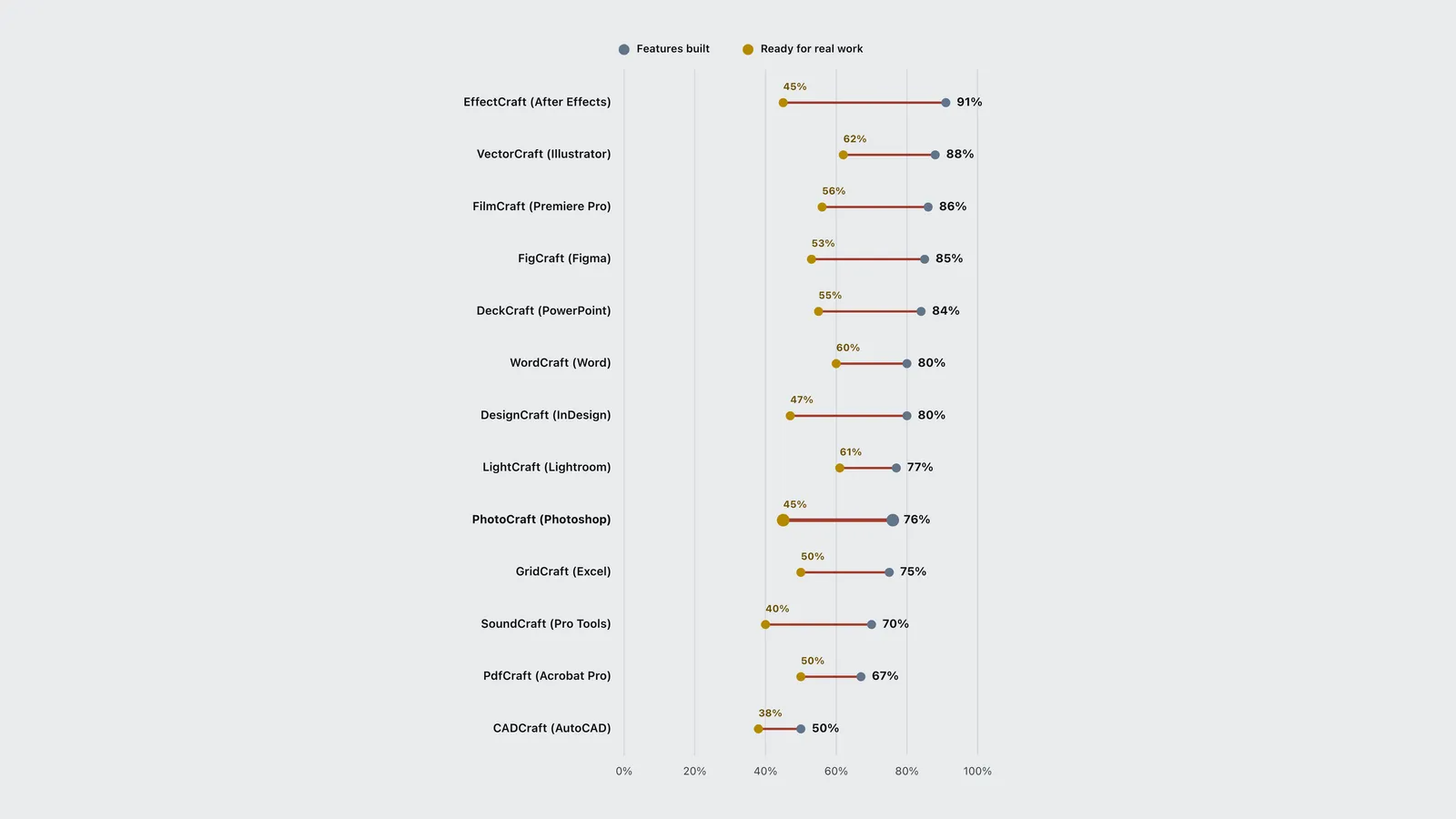
Not yet, and the projects say so themselves. Each roadmap gives two numbers. Feature breadth is how many of the original’s menus, tools and formats exist at all. Ready for real work is a weighted guess at whether a professional could switch, counting file fidelity, stability and speed. The gap between the two is the honest part.
| Item | Features built | Ready for real work |
|---|---|---|
| EffectCraft (After Effects) | 91% | 45% |
| VectorCraft (Illustrator) | 88% | 62% |
| FilmCraft (Premiere Pro) | 86% | 56% |
| FigCraft (Figma) | 85% | 53% |
| DeckCraft (PowerPoint) | 84% | 55% |
| WordCraft (Word) | 80% | 60% |
| DesignCraft (InDesign) | 80% | 47% |
| LightCraft (Lightroom) | 77% | 61% |
| PhotoCraft (Photoshop) | 76% | 45% |
| GridCraft (Excel) | 75% | 50% |
| SoundCraft (Pro Tools) | 70% | 40% |
| PdfCraft (Acrobat Pro) | 67% | 50% |
| CADCraft (AutoCAD) | 50% | 38% |
The pattern is the usual one for AI-built software. Menus and tools are cheap for an agent to add. File compatibility and stability are expensive. PhotoCraft has every one of Photoshop’s 628 menu items wired up and 2,513 open issues and pull requests, and its roadmap says reliable PSD exchange is still the gate to beta. As of October 17, 2026, these are tools to try, not to bet a client job on.
How much of ArtCraft did AI write?
Most of it, and the repository says so. In PhotoCraft’s last 100 commits, Claude Opus 5.5 appears as a co-author on 91. Brandon Thomas appears on 14, and Cursor on 4. The roadmaps for FilmCraft, EffectCraft, GridCraft, CADCraft and FigCraft state the work left to beta in “Opus 5.5 agent-hours”. FilmCraft, for example, estimates 400–700 of them.
So the accurate summary of the “Adobe clone” story is: a human-directed swarm of Claude agents rebuilt the outside of 13 commercial apps from public specs and observation. That is a story about AI coding agents. It is not a story about decompilation, and it has nothing to do with REA.
How do you check an “AI decompiled X” claim yourself?
- Find the project’s own repository, not the coverage. Aggregators repeat each other, and the original caveats get lost.
- Read the method statement. Look for “clean-room”, “decompiled”, “recompiled” or “matching” in the README and in any AGENTS.md or CONTRIBUTING.md. They mean very different things legally and technically.
- Search the repository for the tool. On GitHub, a code search for
rea-agentsormorlutoscoped to the owner settles whether REA was involved. - Count the commit trailers.
Co-authored-bylines show which model did the work. - Read the roadmap’s own numbers before believing “fully working”. Most AI-built clones publish a readiness estimate, and it is usually well below the headline.
Frequently asked questions
Frequently asked questions
- Did REA decompile Photoshop?
- No. The free Photoshop clone, PhotoCraft, is a clean-room Rust rebuild by ArtCraft made with Claude Opus 5.5. Its rules forbid copying Adobe code, and a search of the ArtCraft GitHub organization finds no reference to REA.
- What has REA reverse engineered?
- REA has published five case studies: the Notion desktop clipboard bridge, the Aegis Android authenticator's login codes, a DownUnderCTF flag checker, a DX-Ball sound-pan function and a TH04 bullet-ring calculation. Each covers one feature, not a whole application.
- Is ArtCraft made with REA?
- There is no evidence of it. ArtCraft's 13 repositories describe themselves as clean-room reimplementations built from public specifications and observed behaviour. Claude Opus 5.5 is credited in the commits, and REA is not mentioned anywhere in the organization.
- Are the ArtCraft Adobe alternatives free?
- Yes. All 13 apps are free and open source under permissive licenses and run on macOS, Windows and Linux. All but FilmCraft also run in a browser. They are alpha or pre-alpha software, rated by their own teams at 38% to 62% ready for real work.
- Is it legal to clone Photoshop with AI?
- Rebuilding behaviour from public specs and observation, as ArtCraft says it does, is the traditional clean-room route. Decompiling Adobe's binaries would breach its license terms and could run into 17 U.S.C. §1201. No court has ruled on ArtCraft, and this is not legal advice.
Sources
- morluto (2026). REA: Reverse Engineer Anything README. GitHub. https://github.com/morluto/rea
- REA (2026). Showcases (Notion, Aegis, CTF, DX-Ball, TH04). rea.tools. https://rea.tools/showcase/
- ArtCraft (2026). Apps. getartcraft.com. https://getartcraft.com/apps
- storytold (2026). PhotoCraft README, AGENTS.md, ROADMAP.md and commit history. GitHub. https://github.com/storytold/photocraft
- storytold (2026). indd-utils CLEANROOM.md. GitHub. https://github.com/storytold/indd-utils/blob/main/CLEANROOM.md
- storytold (2026). ROADMAP.md for VectorCraft, FilmCraft, LightCraft, EffectCraft, DesignCraft, PdfCraft, WordCraft, GridCraft, DeckCraft, FigCraft, SoundCraft and CADCraft. GitHub. https://github.com/storytold
- Decrypt (2026). From GTA V on iPhone to Free Photoshop: This AI Tool Is Upending Software. Decrypt (secondary). https://decrypt.co/380741/gta-v-iphone-free-photoshop-ai-tool-rea-upending-software
- Akita, Fabio (2026). AI Reverse Engineering: Is Adobe Dead?. Blog (secondary). https://akitaonrails.com/en/2026/10/13/ai-reverse-engineering-is-adobe-dead/
- Legal Information Institute (current). 17 U.S. Code §1201: Circumvention of copyright protection systems. Cornell Law School. https://www.law.cornell.edu/uscode/text/17/1201