Will the DRAM Lawsuit Lower RAM Prices?
Not soon. A judge let the DRAM supply-conspiracy suit against Samsung, SK hynix and Micron proceed on Nov 14, 2026, but supply, not courts, sets RAM prices.
Not soon. On November 14, 2026 a federal judge let the DRAM supply-conspiracy lawsuit against Samsung, SK hynix and Micron go forward, but surviving a motion to dismiss adds no wafers, and wafers set RAM prices.
What the ruling does change is the risk the three memory makers carry. For the first time in this shortage, a court has said the story of production cuts, a pivot to AI memory and a synchronized DDR4 exit is plausible enough to justify discovery. That puts internal emails, capacity plans and customer-allocation decisions in front of plaintiffs’ lawyers. It is a real legal event. It is not a price event, and the history of the last DRAM cartel case shows why.
What did the judge rule in the DRAM lawsuit?
Judge Wise denied the motion to dismiss in full. In the opinion in Garciaguirre v. Samsung Electronics Co., published on CourtListener, she found the complaint plausibly alleges that the three companies agreed to restrict conventional DRAM supply, which is the claim under Section 1 of the Sherman Act, the federal ban on agreements in restraint of trade.
The bar at this stage is plausibility, set by the Supreme Court in Bell Atlantic Corp. v. Twombly (2007). Parallel behavior alone is not enough: competitors in a concentrated market often move together because they read the same demand signals. A plaintiff has to allege “plus factors”, conduct that would be odd for a company acting on its own but makes sense as part of a deal.
The defendants argued the industry was simply responding to AI demand, and that rival memory makers naturally watch one another closely. Judge Wise answered that metaphor directly. According to the opinion, as quoted by LitNews and Hardware Busters, the plaintiffs’ allegations “go beyond hawks watching each other; their contentions are more akin to hawks flying in formation, an activity that hawks ordinarily do not do.”
The case was filed on June 25, 2026 by consumers and small businesses represented by Bathaee Dunne LLP, as Law Street Media reported at filing. Wccftech’s report on the ruling puts the named plaintiffs at 17, across five states, and says the complaint credits the three companies with more than 91% of global DRAM revenue as of the third quarter of 2025. The suit asks for class status, damages and an injunction.
What do the plaintiffs say the memory makers did?
The complaint tells a sequence, not a single act. Its core allegation is that the three companies cut conventional DRAM output from late 2022, moved wafer capacity to high-bandwidth memory (HBM) for AI accelerators from 2023, and then did a series of things that kept commodity supply tight even as prices rose. HBM uses roughly three to four times the wafer area per gigabyte of standard DDR5, according to the complaint as reported by Wccftech, so every wafer moved to HBM removes more consumer bits than it adds AI bits.
Some of those steps are public company announcements. Others are allegations the court has accepted as plausible but not proven.
Late 2022
SK hynix and Micron announce production cuts, three weeks apart
The opinion notes the two announcements came about three weeks apart, as summarised by LitNews.
April 7, 2023
Samsung follows with its own cut
About four and a half months later. The judge held that the lag did not defeat the parallel-conduct allegation at this stage.
2023 onward
Wafer capacity shifts toward HBM
All three sign long-term HBM contracts, per the complaint. Samsung and SK hynix allegedly refuse long-term agreements with major conventional DRAM buyers and delay or halt new DRAM fabs.
2025, same quarter
DDR4 wind-down
The complaint alleges all three began winding down DDR4 in the same quarter. The judge wrote that the defendants "offer no rationale for their sudden, rapid, and coordinated exit."
December 3, 2025
Micron announces its exit from Crucial
A public company announcement: Micron said it would stop selling Crucial-branded consumer memory and storage, shipping through February 2026, to focus on large strategic customers.
January 2026
Near-identical customer-vetting questionnaires
The complaint alleges the three adopted closely matching questions for vetting buyers. The judge found this "strongly support[s] a plausible inference of conspiracy."
June 25, 2026
Class action filed in the Northern District of California
November 14, 2026
Motion to dismiss denied in full
The Crucial exit is the one item anyone can check without the court file. Micron’s announcement, as carried by StorageNewsletter, framed it as a portfolio move toward AI data-center demand. The plaintiffs frame it as the third-largest supplier walking away from retail buyers at the moment retail prices were climbing. Both readings use the same fact.
The complaint’s price claim is large: it alleges conventional DRAM prices rose 697% over an 18-month span without any of the three expanding output. Treat that as the plaintiffs’ number. The site’s own memory price tracker shows the direction independently: TrendForce’s DDR5 16Gb chip spot reading was US$61.50 on November 3, 2026, more than double the US$27.20 reported for December 2025.
Why did this case survive when the 2018 DRAM case failed?
The defendants’ main argument was that this suit repeats one that already lost. In 2018, buyers sued the same three companies over alleged supply restraint from 2016 to 2018. The district court dismissed it, and the Ninth Circuit affirmed in March 2022, holding the complaint showed parallel behavior without the “something more” needed to infer an agreement. The defendants asked whether this complaint was any different. “The Court finds that it is not” the same, Judge Wise wrote, as quoted by Wccftech.
The difference is the kind of conduct alleged. The 2018 case leaned on public statements about supply discipline. This one alleges physical, costly steps: turning down long-term contracts, shelving fabs and closing a brand. The judge did not accept everything, though, and the split is the best guide to what discovery will focus on.
| Allegation | How the court treated it |
|---|---|
| Near-identical customer-vetting questions (January 2026) | Accepted: “strongly support a plausible inference” |
| Coordinated DDR4 exit in one quarter | Accepted: defendants “offer no rationale” |
| Refusing long-term deals with big conventional buyers | Accepted as a plus factor |
| Delaying or halting new DRAM fabs | Accepted as a plus factor |
| Micron’s Crucial exit | Accepted as part of the pattern |
| 1998–2002 price-fixing history | Noted by the court as background |
| Investor-call remarks about “supply discipline” | Rejected: too close to arguments that failed in the 2018 case |
| Information exchanges at industry conferences | Rejected: no specific exchanges identified |
| Three firms controlling most of the market | Treated as neutral on its own |
Sources for the table: the opinion on CourtListener, as summarised by LitNews and Hardware Busters.
The judge also dealt with the AI-demand defense on timing. The vetting questionnaires came after the HBM pivot was already under way, so AI demand cannot explain why three rivals would converge on the same buyer-screening questions at the same time.
Will the DRAM lawsuit lower RAM prices?
No, not on any timeline that matters for a 2026 or 2027 purchase. There are three reasons.
Damages look backward. The main remedy in a private antitrust case is money. Section 4 of the Clayton Act lets an injured buyer recover three times its damages. That money arrives after a trial or settlement, years from now, and it compensates for prices already paid. It does not change what the next stick of DDR5 costs.
Most plaintiffs here are indirect buyers. Consumers do not buy DRAM chips from Samsung; they buy PCs, phones and memory kits that contain them. Under Illinois Brick Co. v. Illinois (1977), indirect purchasers cannot collect damages under federal antitrust law, so they sue for an injunction federally and for damages under state laws. That is how the last DRAM consumer case worked, and it is part of why it took so long.
An injunction cannot order fabs into existence. Section 16 of the Clayton Act allows a court to stop illegal conduct. If the plaintiffs eventually prove an agreement, a court could bar coordination on output, contracts or customer vetting. It cannot make a cleanroom appear. A new DRAM fab takes years to build and ramp, which is why the site’s memory fab buildout analysis finds Micron’s Boise fab targeting first DRAM wafers in the second half of 2027 and Samsung’s Pyeongtaek P5 expected in 2028.
What does move prices is capacity and allocation. TrendForce’s fourth-quarter 2026 outlook still has AI server demand pushing contract prices up, and analysts quoted in the Korea Herald’s coverage of the filing expected DRAM prices to keep rising through 2027 regardless of the case. For the full supply picture, see when RAM prices will drop and why RAM is so expensive.
There is one indirect path worth watching. Discovery raises the cost of anything that looks like coordination. A memory maker with an open antitrust case has more reason to sign long-term contracts with PC makers, keep a legacy line running a little longer, or avoid moving in lockstep with rivals. None of that is guaranteed, and none of it adds wafers, but it could soften the edges of the next allocation round.
How long will the DRAM lawsuit take?
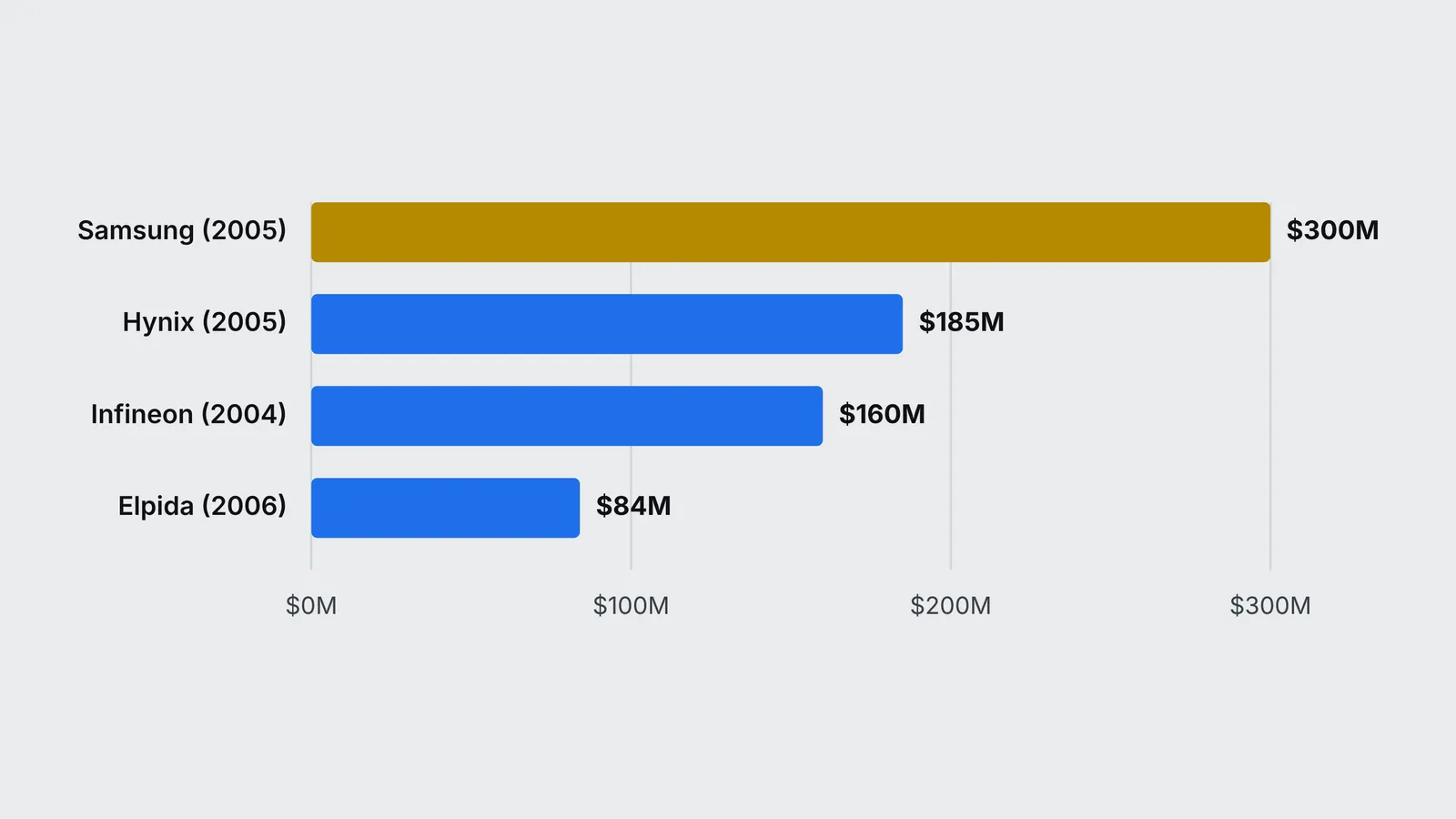
If the last DRAM cartel case is the guide, a decade or more. That case had something this one does not: criminal guilty pleas. The US Justice Department prosecuted the 1999–2002 conspiracy, and Samsung agreed to plead guilty and pay US$300 million in 2005, then the second-largest criminal antitrust fine in US history.
| Item | Value |
|---|---|
| Samsung (2005) | $300M |
| Hynix (2005) | $185M |
| Infineon (2004) | $160M |
| Elpida (2006) | $84M |
Even with those pleas on the record, the civil side ran for years. The dates below come from the Justice Department, the Washington Attorney General’s settlement announcement and the Maine Attorney General’s notice on the consumer settlement.
1999–2002
Price-fixing conspiracy runs
The Justice Department alleged it covered DRAM sold to computer makers including Dell, Apple, IBM and Compaq.
2004–2006
Guilty pleas: Infineon, Hynix, Samsung, Elpida
Combined corporate fines topped US$700 million, and several executives served US prison time.
2006
State attorneys general sue
Thirty-plus states file in federal court in San Francisco on behalf of public agencies and consumers.
June 2014
US$310 million consumer settlement gets final approval
About twelve years after the conspiracy ended. Individual buyers were told to expect a minimum of about US$10.
This case starts further back. There is no criminal plea and no government investigation in the US that the reporting describes. The plaintiffs have to win class certification, survive summary judgment and then either settle or prove an agreement at trial, all against three companies with strong incentives to fight.
Could you get money from the DRAM lawsuit?
Possibly, eventually, if you bought DRAM or a device containing it in the class period, and only if the case settles or wins. No class has been certified, so there is nothing to sign up for today. Be wary of sites that ask for personal details “to join” the DRAM case: a real claims process comes with a court-approved notice and a named claims administrator.
The last round set expectations low. The 2014 settlement covered purchases of computers, servers, graphics cards, printers and game consoles from 1998 to 2002, and the Maine Attorney General told individual claimants to expect around US$10 at minimum. Class actions compensate in aggregate; for one PC builder, the payout rarely matches the overpayment.
What happens next in the DRAM case?
According to Wccftech’s report on the ruling, the three companies must file their answers to the complaint by December 7, 2026, and an initial case management conference is set for January 12, 2027. Those dates come from one outlet and should be checked against the docket before anyone plans around them.
After that comes discovery, the phase where the plaintiffs can demand documents on capacity decisions, HBM contract terms and those customer questionnaires. Class certification is usually fought in 2027 or later. Watch for three signals: whether any government enforcer opens its own inquiry, whether a defendant settles early to cooperate against the others (the pattern Micron followed in the 2000s case), and whether the companies change how they allocate legacy DRAM while discovery is open.
What should you do if you need RAM now?
Buy on your own timeline, not the court’s. If a build or upgrade is waiting on memory, the lawsuit is not a reason to hold off. The should I buy RAM now guide and the ways to save money on RAM cover the practical choices, and how much RAM you need for gaming can stop you overbuying at today’s prices.
The ruling matters more to investors than to shoppers. It adds a legal overhang to three companies whose earnings are at record highs because of the same shortage the suit describes. For the market side, see whether the memory cycle is peaking and the 2027 shortage forecast.
Frequently asked questions
- Did a judge rule that Samsung, SK hynix and Micron fixed DRAM prices?
- No. On November 14, 2026 Judge Noël Wise denied their motion to dismiss, which means the complaint plausibly alleges an illegal agreement and the case can proceed to discovery. It is not a finding that the companies conspired.
- Will the DRAM lawsuit make RAM cheaper?
- Not in the near term. Damages compensate for past overpayment years after the fact, and even an injunction cannot add fab capacity. RAM prices will keep following supply, which depends on new fabs and how much wafer capacity goes to HBM for AI.
- How long will the DRAM antitrust case take?
- Likely years. The last DRAM price-fixing conspiracy ended in 2002, and the consumer settlement was not finally approved until June 2014, even though the companies had pleaded guilty to criminal charges.
- Can I join the DRAM class action?
- Not yet. No class has been certified. If the case settles or wins, a court-approved notice will explain who qualifies and how to claim.
- What did the judge mean by hawks flying in formation?
- The defendants argued that rivals in a concentrated market watch each other like hawks. The judge wrote that the allegations go further, describing coordinated conduct that hawks ordinarily do not do, such as near-identical customer-vetting questions and a synchronized DDR4 exit.
Sources
- US District Court, N.D. Cal. (2026). Marc Garciaguirre, et al. v. Samsung Electronics Co., Ltd., et al., order denying motion to dismiss. CourtListener. https://www.courtlistener.com/opinion/11062568/marc-garciaguirre-et-al-v-samsung-electronics-co-ltd-et-al/
- LitNews (2026). Judge Refuses to Dismiss DRAM Supply Conspiracy Suit Against Samsung, SK Hynix, Micron. Secondary coverage. https://litnews.ai/articles/garciaguirre-samsung-sk-hynix-micron-dram-conspiracy-suit-survives-dismissal
- Hardware Busters (2026). DRAM Antitrust Lawsuit Against Samsung, SK hynix and Micron Survives Dismissal. Secondary coverage. https://hwbusters.com/news/dram-antitrust-lawsuit-against-samsung-sk-hynix-and-micron-survives-dismissal-and-the-judge-sees-hawks-flying-in-formation/
- Wccftech (2026). Federal Judge Rejects Memory Makers’ Defense To Advance Class-Action Antitrust Lawsuit. Secondary coverage. https://wccftech.com/federal-judge-rejects-memory-makers-defense-samsung-micron-sk-hynix-dram-shortage-lawsuit/
- Law Street Media (2026). Antitrust Class Action Accuses Micron, Samsung, and SK Hynix of Manipulating DRAM Market. https://lawstreetmedia.com/news/tech/antitrust-class-action-accuses-micron-samsung-and-sk-hynix-of-manipulating-dram-market/
- The Korea Herald (2026). US DRAM lawsuit unlikely to derail AI memory boom. https://www.koreaherald.com/article/10793202
- Micron Technology (2025). Micron Announces Exit from Crucial Consumer Business. Press release. https://investors.micron.com/news-releases/news-release-details/micron-announces-exit-crucial-consumer-business
- StorageNewsletter (2025). Micron Announces Exit from Crucial Consumer Business. https://www.storagenewsletter.com/2025/12/05/micron-announces-exit-from-crucial-consumer-business/
- Paul, Weiss (2022). Ninth Circuit Analyzes Parallel Conduct Allegations and Does Not Find “Something More”. Law firm client memo. https://www.paulweiss.com/insights/client-memos/ninth-circuit-analyzes-parallel-conduct-allegations-and-does-not-find-something-more-suggesting-an-antitrust-conspiracy
- US Supreme Court (2007). Bell Atlantic Corp. v. Twombly, 550 U.S. 544. Justia. https://supreme.justia.com/cases/federal/us/550/544/
- US Supreme Court (1977). Illinois Brick Co. v. Illinois, 431 U.S. 720. Justia. https://supreme.justia.com/cases/federal/us/431/720/
- US Code. 15 U.S.C. 1, 15 and 26 (Sherman Act Section 1; Clayton Act Sections 4 and 16). Cornell LII. https://www.law.cornell.edu/uscode/text/15/1
- US Department of Justice (2006). Samsung executive agrees to plead guilty in DRAM price-fixing case (summary of corporate pleas and fines). https://www.justice.gov/archive/opa/pr/2006/September/06_at_642.html
- Washington State Attorney General. Memory chip makers will pay $173 million for price fixing. https://atg.wa.gov/news/news-releases/memory-chip-makers-will-pay-173-million-price-fixing
- Maine Attorney General (2014). Settlement to benefit Mainers who purchased DRAM. https://www.maine.gov/ag/news-and-library/press-releases/ag-mills-announces-settlement-benefit-mainers-who-purchased
- TrendForce (2026). AI Server Demand Sustains Memory Contract Price Increases in 4Q26, While Consumer-Side Pressure Persists. https://www.trendforce.com/presscenter/news/20260930-13258.html