Best Local LLMs as Good as Paid AI, Ranked by RAM
The top local LLMs for every RAM size, ranked. A 32GB Mac now runs a free model that ties a paid flagship, and even 8GB beats older paid models.
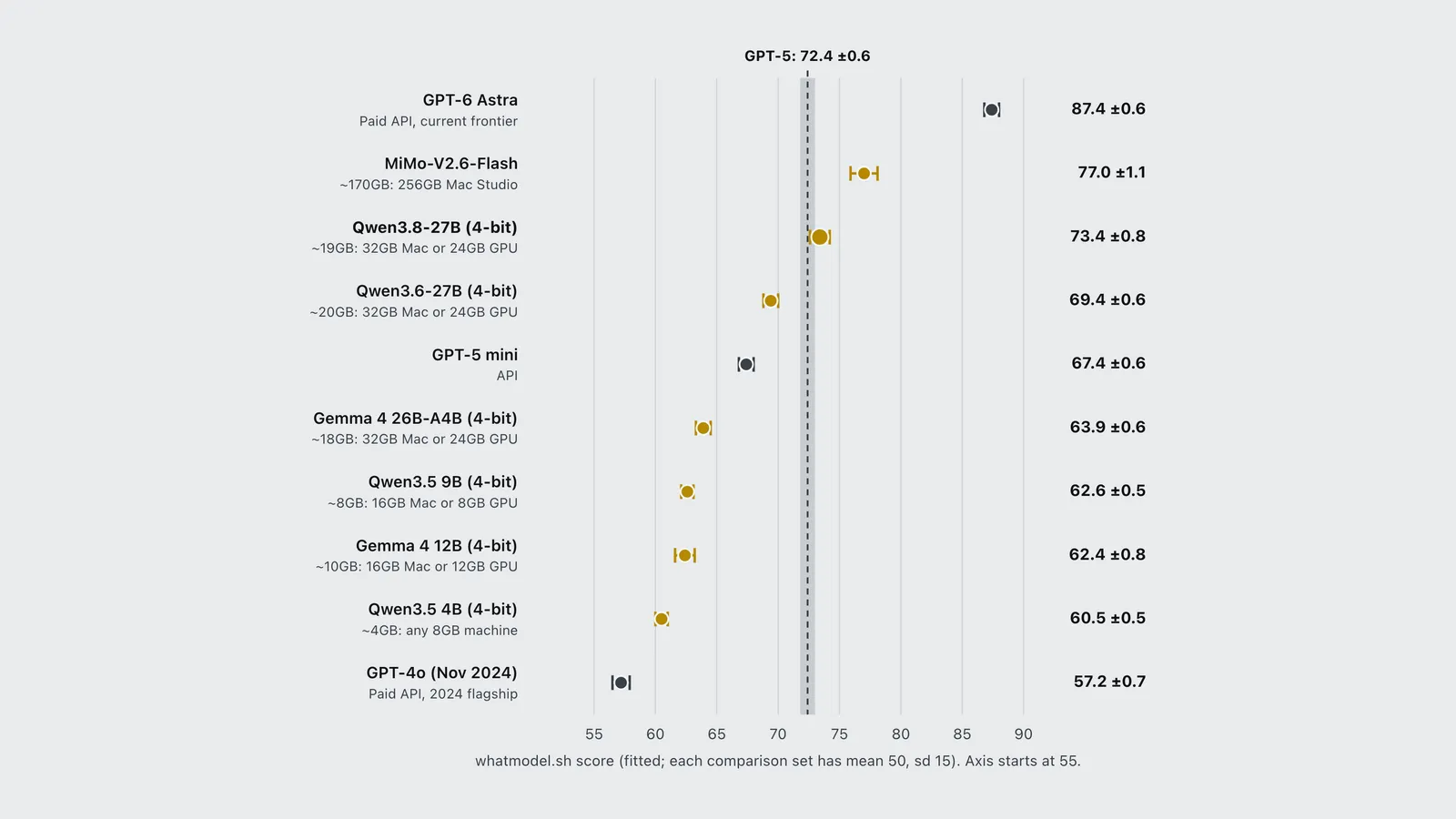
The best local LLM for most people is Qwen3.8-27B. It runs on a 32GB Mac or a 24GB graphics card, it is free under Apache 2.0, and it ties GPT-5 on the Arena text leaderboard, where people vote blind between two answers: 1438 ±5 against 1435 ±5 on October 8, 2026. Below 32GB the top picks still beat older paid models, and at 256GB one clears GPT-5 outright.
Every ranking below was checked against published benchmark data on October 12, 2026, not against anyone’s launch claims. The method is at the end. This page is updated as new open-weight models ship.
What is the best local LLM right now?
Ranked by score, with the cheapest Apple machine that runs each one fully in GPU memory. Scores are from whatmodel.sh, a free, open-source tool that fits one score per model across 19,731 published benchmark results (data updated October 11, 2026).
| Rank | Model | Cheapest Mac that runs it | Memory needed | Score (±) | Matches roughly |
|---|---|---|---|---|---|
| 1 | MiMo-V2.6-Flash (MXFP4) | 256GB Mac Studio (build to order) | ~170GB download | 77.0 ±1.1 | Above GPT-5 |
| 2 | Qwen3.8-27B (4-bit) | Mac mini, 32GB: $1,799 | ~19GB | 73.4 ±0.8 | GPT-5 (72.4) |
| 3 | Qwen3.6-27B (4-bit) | Mac mini, 32GB: $1,799 | ~20GB | 69.4 ±0.6 | Between GPT-5 mini and GPT-5 |
| 4 | Gemma 4 31B (4-bit) | Mac mini, 32GB: $1,799 | ~21GB | 66.9 ±0.6 | GPT-5 mini (67.4) |
| 5 | Gemma 4 26B-A4B (4-bit) | Mac mini, 32GB: $1,799 | ~18GB | 63.9 ±0.6 | Above GPT-5 nano |
| 6 | Qwen3.5 9B (4-bit) | Mac mini, 16GB: $899 | ~8GB | 62.6 ±0.5 | GPT-5 nano (61.9) |
| 7 | Gemma 4 12B (4-bit) | Mac mini, 16GB: $899 | ~10GB | 62.4 ±0.8 | GPT-5 nano |
| 8 | Qwen3.5 4B (4-bit) | Any 8GB machine | ~4GB | 60.5 ±0.5 | Above GPT-4o (57.2) |
Apple prices are from the Apple Store on October 12, 2026. On a PC, the deciding number is graphics-card memory: a 24GB card such as an RTX 3090 or 4090 runs everything down to rank 2, and the GPU price tracker shows what those cost now.
| Model | Runs | Score | Uncertainty (±) |
|---|---|---|---|
| GPT-5 (reference) | API | 72.4 | 0.6 |
| GPT-6 Astra (Paid API, current frontier) | API | 87.4 | 0.6 |
| MiMo-V2.6-Flash (~170GB: 256GB Mac Studio) | Local | 77.0 | 1.1 |
| Qwen3.8-27B (4-bit) (~19GB: 32GB Mac or 24GB GPU) | Local | 73.4 | 0.8 |
| Qwen3.6-27B (4-bit) (~20GB: 32GB Mac or 24GB GPU) | Local | 69.4 | 0.6 |
| GPT-5 mini (API) | API | 67.4 | 0.6 |
| Gemma 4 26B-A4B (4-bit) (~18GB: 32GB Mac or 24GB GPU) | Local | 63.9 | 0.6 |
| Qwen3.5 9B (4-bit) (~8GB: 16GB Mac or 8GB GPU) | Local | 62.6 | 0.5 |
| Gemma 4 12B (4-bit) (~10GB: 16GB Mac or 12GB GPU) | Local | 62.4 | 0.8 |
| Qwen3.5 4B (4-bit) (~4GB: any 8GB machine) | Local | 60.5 | 0.5 |
| GPT-4o (Nov 2024) (Paid API, 2024 flagship) | API | 57.2 | 0.7 |
Which local LLM is best for your RAM?
Memory decides everything, and the cut-offs are sharp. On a Mac, whatmodel assumes the GPU can use about two-thirds of RAM on machines up to 36GB and three-quarters above that. On a PC, only the graphics card’s own memory counts at full speed. A model that spills into system RAM still loads, but generation speed falls off a cliff. For the sizing arithmetic itself, that guide is the reference. This section is about which model to pick once you know your number.
8GB: Qwen3.5 4B
Qwen3.5 4B at 4-bit needs about 4GB and scores 60.5 ±0.5, above the 57.2 of the November 2024 GPT-4o. That holds on benchmarks, not on feel: in blind chat votes, the tuned chat build of GPT-4o still ranks far higher than any 4B model. Use it for summaries, rewrites and quick questions, not long reasoning.
16GB to 24GB Macs, 8GB to 16GB graphics cards: Qwen3.5 9B
Qwen3.5 9B (62.6 ±0.5, ~8GB) is the pick, with Google’s Gemma 4 12B (62.4 ±0.8, ~10GB) close enough to choose on taste. Both sit level with GPT-5 nano. A 24GB Mac does not move you up a tier: with roughly 16GB available to the GPU, the 27B models need about 19GB and do not fit. Spend the extra on 32GB instead.
32GB Mac or 24GB graphics card: Qwen3.8-27B (best overall)
This is where local catches a paid flagship. Qwen3.8-27B at 4-bit needs about 19GB, scores 73.4 ±0.8 against GPT-5’s 72.4 ±0.6, and the two intervals overlap. Alibaba released it in August 2026 under Apache 2.0 with a 262,144-token native context, per its model card. The previous generation, Qwen3.6-27B (69.4), is the runner-up. The Qwen3.8-27B economics breakdown covers hosted prices and the exact file sizes.
64GB to 128GB: Qwen3.8-27B at 8-bit
More memory does not buy a much better model until you reach the very large mixture-of-experts models. whatmodel’s top pick on a 64GB Mac is the same Qwen3.8-27B at 8-bit (~36GB), which leaves room for long documents and agent sessions. A 64GB Mac Studio is $3,799. At 128GB, 2-bit builds of 180B to 284B models appear at the top of the list, but 2-bit is aggressive compression and the scores shown are for the full models, so treat those as experiments.
256GB: MiMo-V2.6-Flash
Xiaomi’s MiMo-V2.6-Flash, a 309B-parameter mixture-of-experts with 15B active per token under an MIT license (per its Hugging Face model card), is the only local pick that clears GPT-5’s band: 77.0 ±1.1. On Arena it scores 1451 ±7, above GPT-5 (high) at 1435. The MXFP4 build is about 170GB. Nine of its 13 benchmark results come from Xiaomi, so the composite leans on the maker. The Arena number is the independent one.
Best for creative writing and roleplay
Benchmarks do not measure tone, humour or repetition. A widely shared r/LocalLLaMA ranking of models for 10GB to 16GB cards, one user’s informal test of dialogue, slop phrases and instruction-following, put Gemma 4 26B-A4B first and Qwen3.6-35B-A3B second. On whatmodel those score 63.9 and 67.7. Take it as a vibe check, not a ranking. The same author found that only models above about 200B parameters reliably knew anime, film and music trivia.
Which local LLM is best for coding?
On paper, Qwen3.8-27B by a distance: whatmodel’s coding filter puts it at 74.7 against GPT-5’s 66.3, and its agent-task score at 70.9 against 62.8. But reading who reported each result in whatmodel’s open dataset changes the picture:
| Evidence | Qwen3.8-27B | GPT-5 |
|---|---|---|
| Results in the composite | 33 | 53 |
| Reported by the model’s own lab | 22 | 5 |
| Reported independently | 11 | 48 |
| Independent coding results | Arena WebDev, Roblox Luau | SWE-bench Verified, Terminal-Bench 2, Aider Polyglot, tau2-bench and more |
Its headline coding numbers (SWE-bench Pro 61.7, Terminal-Bench 2.1 73.0, OSWorld-Verified 84.3) all come from Qwen’s own model card, and SWE-bench Pro was run on Qwen’s refined version of the benchmark. Agentic scores move by 20 points with the harness alone, as the same weights scoring 67.8 or 90.0 showed last generation. Where independent testers did run both, the result splits:
| Independent test | Qwen3.8-27B | GPT-5 | Who leads |
|---|---|---|---|
| Arena text (Oct 8) | 1438 ±5 | 1435 ±5 (high) | Tie |
| Arena WebDev (Oct 8) | 1593 ±7 | 1418 ±16 (medium) | Qwen3.8-27B |
| Arena Vision (Oct 9) | 1244 ±8 | 1210 ±7 (high) | Qwen3.8-27B |
| Roblox LLM Leaderboard, Luau LeetCode | 64.9% | 78.8% | GPT-5 |
| Roblox LLM Leaderboard, RobloxQA | 90.8% | 94.4% | GPT-5 |
| Artificial Analysis Intelligence Index | 34 (Xhigh) | 23 (high, estimated) | Qwen3.8-27B, with a caveat |
Can a local LLM really replace paid AI?
For a lot of daily use, yes. For the newest paid frontier models, no, and four practical limits apply even where the scores match.
The frontier moved on. Paid models keep climbing. On the same whatmodel.sh scale, the top hosted model when this page was last checked (OpenAI’s GPT-6 Astra, October 12, 2026) scores 87.4, about 15 points above the best model a 32GB machine can run. Local tends to match the paid flagship of a year earlier, not the current one.
Speed. Each generated token reads every weight once, so memory bandwidth caps speed. A 32GB Mac mini M6 has 170GB/s and the 4-bit MLX build of Qwen3.8-27B is 16.1GB, so the ceiling is about 170 ÷ 16.1 ≈ 10 tokens per second before overhead. Readable, but slower than a hosted model. A 24GB RTX card is several times faster.
Context. The ~19GB figure assumes a modest context. Long documents grow the KV cache, and past a point context costs more memory than the weights. A 32GB Mac has about 2GB of headroom.
Quantization. whatmodel gives the 4-bit file the same score as the full model. That is a fair approximation at 4-bit: a community quantization comparison on Llama 3 8B found Q4_K_M kept about 99% of the full-precision MMLU score. It is not a guarantee for agentic work, and it gets much worse at 2 to 3 bits.
Is a local LLM cheaper than paying for AI?
Only if you would pay for AI anyway and keep the machine for years. The arithmetic, with Apple prices from October 12, 2026:
| Option | Upfront | Monthly | Notes |
|---|---|---|---|
| Mac mini M6, 24GB / 512GB | $1,299 | $0 | Cannot run Qwen3.8-27B in GPU memory |
| Mac mini M6, 32GB / 1TB | $1,799 | $0 | Runs the best overall pick; the $500 step also doubles storage |
| Entry paid AI chat plan | $0 | $20 | The going rate for the major chat apps’ first paid tier |
| GPT-5 API | $0 | $1.25 in / $10 out per 1M tokens | $500 buys 50 million output tokens |
The $500 memory step equals about two years of a $20-a-month AI subscription, and the paid models it buys access to are stronger than anything here. So local does not win on price. It wins on privacy (nothing leaves your machine), working offline, no message caps, and a model that never changes underneath you. Memory prices make the hardware side harder, not easier: Apple raised Mac prices in June 2026 and DRAM is still climbing on the memory price tracker. For the full per-token model on owned hardware, see self-hosted LLM tokenomics.
How this ranking works
- Criteria. Rank is the whatmodel.sh composite score for the best build that fits fully in GPU memory at each tier. Speed, license and context break ties.
- What the score is. An item response theory fit across published results: each result is modelled from how sharply its test separates models, how strong the model is, and an offset for the evaluator. Each connected set has a mean of 50 and a standard deviation of 15. The ± is the fit’s own uncertainty, which the method page describes as “not a guarantee of real-world performance.”
- Exclusions. Models whose every result came from their own maker (marked with a dagger on whatmodel) are left out of the picks, even when they rank higher.
- Independent checks. Every pick was cross-checked against the Arena leaderboards and, where available, Artificial Analysis. Where most of a model’s results are lab-reported, the text says so.
- Not tested here. These models were not run on this site’s hardware. Rankings are verified against primary published data.
- Last checked: October 12, 2026.
How to get started
- Find your fast memory. On a Mac it is your RAM (Apple menu, About This Mac). On a PC it is your graphics card’s VRAM.
- Pick from the tier above, or check the fit on this site’s Can I run this LLM? checker. whatmodel.sh also works from a terminal:
curl "whatmodel.sh/?ram=32&gpu=apple&max=0"lists local-only picks for a 32GB Mac. - Install a runner. Ollama, LM Studio and llama.cpp all run 4-bit GGUF builds. On a Mac, MLX builds such as the 16.1GB Qwen3.8-27B 4-bit are usually fastest.
- Test it on your own work. Run five real tasks side by side with the paid AI you use now. A ranking tells you where to start, not whether it fits your workload.
Frequently asked questions
- What is the best local LLM?
- Qwen3.8-27B for most people, as of October 12, 2026. It needs about 19GB, so a 32GB Mac or a 24GB graphics card, and ties GPT-5 on the independent Arena text leaderboard (1438 against 1435). On a 256GB machine, MiMo-V2.6-Flash scores higher.
- What is the best local LLM for 16GB of RAM?
- Qwen3.5 9B at 4-bit (about 8GB, score 62.6 on whatmodel.sh), with Gemma 4 12B (about 10GB, 62.4) close behind. Both are roughly level with GPT-5 nano. The 27B models need about 19GB and do not fit.
- Can a local LLM be as good as paid AI?
- It can match last year's paid flagship: Qwen3.8-27B on a 32GB Mac ties GPT-5 on blind human votes (1438 against 1435, October 8, 2026). It does not match the newest paid frontier models, which score about 15 points higher on the same scale.
- Which local LLM is best for coding?
- Qwen3.8-27B scores highest on paper, but its coding and agent results are reported by Qwen. Independently, it beats GPT-5 (medium) on Arena WebDev, 1593 to 1418, and trails GPT-5 on the Roblox Luau leaderboard, 64.9% to 78.8%.
- Is running a local LLM cheaper than an AI subscription?
- Rarely. Moving a Mac mini from 24GB to 32GB costs $500, about two years of a $20-a-month AI subscription, and the paid models are stronger. The reasons to run locally are privacy, offline use and no message caps.
Sources
- Manger, J. (2026). whatmodel.sh: method. whatmodel.sh. https://whatmodel.sh/method
- Manger, J. (2026). jakemanger/whatmodel (data, scoring code and bench script; data updated 2026-10-11). GitHub. https://github.com/jakemanger/whatmodel
- Qwen Team (2026). Qwen3.8-27B model card. Hugging Face. https://huggingface.co/Qwen/Qwen3.8-27B
- Xiaomi MiMo (2026). MiMo-V2.6-Flash-RL model card. Hugging Face. https://huggingface.co/XiaomiMiMo/MiMo-V2.6-Flash-RL
- LMArena (2026). Text Arena leaderboard (snapshot October 8, 2026). arena.ai. https://arena.ai/leaderboard/text
- LMArena (2026). WebDev Arena leaderboard (snapshot October 8, 2026). arena.ai. https://arena.ai/leaderboard/webdev
- LMArena (2026). Vision Arena leaderboard (snapshot October 9, 2026). arena.ai. https://arena.ai/leaderboard/vision
- Artificial Analysis (2026). Qwen3.8 27B: Intelligence, performance and price analysis. https://artificialanalysis.ai/models/qwen3-8-27b
- Artificial Analysis (2026). GPT-5 (high): Intelligence, performance and price analysis. https://artificialanalysis.ai/models/gpt-5
- TorpedoSoftware (2026). Roblox LLM Leaderboard. Hugging Face Spaces. https://huggingface.co/spaces/TorpedoSoftware/Roblox-LLM-Leaderboard
- OpenAI (2026). GPT-5 model documentation. https://developers.openai.com/api/docs/models/gpt-5
- Apple (2026). Buy Mac mini and Buy Mac Studio (configuration prices). https://www.apple.com/shop/buy-mac/mac-mini
- matt-c1 (2024). llama-3-quant-comparison. GitHub. https://github.com/matt-c1/llama-3-quant-comparison
- r/LocalLLaMA user (2026). Every model that can be run on 10-16GB VRAM, ranked (informal, single user). Reddit. https://www.reddit.com/r/LocalLLaMA/comments/1x3gpyi/every_model_that_can_be_run_on_1016gb_vram_ranked/