Qwen3.8-27B: What Free Open Weights Do to API Pricing
Apache 2.0 weights for Qwen3.8-27B landed on August 14, 2026. Strong vendor scores, hosted tokens at 80 percent off the flagship, and a catch in the local math.
Qwen3.8-27B is a 27-billion-parameter dense vision-language model that Alibaba released as open weights under the Apache 2.0 license on August 14, 2026, downloadable from Hugging Face and ModelScope. It is the self-hostable member of the Qwen3.8 generation: same family as the 2.4-trillion-parameter Qwen3.8-Max flagship, small enough to run on one workstation GPU, and free of the revenue-gated custom license the Max carries.
The economics underneath are the story. Alibaba’s own launch table shows the 27B clearing its predecessor by wide margins on coding and office-agent benchmarks, with Qwen’s announcement claiming it outperforms Qwen3.7-Plus overall. Third-party hosts put frontier-family tokens at $0.40 per million input, an 80 percent cut against the flagship’s $2.00 rate. And the download counts say demand is real: Unsloth’s day-one GGUF build passed 1.9 million downloads in about three days per Hugging Face’s API, read August 16, 2026.
What Qwen3.8-27B actually is
A dense, natively multimodal model: text, images, video, diagrams, and documents go through one set of weights, with no separate vision adapter to bolt on. The model card specifies 64 layers, a hidden size of 5,120, grouped-query attention with 24 heads against 4 KV heads, and a hybrid attention scheme that alternates Gated DeltaNet linear attention with full attention every four layers. That hybrid design matters locally: because only a quarter of the layers carry full attention, KV cache growth at long context should be lower than a conventional dense model of the same size, which is the memory component that usually blows past the weights themselves.
Context is a native 262,144 tokens, extendable to roughly one million through YaRN scaling, matching the reach of the flagship without its data-center footprint. An official FP8 quantization ships alongside the full-precision weights, and inference support landed fast: vLLM and SGLang both merged support around release day, and Unsloth published GGUF builds the same week.
The license is the quiet headline. Qwen3.8-Max shipped under a custom qwen3.8-max license that demands a separate agreement once a model-as-a-service business crosses US$50 million in revenue over twelve months, as covered in the Qwen3.8 Max release coverage. The 27B skips all of that: Apache 2.0, no user-count cap, no commercial-discussion trigger. Anyone can wire it into a product on day one without talking to Alibaba’s legal team, which is exactly why the fear that a Qwen release would arrive under the Tongyi Qianwen license did not materialize here, as OrcaRouter’s release tracking noted.
What the benchmarks actually say
Alibaba’s launch table concentrates on coding and office-agent work, and the generation-over-generation gains are large everywhere it measured.
| Item | Qwen3.8-27B | Qwen3.6-27B |
|---|---|---|
| SWE-bench Pro | 61.7 | 53.5 |
| Agentic terminal coding | 73.0 | 63.4 |
| JobBench | 33.4 | 21.8 |
Beyond the generational comparison, the launch table puts the 27B near much larger systems: 70.7 on CoWorkBench against the 68.2 Alibaba reports for Claude Opus 4.6 Max, 90.3 on LiveCodeBench v6, and 89.2 on GPQA Diamond, per GIGAZINE’s summary of the release benchmarks. On Humanity’s Last Exam it scores 30.8 percent without tools, thirteenth of nineteen models on AI Release Tracker’s board, far behind the frontier leaders.
Treat every one of those figures the way this site treated Qwen3.8-Max’s launch claims: they are vendor-reported, produced with the vendor’s own harness, and unreproduced. The same weights scored twenty-two points apart on SWE-bench Verified last generation depending only on which agent scaffold ran them, so the harness question applies double to numbers arriving with a launch announcement. One independent-ish datapoint exists: OrcaRouter’s model catalog carried the 27B at roughly 52 intelligence and 68 coding as of August 15, 2026, but that is a third-party aggregator listing rather than a published independent evaluation, so it is directional at best. A proper Artificial Analysis read, like the one that cut Qwen3.8-Max down from “second only to Fable 5” to ninth place, has not landed yet.
The local math, corrected
The version circulating on social media runs like this: 27 billion parameters, 4-bit quantization, 16 GB of VRAM, free frontier intelligence forever. The real file sizes tell a more specific story, and the difference decides whether the model runs on your card or spends its life swapping to system RAM.
Unsloth’s hardware table gives 4-bit builds 17 to 19 gigabytes, and the units matter: total memory, meaning RAM plus VRAM or unified memory, a budget for the whole machine rather than a spec for the graphics card. The actual files agree. Measured from the repositories on August 15, Q4_K_M, the usual home default, weighs 17.1 GB and does not fit a 16 GB GPU; the prior generation’s equivalent was 16.8 GB, a small increase with a decisive consequence. On a 16 GB card the practical choices are IQ4_XS at 15.7 GB or UD-Q3_K_XL at 13.4 GB, both compromises. A 24 GB card runs Q4_K_M or Q5_K_M comfortably. Full-precision BF16 is a 55.6 GB download across eighteen shards.
Three practical notes from the first week. Vision input through GGUF needs a separate multimodal projector file, about 931 MB, on top of the quantized weights. The official Ollama library had no qwen3.8 entry as of August 15 Japan time, so ollama run pointed nowhere until the library caught up. And Apple silicon users get the best deal in town: unified memory means the 4-bit budget of 17 to 19 GB fits a base-model machine that no discrete-GPU owner would call sufficient.
None of this kills the local story. It reprices it: the honest entry point for the quantization Qwen actually tuned is a 24 GB card, and the used market prices those accordingly. Our hardware fit checker does the exact arithmetic for any card, and how much RAM a local LLM needs covers the system-memory side. The deeper point stands regardless of hardware: a model with credible flagship-family scores living in a 17 GB file is a different economic object than anything the closed labs ship, because its marginal cost after the hardware is paid is electricity.
Renting it instead: where the price lands
Self-hosting is not the only path. Within hours of the weight drop, commercial endpoints appeared, and their rates frame what the market thinks open-weight serving costs.
| Provider (via OpenRouter) | Precision | Input per Mtok | Output per Mtok |
|---|---|---|---|
| Chutes | fp8 | $0.40 | $3.00 |
| AkashML | bf16 | $0.45 | $3.20 |
Both listings carry the full 262,144-token context, per OpenRouter’s model page. Set those against the family and the frontier: Qwen3.8-Max lists at $2.00/$6.00, Kimi K3 at $3.00/$15.00, and Claude Opus 5 at $5.00/$25.00, rates consistent with Artificial Analysis’s measurements of each.
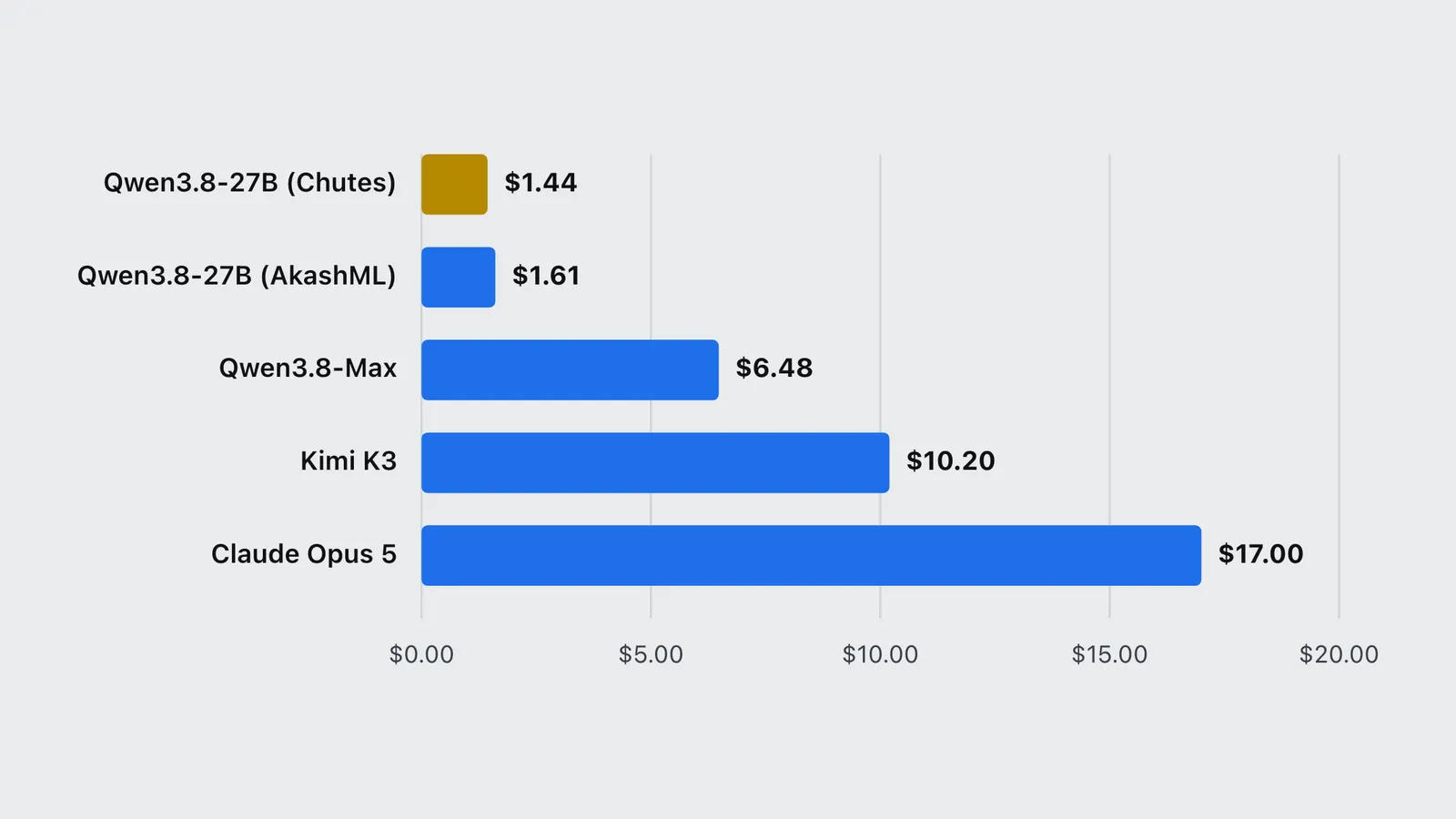
Price per finished task is where this compounds, so apply this site’s modeled multi-step agentic profile, three million input tokens and eighty thousand output tokens per completed task, at list rates with no cache discount, since neither host publishes one:
| Item | Value |
|---|---|
| Qwen3.8-27B (Chutes) | $1.44 |
| Qwen3.8-27B (AkashML) | $1.61 |
| Qwen3.8-Max | $6.48 |
| Kimi K3 | $10.20 |
| Claude Opus 5 | $17.00 |
Even granting the caveat that these five models are not equally capable, the shape of the bar chart is the signal. The cheapest frontier-family option completes a modeled task for under eight percent of the most expensive one. If the vendor scores survive independent testing anywhere near where they launched, the middle of that chart, the $6 to $17 band where the closed flagships live, comes under pressure that has nothing to do with marketing.
Why the “silence” narrative gets it backwards
A popular framing this week holds that closed labs went quiet after the GLM and Kimi launches drew “open source is dangerous” coverage, and that their current silence proves fear. The motives of other companies are not verifiable, so this site will not litigate them. What is checkable is the pricing behavior, and it points the other way: within days of the 27B landing, OpenAI began rolling ChatGPT advertising out across 31 European markets starting August 24, per Dataconomy, which reads as diversifying revenue rather than retreating from it. Wall Street analysts spent the same week warning that the AI spending boom could trigger a credit event, also via Dataconomy’s coverage. Closed labs do not need press releases to respond to commoditization; their investors and pricing pages respond for them.
The structural point survives any motive-questioning: Apache 2.0 weights at this size turn capability into a commodity input faster than licensing ever could. When a plausible-flagship model costs $1.44 per modeled task rented and pennies per hour owned, every closed provider must answer a harder version of the same question: what does your model do that a free one running next to the user’s data does not? Qwen3.8-Max’s own eval economics showed how brutal that question gets even within one vendor’s lineup: cheaper tokens did not mean cheaper work. Commoditize your complement, profit from the scarce thing adjacent to it. The labs that own the scarce layers, distribution, agents, hardware integration, adapt. The ones selling raw tokens per million are the ones who should be quiet, whatever their reason.
Frequently asked questions
- Can you run Qwen3.8-27B on 16 GB of VRAM?
- Only with compromises. The standard Q4_K_M quantization is a 17.1 GB file and does not fit a 16 GB card. On 16 GB hardware the practical options are IQ4_XS at 15.7 GB or the UD-Q3_K_XL 3-bit build at 13.4 GB. The widely shared 17 GB figure is Unsloth's guidance for total memory, RAM plus VRAM, not a graphics-card requirement.
- Is Qwen3.8-27B really as good as Claude Opus?
- Unproven. Alibaba's launch table reports the 27B at 70.7 on CoWorkBench against 68.2 for Claude Opus 4.6 Max, but every Qwen figure is vendor-reported with no independent reproduction as of August 23, 2026. Last generation, identical open weights scored up to 22 points apart on SWE-bench Verified depending on the agent harness, so independent testing is the gate that matters.
- What does Qwen3.8-27B cost through an API?
- OpenRouter lists two hosted providers: Chutes at $0.40 per million input and $3.00 per million output tokens on fp8, and AkashML at $0.45/$3.20 on bf16, both at the full 262K context. There is no official Alibaba rate card for the open weights; Qwen3.8-Max, the hosted flagship, lists at $2.00/$6.00.
- What license does Qwen3.8-27B use?
- Apache 2.0, a permissive license with no user-count cap and no commercial-revenue gate. This differs from Qwen3.8-Max, whose custom qwen3.8-max license requires a separate agreement for model-as-a-service businesses above US$50 million in revenue over twelve consecutive months. Internal use was exempt there anyway; on the 27B even resale is unrestricted.
Sources
- Qwen Team, Alibaba (2026). Qwen3.8-27B (model card). Hugging Face. Primary, vendor documentation: architecture specs (64 layers, hidden 5,120, GQA 24/4, hybrid Gated DeltaNet attention), 262,144-token native context with YaRN extension, Apache 2.0 license, and the vendor benchmark table including CoWorkBench 70.7. Verified 2026-08-23.
- Qwen Team, Alibaba (2026). “We promised open weights for Qwen3.8” (official X post). Primary: the August 14, 2026 release announcement, native multimodality, 262K-to-1M context, and the claim that the 27B outperforms Qwen3.7-Plus overall. Verified 2026-08-23.
- Qwen Team, Alibaba (2026). Qwen3.8-27B-FP8 (model card). Hugging Face. Primary: existence of the official FP8 quantization. Verified 2026-08-23.
- OrcaRouter (2026). Qwen3.8-27B Release Date: Weights Dropped August 14. Secondary analysis: the layered-release timeline, Apache 2.0 confirmation, the Tongyi-license concern that did not materialize, and the guidance to treat vendor scores as unreproduced claims. Published 2026-08-12, updated after the drop. Verified 2026-08-23.
- GIGAZINE (2026). “Qwen3.8-27B,” a locally runnable version, has been released for free. Secondary reporting: the launch-table comparison figures (CoWorkBench 70.7 vs Opus 4.6 Max at 68.2, LiveCodeBench v6 90.3, GPQA Diamond 89.2) and framework availability. Published 2026-08-17. Verified 2026-08-23.
- AI Release Tracker (2026). Qwen3.8-27B: Benchmarks, Specs and Release Date. Secondary aggregator: Humanity’s Last Exam 30.8% no-tools (13th of 19), GPQA Diamond context, and the release chronology. Verified 2026-08-23.
- Unsloth (2026). Qwen3.8: How to Run Locally (documentation). Primary, vendor documentation for the GGUF builds: 17 to 19 GB total-memory guidance at 4-bit, NVFP4 and Desktop support. Verified 2026-08-23.
- Oflight Inc. (2026). Qwen3.8 27B Requirements: VRAM, GPU and RAM. Secondary analysis built on primary repo data: measured GGUF file sizes (Q4_K_M 17.1 GB, IQ4_XS 15.7 GB, UD-Q3_K_XL 13.4 GB, BF16 55.6 GB, mmproj 931 MB), the 16 GB non-fit finding, config.json architecture details, and Ollama library status as of 2026-08-15 JST. Published 2026-08-15. Verified 2026-08-23.
- Modelfit (2026). Run Qwen3.8-27B Locally: 24GB Mac and GPU Guide. Secondary reporting: Unsloth GGUF passing 1,945,635 downloads in about three days per the Hugging Face API. Published 2026-08-16. Verified 2026-08-23.
- OpenRouter. Qwen3.8-27B (hosting marketplace listing). Primary marketplace data: Chutes at $0.40/$3.00 per Mtok on fp8 and AkashML at $0.45/$3.20 on bf16, both serving the full 262,144-token context. Verified 2026-08-23 via Ofox’s measured reading.
- Artificial Analysis. Qwen3.8 Max: Intelligence, Performance and Price Analysis [independent benchmark]. Source for the comparative list rates ($2/$6 Qwen3.8-Max, $3/$15 Kimi K3, $5/$25 Claude Opus 5) and the precedent for independent scores cutting vendor claims down. Verified 2026-08-23.
- Dataconomy (2026). OpenAI to launch ChatGPT ads in 31 European markets on August 24. Secondary reporting, attributed as such. Published 2026-08-19. Verified 2026-08-23.
- Capital & Compute. Qwen3.8 Max Preview: Release, Access, and Open Weights [this site’s prior coverage]: the Max launch claims, the independent Artificial Analysis score, and the cost-to-run-index result referenced above.
- Capital & Compute. Why Local LLMs Fail at Agentic Coding [this site’s prior coverage]: the 22-point same-weights harness spread on Qwen3.6-27B that motivates the vendor-score caution.