Why Is My VPS Price Going Up? The 2026 Answer
Hetzner and OVHcloud raised VPS prices repeatedly in 2026. Here is the memory-cost mechanism behind it, and what it actually means at renewal.
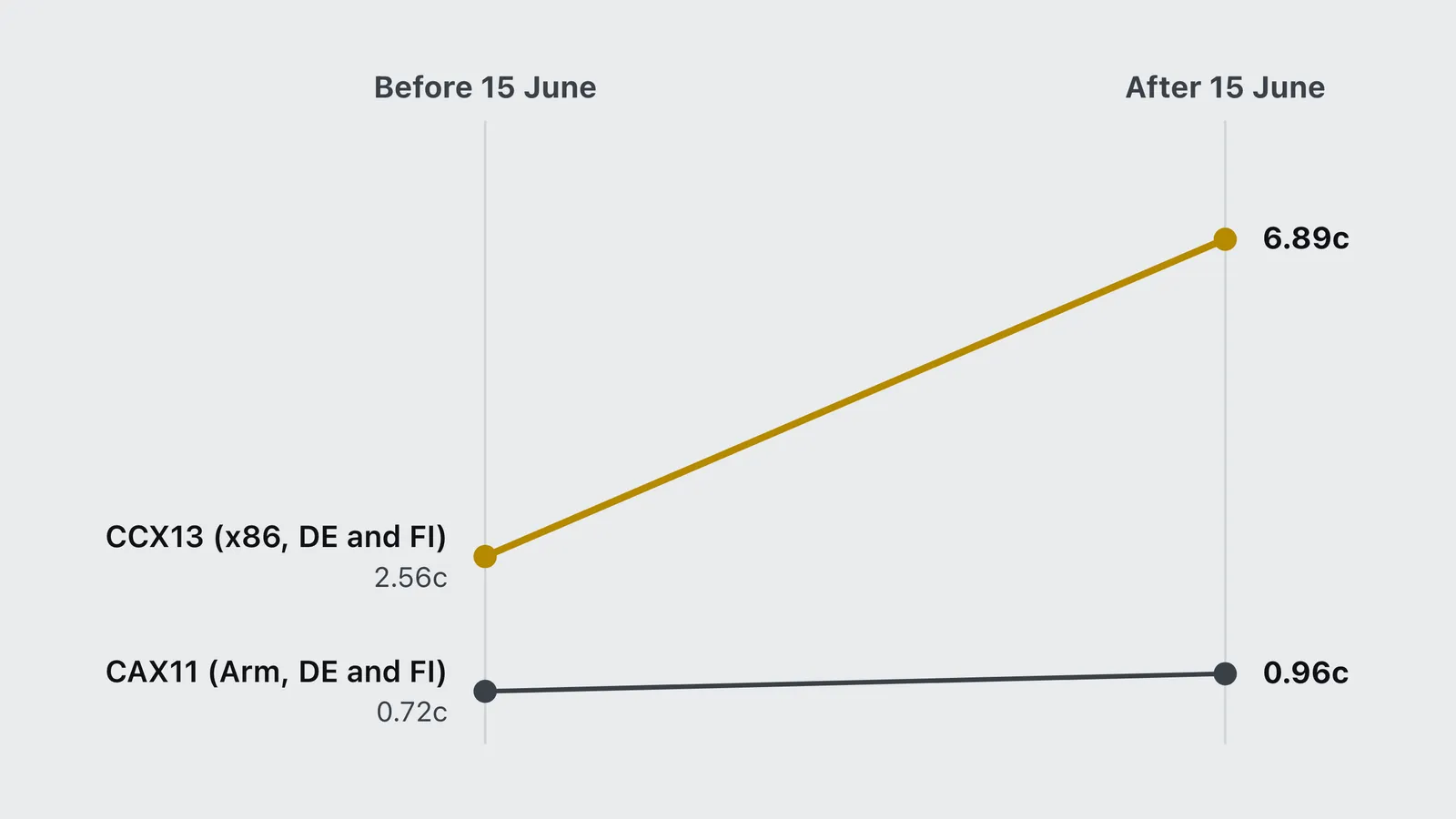
Your VPS got more expensive in 2026 because the memory inside it repriced, and almost nothing else did. OVHcloud says it paid six times more for RAM in June 2026 than in June 2025. Hetzner raised prices three separate times across the year. The clearest proof that this is a memory story rather than a general inflation story sits inside a single Hetzner announcement: on 15 June 2026 its Arm-based CAX plans went up about 31 to 33 percent while its x86 CPX and CCX plans went up 94 to 192 percent, on the same day, from the same company, in the same data centres. Same electricity, same staff, same buildings. Different exposure to DDR5.
The one comparison that proves it is memory
Hetzner publishes its before-and-after prices, which makes this unusually easy to check rather than assume. On 15 June 2026 it moved cloud plan pricing across every location. The plans did not move together.
| Item | Before 15 June | After 15 June |
|---|---|---|
| CAX11 (Arm, DE and FI) | 0.72c | 0.96c |
| CCX13 (x86, DE and FI) | 2.56c | 6.89c |
The Arm line barely moves. The x86 line roughly triples, and so did every other x86 plan in the table. If this were an energy shock, a wage shock, or a margin decision, both lines would move together. They do not, and that is the whole argument.
What each provider actually did
Hetzner moved first, with a broad adjustment effective 1 April 2026 that it announced on 23 February. It followed with a setup-fee adjustment on 29 April, and then the large one: a standardisation and price adjustment effective 15 June, applying to new orders and rescales while existing contracts kept their terms. Notably, that June change reduced setup fees for most dedicated servers while raising monthly prices, which is the kind of detail a single headline percentage cannot carry.
OVHcloud moved twice. Its 5 March announcement covered Public Cloud, Bare Metal and VPS, with an average increase of 9 to 11 percent on newer equipment and only 2 to 6 percent on pre-2025 hardware. That 9 to 11 percent figure is the one that circulated most widely, and taken as a summary of 2026 it is badly misleading, because the VPS 2026 range in the same announcement moved about 44 to 48 percent (VPS-1 went from 4.49 to 6.49 euros a month). Then on 17 August OVHcloud announced dedicated server pricing for the second half of the year, with Game Gen 2026 up 74 to 100 percent and High Grade Gen 2026 up 46 to 83 percent.
The full cross-provider record, with the effective date and pricing channel for every change, is in the 2026 hosting price hike tracker.
Check which price actually changed before you panic
This is where most reporting on the topic goes wrong, and where you can save yourself an unnecessary migration. A single announcement can contain four different kinds of price, and they are not comparable:
| Channel | What it means | Who feels it |
|---|---|---|
| List price, new orders | What the pricing page shows today | New customers, and existing ones who rescale |
| Billed price at renewal | The rate applied to a contract you already hold | Existing customers, on their renewal date |
| Option or add-on price | Memory or storage sold as a separate line item | Anyone configuring extras |
| One-off setup fee | A single charge, not a recurring rate | New orders only |
The gap between the first two is why many people saw alarming headlines in June 2026 and no change on their invoice. Hetzner explicitly left existing contracts on their existing terms. OVHcloud applies its second wave to existing customers from 1 October 2026, at renewal. If your bill has not moved yet and you are on OVHcloud, that is the date to put in the calendar rather than evidence that the reporting was wrong.
The option channel is the most extreme and the most misquoted. OVHcloud memory options on new orders rose 68 to 652 percent while the whole servers those options go into rose 16 to 100 percent. Both figures come from the same company in the same month. Memory sold as a line item passes the component cost through almost undiluted; memory folded into a plan price gets diluted by everything else in the bundle.
What to do about it
Right-size your memory before you do anything else. Because the increases track memory share rather than compute, dropping one memory tier is now worth substantially more than dropping one CPU tier, which reverses the usual advice. Check whether your workload actually needs the RAM you provisioned in 2024.
Test whether an Arm instance fits. The Hetzner CAX line rose about a third while its x86 equivalents roughly tripled, so the Arm price advantage in 2026 is far larger than it was in 2025. If your stack runs on Arm, that gap is now the single biggest lever available.
Do not automatically assume older hardware is a compromise. OVHcloud raised legacy pre-2025 equipment only 2 to 6 percent and left the Kimsufi, So you Start and Rise ranges alone entirely, precisely because they do not carry DDR5. And where a provider offers a renewal lock, take it: OVHcloud let customers renewing before 1 April 2026 hold their rates for up to two years.
If you are sizing a new project rather than defending an existing one, the per-month cost bands for self-hosted and managed options are worked through in what a personal AI agent costs to run, and the infrastructure line items in a production deployment are broken down in what an AI agent costs in production. Those numbers predate the June increases, so treat them as the shape of the bill rather than its current level.
The case that this is overstated
There are three honest arguments against reading this as a crisis, and they deserve stating.
First, the eye-catching percentages are concentrated in specific places. The 192 percent figure is a small USA x86 tier, and the 652 percent figure is an add-on rather than a server. Plenty of customers on legacy ranges saw 2 to 6 percent, which is ordinary. Second, hosting was unusually cheap before this. Hetzner CPX and CCX pricing had been static for years while the underlying hardware costs moved, so part of what happened in June 2026 is a correction of an unsustainable price rather than pure shortage pass-through. Hetzner frames its June change as a standardisation of its product structure, not only a price rise, and that framing is at least partly fair.
Third, and most importantly for anyone tempted to migrate in a hurry: every provider is buying from the same three memory manufacturers. A competitor that has not raised prices yet is not insulated, it is merely earlier in the same cycle or sitting on older stock. Moving to a host purely because its price has not moved is a bet that it never will, and nothing in the component data supports that bet.
Bottom line
Your VPS price went up because roughly a fifth to a third of what you rent is memory, and memory got several times more expensive while everything else went up modestly. That is a component story with a known cause and no quick fix: the fabs funded in 2026 deliver in 2028 and 2029, as covered in the memory capex buildout, and no provider on record forecasts relief before 2028. Klaba projects OVHcloud paying twelve times the June 2025 RAM price in early 2027, which is above the six times already passed through into the 2026 increases.
The practical reading is that 2026 hosting prices are a floor rather than a peak. If you have a renewal lock available, use it. If you are provisioning new capacity, provision the memory you need rather than the memory you might want, and check the server memory street prices and why RAM got so expensive to see the component market your provider is buying in.
Frequently asked questions
- Why did my VPS price go up in 2026?
- Because DDR5 memory and NVMe storage repriced sharply after autumn 2025, when manufacturers shifted capacity toward high-bandwidth memory for AI hardware. Memory is one of the largest line items in a server, so a large move in its cost pushes the finished price up. OVHcloud states it paid six times more for RAM in June 2026 than a year earlier.
- Is my existing VPS affected or only new orders?
- At first, usually only new orders. Hetzner applied its 15 June 2026 adjustment to new orders and rescales while existing contracts kept their terms. OVHcloud applies its second 2026 wave to existing customers at renewal from 1 October 2026. Renewal is the point at which most existing customers see a change.
- Which VPS plans went up the most?
- Memory-heavy x86 plans. In the Hetzner adjustment of 15 June 2026, the Arm-based CAX plans rose about 31 to 33 percent while the x86 CPX and CCX plans rose between roughly 94 and 192 percent depending on location, computed from the prices Hetzner published. At OVHcloud, Game Gen 2026 dedicated servers rose 74 to 100 percent.
- Should I switch hosting provider because of the increase?
- Rarely, and not on price alone. Every provider buys memory from the same three manufacturers, so a host that has not raised prices yet is earlier in the cycle rather than insulated from it. Right-sizing your memory, testing an Arm instance, or moving to a legacy hardware range usually saves more than a migration, and carries far less risk.
- When will VPS prices go back down?
- No provider on record forecasts a decrease during 2026 or 2027. OVHcloud founder Octave Klaba has said the situation is exceptional and will last until 2028, and projects the price his company pays for RAM reaching twelve times its June 2025 level in early 2027. New memory fabs announced in 2026 do not produce output until late 2028 at the earliest.
Sources
- Hetzner Online GmbH (2026). Price Adjustment 15 June 2026. Hetzner Docs. The published before-and-after hourly prices for CAX11, CPX11, CPX22, CCX13 and CCX43 that every Hetzner percentage in this article is computed from. Verified September 1, 2026.
- Hetzner Online GmbH (2026). Details regarding the standardization and price adjustment of our server products effective 15 June 2026. Hetzner pressroom, announced May 27, 2026. Vendor statement. The scope of the change, and the confirmation that existing contracts keep their terms. Verified September 1, 2026.
- Hetzner Online GmbH (2026). Statement on the latest adjustment to setup fees. Hetzner pressroom, April 29, 2026. Vendor statement. The passage naming RAM and NVMe SSDs as the driver. Verified September 1, 2026.
- OVHcloud (2026). Pricing evolution of Public Cloud, Bare Metal and VPS at OVHcloud. OVHcloud Blog, March 5, 2026. Vendor statement. The 9 to 11 percent average, the 2 to 6 percent legacy figure, the VPS-1 move from 4.49 to 6.49 euros, and the renewal lock before April 1. Verified September 1, 2026.
- OVHcloud (2026). Dedicated servers: new pricing in second half 2026. OVHcloud Blog, August 17, 2026. Vendor statement. Per-range percentages, the 68 to 652 percent memory option range, and the October 1 renewal date. Verified September 1, 2026.
- InfoQ (2026). OVHcloud Raises Prices as AI Memory Demand Reprices Non-AI Infrastructure. August 23, 2026. Secondary source reporting OVHcloud founder Octave Klaba, attributed as such. The component multiples versus June 2025 and the statement that the situation lasts until 2028. Verified September 1, 2026.